



About this worksheet
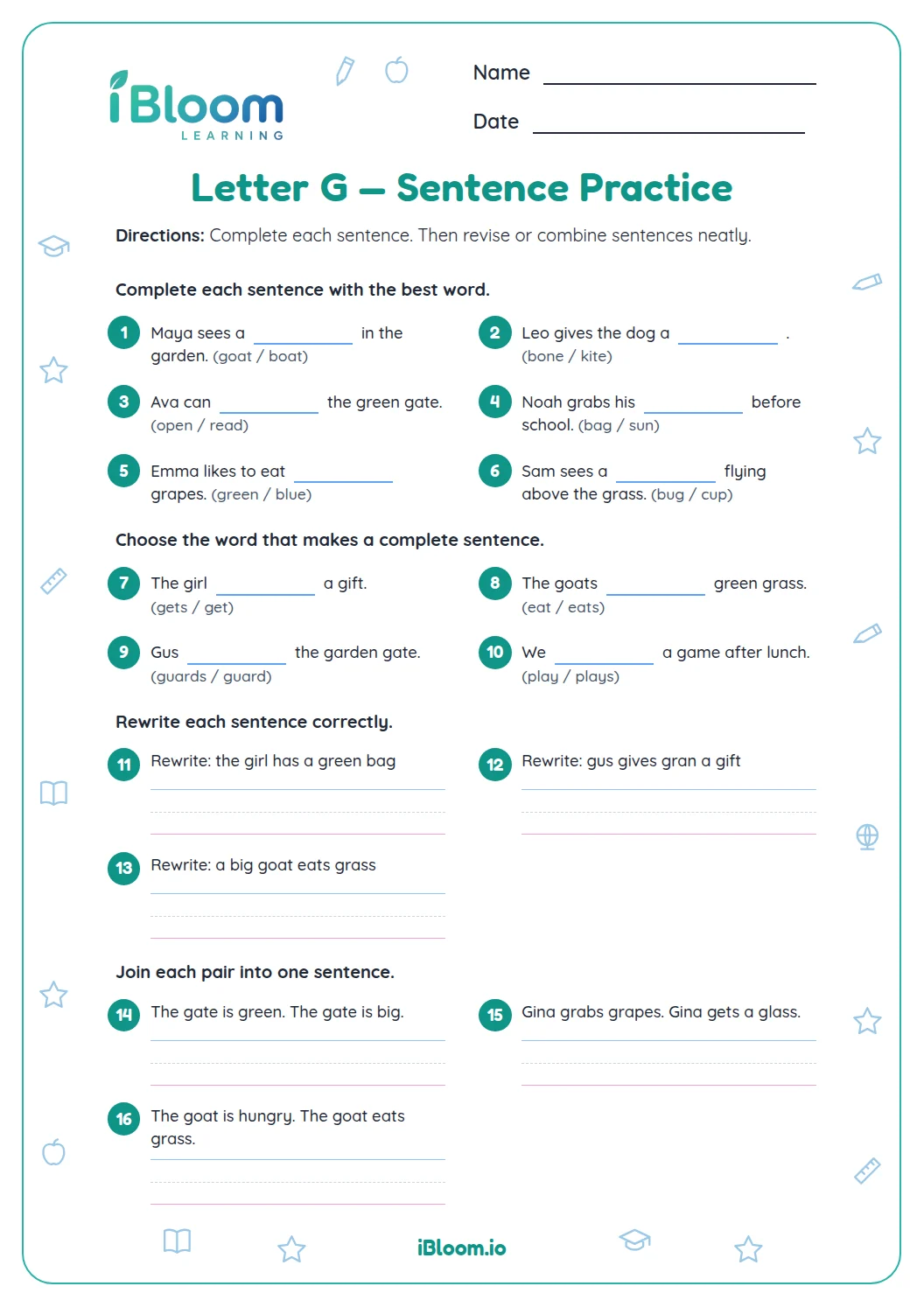
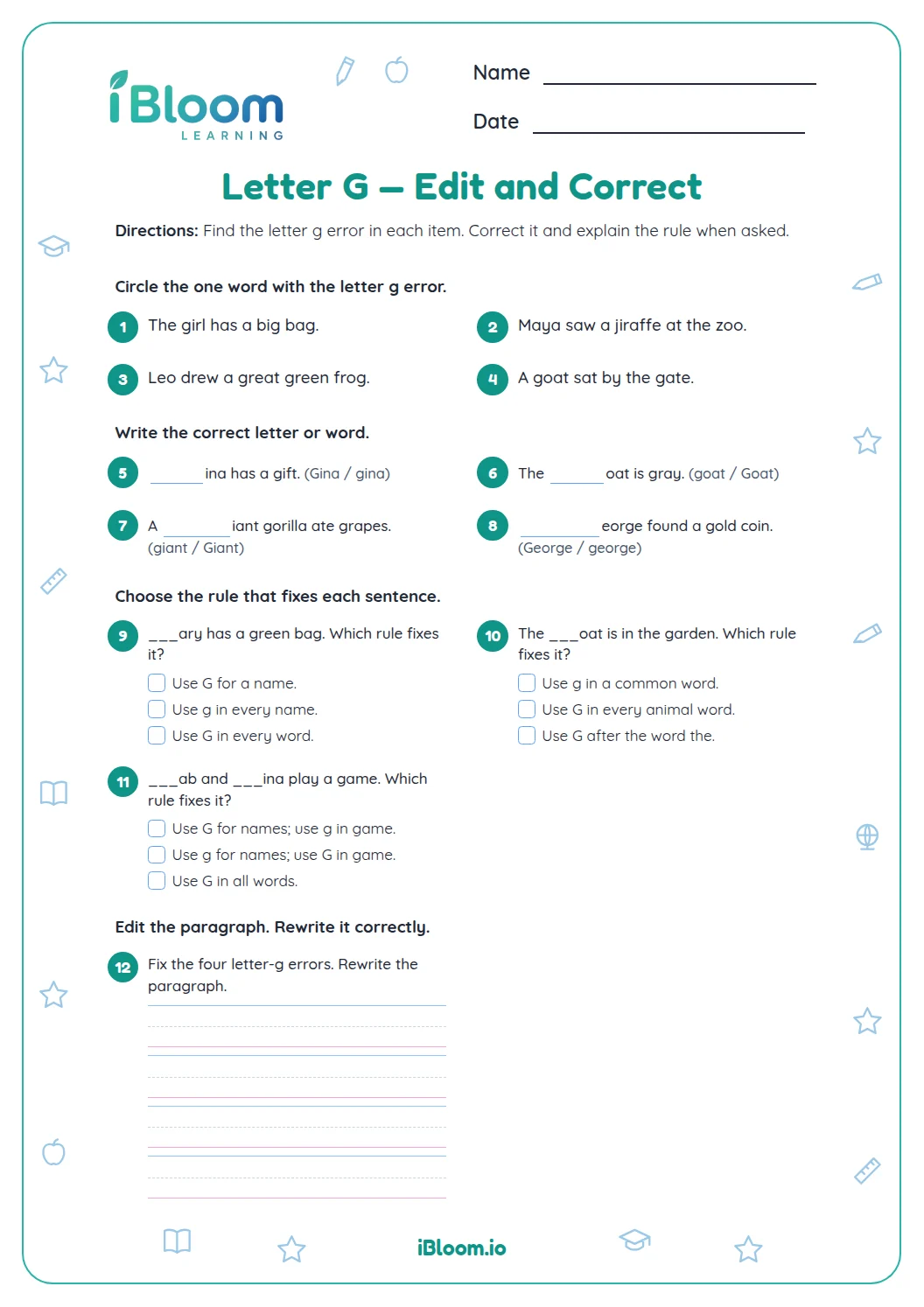
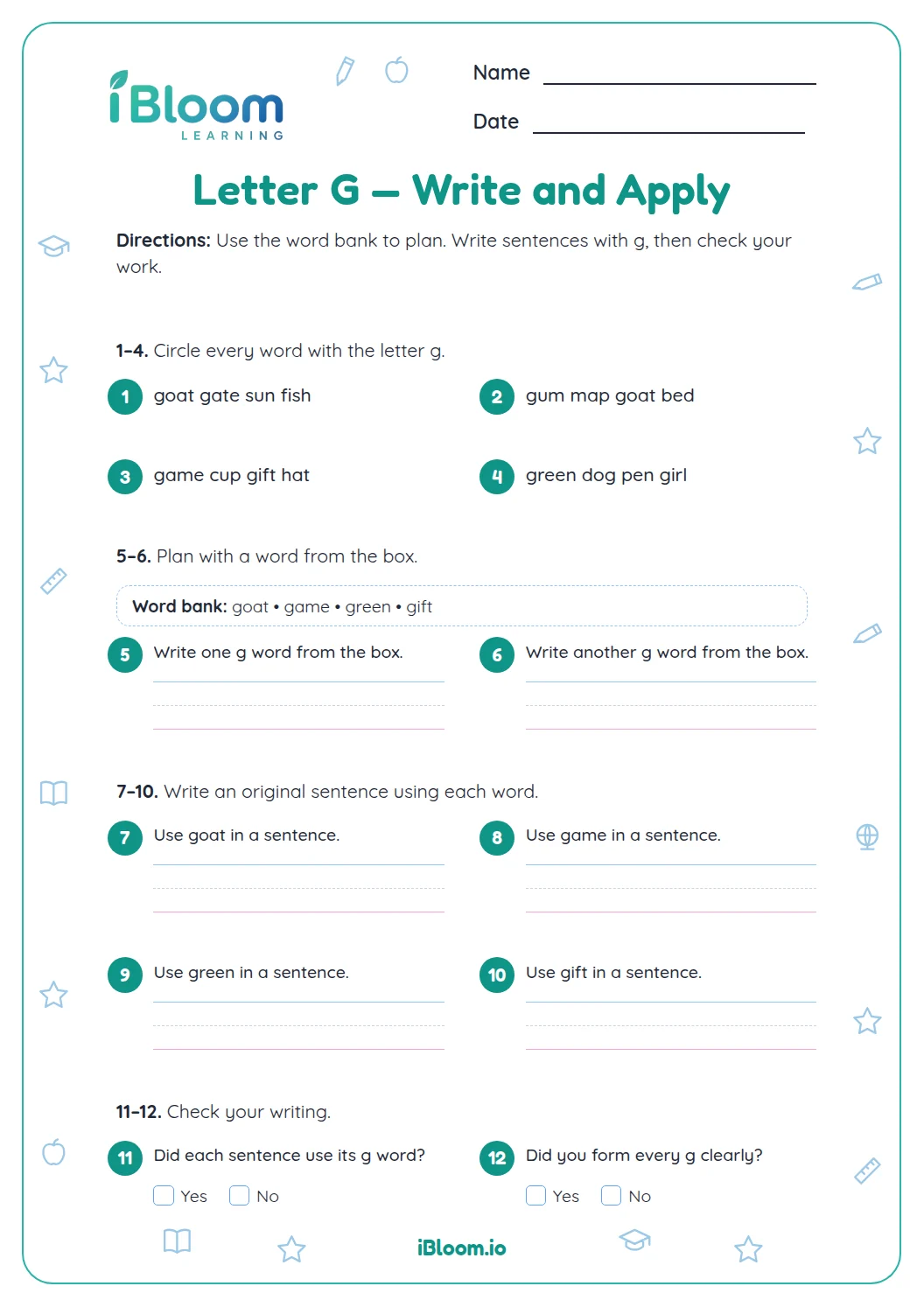
This free printable Grade 1 worksheet helps children recognize and print uppercase G and lowercase g. It begins with tracing, then asks learners to identify G and g among other letters, find the letter in familiar words, and print it independently. These activities practice the letter-printing skill in CCSS L.1.1.a. The sheet has 14 short questions and a separate answer key.
Aligned to L.1.1.a
How do uppercase G and lowercase g look?
Uppercase G is tall and has an open side with a short bar. Lowercase g drops below the writing line in this print model.
Questions 1 and 2 let learners trace each form before they identify G and g among other letters.
- 1Uppercase: G
- 2Lowercase: g
- 3Say the letter name: G
How can you find G in a word?
Look at the first or last letter. Goat, grapes and gift begin with g; bag and leg end with g. The letter can represent different sounds in different words, so these questions focus on spotting the printed letter.
What will children practice on the page?
Fourteen short tasks move from tracing to recognition, alphabet order and printing. Word choices use familiar examples with a clear printed g.
How to use this worksheet at home or in class
- 1Name the letter and say its sound as you begin.
- 2Trace uppercase G, following the printed model.
- 3Trace lowercase g and notice that it drops below the line.
- 4Find g at the beginning or end of each word.
- 5Print both forms slowly on the writing lines.
- 6Check the answer key, then try a word beginning with g.
Common mistakes and quick fixes
The mistake
Reversing or closing the open side of uppercase G.
The fix
Compare the printed letter to the model before tracing.
The mistake
Writing lowercase g on the line without its descender.
The fix
Let the lower loop drop below the writing line.
The mistake
Choosing a word that has the sound but not the letter g.
The fix
Look at the printed letters in the word, not only how it sounds.
Common Core alignment
This worksheet practices the Common Core skill named below.
Print uppercase and lowercase letters, including G and g.
On this sheet: Learners identify and print the uppercase and lowercase forms of G.
Show the official wordingHide the official wording
Print all upper- and lowercase letters.
What to practice next
Make more practice
Further reading
Questions parents and teachers ask
Which forms of the letter G will my child practice?
The worksheet includes uppercase G and lowercase g. Children trace both forms, recognize them among similar letters, spot the printed letter at the beginning or end of familiar words, and then print the forms independently. The answer key lets families check each item at a glance.
What is the difference between uppercase G and lowercase g?
Uppercase G is a capital letter with an open side and a short bar. In this print model, lowercase g has a loop that drops below the writing line. The tracing tasks give children a model before they try writing either form themselves.
Why look for g inside familiar words?
Finding the printed letter in words helps children connect letter recognition to everyday reading. The choices include words such as goat, grapes, bag, and leg. Learners should look for the letter g itself, even when its sound changes in different words.
Does the sheet have an answer key?
Yes. The separate key shows the correct letter choices and gives a sample for the open-ended word question. A child may write another word that begins with g, as long as the letter is at the start of the word. This open response lets children use another familiar g word they know.
Does the worksheet practice both G and g?
Yes. Children trace uppercase G and lowercase g, identify each form among other letters, and recognize words with g at the beginning or end. The final section also asks them to print the letters and use a word that begins with g.
What is a good way to help with letter formation?
Have the learner trace each gray model from its starting point, then copy the letter on the writing line. Say “uppercase G” or “lowercase g” before writing so the learner connects the letter name, shape, and printed form.