






About this worksheet
This free printable worksheet helps first graders prepare sentences for a letter to a family member. Part A asks for four ending marks. Part B gives four sets of words to put in order. In Part C, children choose one family member and write six sentences addressed to that person: news, thanks, a shared activity, a question, a favorite book or game, and a goodbye. The practice supports Common Core L.1.1.j and L.1.2.b, producing sentences and using end punctuation. The separate answer key gives fixed answers for Parts A and B and sample responses for the personal writing.
Aligned to L.1.1.j and L.1.2.b
Who is the letter for?
Children may choose a sibling, grandparent, cousin, parent or another person they consider family. Keep that reader in mind for all six personal sentences so the news and question belong together.
Before writing, let the child say the news aloud as if speaking to the person. A simple event such as learning a game or making a card is enough to give the letter something specific to say.
How do the word-order questions help?
The four word groups in Part B supply all the words a child needs. Children put the words in a sensible order and add a period, rehearsing the shape of a complete thought before choosing their own words.
- 1Words: miss / I / you
- 2Put the person speaking first: I
- 3Tell what the speaker does: miss you
- 4Finished sentence: I miss you.
When should a sentence end with a question mark?
Use a question mark when the writer asks the reader to answer. In Part A, “Will you visit soon” and “What games do you like” ask for replies. The other two sentences tell something and take periods.
Part C includes a question to keep the exchange going. After checking the sentences, the child can copy them onto a separate note, add a greeting such as “Dear Nana,” and sign their name.
How to work through the sheet
- 1Choose a family reader and talk about one thing that person would like to hear.
- 2Read each Part A sentence aloud; decide whether it tells or asks.
- 3Arrange every word in each Part B item, then write the sentence with a capital and period.
- 4Say each Part C sentence aloud before writing it. Keep the same reader throughout.
- 5Check each sentence for a complete thought and an ending mark; compare six personal answers with the samples.
Mistakes to look for and how to fix them
The mistake
Writing “My new bike” as the news sentence.
The fix
Ask what happened with the bike: “I learned to ride my bike” tells the reader a complete thought.
The mistake
Putting a period after “Will you visit soon.”
The fix
Ask whether the family member could answer the sentence. If so, use a question mark.
The mistake
Writing about a different person in every Part C response.
The fix
Say the chosen reader’s name before each prompt, then address that person as “you.”
Common Core alignment
Build complete sentences and write personal statements and a question.
On this sheet: Children arrange words into complete sentences and produce their own sentences for a family reader.
Show the official wordingHide the official wording
Produce and expand complete simple and compound declarative, interrogative, imperative, and exclamatory sentences in response to prompts.
Use periods for statements and question marks for questions.
On this sheet: Part A asks for ending marks; Parts B and C apply them in complete sentences.
Show the official wordingHide the official wording
Use end punctuation for sentences.
What to practice next
Make more practice
Further reading
Questions parents and teachers ask
Does my child write a whole letter on this sheet?
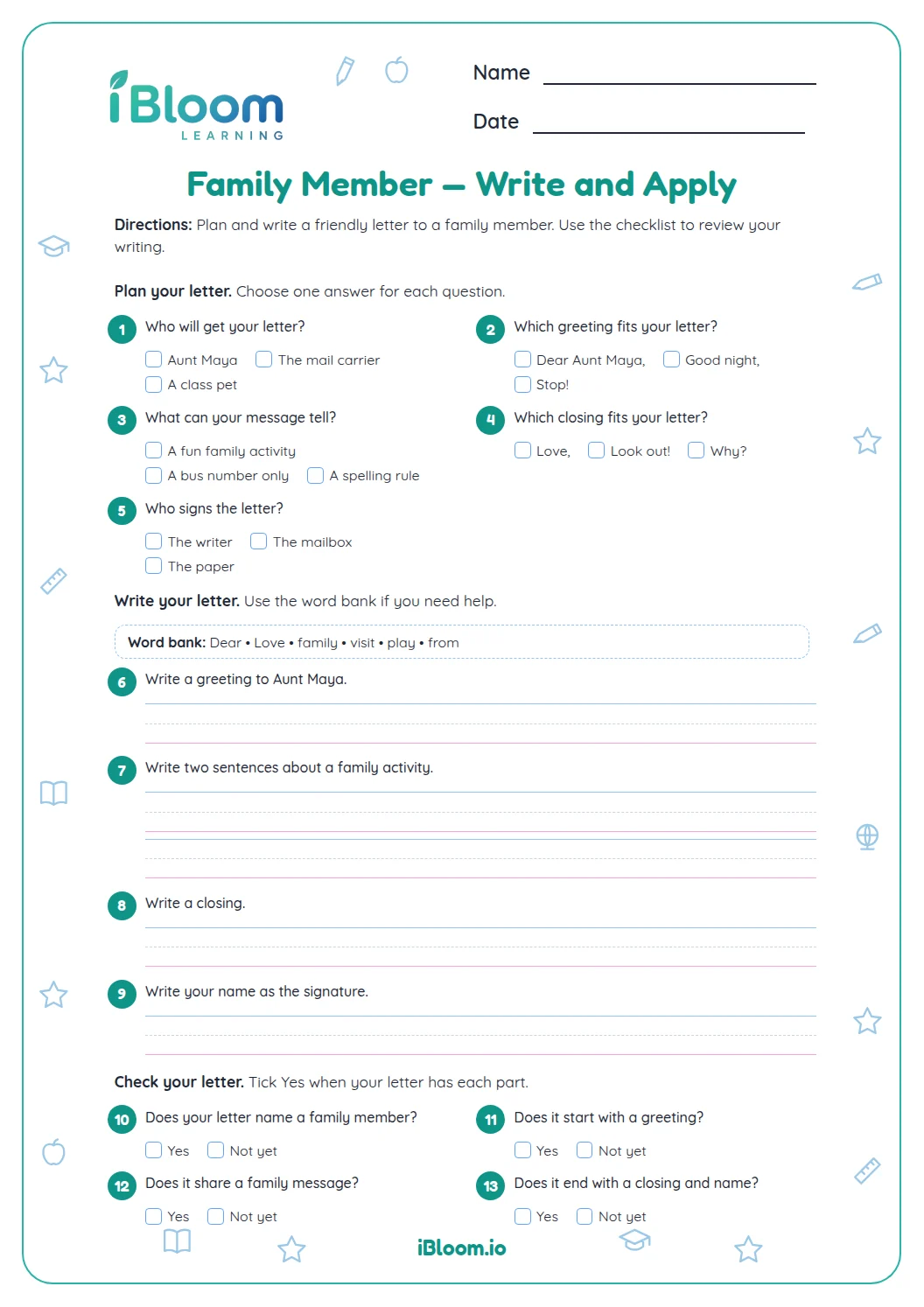
Your child writes six sentences that can become the body of a family letter. The earlier questions rehearse sentence order and ending marks. After finishing, children can copy their own six sentences onto separate paper, add a greeting, and finish with a closing and their name.
Can my child choose any family member?
Yes, your child can choose anyone they consider family. A cousin, sibling, grandparent or another caring family member can be the reader. Encourage the child to keep that same person in mind for all four personal prompts so the sentences sound like one message.
How should I check the personal sentences?
Check whether each sentence answers its prompt, makes sense and ends correctly. The answer key offers examples, so your child’s details can differ. A news sentence should tell something that happened; the question response should ask the reader a question and end with a question mark.
Can I help with spelling and reading?
Yes, you can read the prompts aloud and help spell a family member’s name or an unfamiliar word. Ask the child to say the sentence first so the idea remains theirs. Then have them write it and reread it to check word order and punctuation.
What if my child writes only a few words?
A short sentence is fine if it expresses a complete thought. “I miss you” is a useful model from Part B. If the child writes only “the park,” ask what they want to say about the park, then help them say a whole sentence before writing.