




About this worksheet
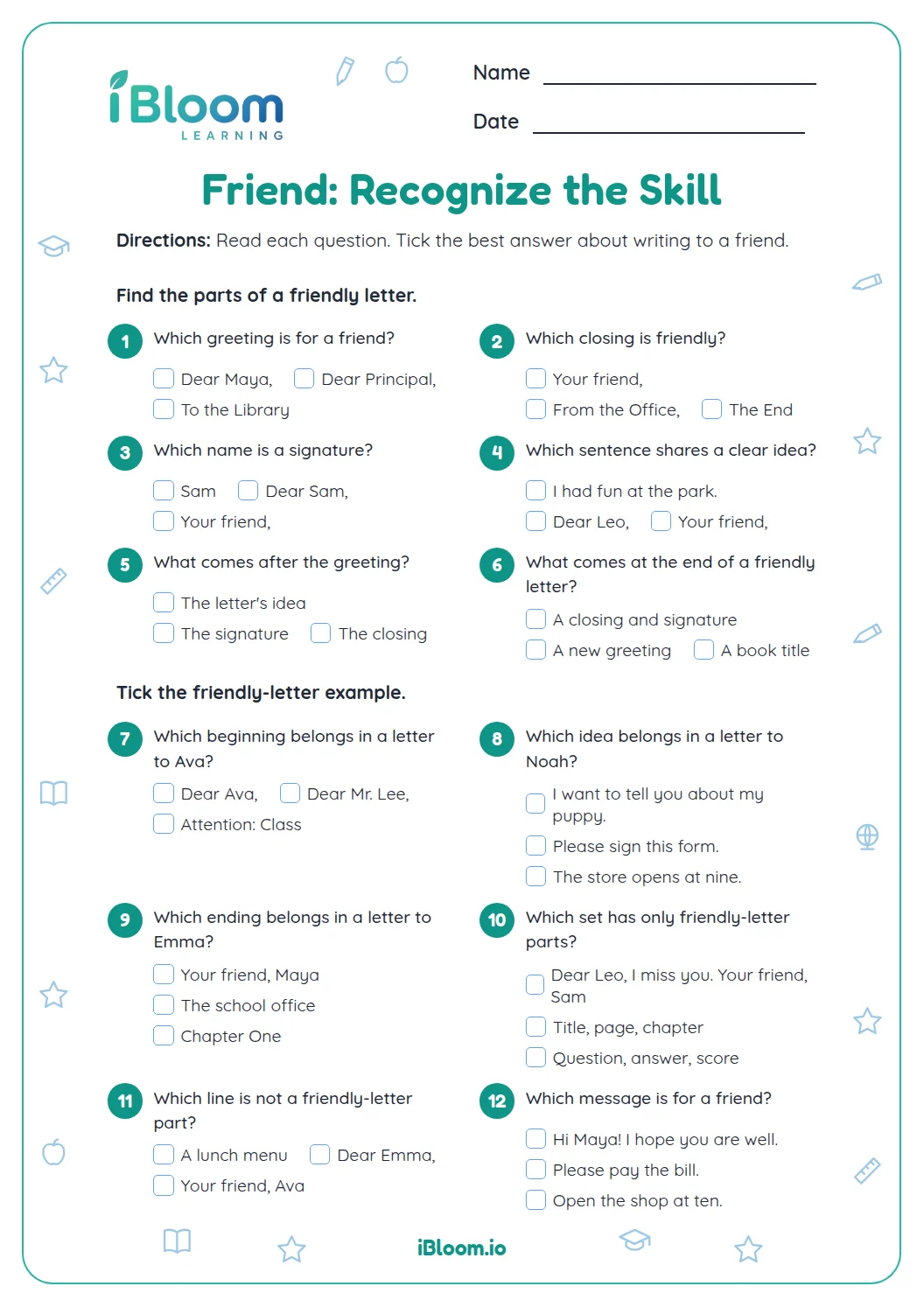
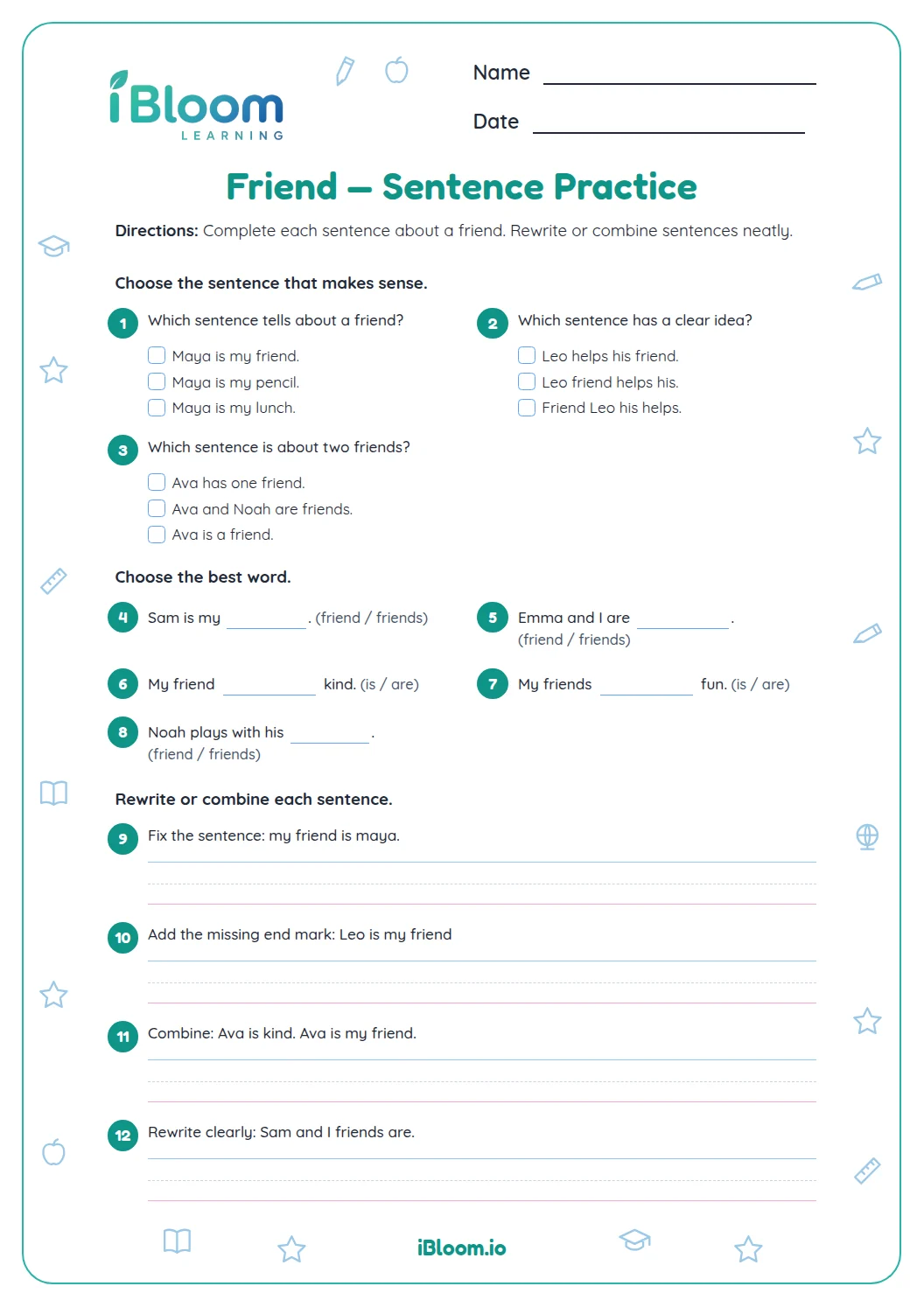
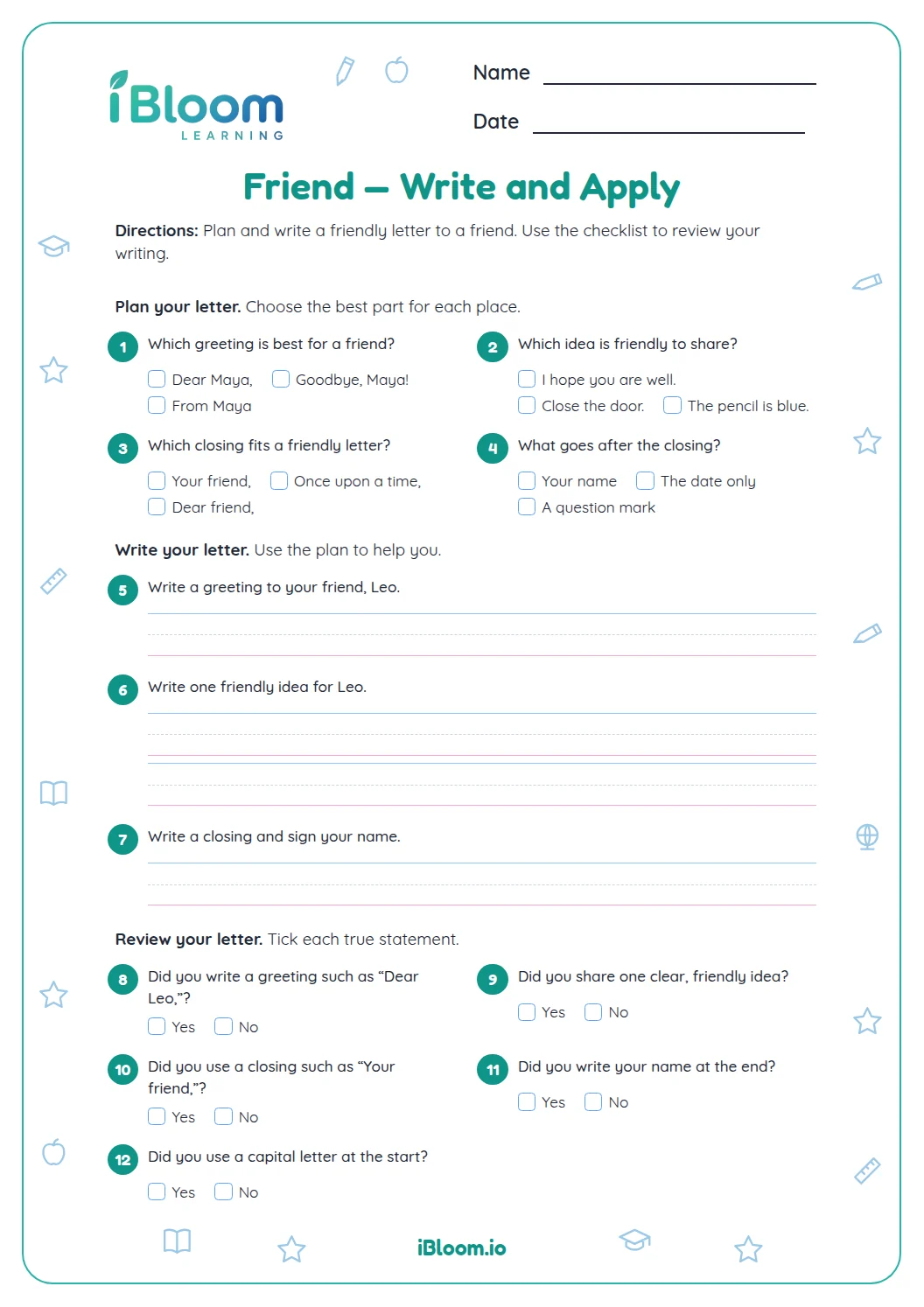
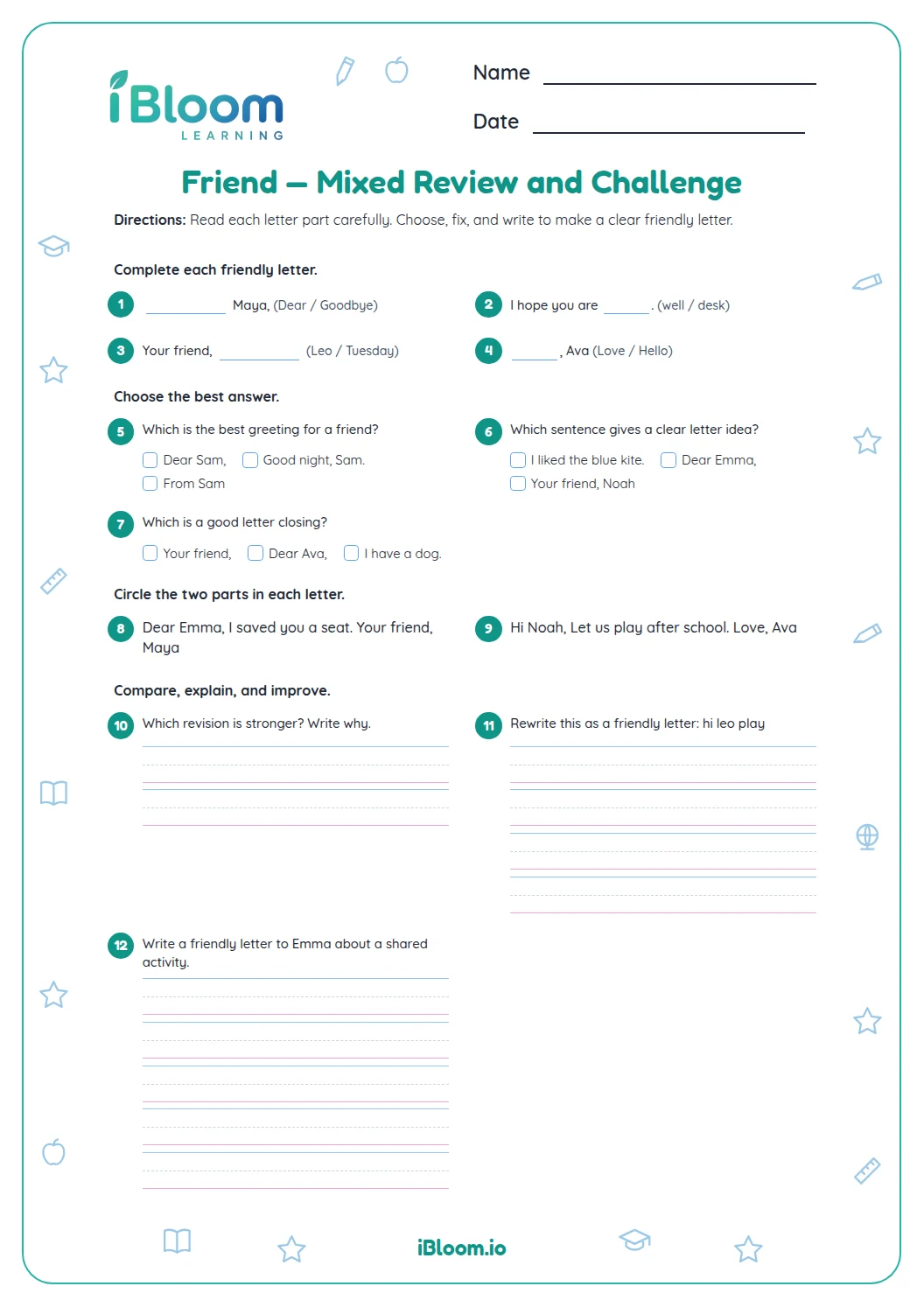
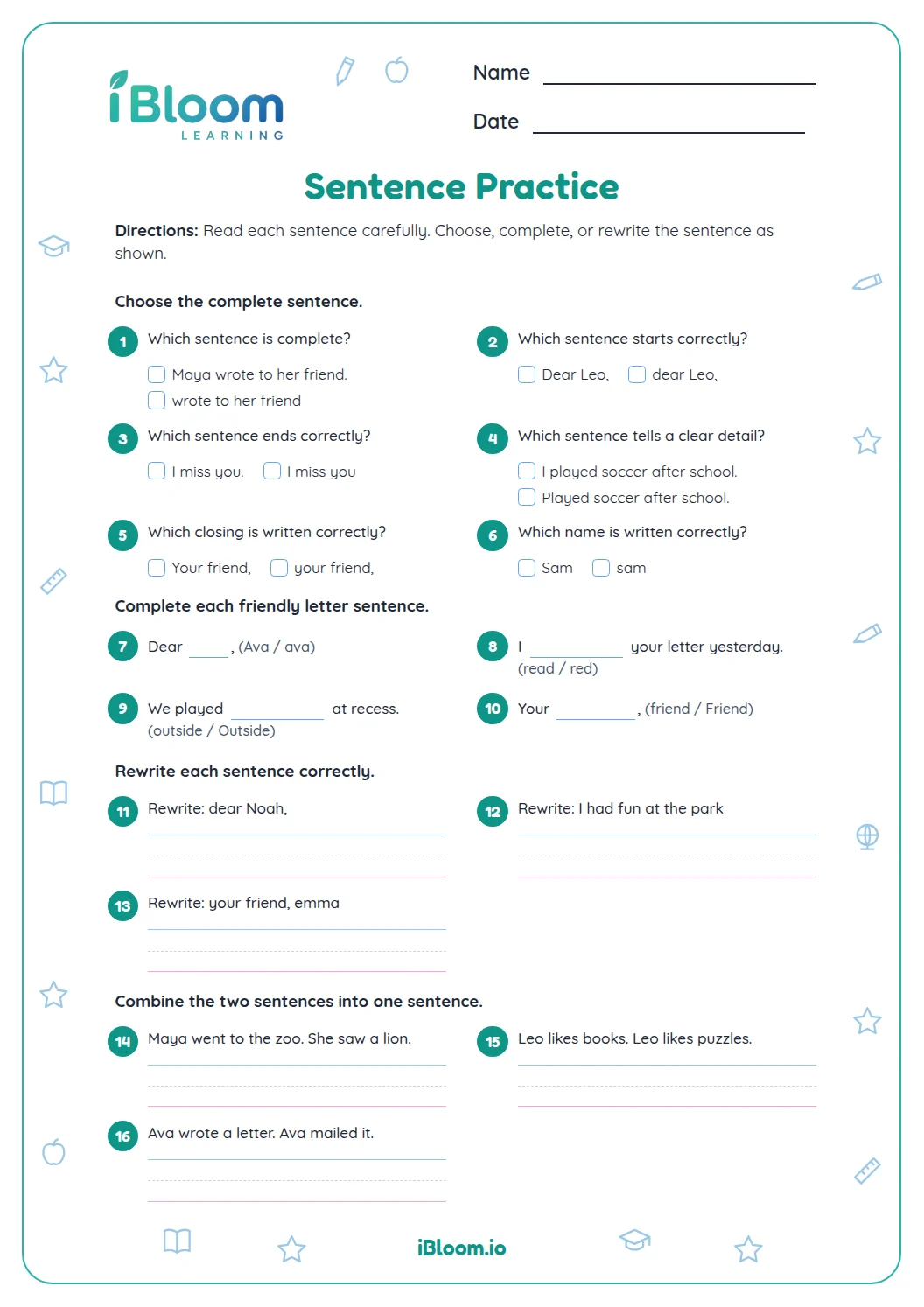
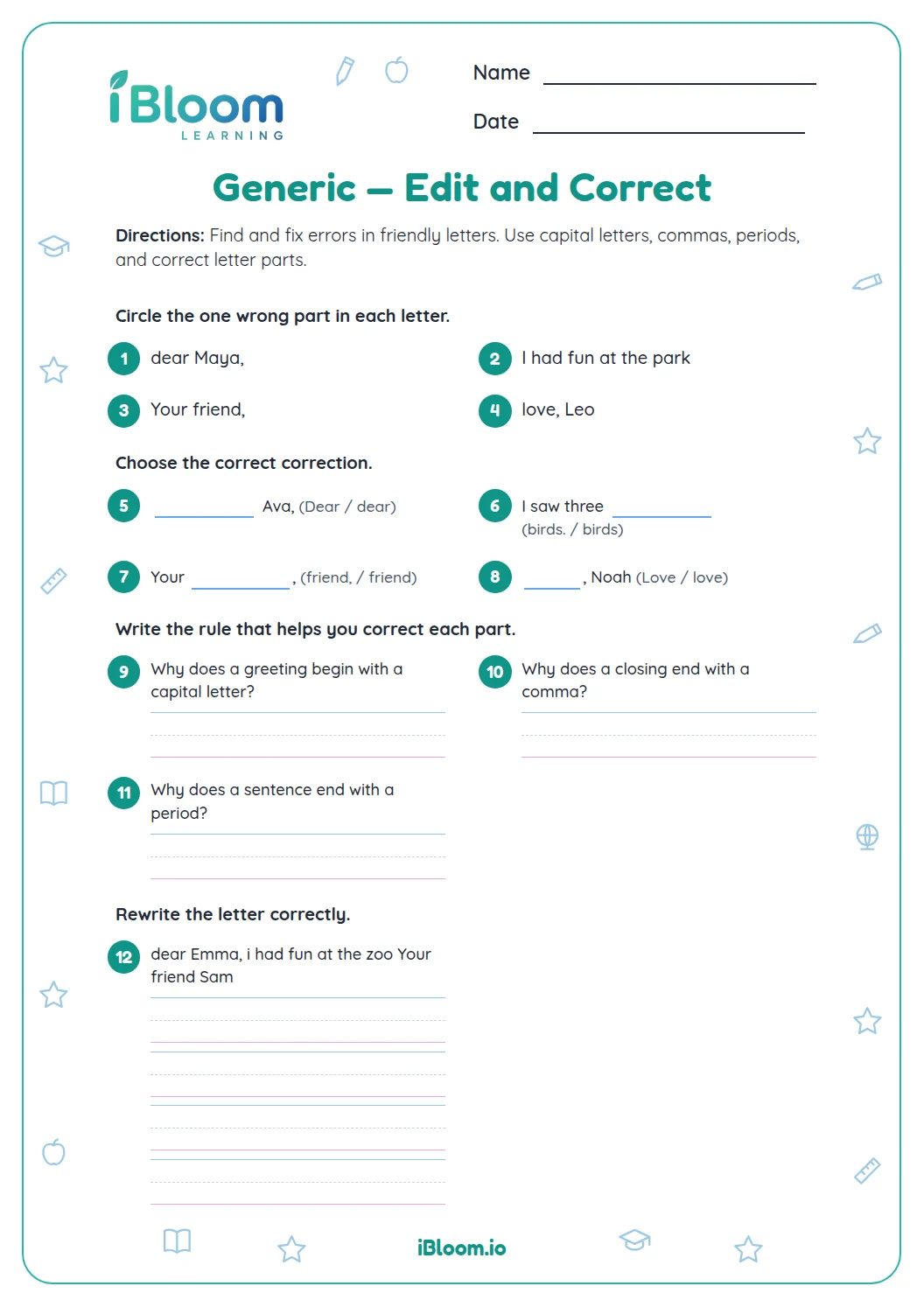
This Grade 1 printable helps children edit and complete a friendly letter to a friend. Students check a greeting and closing, fix capitals and end marks, identify complete thoughts, and correct short letter parts of their own. The 14 questions use three parts to move from noticing conventions to writing. The separate answer key provides sample responses and the sheet supports Common Core L.1.2 with guided revision practice.
Aligned to L.1.2
What belongs in a friendly letter?
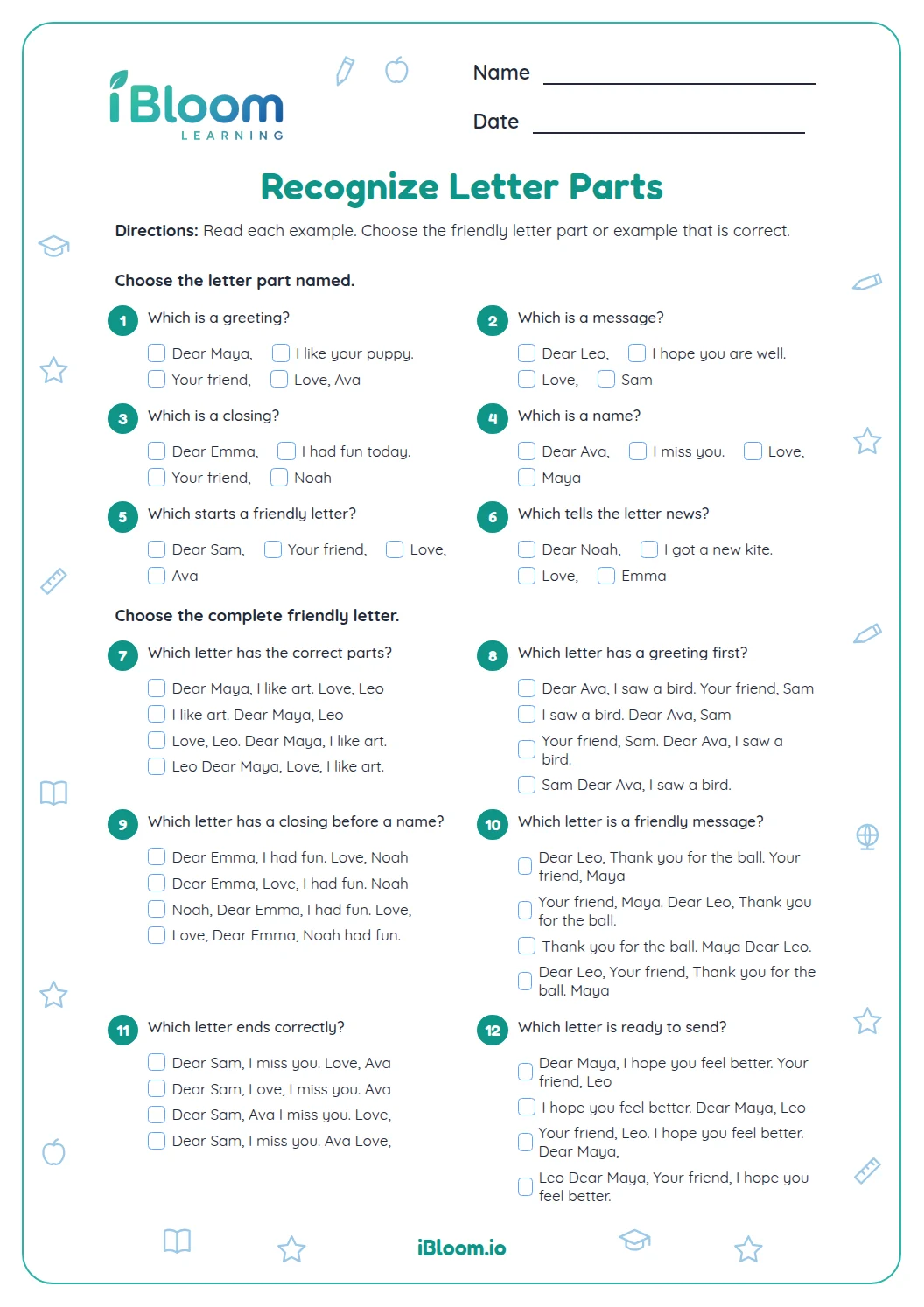
A short friendly letter can begin with a greeting such as “Dear Sam,” and end with a closing such as “Your friend,” followed by the writer’s name. The message in between uses complete sentences to share news or ask a question.
This worksheet keeps the letter familiar and brief so children can focus on editing the words and punctuation.
How can children edit a letter sentence?
Read one sentence at a time. Check its first letter, names, and end mark. Then read it again to see whether it tells a complete thought. A question needs a question mark; a telling sentence usually ends with a period.
- 1Can you visit me.
- 2This asks a question, so it needs a question mark.
- 3Corrected: Can you visit me?
What writing practice is included?
Part A checks greetings, closings, end marks, and complete sentences. Part B edits sentence examples. Part C asks children to correct a greeting, sentence ending, name, and closing.
The key gives sample answers for writing questions. Children may use different words if the sentence follows the prompt and is complete.
How to use this worksheet
- 1Read each line aloud.
- 2Check the greeting or closing for capitals and punctuation.
- 3Start each sentence with a capital letter.
- 4Choose a period for a telling sentence and a question mark for a question.
- 5Reread your Part C sentence to make sure it tells a complete thought.
Mistakes to watch for
The mistake
Using a lowercase letter for a person’s name.
The fix
Capitalize names such as Sam, Lee, and Mia.
The mistake
Ending every sentence with a period.
The fix
Listen to whether the sentence asks something; use a question mark for a question.
The mistake
Leaving out who or what the sentence is about.
The fix
Check that the sentence tells who did or felt something.
Curriculum alignment
This printable connects focused practice with a Common Core learning goal.
Use capitals and end punctuation correctly when writing.
On this sheet:
Show the official wordingHide the official wording
Demonstrate command of the conventions of standard English capitalization, punctuation, and spelling when writing.
What to practice next
Make more practice
Further reading
Questions parents and teachers ask
What letter parts do students review?
Students check friendly greetings and closings, sentence capitals, end marks, and complete thoughts. Later questions revisit those conventions in short letter parts, including a greeting, a telling sentence, a name, and a closing. The examples use short, familiar language so students can focus on the correction.
Why does “Dear Sam,” use capital letters?
The greeting begins with a capitalized word, and Sam is a person’s name, so it also begins with a capital. The worksheet asks students to notice capitals in greetings and names, then select the corrected version. The choices let students compare a correct version with common capitalization or punctuation errors.
How can a student choose an end mark?
Read the sentence to see what it does. A telling sentence such as “I made a card” ends with a period, while a question such as “Can you visit me?” ends with a question mark. The sheet practices both kinds.
Does this printable include an answer key?
Yes. The separate two-page key marks the correct choices for all 14 questions. Students can review why a greeting, sentence, name, or closing needs a correction and compare their choices with the key. It gives children a way to check each edit after finishing.
How many questions are on the worksheet?
There are 14 questions on two worksheet pages, followed by two answer-key pages. The first section reviews letter and sentence conventions, the second edits sentences, and the last revisits letter parts. Each page keeps the practice focused on editing a friendly letter for a clear reader.