



About this worksheet
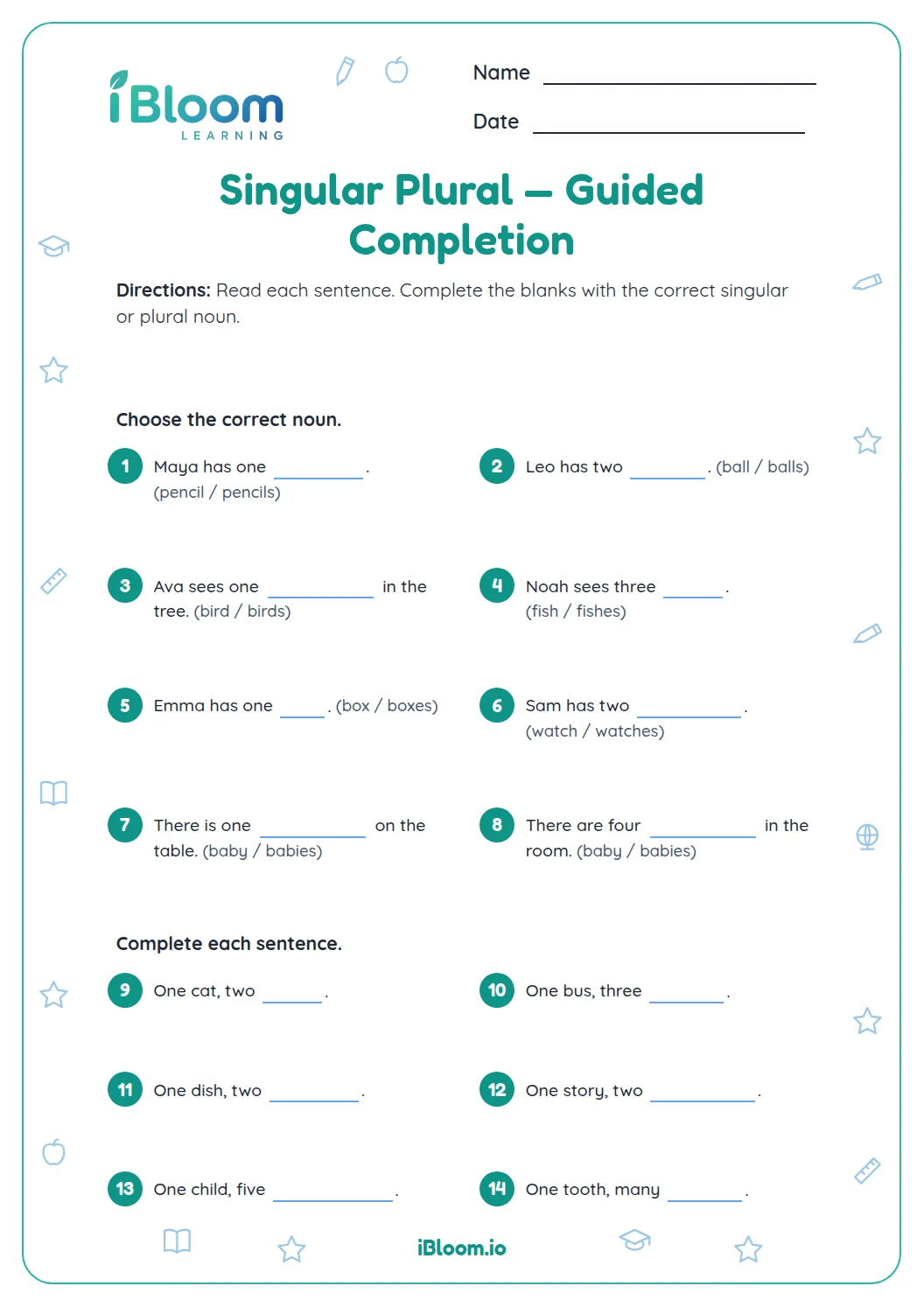
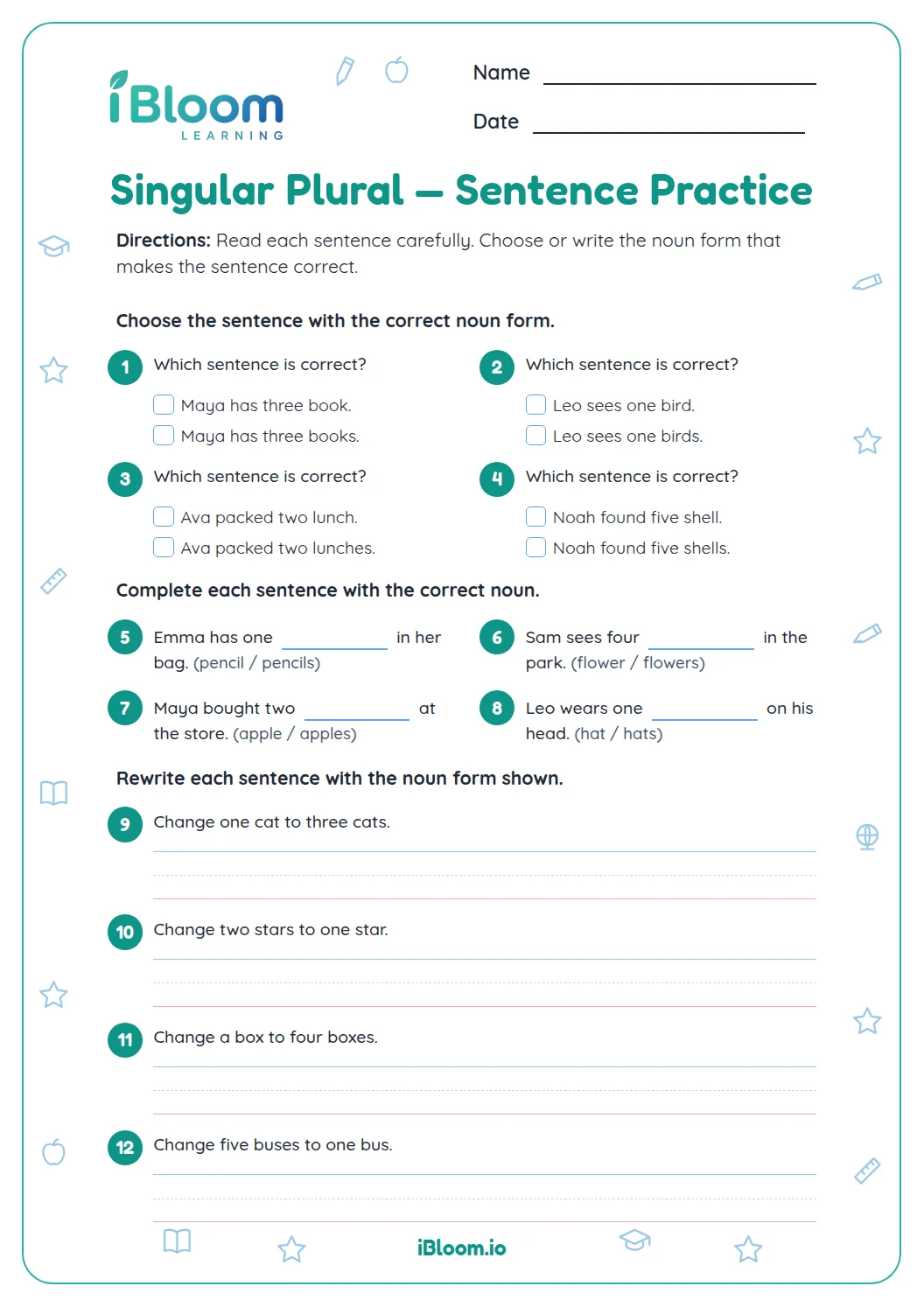
This free Grade 2 worksheet reviews how singular nouns change to plural nouns. Children write common forms such as cats and boxes, change consonant-y words such as baby to babies, identify irregular forms such as children and teeth, and apply plurals in short sentences. Sixteen questions progress from word formation to sentence use. The page aligns with Common Core L.2.1 and focuses especially on frequently occurring irregular plurals in L.2.1.b.
Aligned to L.2.1 and L.2.1.b
When do you add -s or -es?
Many nouns take -s, as in cat to cats. Nouns ending in sounds such as sh or x often take -es, as in brush to brushes and box to boxes. Say the new word aloud and check that the ending is part of the plural.
- 1brush → brushes
- 2The ending -es makes the plural easier to say.
What happens to a noun ending in consonant plus y?
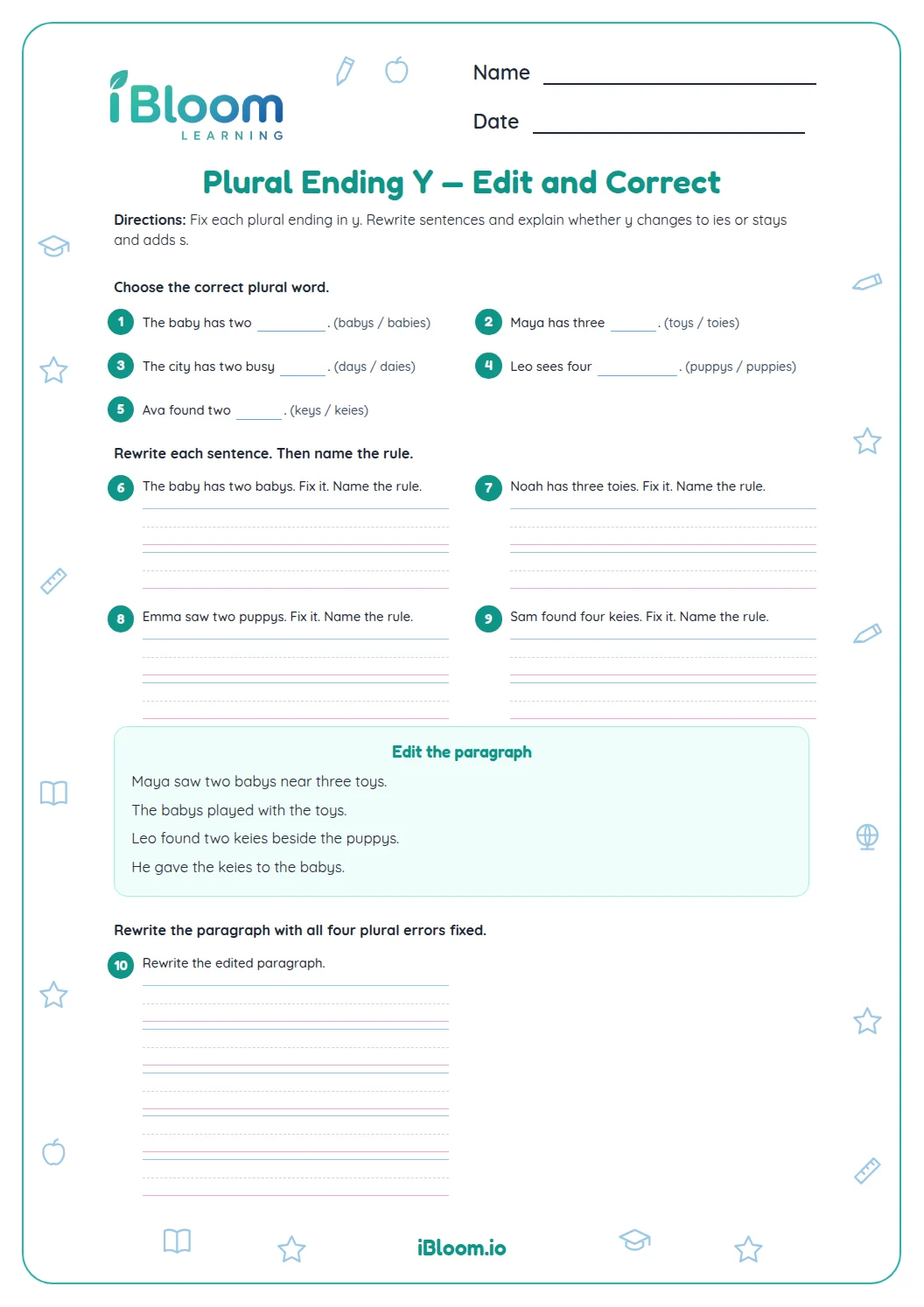
For many nouns ending in a consonant and y, change y to i and add -es: baby becomes babies. When a vowel comes before y, keep the y and add -s: toy becomes toys. The two patterns appear side by side in questions 4 and 5.
Which plural nouns change in an unusual way?
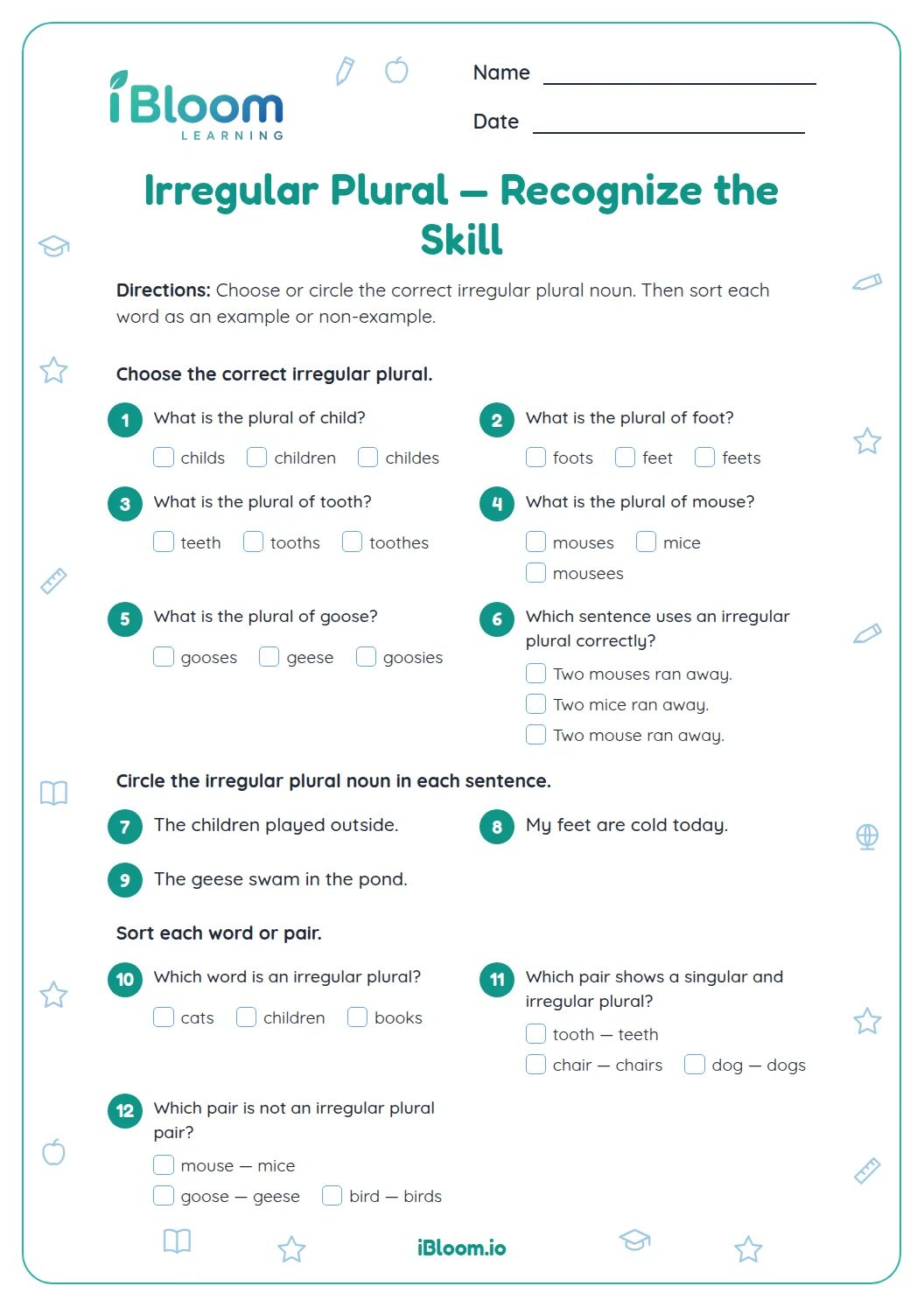
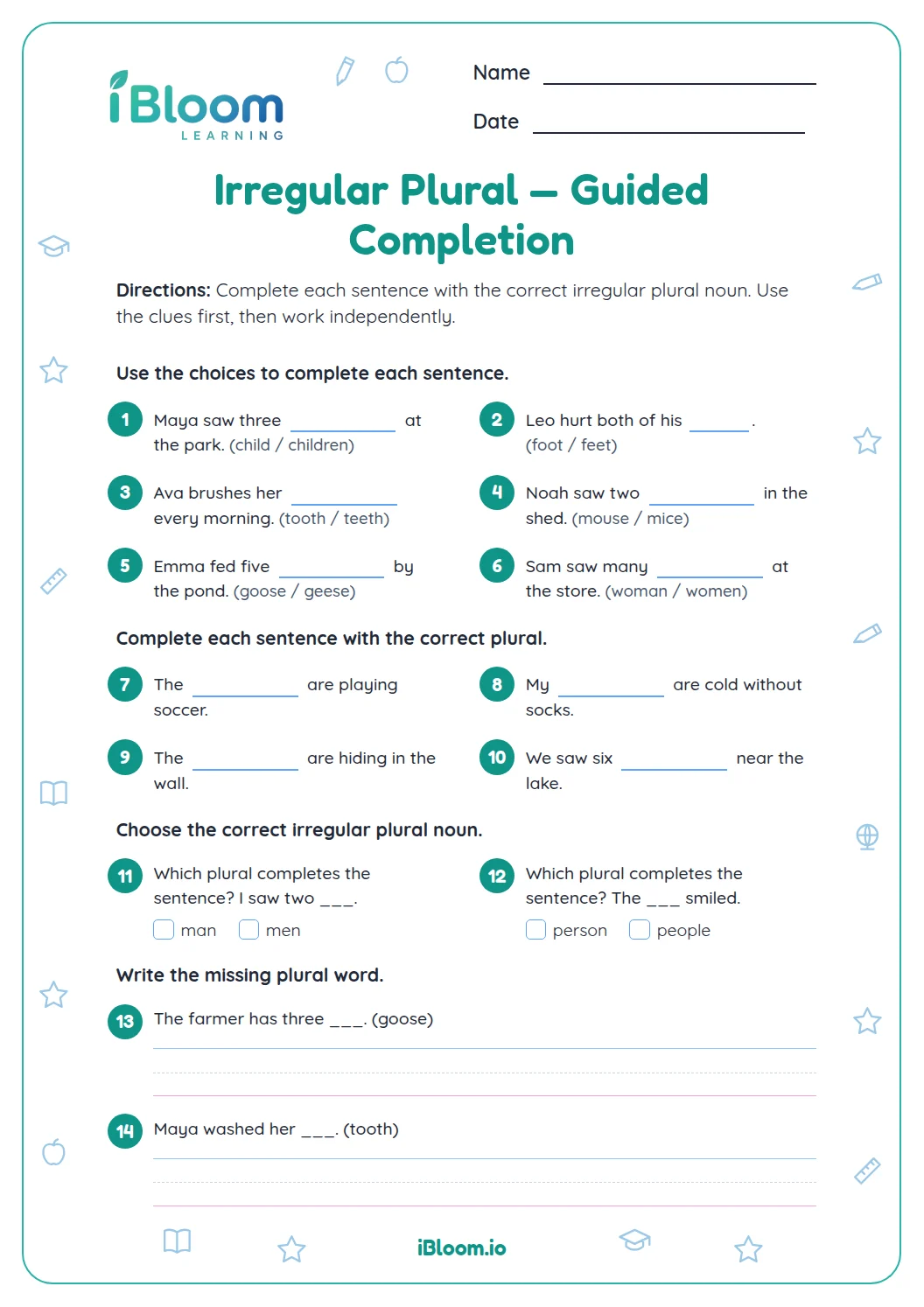
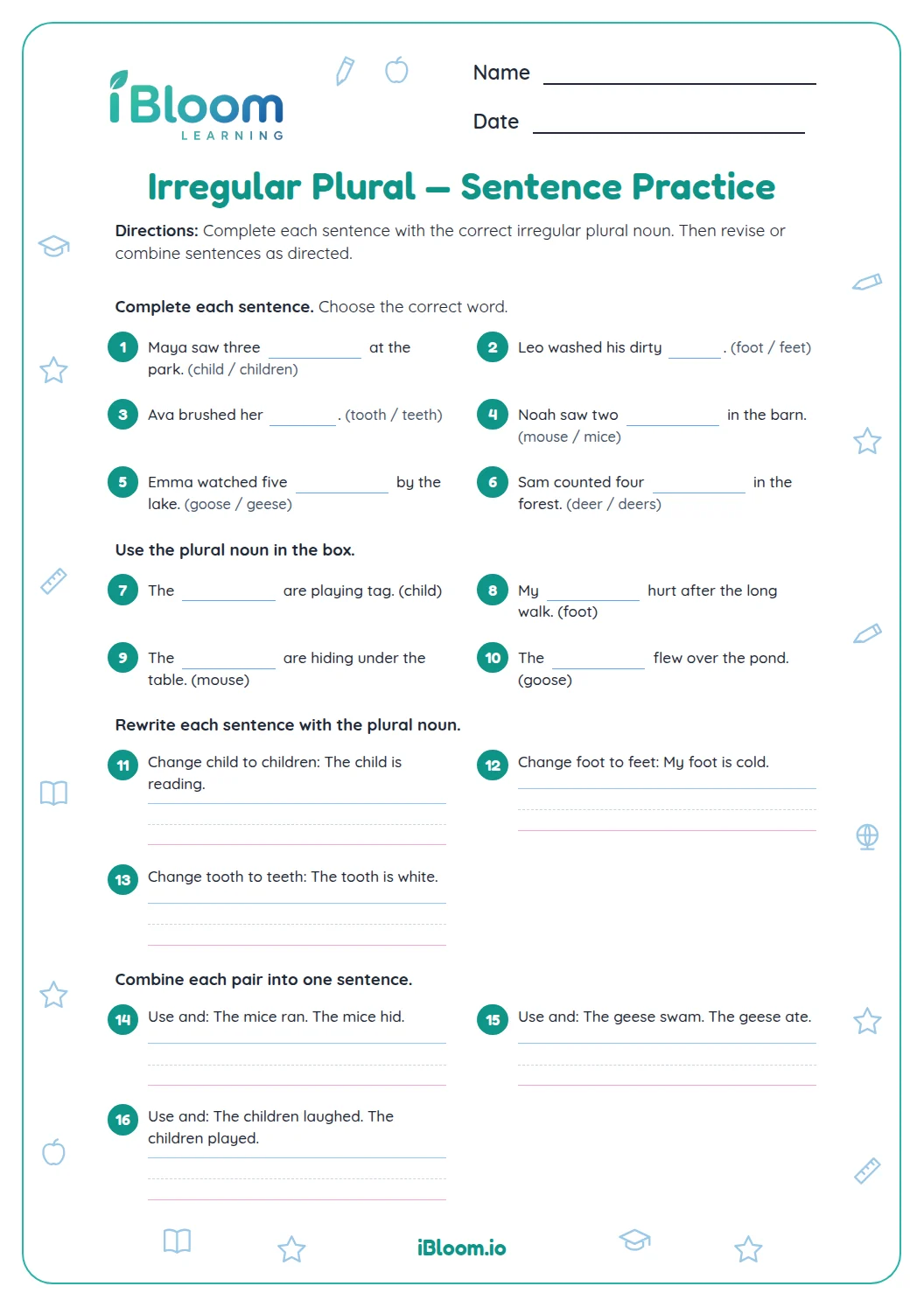
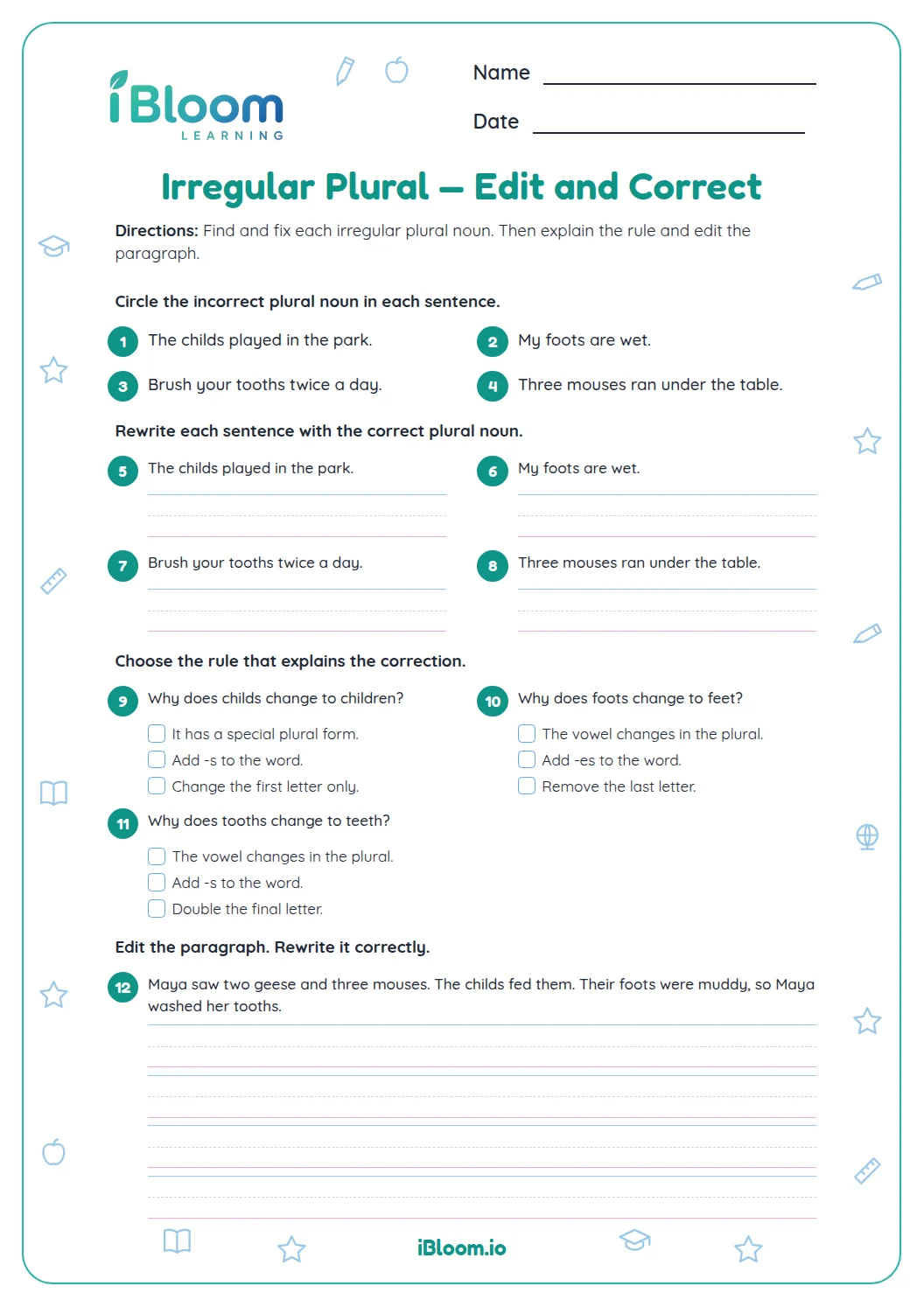
Some common nouns have a plural form that must be learned as a word pair: child/children, tooth/teeth, man/men and foot/feet. Questions 7–12 review several of these forms, and the sentence section includes people.
How to use this worksheet
- 1Read each singular noun and say its plural before writing it.
- 2Check the ending: decide whether the noun takes -s, -es, or a spelling change.
- 3For irregular forms, recall the whole noun pair rather than adding an ending.
- 4Read each corrected sentence aloud to see whether it names more than one.
- 5Use the key to review the noun pattern that needs another try.
Common mistakes and quick fixes
The mistake
Adding only -s to a noun that needs -es.
The fix
Check the final sound or letters; brush and box use -es.
The mistake
Keeping y after a consonant in baby.
The fix
Change the consonant-y ending to -ies, then reread “babies.”
The mistake
Adding a regular ending to an irregular noun.
The fix
Learn the pair together: one child, two children; one tooth, two teeth.
Common Core alignment
This page practices forming and using plural nouns in Grade 2.
Use standard English grammar when forming and using plural nouns.
On this sheet: The questions ask students to form plural nouns and use them in sentences.
Show the official wordingHide the official wording
Demonstrate command of the conventions of standard English grammar and usage when writing or speaking.
Form and use common irregular plural nouns such as children and teeth.
On this sheet: Questions 7–12 and 15–16 practice irregular plural forms.
Show the official wordingHide the official wording
Form and use frequently occurring irregular plural nouns (e.g., feet, children, teeth, mice, fish).
What to practice next
Make more practice
Further reading
Questions parents and teachers ask
What plural patterns are included?
The questions include adding -s, adding -es, changing consonant-y to -ies, changing leaf to leaves, and irregular forms such as children and teeth. Students also use plurals in short sentences. This range makes the review useful for checking more than one spelling pattern.
Why does “toy” become “toys” but “baby” become “babies”?
In toy, a vowel comes before y, so keep y and add -s. In baby, a consonant comes before y, so change y to i and add -es. Questions 4 and 5 place those forms together for comparison. This contrast makes the spelling pattern easy to notice.
Are irregular plurals included?
Yes. The worksheet practices child/children, tooth/teeth, man/men, foot/feet and person/people. These words do not follow the most common -s or -es pattern, so students need to learn and use their plural forms. Saying each pair aloud can help with recall. Compare “toys” with “babies” to review the y pattern.
How should I check the sentence questions?
Read the whole sentence and ask how many people, animals or things it names. “Two foxes ran” and “our teeth” both call for plural nouns. The answer key provides a corrected sentence, while the first section lets children practice forms outside a sentence.
How many questions are on the worksheet?
There are 16 questions: eight written plural forms, four multiple-choice items and four sentence rewrites. The questions move from forming a word to recognizing patterns and using a plural noun in context. The answer key lists all forms and corrected sentences so a child can check each pattern.