
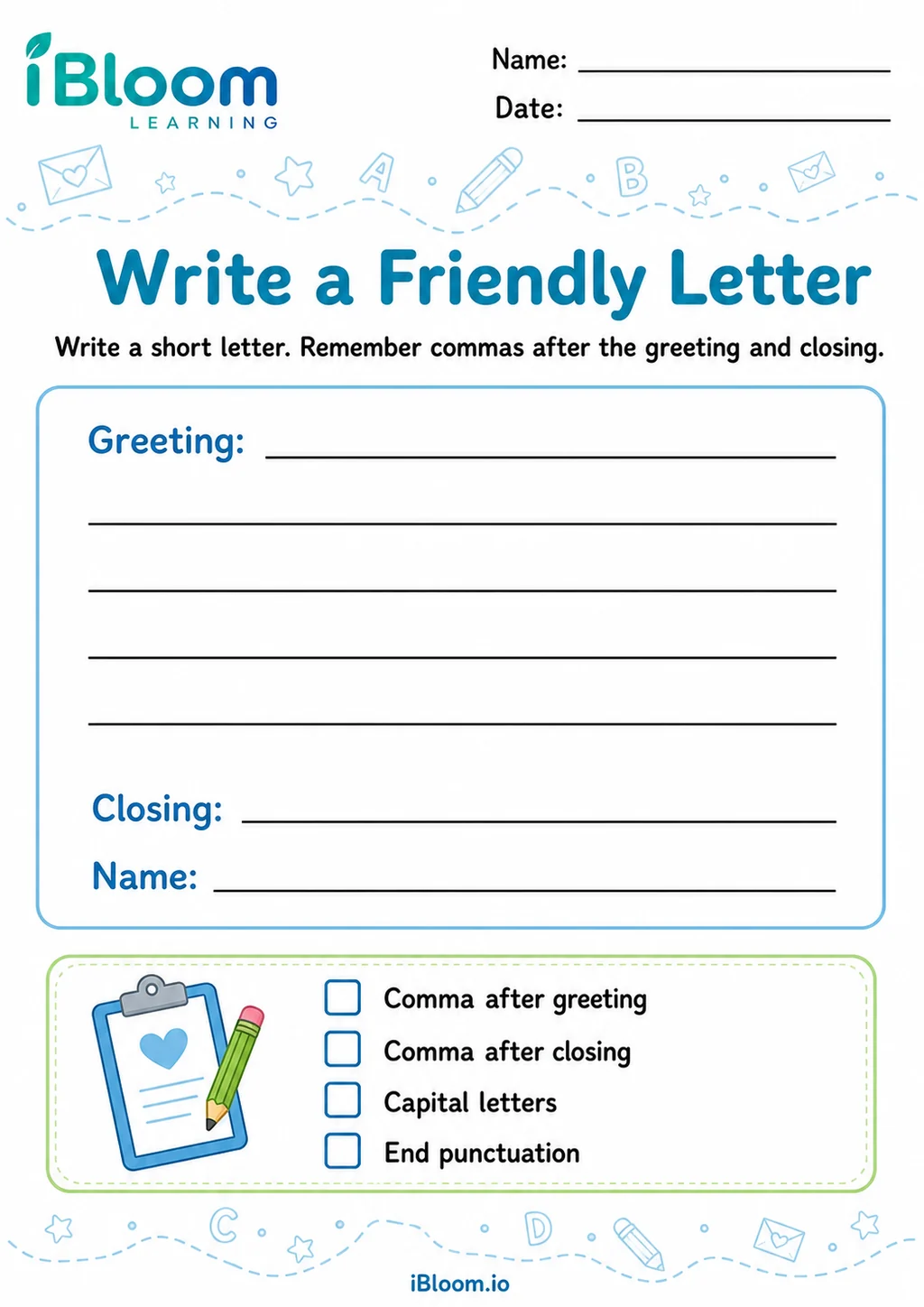
About this worksheet
This Grade 2 page turns the old rewrite activity into short line-completion practice. Each item shows three greeting or closing lines; students write the complete greeting or closing with its comma. Examples include familiar names and sign-offs. The answer key shows the correctly punctuated line for each item.
Aligned to L.2.2b
Where does the comma go in a letter greeting?
A greeting names the person the letter is for. Put a comma after the greeting words: “Dear Sam,”. In this sheet, students complete greetings by adding the comma after the name.
How is a letter closing punctuated?
A closing signals the end of the message before the writer’s name. Put the comma after the closing words, as in “Love,” or “Your friend,”.
- 1Prompt: Dear Sam
- 2Add the comma after the greeting.
- 3Correct line: Dear Sam,
How can writers check their own letter lines?
Read each line as a greeting or closing, then add a comma after all of its words. Check that the comma is not between “Dear” and the name.
What does this worksheet include?
Students complete 14 greeting and closing lines, choose among correctly and incorrectly punctuated examples, and check answers with the separate key.
How to use this worksheet
- 1Read the words as a greeting or closing.
- 2Read the greeting or closing words before the blank.
- 3Place a comma after the full greeting or closing.
- 4Check that the comma is not between the greeting word and the name.
- 5Use the same pattern in your own letter line.
Common mistakes and quick fixes
The mistake
Putting the comma between Dear and the name.
The fix
Keep the greeting together and add the comma after the name.
The mistake
Leaving the comma off a closing such as Love.
The fix
Add a comma after the closing word.
The mistake
Putting the comma after the writer’s name instead of the closing.
The fix
Put the closing and its comma on their own line before the name.
Common Core alignment
This worksheet applies Grade 2 punctuation conventions in friendly letters.
Use commas in greetings and closings of letters.
On this sheet: Students add and select commas in letter greetings and closings, then write examples of their own.
Show the official wordingHide the official wording
Use commas in greetings and closings of letters.
What to practice next
Make more practice
Further reading
Questions parents and teachers ask
Where does the comma go in a letter greeting?
Put the comma after the greeting words, as in “Dear Sam,”. Keep the greeting together and place the comma after the name. This worksheet gives students practice completing and checking that punctuation. The greeting appears at the beginning of a letter.
How is a friendly letter closing punctuated?
Place a comma after the closing words, as in “Your friend,” or “Love,”. The writer’s name goes on the next line. Students use the same placement in the rewrite and apply sections. This marks the sign-off before the writer adds a name.
What types of comma practice are included?
Students complete greeting and closing lines, identify correctly punctuated examples, and apply the pattern to new prompts. The answer key shows the comma placement for each item. The blank follows all the greeting or closing words, so students can check the punctuation in context.
Which Common Core standard does this sheet support?
The worksheet aligns with Grade 2 Language standard L.2.2b: use commas in greetings and closings of letters. Students practice the punctuation directly in friendly-letter greetings and closings. This connects the punctuation rule to writing a real letter. The comma follows the closing words.
Does the comma go after the name in a greeting?
Yes. In “Dear Sam,” the comma follows the name, after all the greeting words. In a closing such as “Your friend,” it follows the closing phrase. The worksheet asks students to add or recognize that placement in each letter line.