






About this worksheet
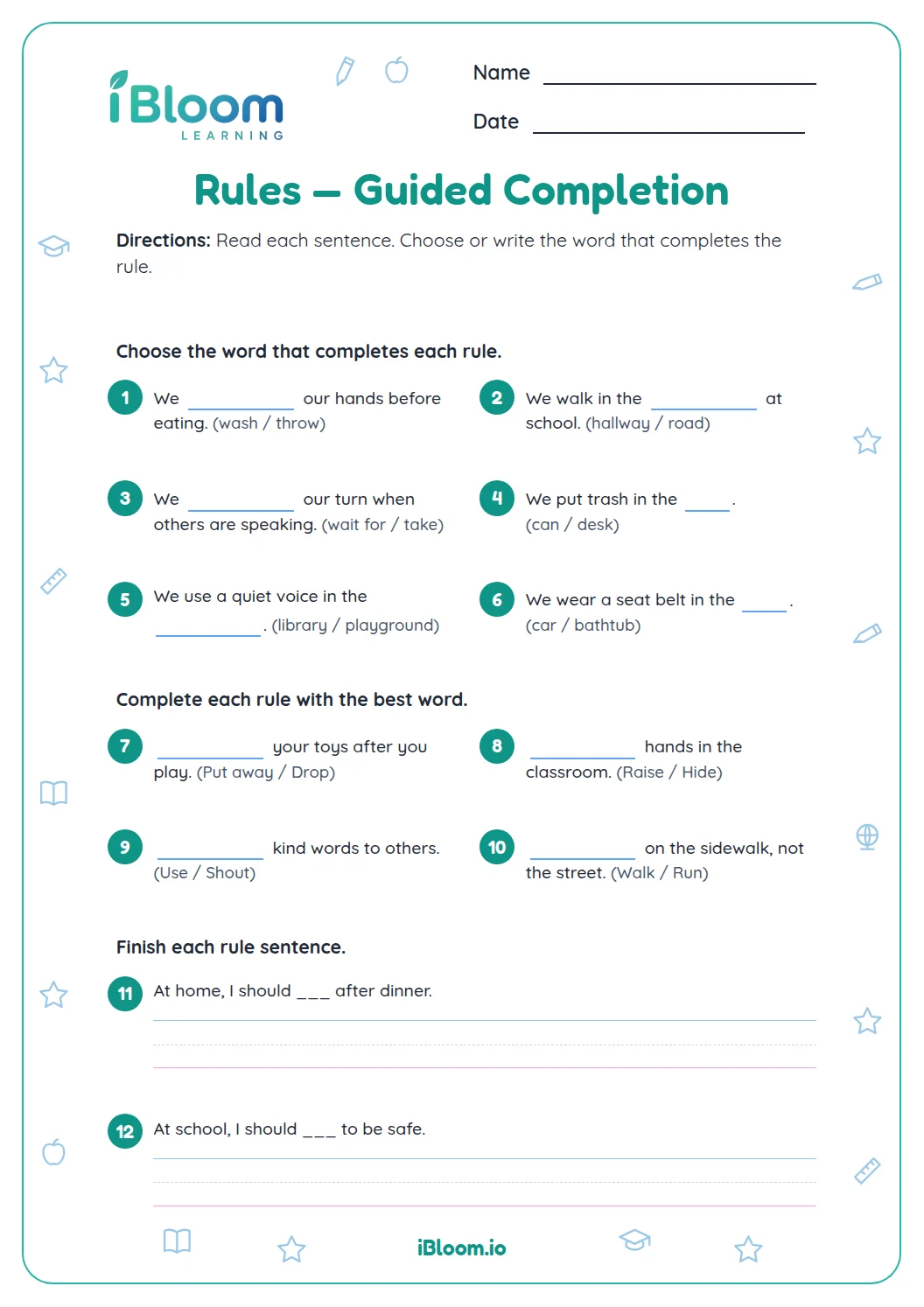
This Grade 2 writing worksheet helps learners recognize and write clear classroom rules as complete sentences. Its 16 questions move from choosing a useful rule to editing capitalization and end punctuation, composing original rules, and applying them to classroom situations. A separate key gives exact choices and sample responses for open-ended writing.
Aligned to L.2.1f
What writing tasks are included?
Questions 1–4 recognize complete, helpful rules. Questions 5–8 edit or improve a sentence. Questions 9–12 invite original rules for games, supplies, reading areas, and safety. Questions 13–16 apply rule writing to shared spaces and classroom situations.
- 16 questions on recognizing, editing, and writing rules
- Open responses have sample answers in the key
How can a learner improve an incomplete rule?
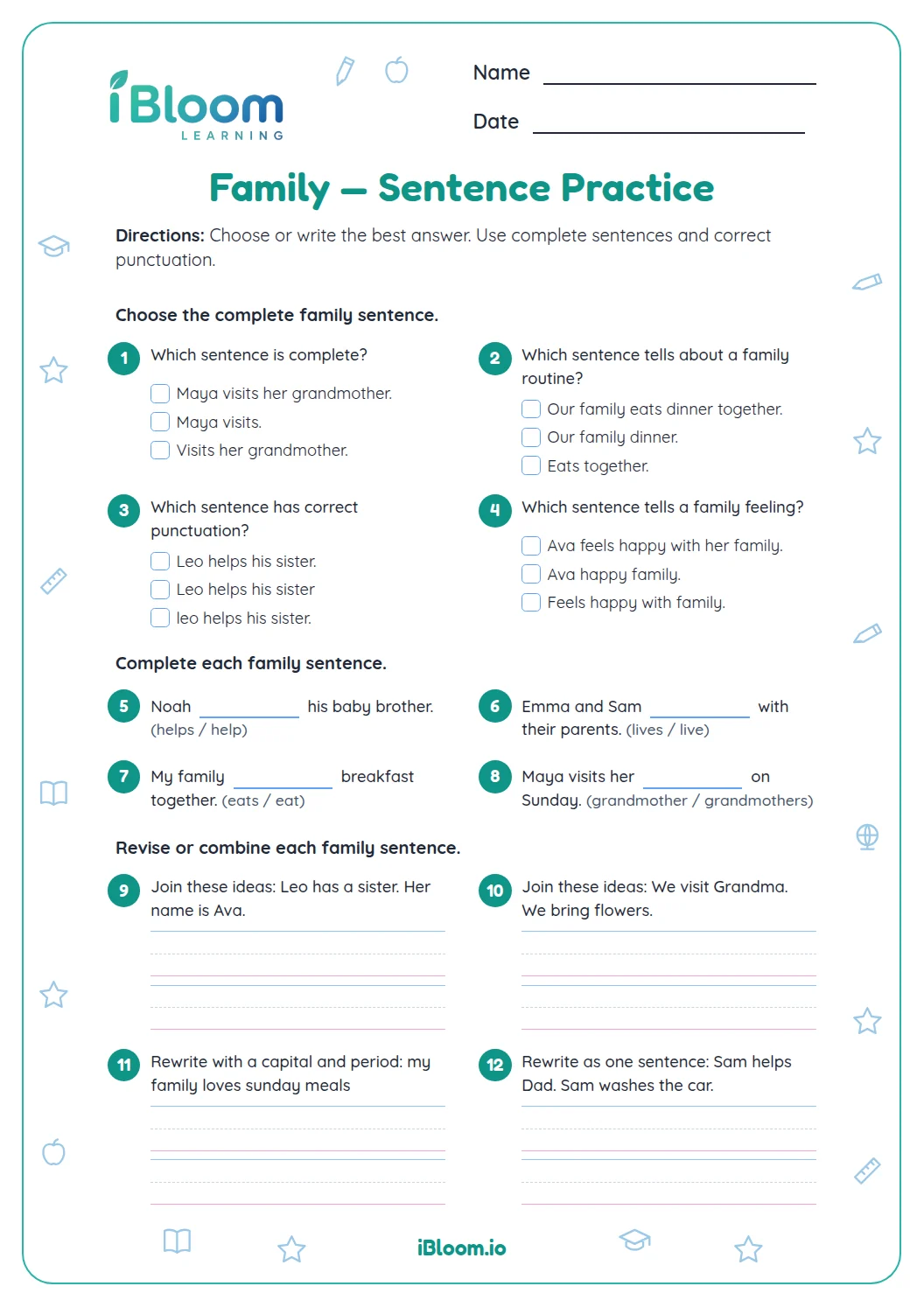
Check whether the words form a complete instruction. Then capitalize the first word and add a period. Keep the rule specific enough to tell a reader what action to take.
- 1Question 5: “please wait your turn”
- 2Capitalize the first word and add a period.
- 3“Please wait your turn.”
What makes a written rule useful?
A useful rule names an action the reader can take. For open-ended items, compare the response with the prompt: a rule about lining up should describe what to do while lining up.
How to use this worksheet
- 1Read the whole prompt and identify the classroom situation.
- 2Choose or write a sentence that tells a clear action.
- 3Capitalize the first word and add an ending mark.
- 4Reread the rule to see whether it fits the situation.
- 5Use the answer key to compare exact choices and sample responses.
Common mistakes and quick fixes
The mistake
Writing a topic instead of a complete rule.
The fix
Add an action that tells the reader what to do.
The mistake
Forgetting the capital at the beginning.
The fix
Check the first word after writing the sentence.
The mistake
Choosing a rule that does not fit the situation.
The fix
Reread the setting and match the action to it.
Common Core alignment
produce complete imperative sentences that state classroom rules
On this sheet: The questions directly practice writing clear classroom rules as complete sentences.
Show the official wordingHide the official wording
Produce, expand, and rearrange complete simple and compound sentences.
What to practice next
Make more practice
Further reading
Questions parents and teachers ask
What is a classroom rule sentence?
It is a complete sentence that tells people what to do in a classroom situation. “Put books back on the shelf.” is a rule; “The shelf is made of wood.” only describes something. Examples refer to familiar settings such as a hallway, a desk, a reading area, or shared classroom supplies.
How many questions does the worksheet include?
The page includes 16 questions: four recognition choices, four editing or improvement items, four original-rule prompts, and four classroom-situation applications. Open-ended questions include sample answers in the key. The sequence includes both selecting a rule and composing sentences that fit a stated classroom need.
What writing conventions do learners practice?
Several questions ask learners to capitalize the first word and use a period. Other items ask them to choose a complete sentence or write an instruction that fits a classroom situation. The editing tasks give practice with capitals, sentence completeness, and end punctuation in the context of rules.
Can answers to the writing prompts differ from the key?
Yes. The key gives sample responses for open-ended prompts. A different response is suitable if it is a complete, clear rule that answers the specific prompt. Sample answers in the key illustrate one possible response; another clear rule can also meet an open prompt.
What is one way to check a rule before finishing?
Reread it and ask whether it tells the reader a clear action. Then check the capital letter, sentence completeness, and ending punctuation. This page keeps the writing purpose concrete by asking learners to state actions that help a classroom run smoothly.