




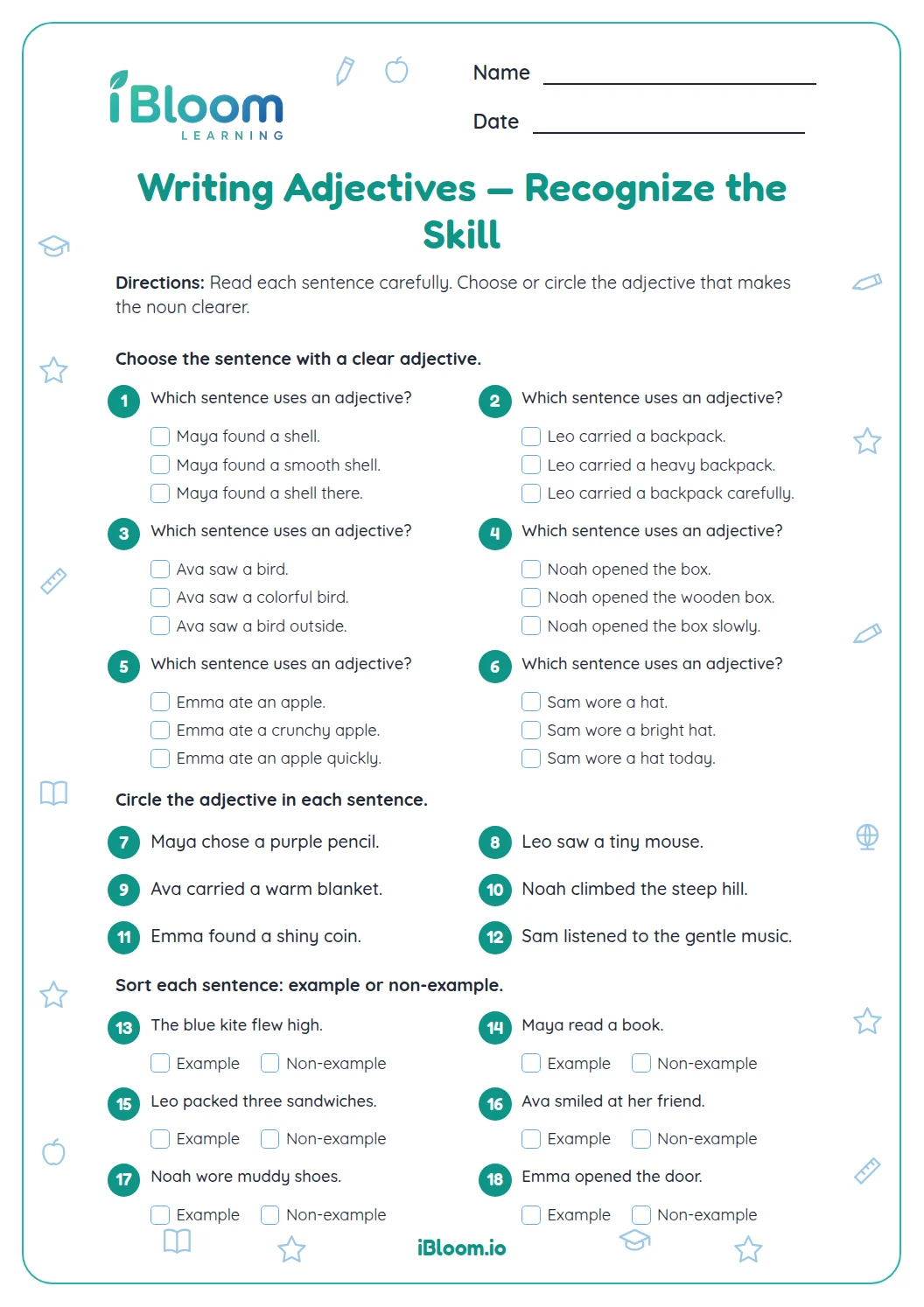
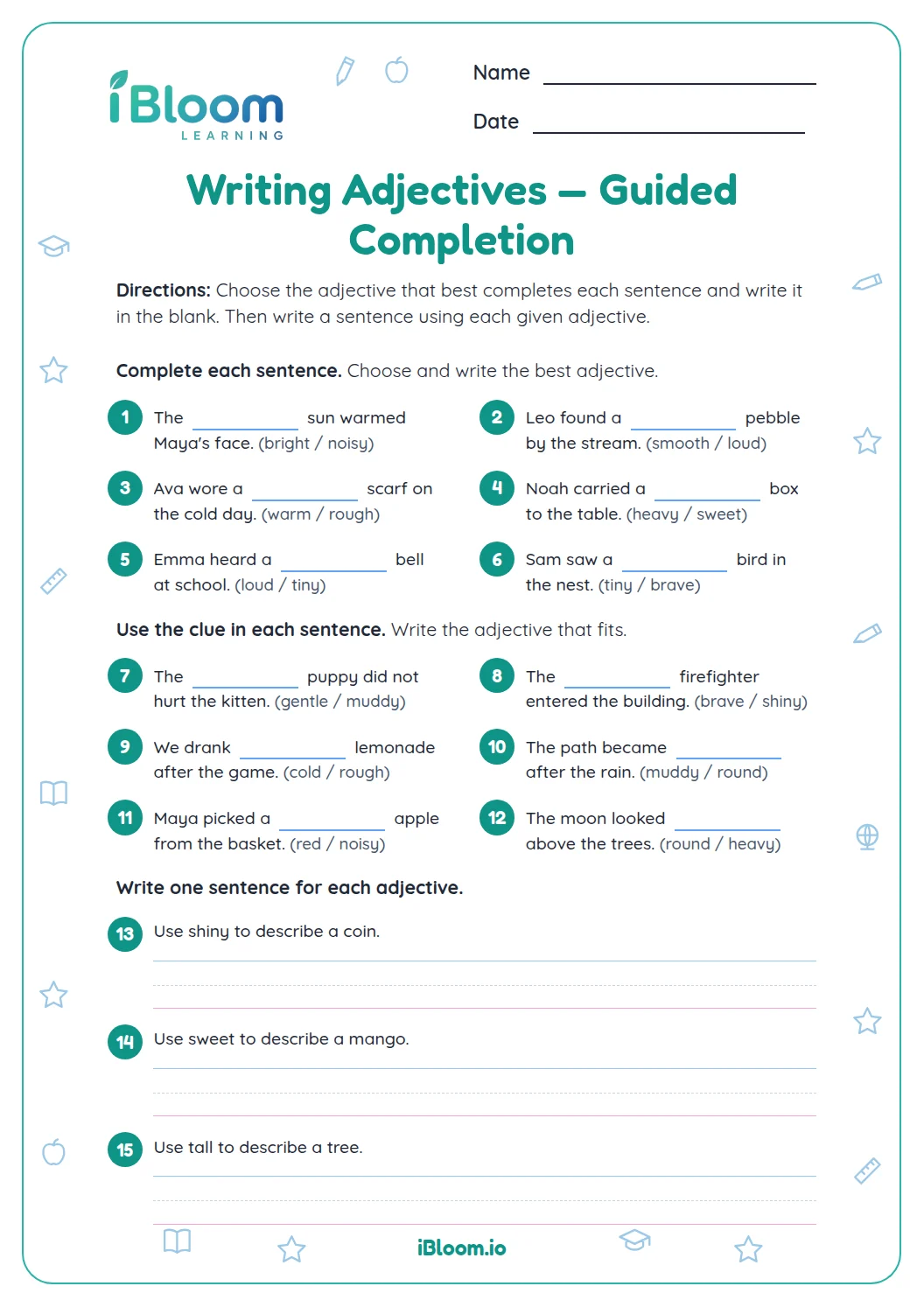

About this worksheet
This free Grade 3 worksheet reviews adjectives and nouns in fourteen questions. Part A asks children to circle four adjectives. Part B asks which noun each of four capitalized adjectives describes, including adjectives after a linking verb. Part C adds clue sentences and choices between plain and more detailed descriptions. Part D asks children to explain two adjectives describing one noun and write two descriptive sentences of their own. The work practices Common Core L.3.1a by identifying words and explaining their jobs. A separate key includes sample explanations and writing.
Aligned to L.3.1a
What do adjectives and nouns do in these sentences?
A noun names a person, place, thing, or idea. An adjective gives information about a noun. In “The fluffy kitten naps,” kitten names the animal and fluffy tells what its fur is like. Part A asks students to find the describing word.
Keep the two jobs connected: after circling fluffy, ask “What is fluffy?” The answer kitten shows that the student can connect the adjective to its noun.
Can an adjective describe a noun that is several words away?
Yes. In Part B, two adjectives follow is or are. The noun they describe can appear earlier in the sentence, with a phrase between them. The closest noun is not always the right match.
Question 7 says “The soup in the bowl is HOT.” The sentence tells about the soup’s temperature. The phrase “in the bowl” tells where the soup is, so soup is the answer.
- 1The soup in the bowl is HOT.
- 2Ask: What is hot?
- 3The soup is hot.
- 4HOT describes soup.
How do children move from finding adjectives to using them?
Part C first asks children to select hot for soup that burned a tongue and narrow for a path only a foot wide. Then they compare plain sentences with versions that add a describing word, such as “A tiny bird sang.”
In question 13, small and brown both describe rabbit: one gives its size and the other its color. Question 14 asks for two new sentences, each with two adjectives. Children describe a market in one sentence and an object in the other.
How to use this worksheet
- 1Circle fluffy in question 1 and identify kitten aloud.
- 2Finish Part A, checking which noun each adjective describes.
- 3Read each capitalized adjective in Part B and find its noun.
- 4Use the clues in Part C, then identify the detail added by tiny or heavy.
- 5For question 13, explain how small and brown describe rabbit.
- 6Write the two sentences in question 14, then underline each adjective and name its noun.
Mistakes to notice and fix
The mistake
Choosing a noun simply because it stands beside the adjective.
The fix
Use the sentence’s meaning: HOT describes soup, even though bowl is closer.
The mistake
Missing adjectives that follow is or are.
The fix
Ask what quality the sentence gives the subject, such as boots being muddy.
The mistake
Using only one adjective in a sentence when the task asks for two.
The fix
After writing each sentence in question 14, underline two describing words and name the noun each describes.
Common Core alignment
Identify adjectives and explain which nouns they describe in sentences.
On this sheet: Students identify adjective–noun connections, explain the details adjectives add, and use them in sentences.
Show the official wordingHide the official wording
Explain the function of nouns, pronouns, verbs, adjectives, and adverbs in general and their functions in particular sentences.
What to practice next
Make more practice
Further reading
Questions parents and teachers ask
Which adjectives should children circle in Part A?
The four answers are fluffy, narrow, warm, and muddy. The first two come before their nouns, while warm and muddy come after linking verbs. After checking each circle, ask the child to name the noun being described: kitten, path, soup, or boots, respectively.
Why are the adjectives capitalized in Part B?
Capital letters identify the adjective students should connect to a noun. This lets the four questions focus on which word is being described. For example, HOT is already marked in the soup sentence, and children must decide whether it describes soup or bowl by reading the whole sentence.
Can more than one adjective describe the same noun?
Yes, two adjectives can give different details about one noun. In question 13, small and brown both describe rabbit. Small gives its size, while brown gives its color. The student should name both adjectives and their shared noun, then explain those details in a short response.
How do children choose the more detailed sentence?
They identify what the added adjective tells them about the noun. “A tiny bird sang” gives the bird’s size, while “A bird sang” leaves that detail out. “The heavy bag fell” adds information about weight. Ask children to name the added word and the noun it describes.
How should I check the final explanation and writing?
Check that question 13 connects small and brown to rabbit and explains size and color. For question 14, look for two complete sentences, one about a market and one about an object, with two adjectives in each. The sample key shows possibilities; other clear descriptions also work.