





About this worksheet
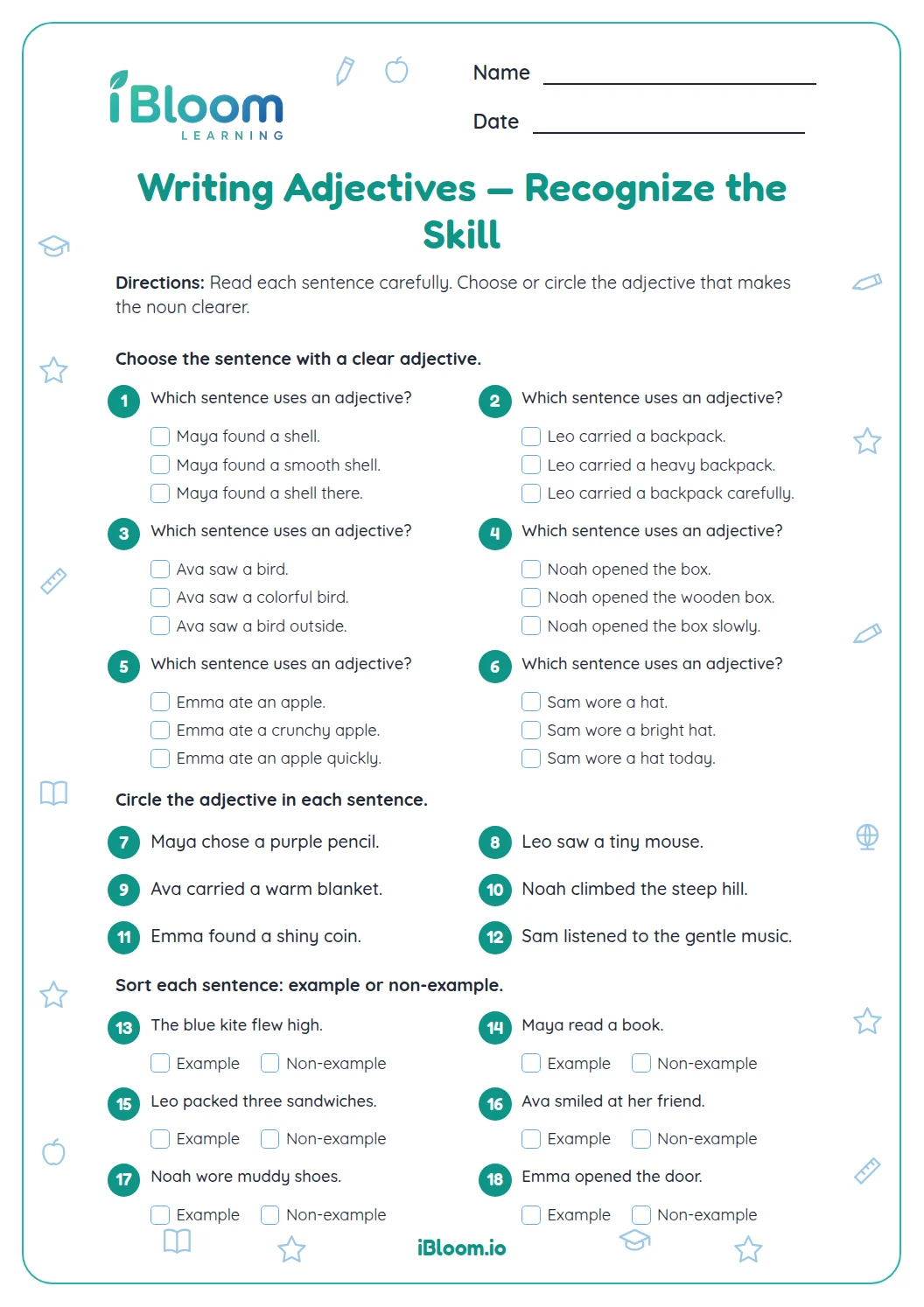
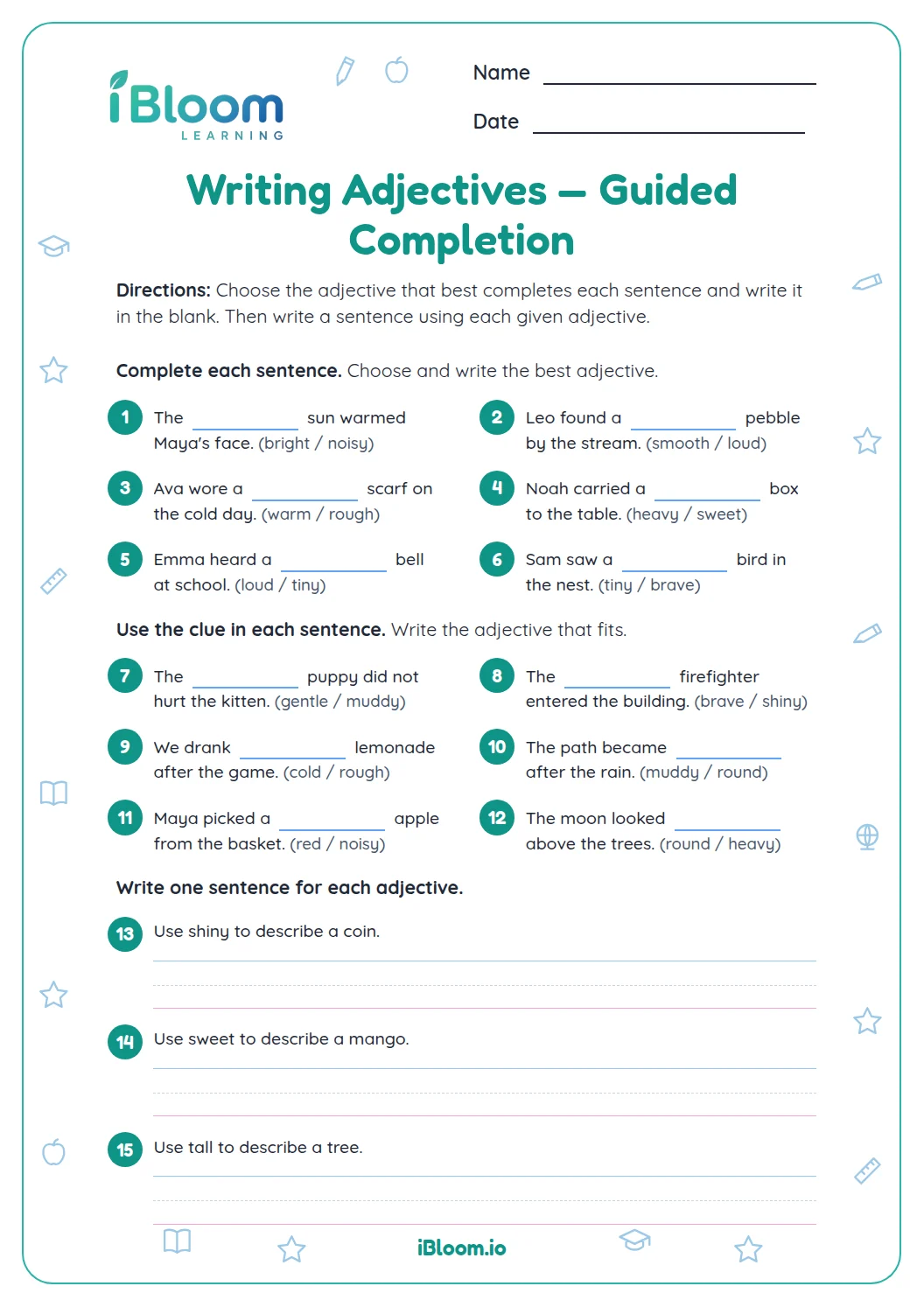
This free printable Grade 3 worksheet gives children eleven sentences to work with so they can see what an adjective does in a real sentence. They pick the adjective from a noun, a verb and an adjective, circle the adjective in four short sentences, and then combine two sentences into one by moving the describing word in front of the noun. The last question asks for two adjectives of their own. It practices Common Core L.3.1.a and suits third graders who can name a noun and a verb. A matching answer key is included.
Aligned to L.3.1.a
What does an adjective do in a sentence?
An adjective is a word that describes a noun. It answers a question about the noun, most often what kind (a tiny frog), but also which one or how many. Take the adjective away and the sentence still works, but the picture in your head gets blurry.
Part A shows this with sentences where every word is a plain, familiar one. Each question lists a noun, a verb and an adjective, so children have to decide what job each word does instead of guessing which one sounds fancy.
- 1A tiny frog sat on the log.
- 2Nouns: frog, log
- 3Verb: sat
- 4Which word tells what kind of frog? tiny
- 5The adjective is tiny.
What is on this worksheet?
Eleven questions on two pages, in three parts that grow harder. The sentences use everyday things: a frog, warm bread, a shiny coin, a wet dog and a kite.
- Part A, Find the adjective: four sentences, each with three words to choose from
- Part B, Circle the adjective: four short sentences, with the describing word to circle
- Part C, Combine and rewrite: three short answers where the adjective moves in front of its noun
- Answer key, two pages, in the same layout
Why combine two sentences into one?
“The cat purred. The cat was fluffy.” says the same thing twice. Moving the adjective in front of the noun gives one smoother sentence: “The fluffy cat purred.” Children see that an adjective can sit before the noun, not only after “was.”
Question 11 leaves the choice open. A child adds any two adjectives that fit the kite, and the answer key shows one sample. Accept any sentence that keeps the adjectives before the noun and still makes sense.
How to use this worksheet at home or in class
- 1Read the worked example aloud and say the noun first: “Frog. What kind of frog? Tiny.”
- 2Do question 1 together, and let your child say why the other two words are a noun and a verb.
- 3Have your child finish Part A and Part B alone, circling the adjective in pencil.
- 4For Part C, read each pair of sentences aloud first. Ask which word is repeated and which word describes.
- 5Mark with the answer key and ask your child to point to the noun each adjective describes.
- 6Do a quick oral round: name an object in the room and take turns giving two adjectives for it.
Common mistakes and quick fixes
The mistake
Choosing the noun because it is the most important word, such as frog in question 1.
The fix
Ask “Is it a thing or a describing word?” Frog names a thing. Tiny describes it. Have your child touch the noun first, then find the word that goes with it.
The mistake
Circling the verb in a short sentence, such as ate in “Nina ate a juicy peach.”
The fix
Check whether the word can be put in front of a noun: a juicy peach works, an ate peach does not. If it does not fit before the noun, it is not an adjective.
The mistake
Leaving the repeated noun in when combining, such as “The cat fluffy purred.”
The fix
Say both sentences aloud, then say the noun only once with the adjective right before it: “The fluffy cat purred.”
Common Core alignment
Most US states teach grammar with the Common Core standards or a close state version. This sheet practices the standard below.
Explain what adjectives do in particular sentences.
On this sheet: Children pick out the adjective from nouns and verbs, circle it in a sentence and move it in front of the noun it describes.
Show the official wordingHide the official wording
Explain the function of nouns, pronouns, verbs, adjectives, and adverbs in general and their functions in particular sentences.
What to practice next
Make more practice
Further reading
Questions parents and teachers ask
What is an adjective, in words a third grader will remember?
An adjective is a word that describes a noun. It tells what kind, which one or how many, like tiny frog, warm bread or loud noise. A quick test is to ask whether the word could go right in front of a noun. If it can and it describes it, it is an adjective.
Why does Part A list a noun and a verb as choices?
Each question lists one adjective beside a noun and a verb, so children must sort the three words by their jobs. Without those choices a child could guess the word that sounds most colorful. For “Mia heard a loud noise outside,” the choices loud, heard and noise make the child decide.
Can an adjective come after the noun?
Yes. In “The shell was smooth,” the adjective smooth comes after the noun and the verb was. Questions 9 and 10 start from sentences like this and have children move the adjective in front of the noun, as in “a smooth shell,” which is the more common place for it.
How should I mark the combine-and-rewrite questions?
Check that the noun appears once, the adjective comes right before it and the sentence reads smoothly. Question 9 has one expected answer, The fluffy cat purred. Question 11 has many right answers, so accept any two adjectives that fit a kite and sit before the noun.
Does a number count as an adjective?
Yes, a number word can describe how many, as in three ducks. This sheet sticks to adjectives that tell what kind, like shiny, juicy and steep, because those are easiest to spot first. Once children are comfortable, ask them to add a number word to a few of the sentences.
Is there an answer key for this worksheet?
Yes. The answer key lists the adjective for each question in Parts A and B and a model sentence for each question in Part C, on two pages that match the worksheet. Download the free PDF from this page, print the worksheet on its own and keep the key for checking your child's work.