





About this worksheet
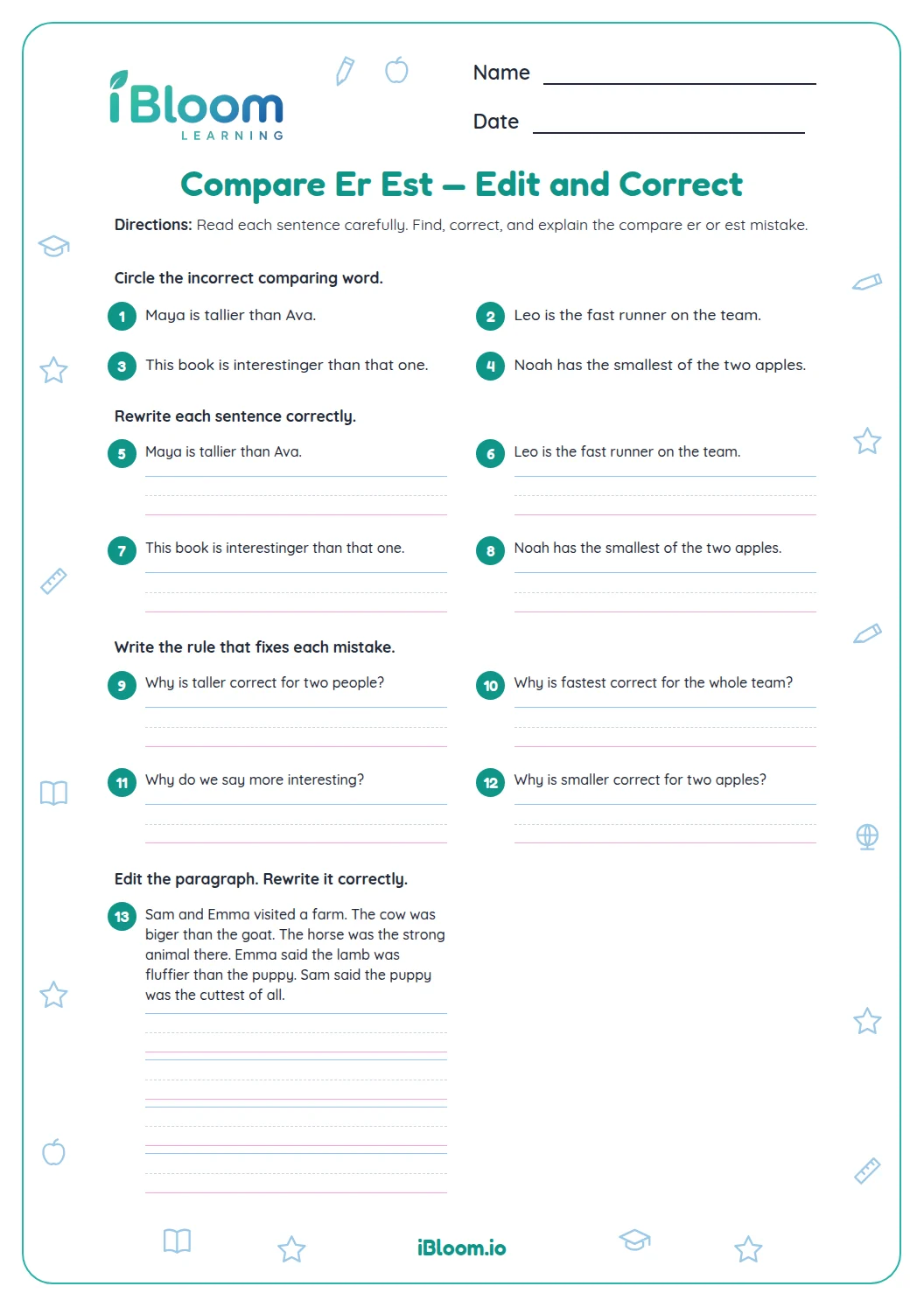
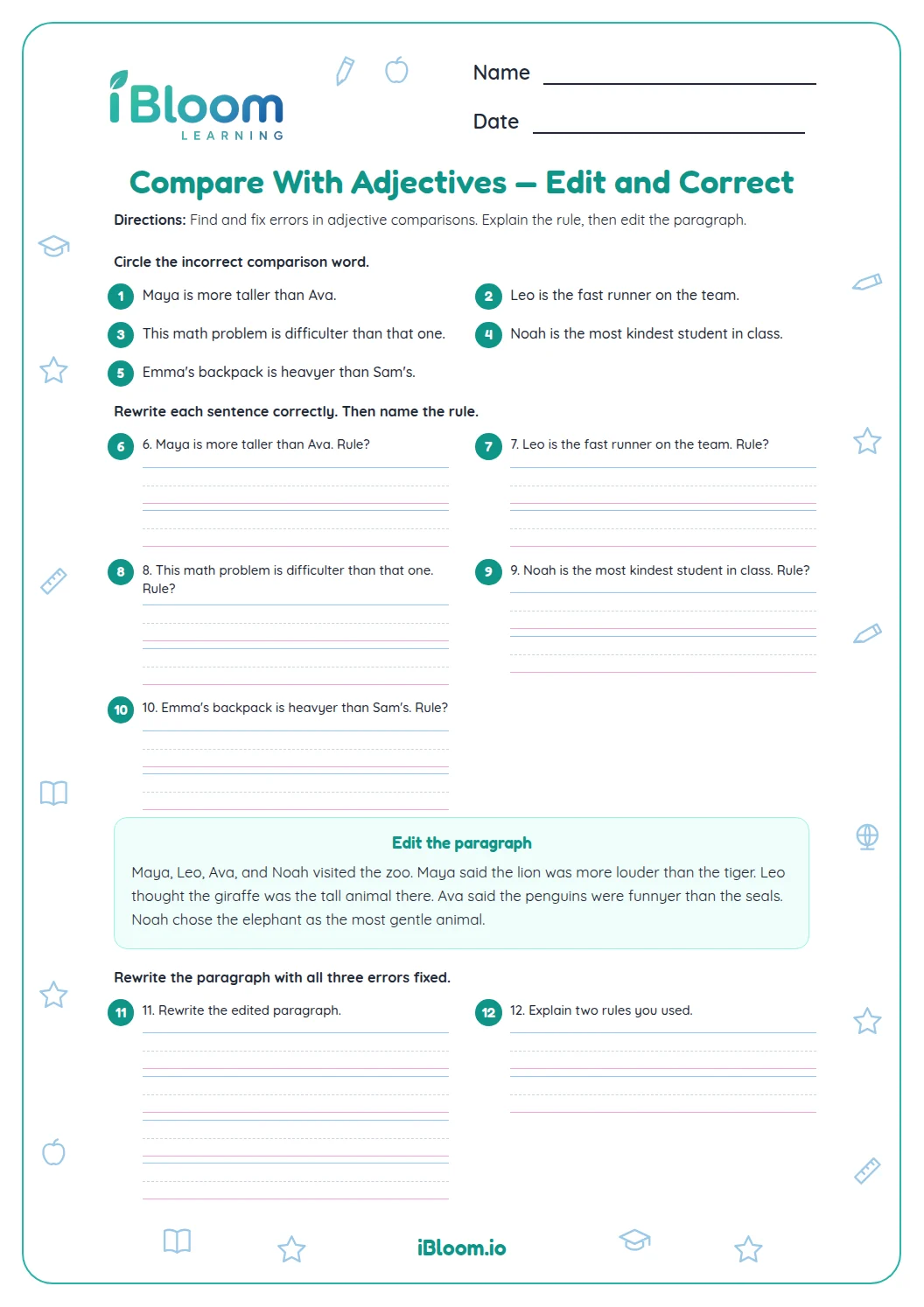
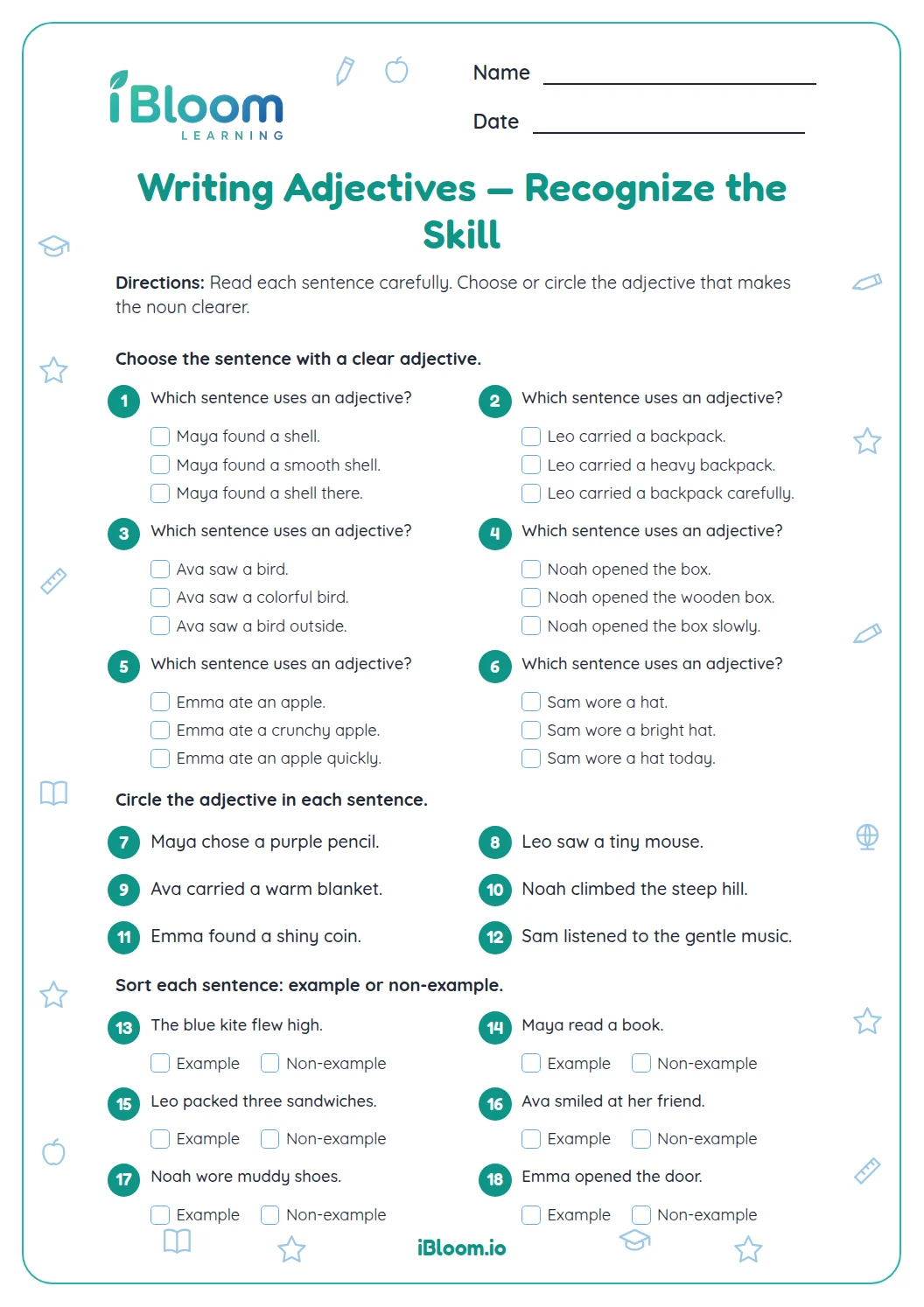
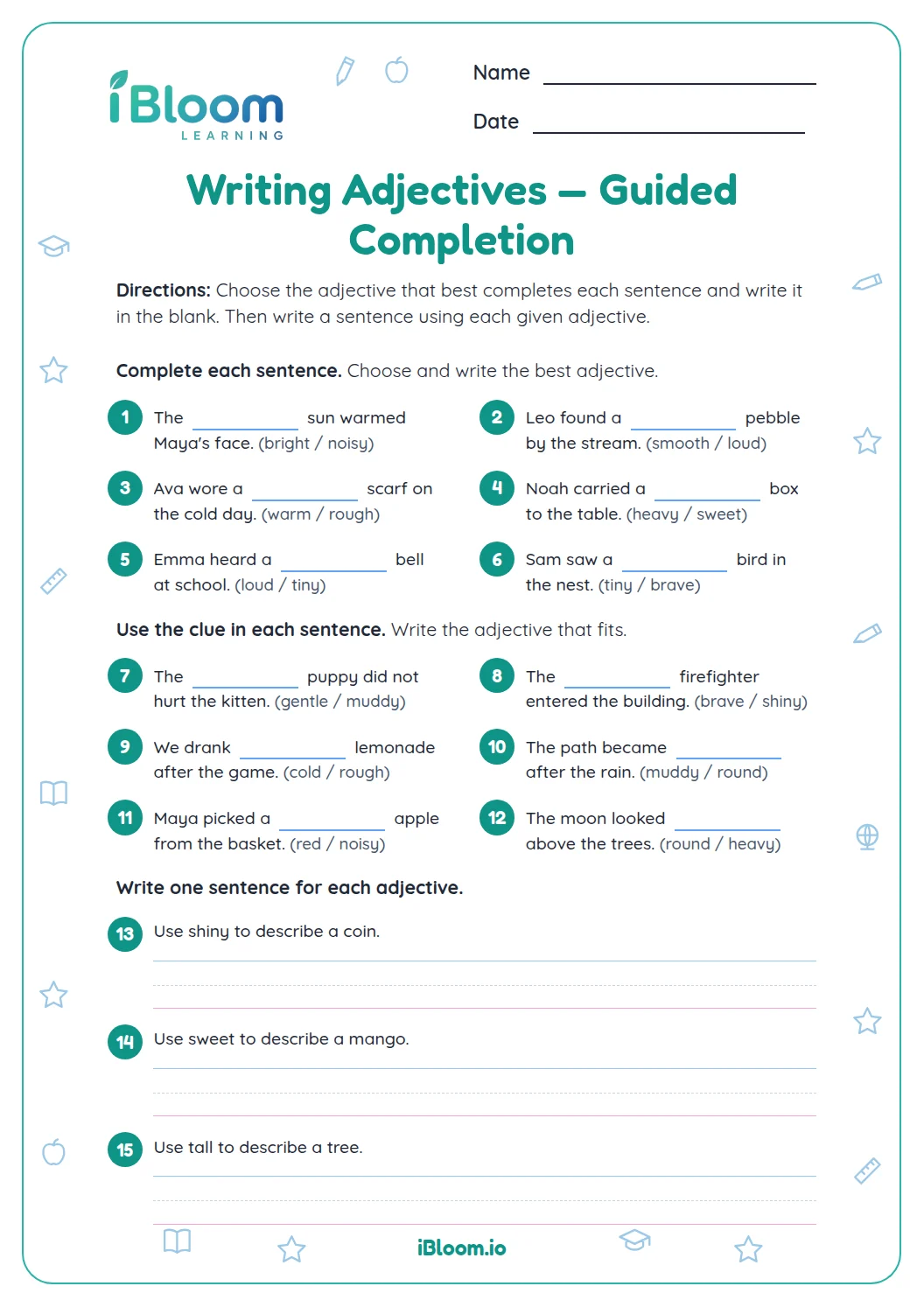
This Grade 3 printable practices comparing two people, places, animals, or things. Students choose a correct form, complete comparisons with spelling changes such as funny to funnier, and edit sentences with an extra comparison marker. The 16 questions build from recognition to independent use, and the answer key includes sample comparisons.
Aligned to L.3.1.g
How do comparative adjectives work?
A comparative adjective describes a difference between two people, places or things. Many short adjectives add -er, as in “fast” to “faster.” If an adjective ends in consonant plus y, change y to i and add -er: “funny” becomes “funnier.” For longer adjectives, use “more,” as in “more comfortable.”
- 1In q1, “faster” compares how quickly the rabbit and turtle move.
When should a sentence use “more” or “-er”?
Use one comparative marker. “Smaller” already means more small, so “more smaller” repeats the comparison. With two items, use the comparative form: “Maya is taller than Jo.” The superlative “tallest” compares one item with a group of three or more.
- 1In q5, “more difficult” is the comparative form of difficult.
How can a comparison sound precise?
Name both sides of the comparison so a reader knows what differs. “The second story was funnier than the first” identifies the quality and the two stories. Part C gives practice correcting mismatched forms and composing one clear comparison.
- 1In q13, remove “more” because “smaller” already marks the comparison.
How to use this worksheet
- 1Read both things being compared before choosing a form.
- 2For short adjectives, try adding -er: fast → faster.
- 3For an adjective ending in consonant plus y, change y to i before -er.
- 4For longer adjectives, use more before the adjective.
- 5Use either more or an -er form, not both.
- 6Check that the sentence compares two things and uses than when needed.
Common mistakes and quick fixes
The mistake
Writing “more smaller” with two comparison markers.
The fix
Keep only one marker: “smaller.”
The mistake
Changing every adjective by adding -er, such as “comfortabler.”
The fix
Use “more comfortable” for this longer adjective.
The mistake
Using “tallest” to compare two people.
The fix
Use “taller” for two; reserve “tallest” for a group.
Common Core alignment
These standards describe the reading, language, or math work practiced on this page.
Form and use comparative adjectives to compare two things.
On this sheet: Children choose and form comparative adjectives in sentences.
Show the official wordingHide the official wording
Form and use comparative and superlative adjectives and adverbs, and choose between them depending on what is to be modified.
What to practice next
Make more practice
Further reading
Questions parents and teachers ask
What is a comparative adjective?
A comparative adjective describes how two people, places, or things differ. In “A rabbit is faster than a turtle,” faster compares the animals’ speed. This worksheet asks students to recognize the form, spell it correctly, and use it in a complete comparison.
When should a student add -er?
Many short adjectives take -er, as fast becomes faster. For adjectives ending in consonant plus y, change y to i before adding -er, as funny becomes funnier. The worksheet also includes longer adjectives that use more, so students compare the word patterns.
When do we use more instead of -er?
Use more with many longer adjectives, including comfortable and difficult: more comfortable, more difficult. Do not add more to a form that already ends in -er. Part A asks students to choose between forms, and Part B gives them practice producing the form themselves.
Why is “more smaller” incorrect?
Smaller already means that one thing is smaller than another, so more repeats the comparison. Write “smaller” by itself. In Part C, students correct that kind of sentence and check that the adjective compares the two items named.
How many questions and pages are included?
There are 16 questions in three parts: six multiple-choice items, six comparative-form completions, and four editing or application items. The printable has two worksheet pages followed by a separate two-page answer key with expected forms and sample sentences.