



About this worksheet
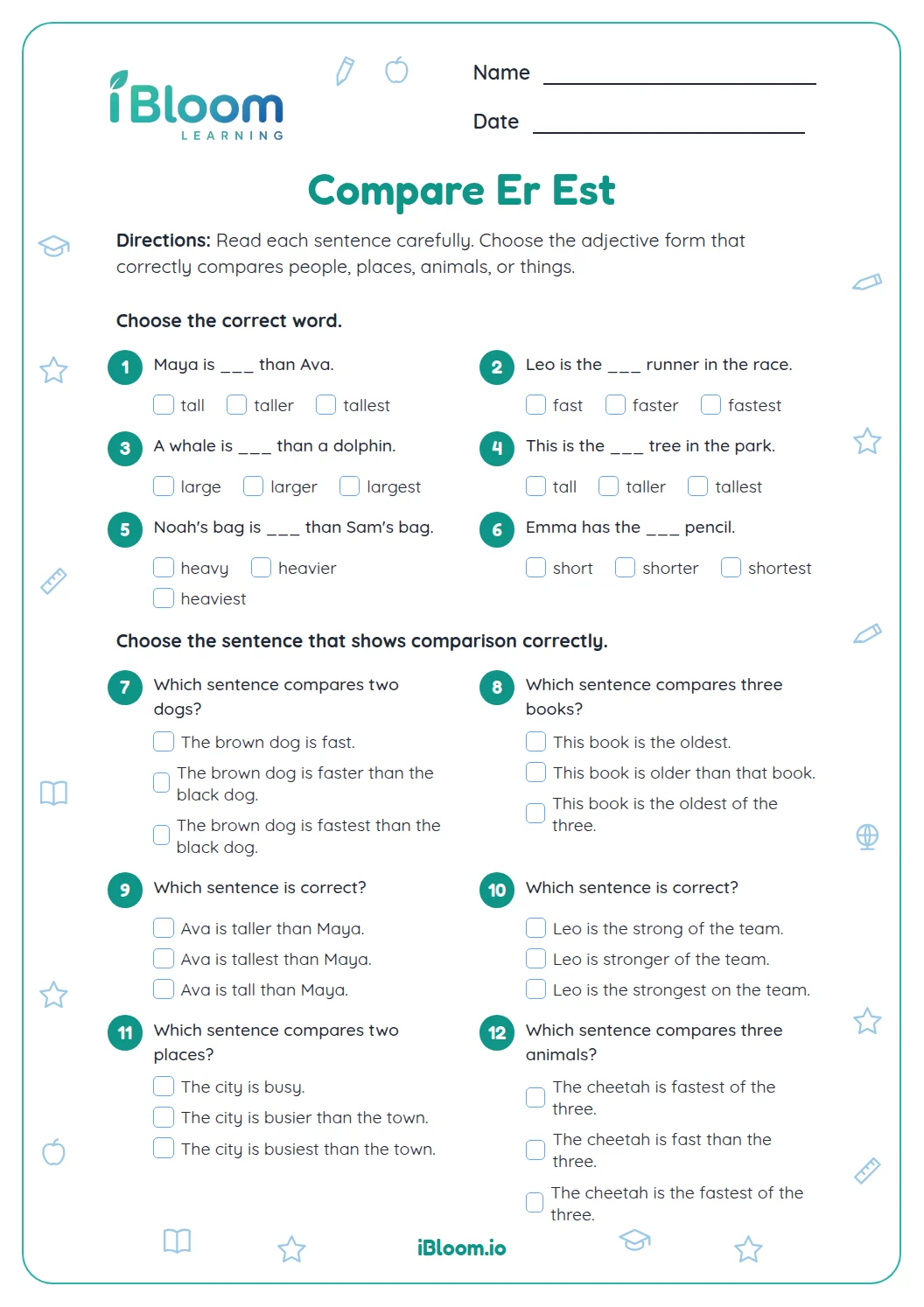
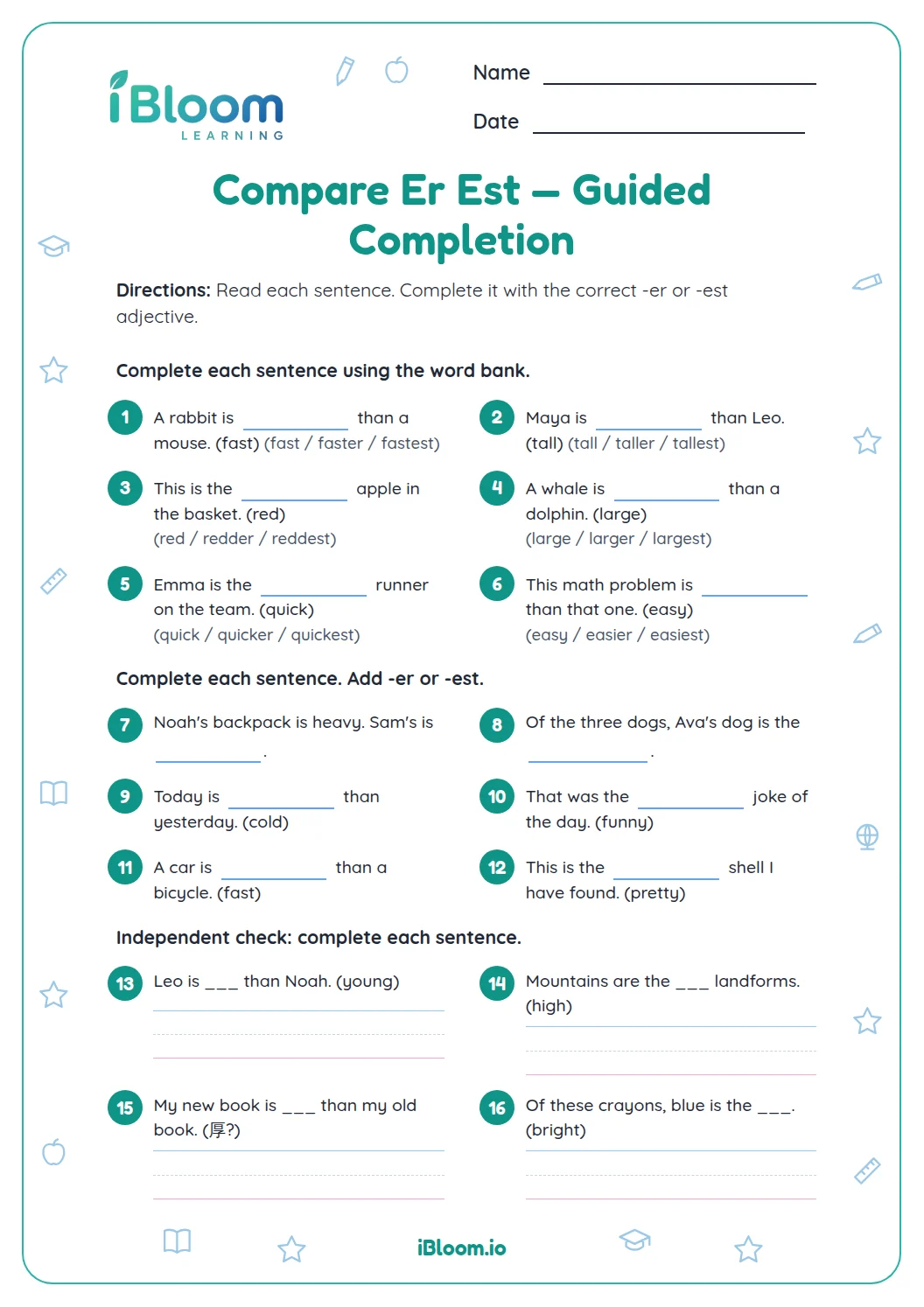
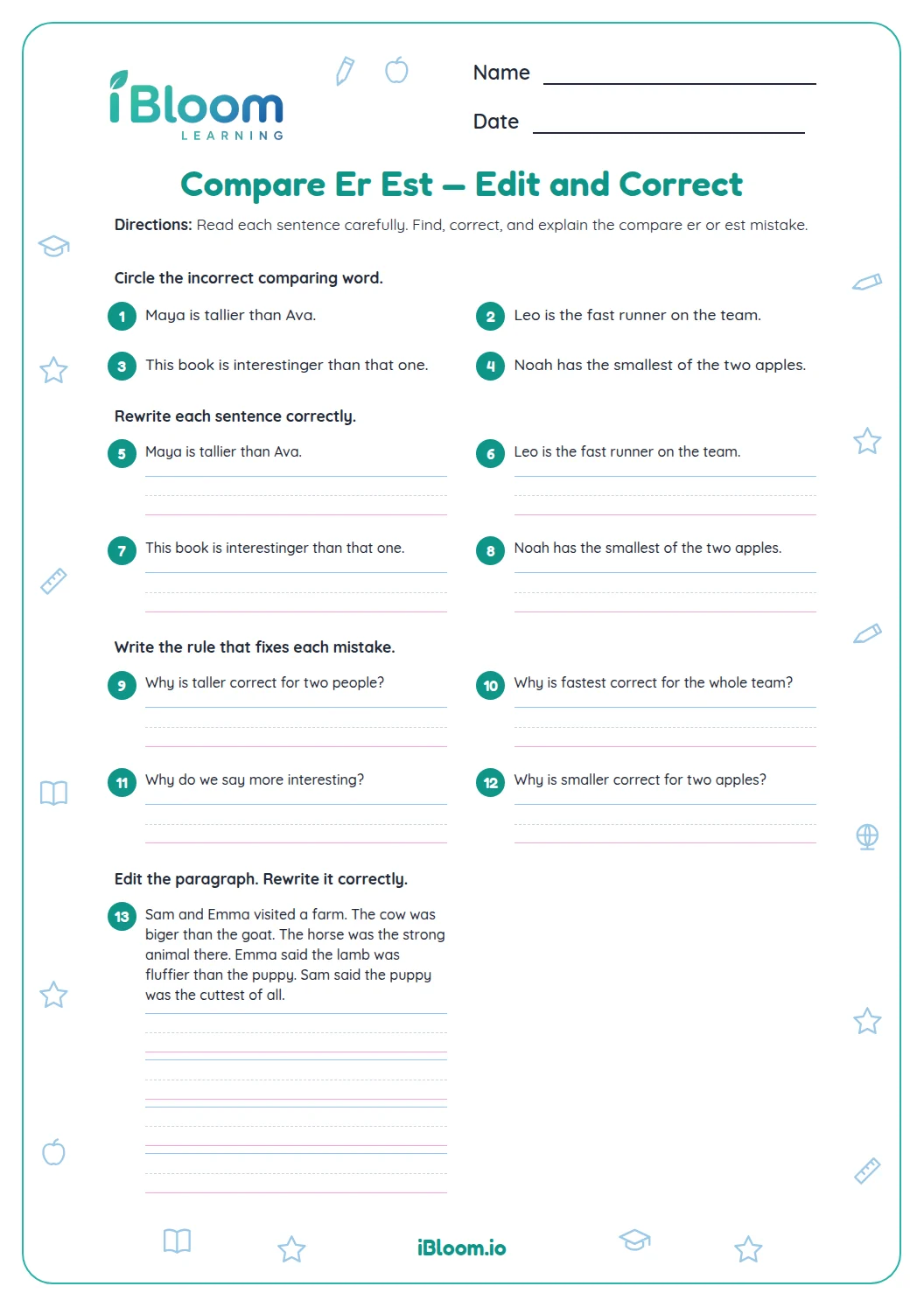
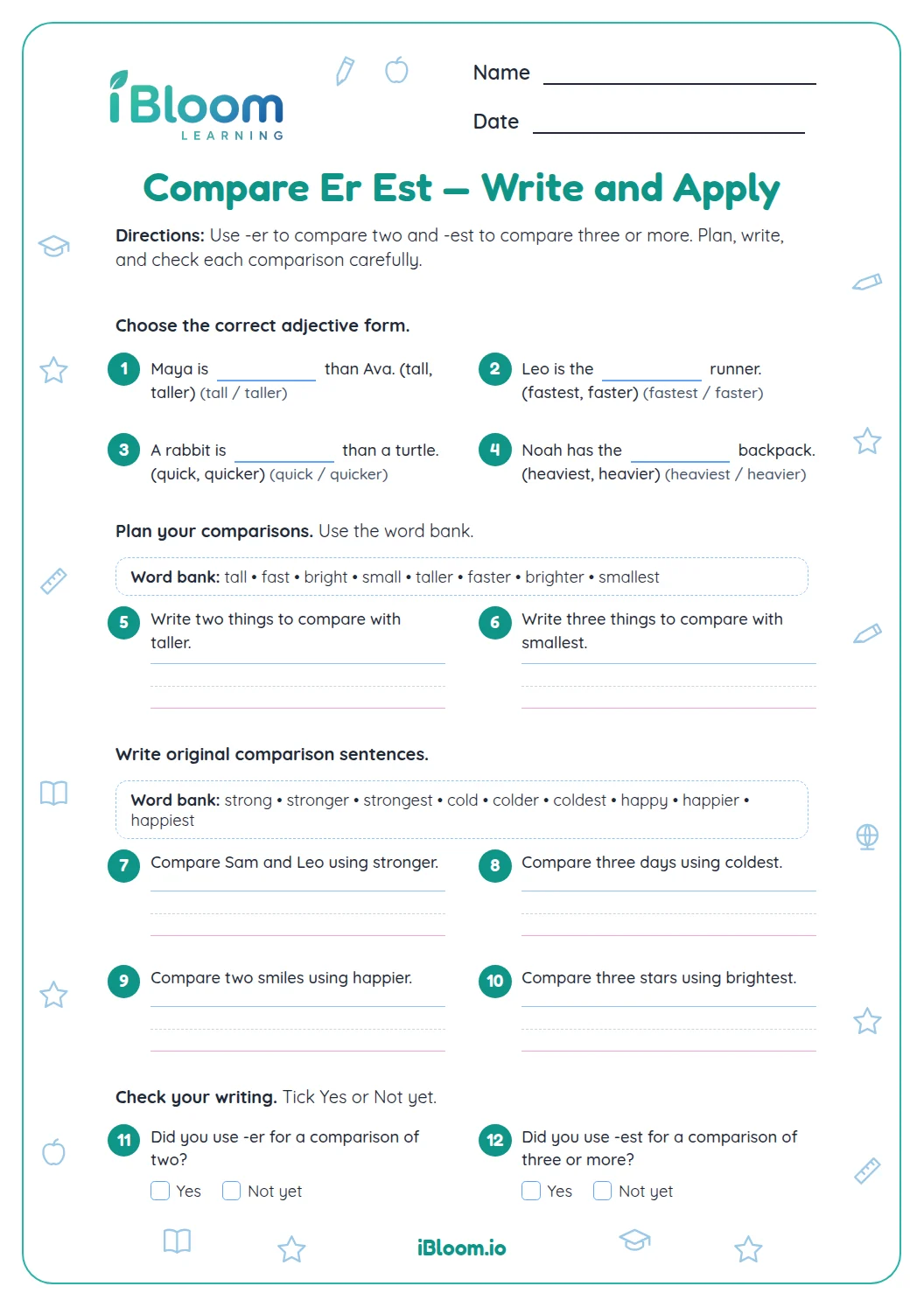
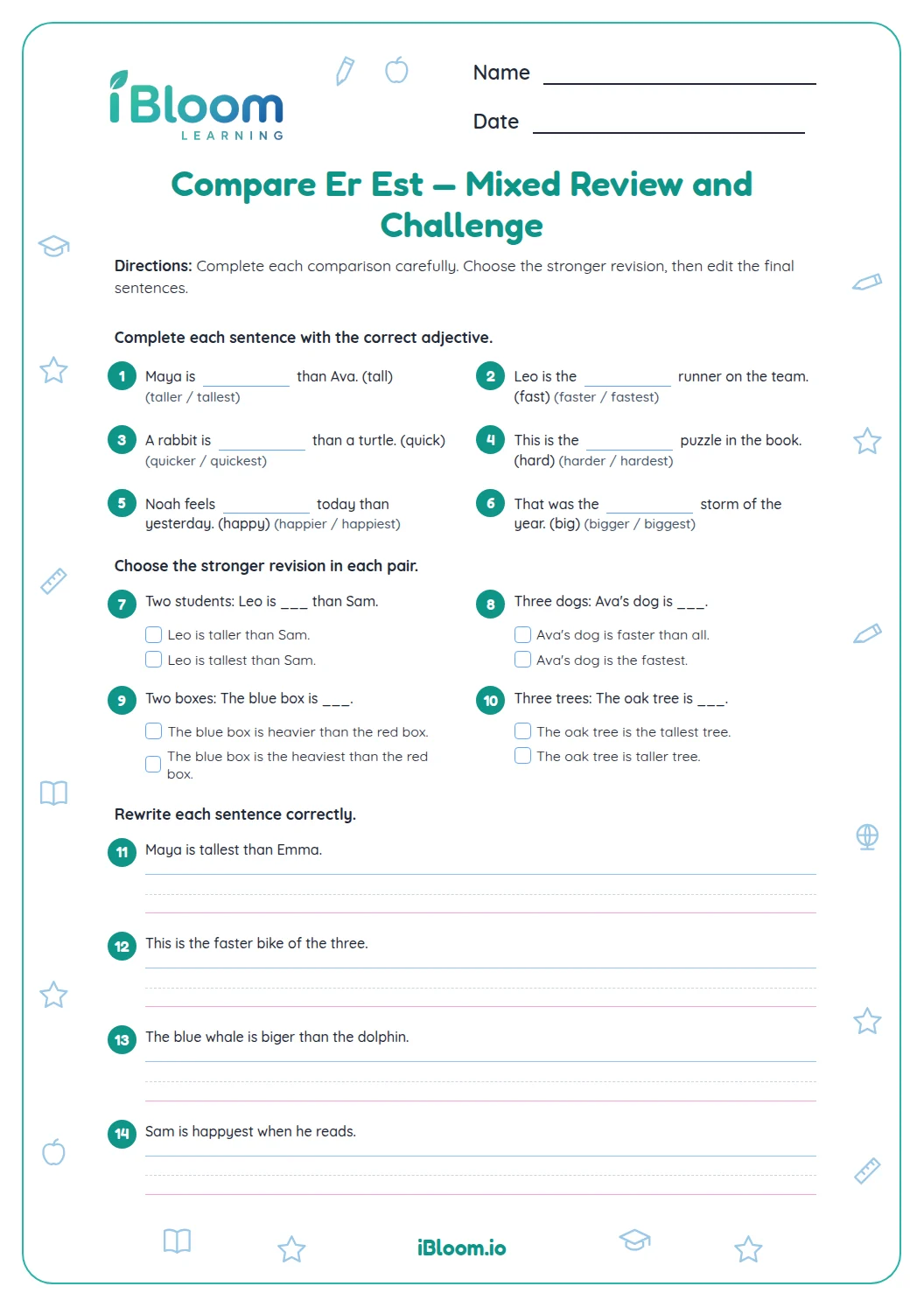
This Grade 3 printable gives 16 sentence-based choices for comparative and superlative adjectives. Students use clues such as “than,” “of the three,” and “of all” to choose -er or -est forms, then check their work with the separate answer key. The practice aligns with CCSS L.3.1.g.
Aligned to L.3.1.g
When does an adjective need -er or -est?
Use a comparative adjective to compare two things: “The kitten is smaller than the puppy.” Use a superlative to compare one thing with a group: “This is the smoothest shell on the beach.” Look for than, of the three, and of all.
- 1The kitten is ___ than the puppy. → smaller
- 2“Than the puppy” compares two, so smaller fits.
What spelling change should I check?
Short adjectives often add -er or -est directly. If an adjective ends in consonant + y, change y to i before adding the ending: funny becomes funniest.
How does the worksheet build practice?
Part A completes comparison sentences with -er or -est. Part B asks one multiple-choice question about which sentence compares three.
How to use this worksheet
- 1Read the entire sentence before filling the blank.
- 2Underline a clue such as “than,” “of the three,” or “of all.”
- 3Decide whether the sentence compares two things or a group.
- 4Check the adjective spelling before adding the ending.
Common mistakes and quick fixes
The mistake
Using -est to compare two things.
The fix
Use -er when the sentence compares two things.
The mistake
Using -er for one item compared with a group.
The fix
Look for “of all” or “of the three” and use the superlative form.
The mistake
Writing funnyest.
The fix
For an adjective ending in consonant + y, change y to i before adding -est: funniest.
Curriculum alignment
This worksheet connects focused practice to the following standard.
Form and use comparative and superlative adjectives in complete sentences.
On this sheet: Students choose and use -er and -est adjectives in sentence contexts.
Show the official wordingHide the official wording
Form and use comparative and superlative adjectives and adverbs, and choose between them depending on what is to be modified.
What to practice next
Make more practice
Further reading
Questions parents and teachers ask
When do I use -er or -est?
Use -er to compare two things, as in “The kitten is smaller than the puppy.” Use -est to compare one thing with a group, as in “the smoothest shell.” The worksheet gives 15 sentence blanks and one choice question, with a separate answer key.
How many questions are on this printable?
There are 16 questions in two parts. Part A has 15 sentences to complete with a comparative or superlative adjective. Part B asks which of three sentences compares three things. The answer key is printed separately. The answer key is printed separately for checking.
Does every adjective just add -er or -est?
No. Many short adjectives add the ending, but spelling can change. For an adjective ending in consonant plus y, change y to i before adding -er or -est: funny becomes funnier or funniest. Read the complete word after changing it.
What clues help choose the form?
Words such as “than” usually signal a comparison between two things, so look for -er. Phrases such as “of the three” and “of all” compare one item with a group and point to -est. Read the whole sentence before filling the blank.
How can I check the answers?
Use the separate key after completing the page. If an answer differs, reread the comparison clue and decide whether it refers to two things or a group. Then check the adjective spelling, especially words that change y to i before the ending.