





About this worksheet
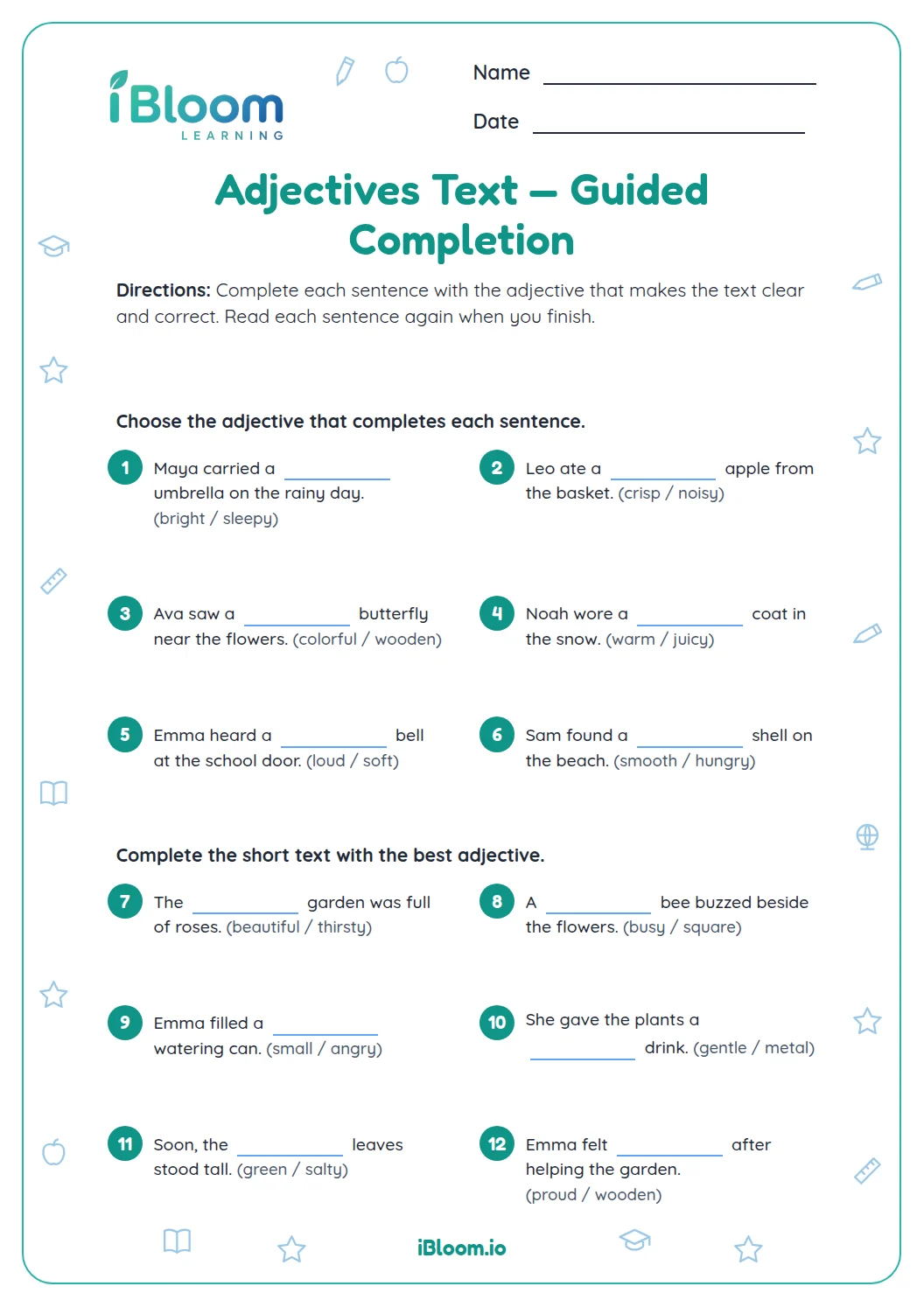
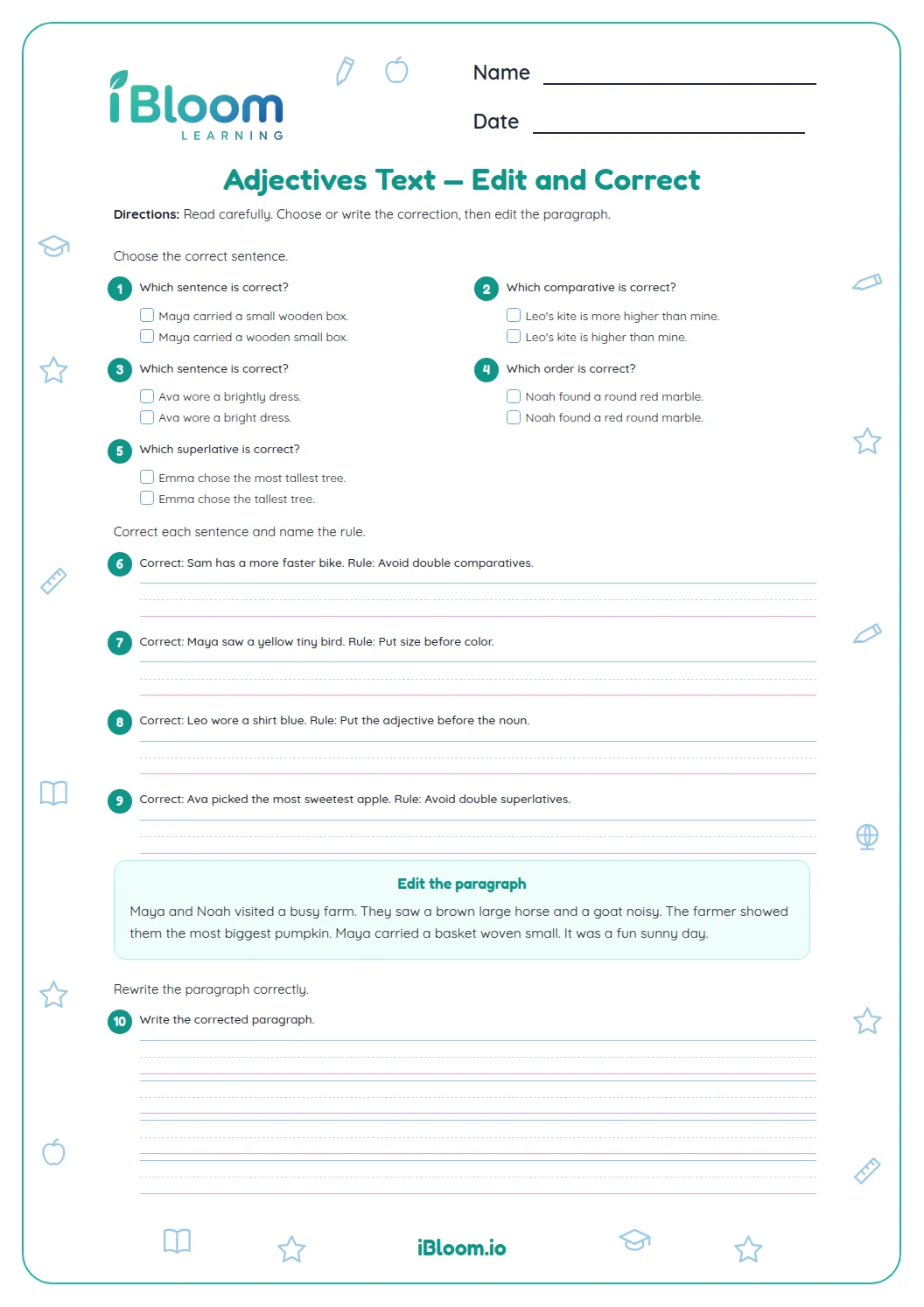
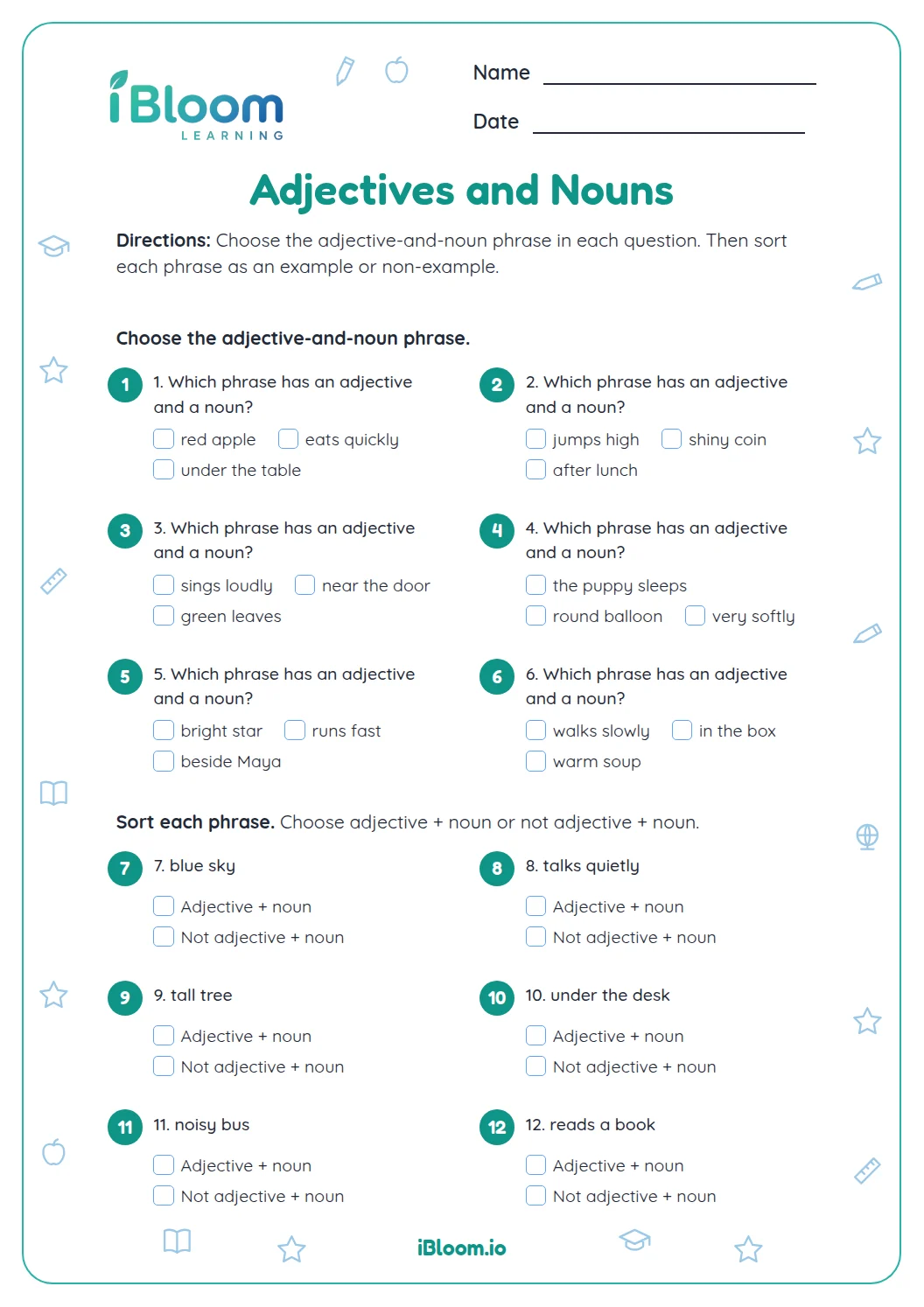
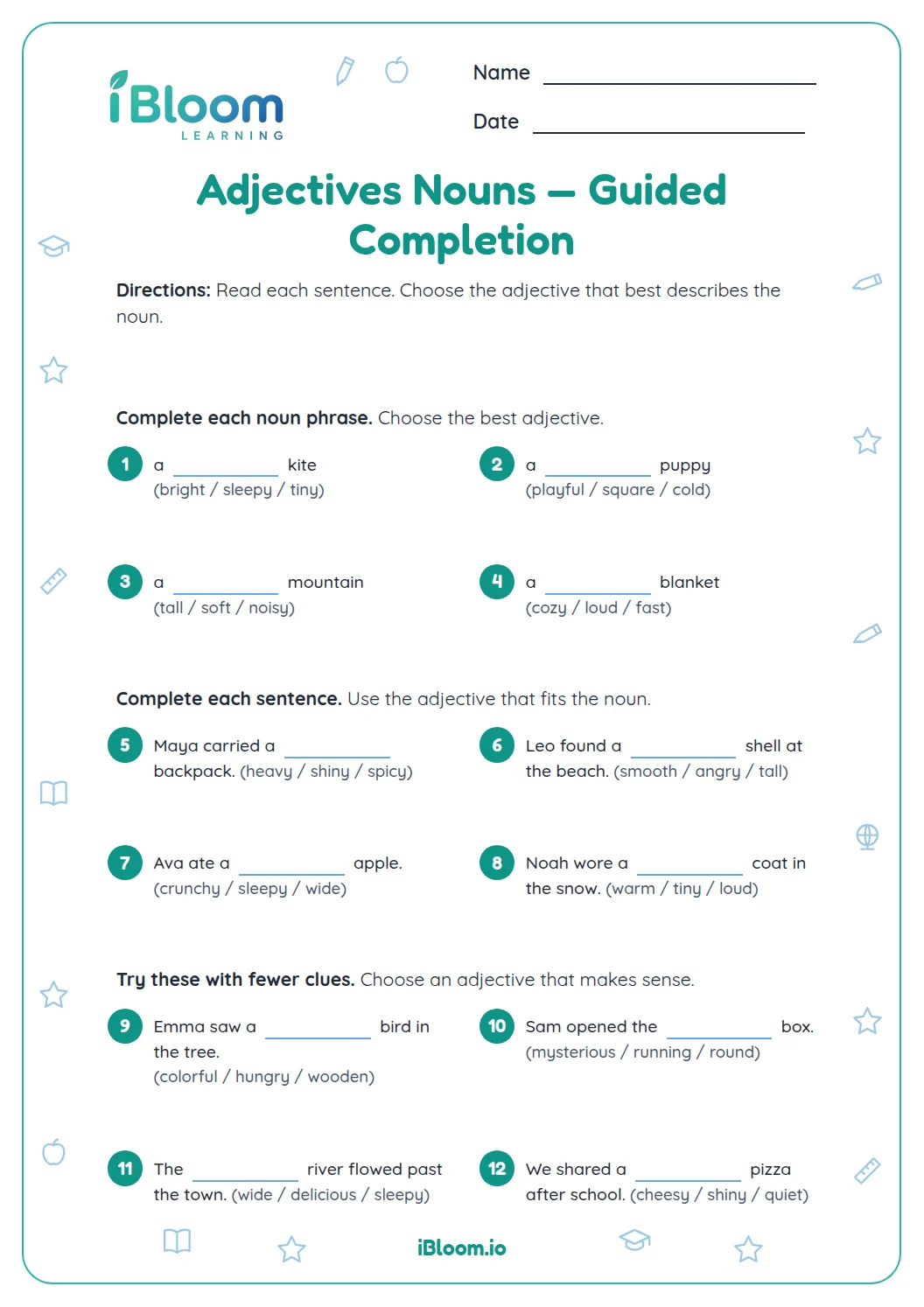
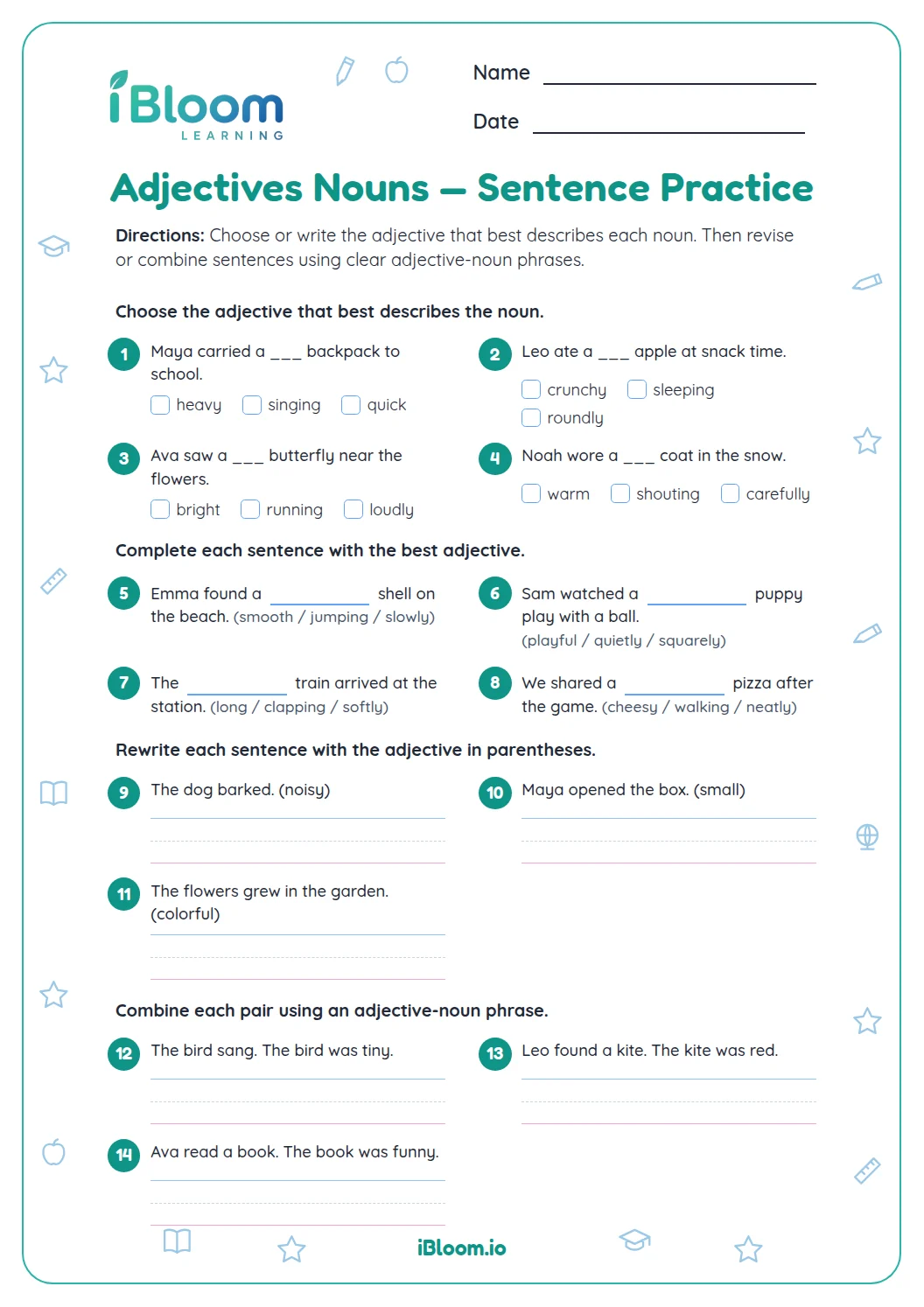
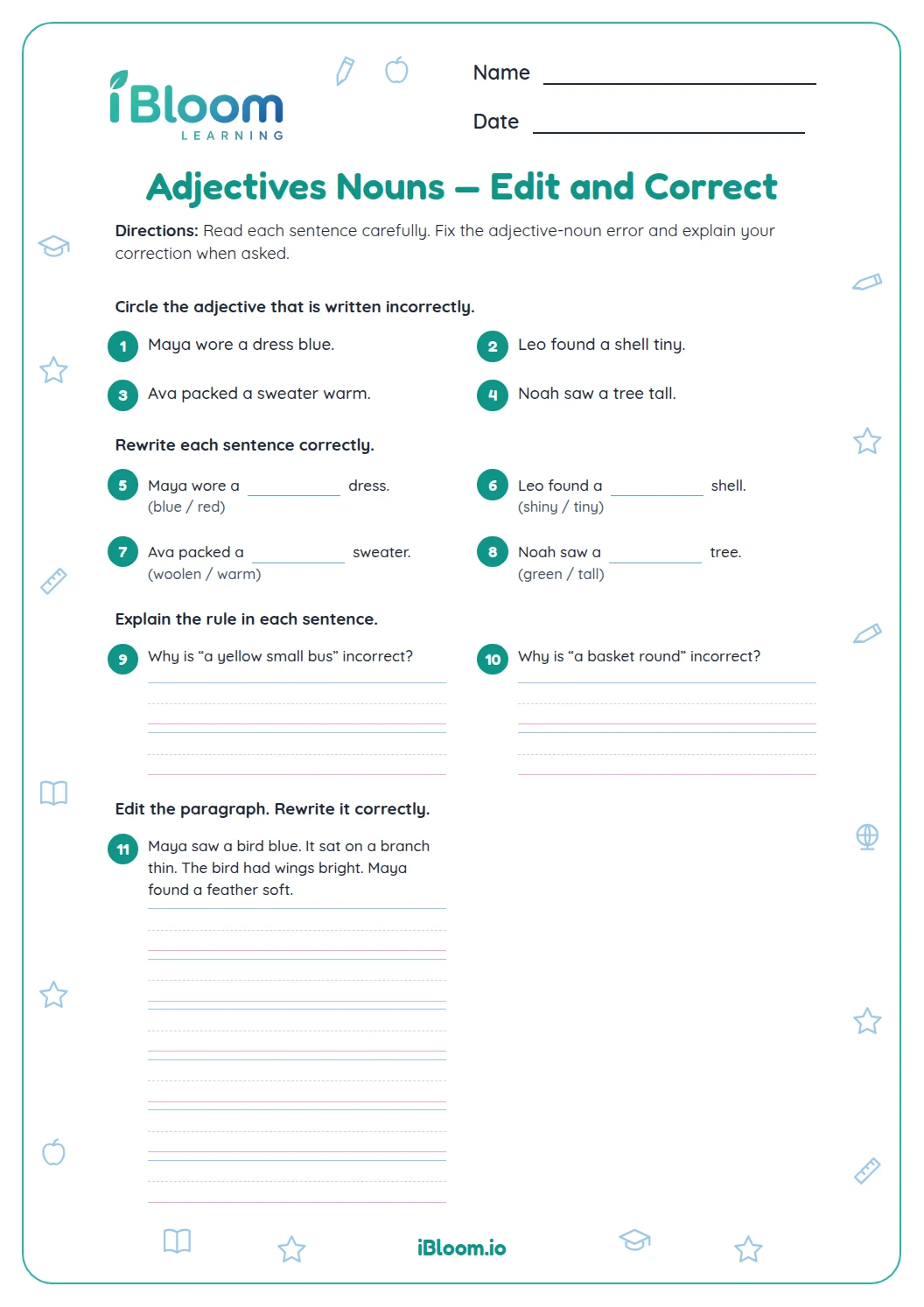
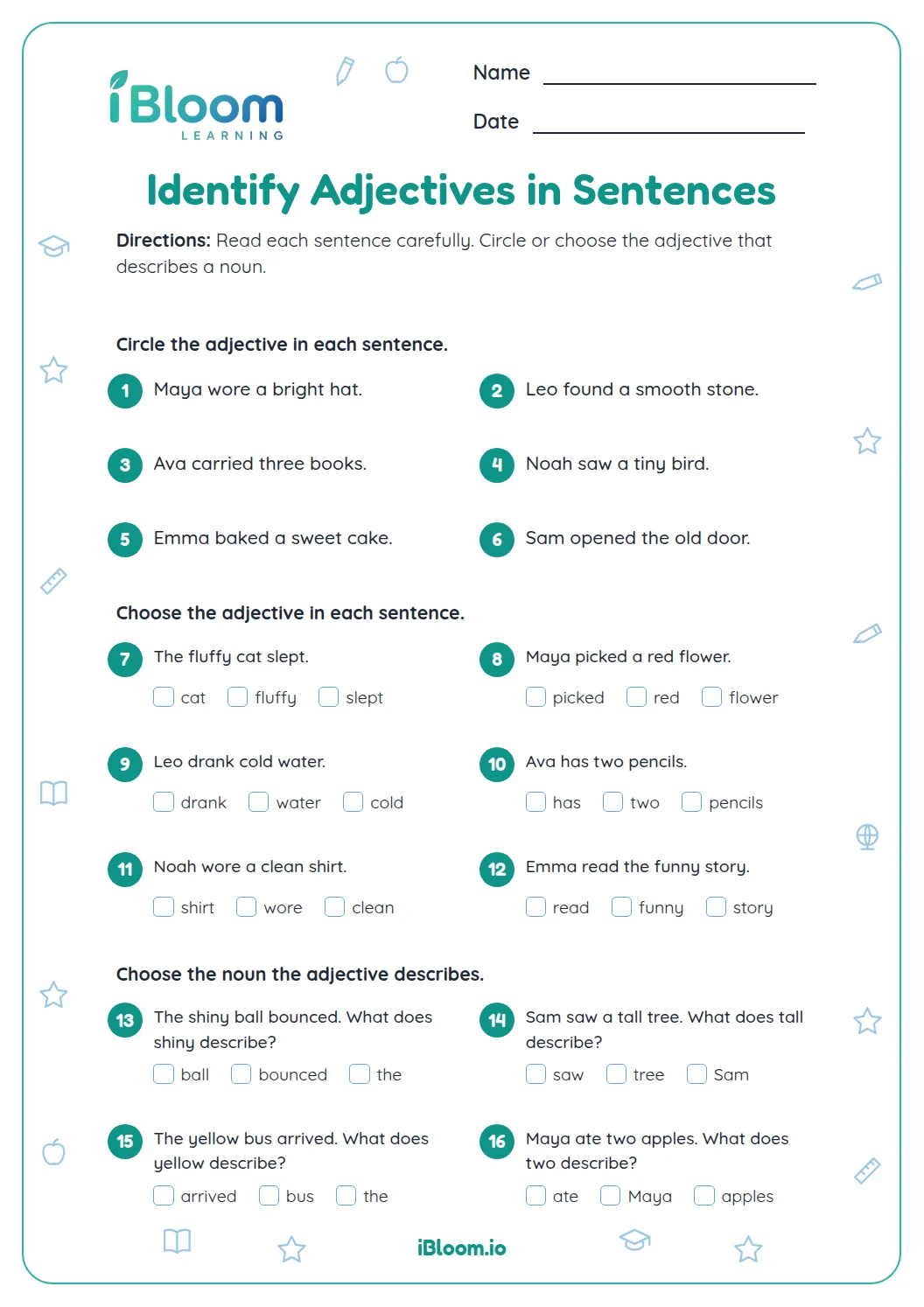
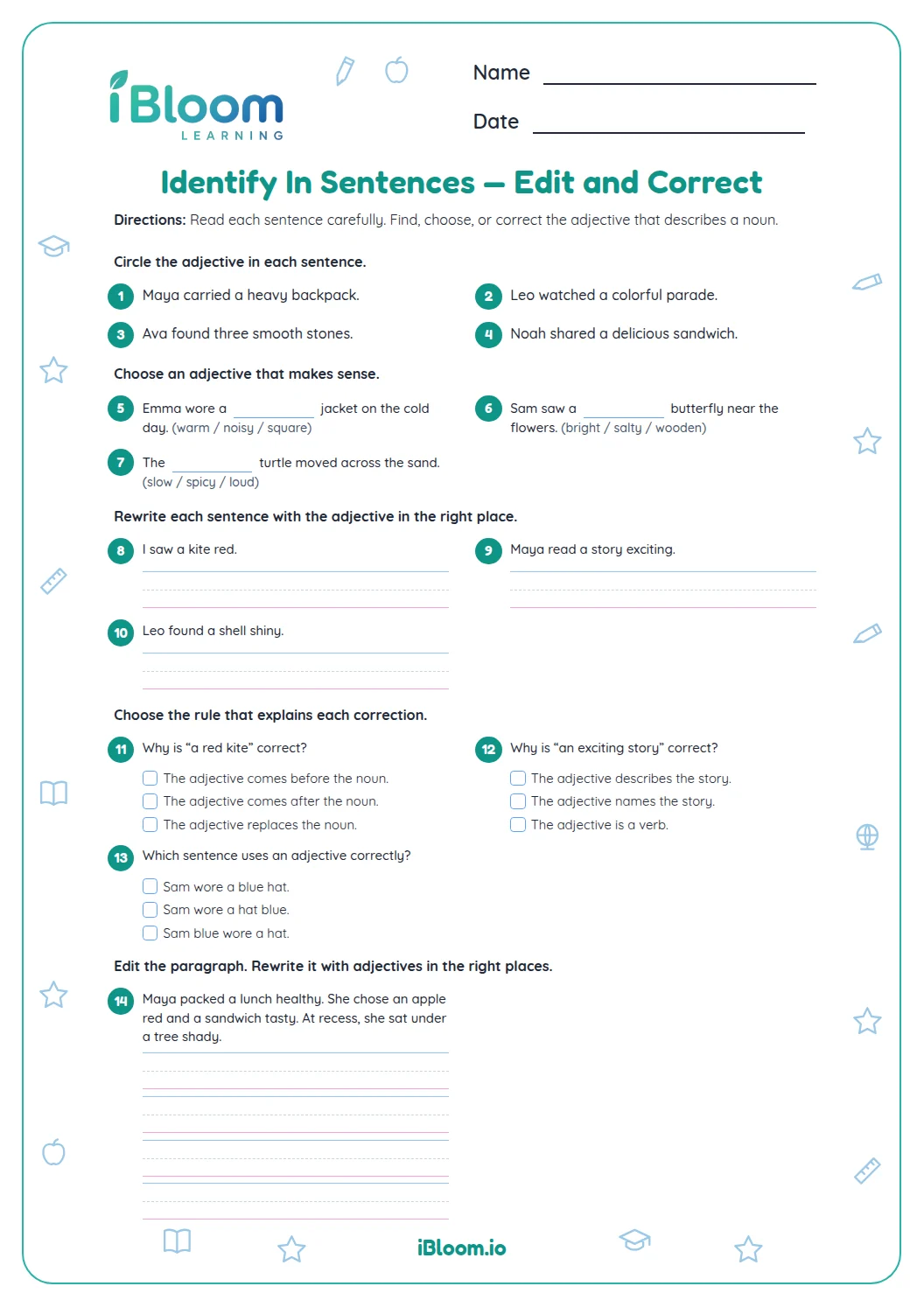
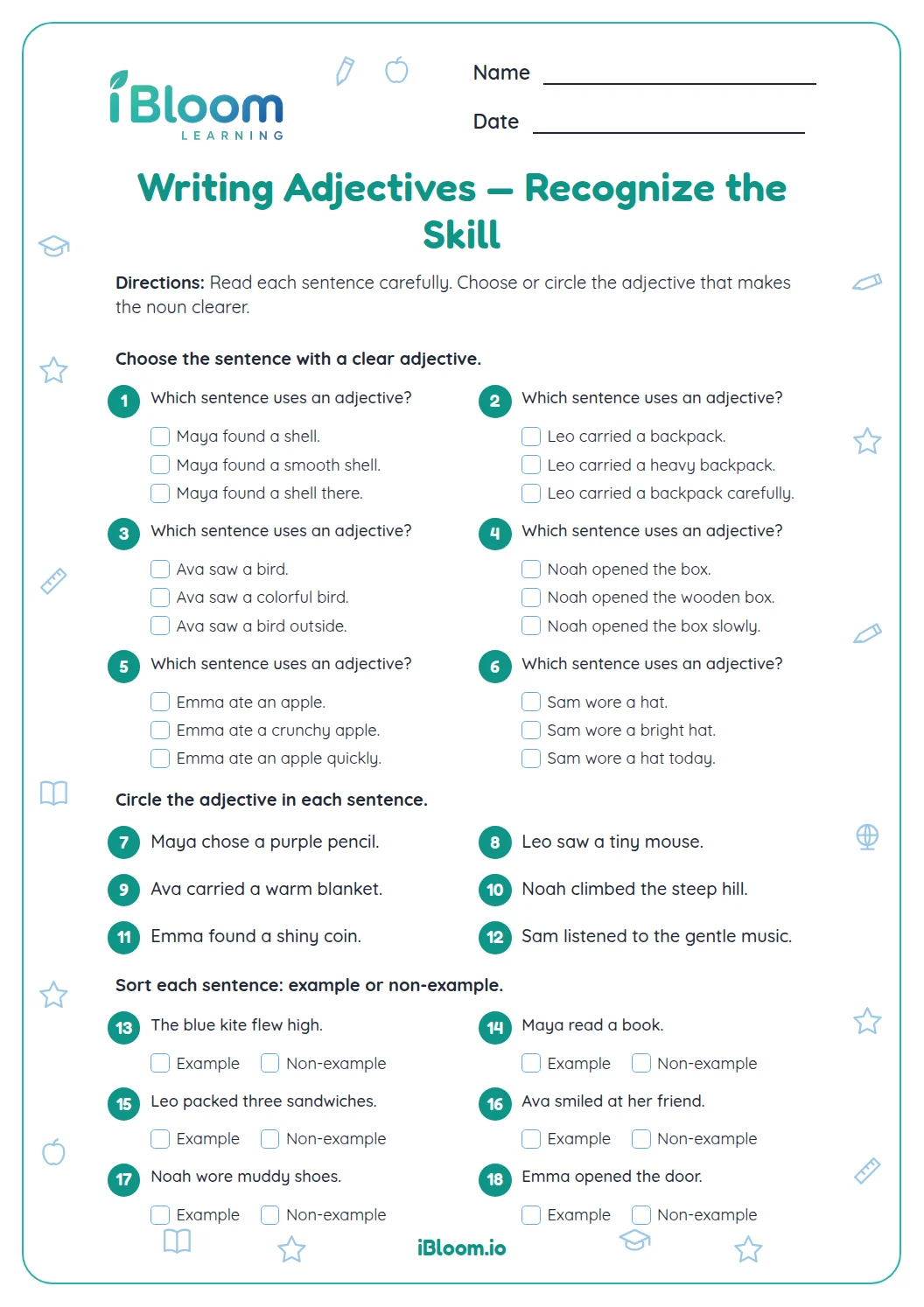
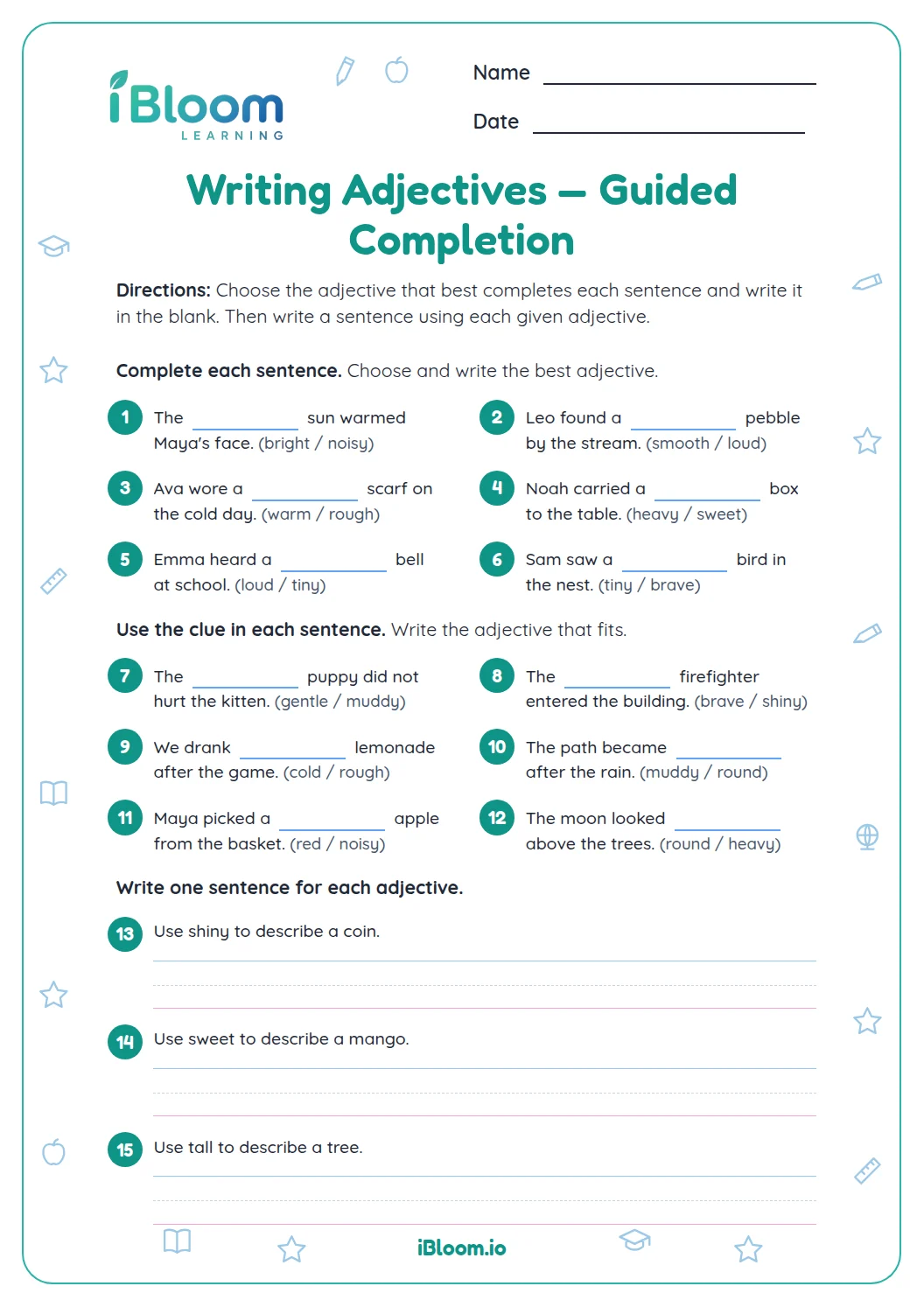
This free Grade 3 printable gives students 14 questions about adjectives in sentences. Learners circle describing words, choose adjectives that fit context clues, and compare revisions with precise details. The sequence follows the saved sheet’s identification, sentence completion, and revision approach, with a mixed review of how adjectives describe nouns. It practices Common Core L.3.1a and includes a separate answer key.
Aligned to L.3.1a
What does an adjective describe?
An adjective gives information about a noun, such as its size, color, or quality. In “The tiny mouse crossed a bridge,” tiny describes mouse. The first part asks students to circle the adjective in each short sentence.
- 1The tiny mouse crossed a bridge.
- 2Mouse is the noun.
- 3Tiny describes the mouse, so circle tiny.
How can a sentence clue help you choose an adjective?
Read the full sentence and look for a detail that points to a fitting description. In “The ___ blanket kept Ava warm,” soft fits the clue. The choices that do not describe a blanket in this situation can be ruled out.
How do adjectives make a sentence more precise?
A general noun can leave the reader with little detail. Adding a useful adjective can show color, size, texture, or another relevant feature. The final five questions ask learners to compare sentence revisions and notice which detail helps the reader picture the noun.
How to use this worksheet
- 1Read each sentence before marking a word.
- 2Find the noun being described.
- 3Use the sentence clue to choose a fitting adjective.
- 4Compare revisions and notice which details they add.
- 5Write your own sentence with specific adjectives.
- 6Check written answers against the key’s sample, allowing other clear answers.
Mistakes to check
The mistake
Circling a noun instead of the adjective.
The fix
Ask what the sentence says about the noun; circle the describing word.
The mistake
Choosing an adjective that does not fit the sentence clue.
The fix
Read the sentence with each choice and keep the one that makes sense.
The mistake
Adding details that do not help the reader picture the noun.
The fix
Choose a relevant feature, such as color, size, texture, or condition.
Curriculum alignment
Explain how adjectives work in sentences and what they describe.
On this sheet: Students identify adjectives in sentences, connect them to nouns, and use them to add precise details.
Show the official wordingHide the official wording
Explain the function of nouns, pronouns, verbs, adjectives, and adverbs in general and their functions in particular sentences.
What to practice next
Make more practice
Further reading
Questions parents and teachers ask
What is an adjective?
An adjective describes a noun by telling more about it, such as its color, size, or quality. In “The tiny mouse crossed a bridge,” tiny describes mouse. The first part of this worksheet asks students to find and circle an adjective in each sentence.
How do sentence clues help choose an adjective?
Read the full sentence and use its meaning to choose a description that fits. In “The ___ blanket kept Ava warm,” soft fits the clue. The worksheet gives three choices for each context question, with one word that makes sense in the sentence.
How many questions are on the adjective worksheet?
There are 16 questions across the worksheet pages, followed by an answer key. Four ask students to circle adjectives, five use sentence clues, four compare sentence revisions, and three ask for a written explanation or improved sentence The page’s worked examples and answer key help learners review the steps and check their responses after completing each section.
Can more than one adjective fit a sentence?
In everyday writing, many adjectives might describe the same noun. These multiple-choice questions include a sentence clue and choices designed to point to one best answer. For the open writing prompts, the answer key gives a sample; other clear, grammatical responses can also work.
What does “more precise” mean in the revision questions?
A more precise sentence gives the reader useful detail. “The girl wore a dress” is general; “The girl wore a sparkly blue dress” tells what the dress looked like. The worksheet asks learners to recognize and create revisions with describing words.
How many questions are on the worksheet?
There are 14 questions across the worksheet pages, followed by a separate answer key. Four items ask students to circle adjectives, five use sentence clues, and five compare clearer revisions. Plan about 20 minutes for reading, choosing, and checking the full set.