



About this worksheet
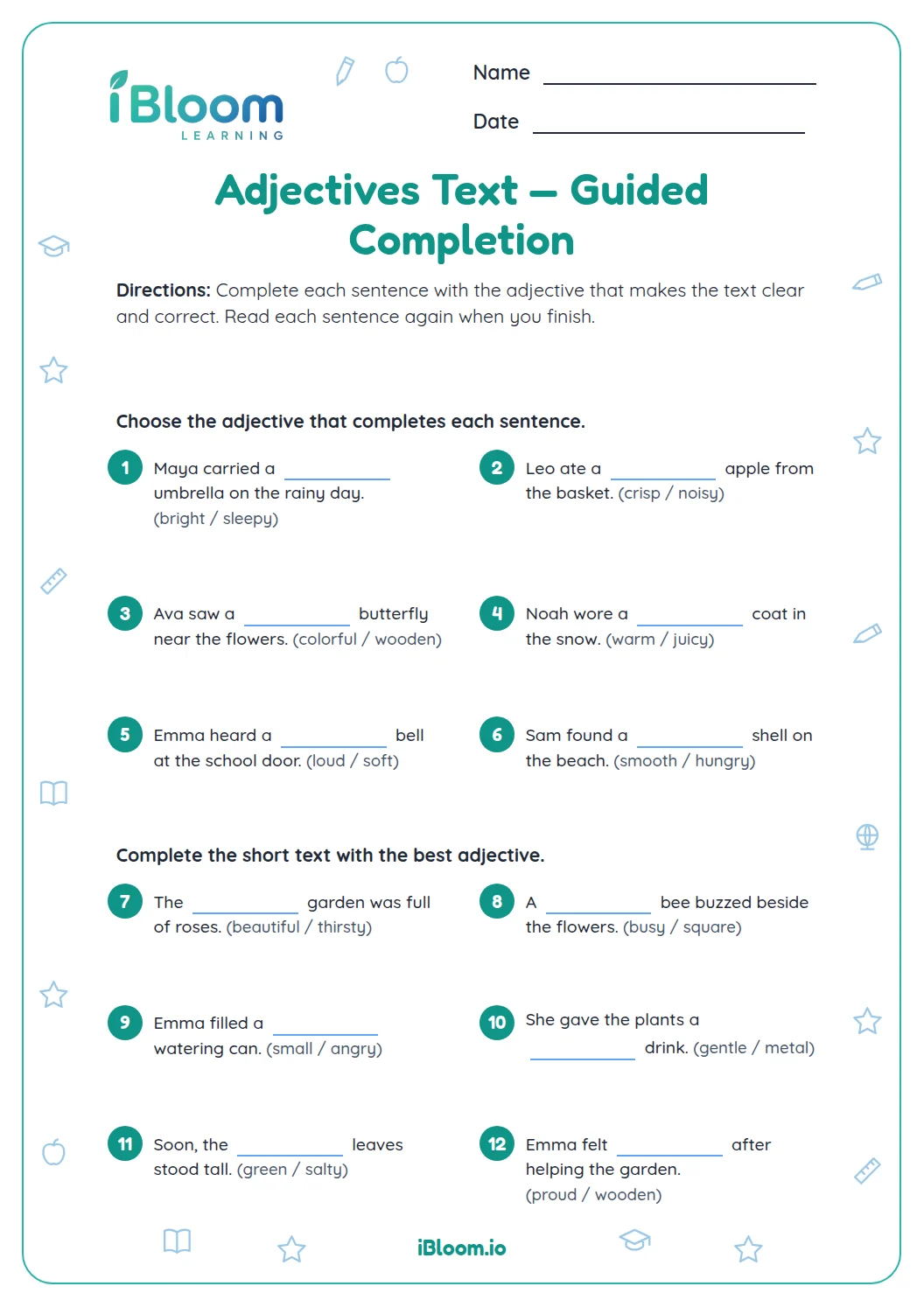
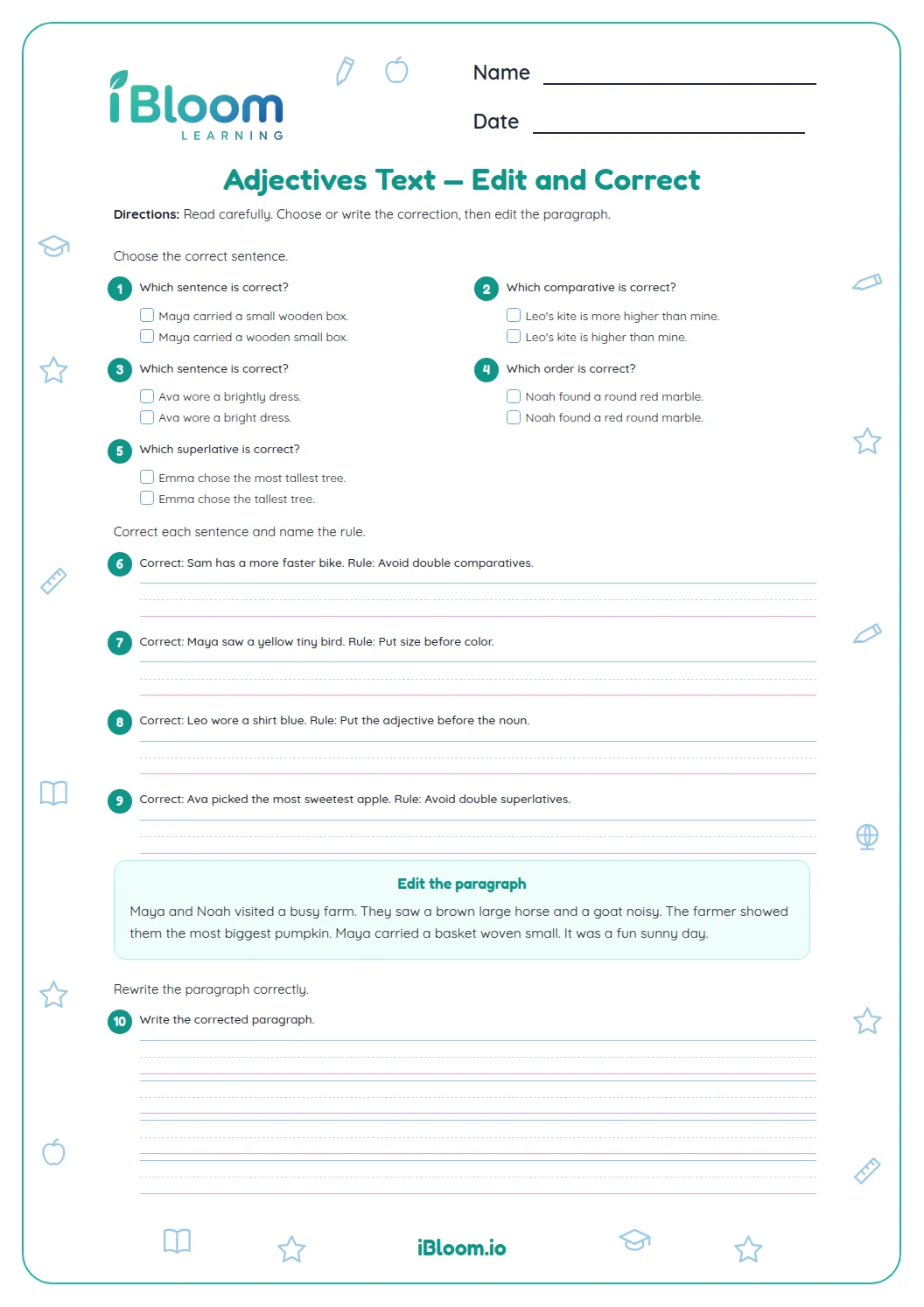
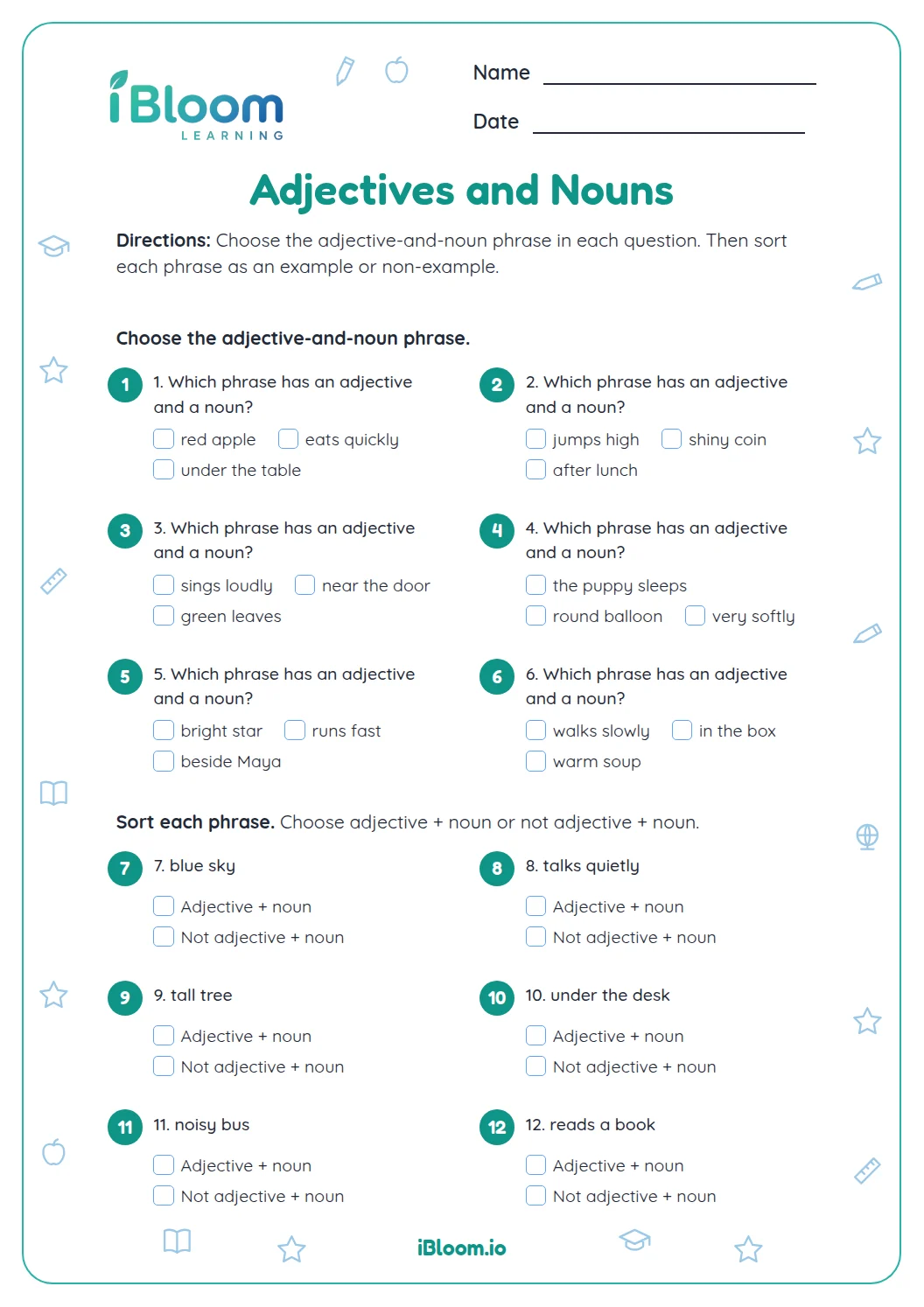
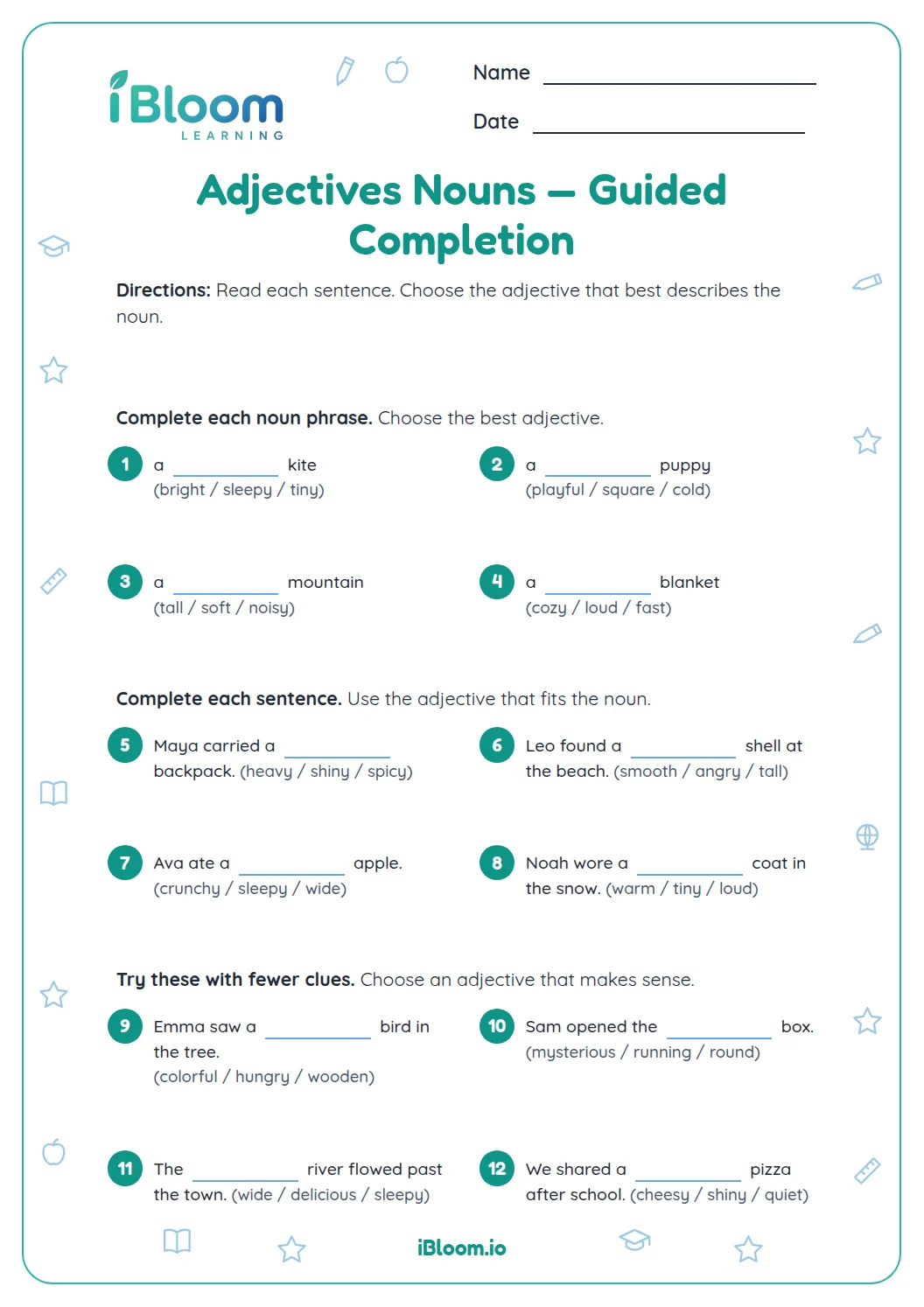
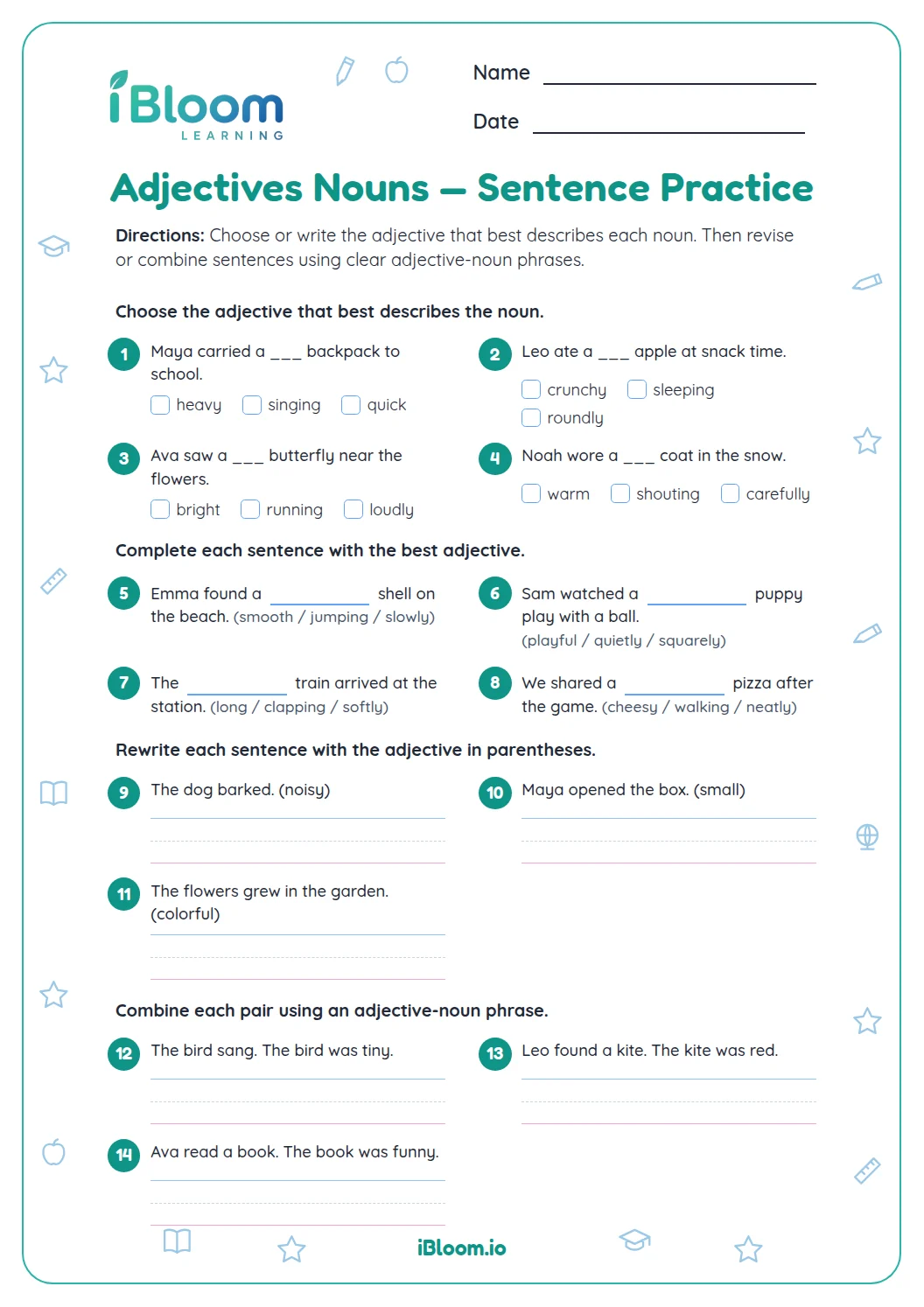
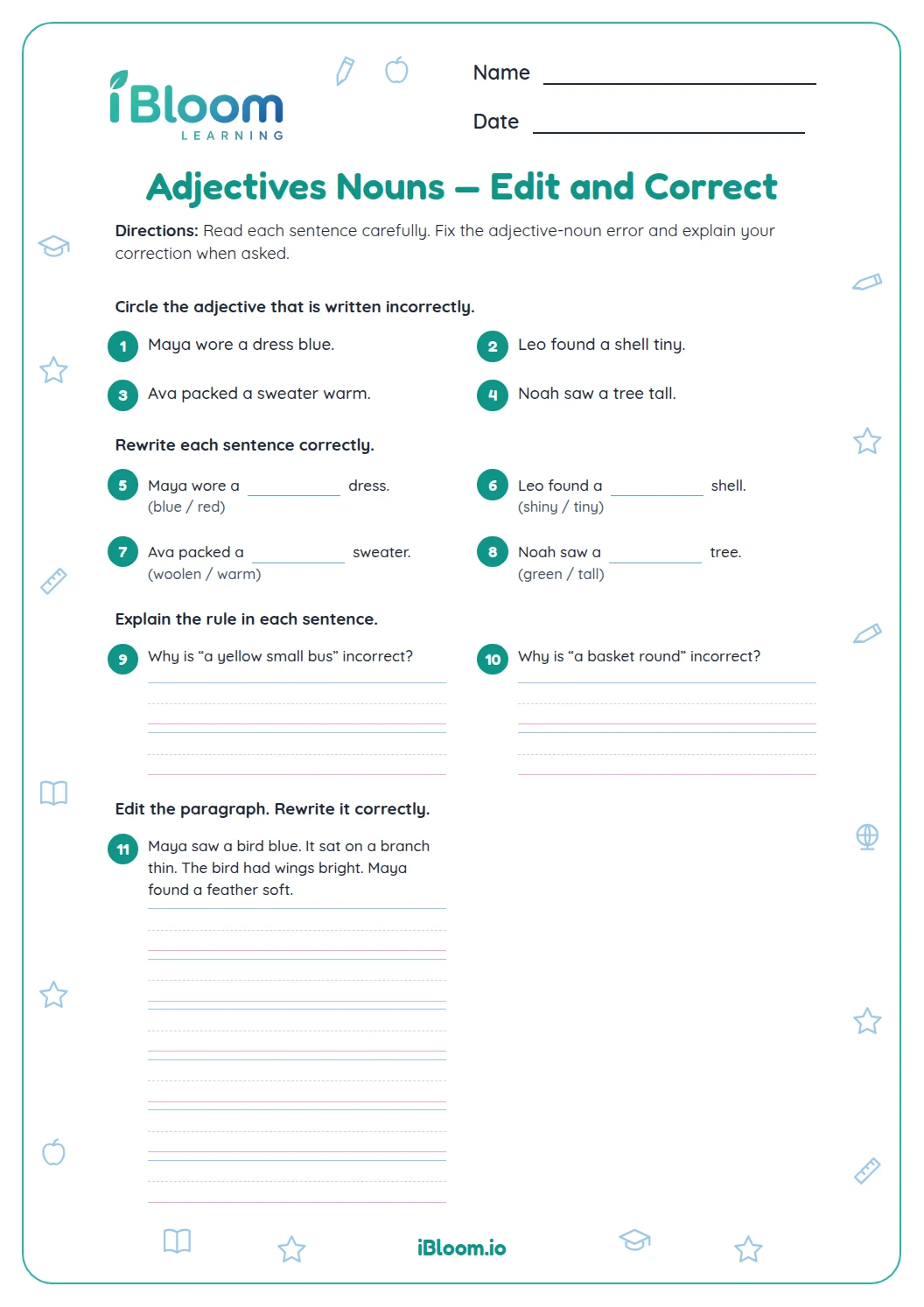
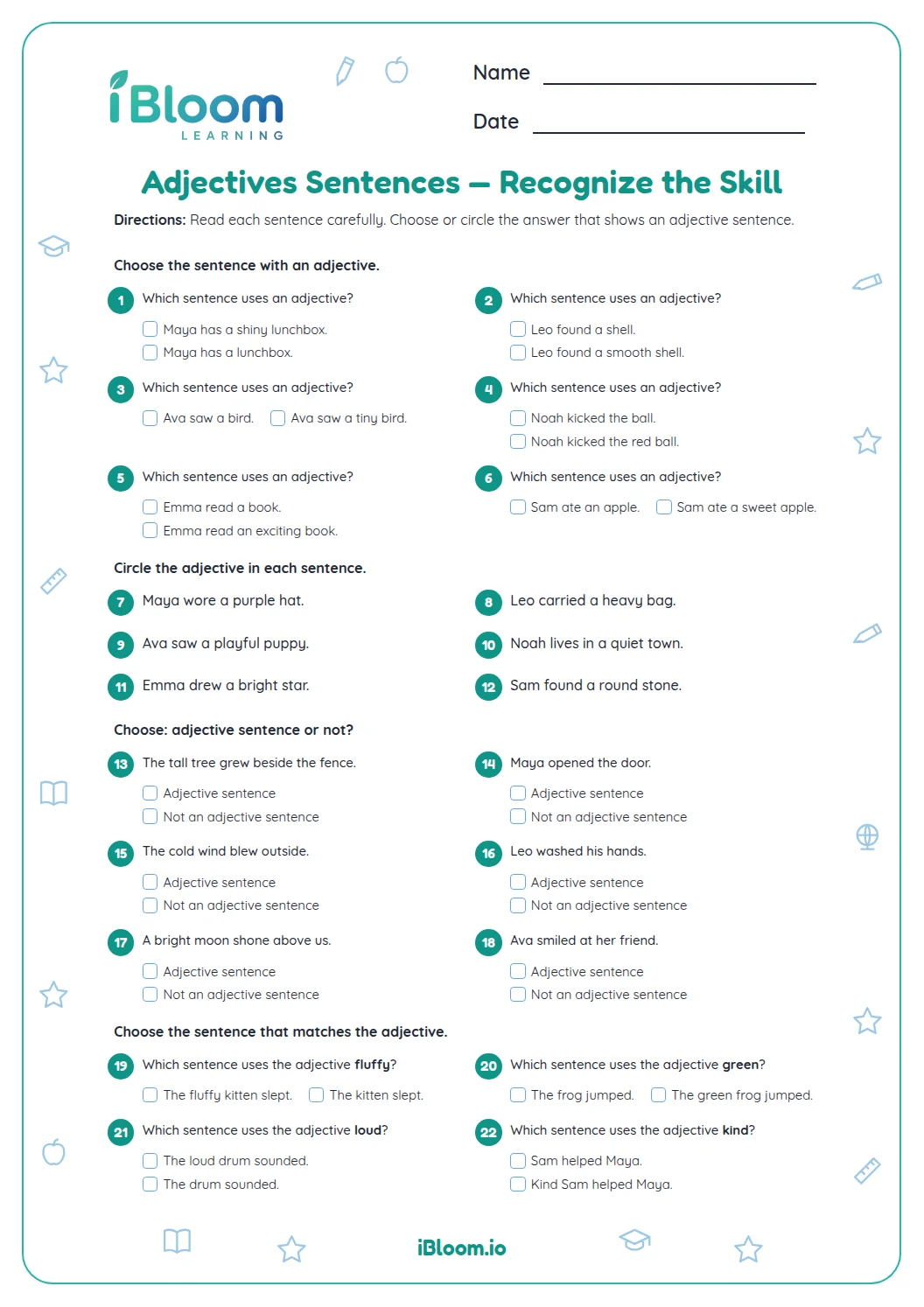
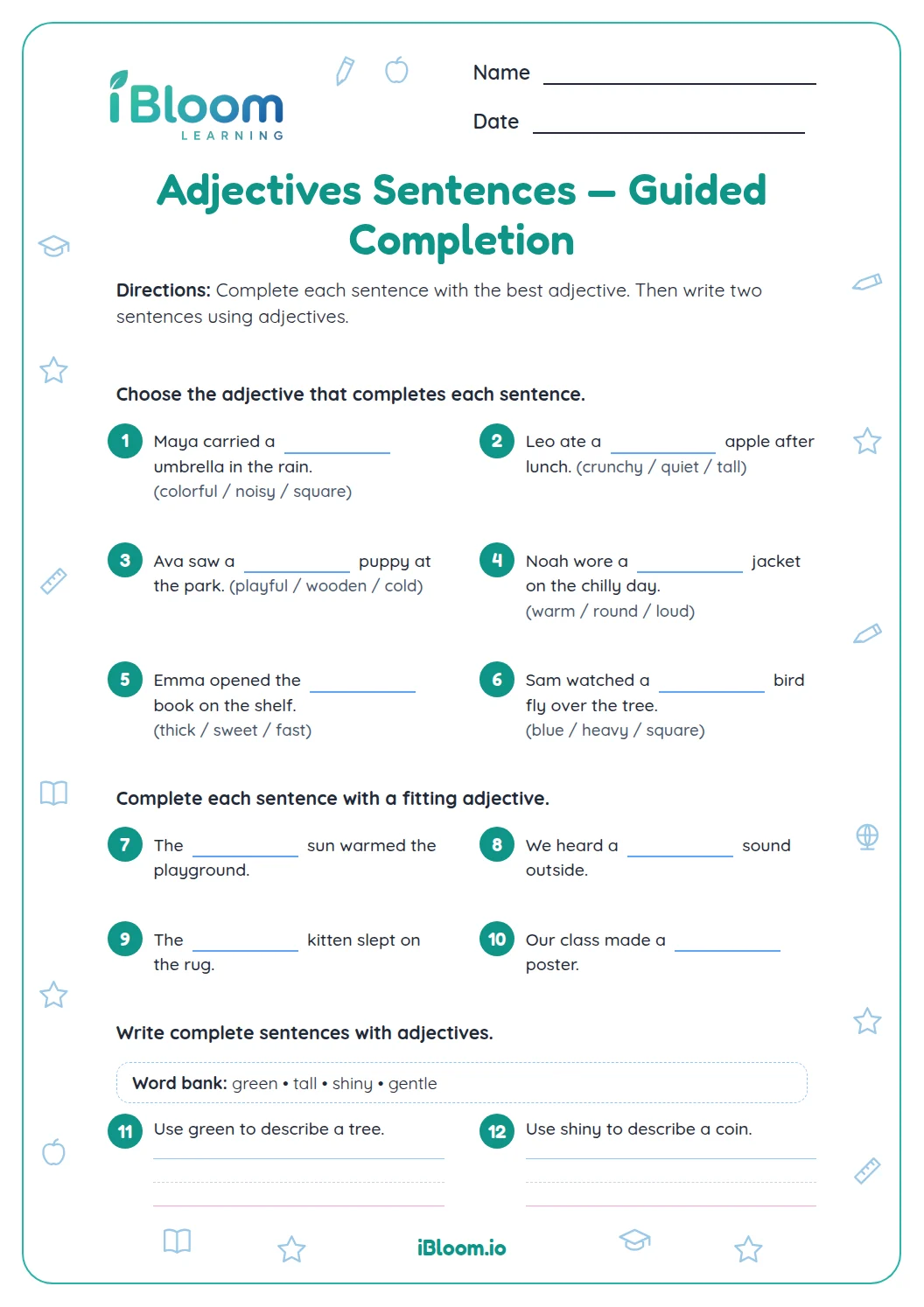
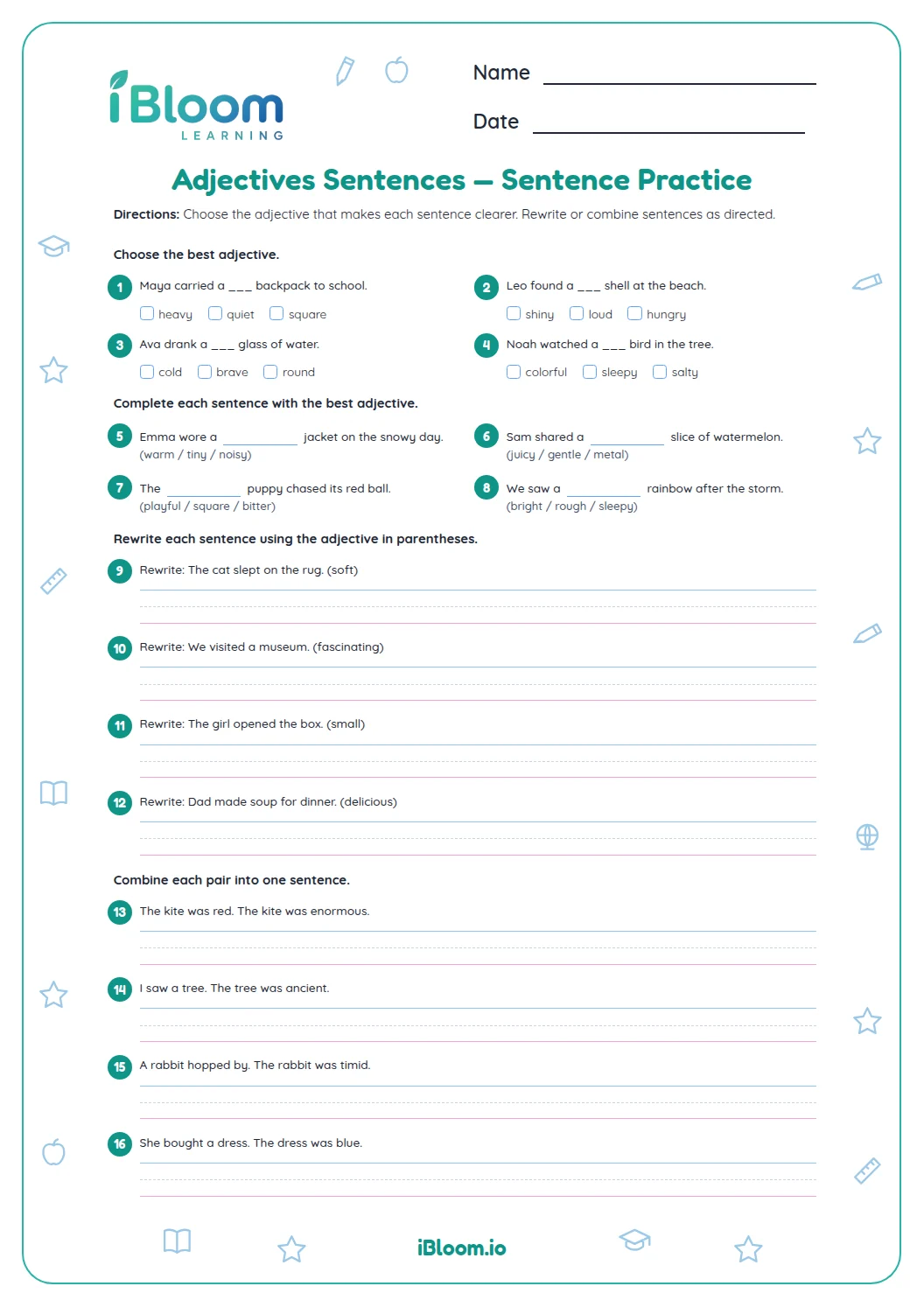
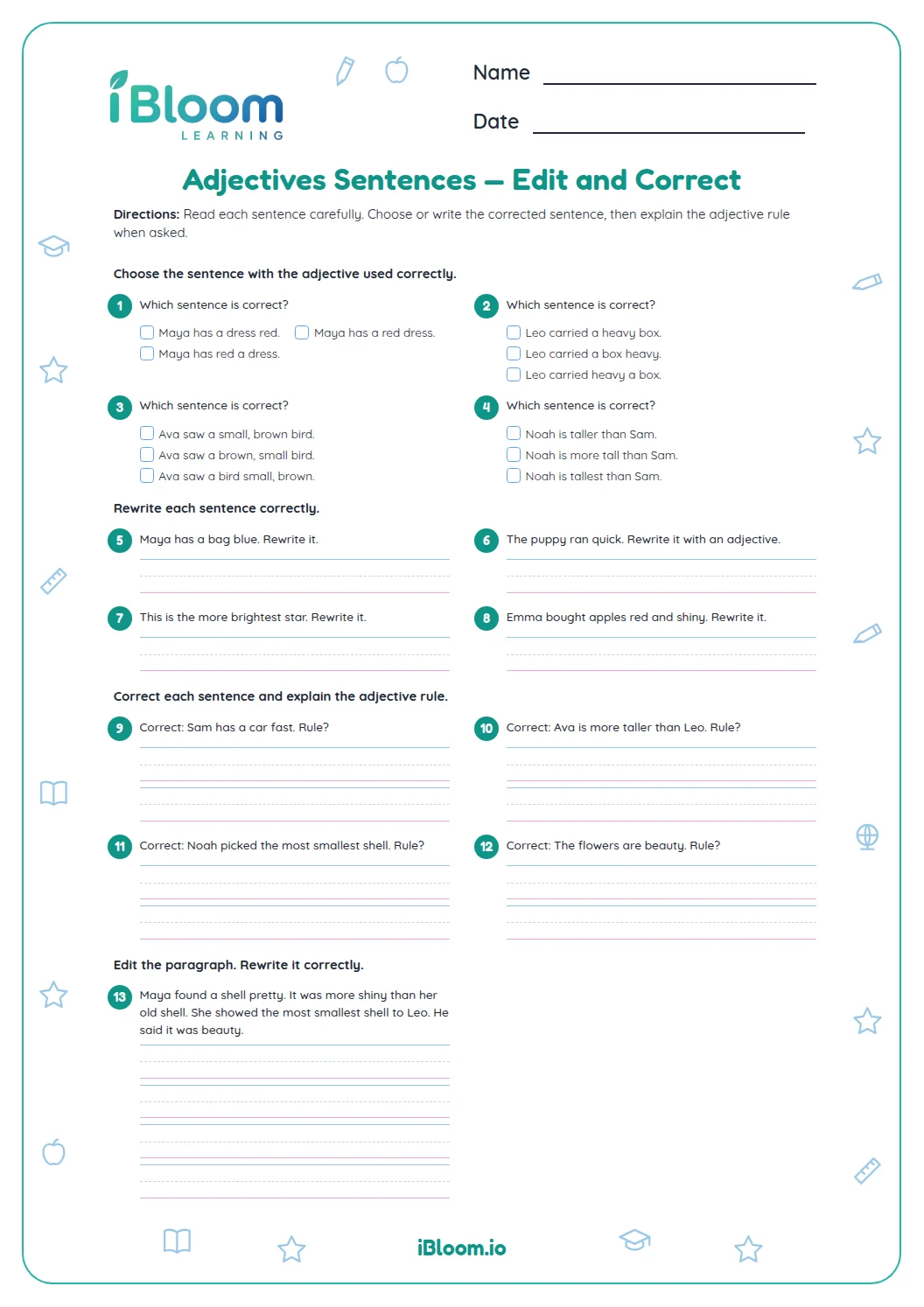
This Grade 3 worksheet practices adjectives in garden sentences. Students complete short context sentences with describing words, then write one sentence using two adjectives. The 14 questions use compact response spaces, with sample answers in the separate key.
Aligned to L.3.1.a
How can you find the adjective in a sentence?
Find the noun named in the question, then look for the word that describes it. In question 1, seed is the noun and tiny tells what kind of seed it is. The answer is tiny.
- 1The tiny seed rested in the soil.
- 2Which word describes seed?
- 3Answer: tiny
How do sentence clues help you choose an adjective?
The adjective should make sense with the noun and the rest of the sentence. In question 8, a watering can can be heavy; “carried” is an action and “carefully” tells how someone carried it, so neither fits the blank as an adjective.
How can adjectives make a sentence more precise?
Choose a word that gives the reader a clearer detail. Instead of “a nice flower,” a writer might say “a fragrant flower” or “a bright flower.” In your own sentence, check that each adjective describes a noun.
How to find and use adjectives
- 1Read the whole sentence before choosing a word.
- 2Identify the noun named in the prompt.
- 3Ask which word describes that noun.
- 4For a blank, check that the adjective fits both the noun and the sentence meaning.
- 5When writing, choose details that help the reader picture the noun.
- 6Reread your sentence to make sure each adjective has a noun to describe.
Common adjective mix-ups
The mistake
Choosing an action word such as “buzzed” to describe bee.
The fix
Ask what kind of bee it is; choose a describing word such as yellow.
The mistake
Choosing an adverb such as “carefully” before a noun.
The fix
Use an adjective that describes the noun, such as a heavy watering can.
The mistake
Adding a describing word that does not fit the sentence.
The fix
Reread the whole sentence and check the meaning with the noun.
Common Core alignment
Students identify adjectives in sentences and consider how they describe nouns.
Identify adjectives in sentences and explain how they describe nouns.
On this sheet: The first parts ask students to identify adjectives and choose words that describe sentence nouns.
Show the official wordingHide the official wording
Explain the function of nouns, pronouns, verbs, adjectives, and adverbs in general and their functions in particular sentences.
What to practice next
Make more practice
Further reading
Questions parents and teachers ask
What is an adjective?
An adjective is a word that describes a noun. In “The tiny seed rested in the soil,” tiny describes the seed. The first part of this worksheet asks children to find adjectives that tell what a named noun is like.
How many questions are included?
There are 14 questions: short sentences to complete with fitting adjectives and one prompt to write a sentence using two adjectives. The separate answer key gives the expected words and a sample sentence. Other adjectives are acceptable when they describe the named person, place, thing, or animal clearly.
Can more than one adjective fit a writing prompt?
Yes. Several final prompts invite original wording, so many adjectives can be correct when they fit the noun and sentence. For example, “small” and “quiet” could both describe a bird in the sentence about the fence. The separate answer key gives a place to check this example.
What is the difference between an adjective and an adverb?
An adjective describes a noun, while an adverb can describe how an action happens. In “The gardener carried a heavy watering can,” heavy describes the can. Carefully would tell how the gardener carried it. The separate answer key gives a place to check this example. Review the model once more together.
How can students choose a more precise adjective?
Think about the detail you want the reader to notice. For the sentence “We saw a nice flower,” fragrant tells about its scent and bright tells about its color. The prompt asks for a more exact adjective, so either can work if it fits.
How should I use the answer key?
Check the fixed identification and multiple-choice answers against the key. For original sentences, treat the examples as models: accept another adjective when it describes the noun and makes sense in the sentence. Ask the student to point to the noun being described.