

About this worksheet
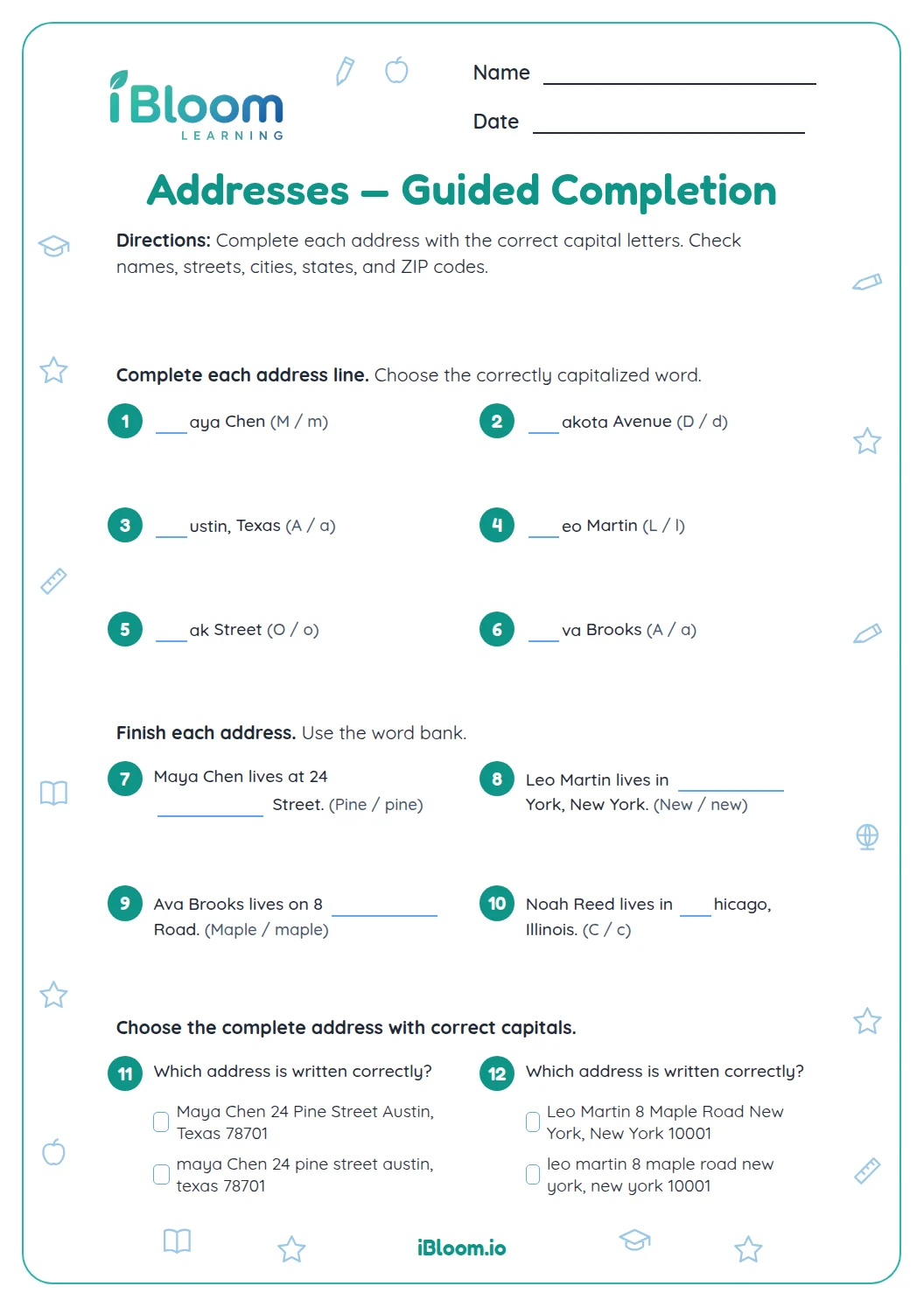
This free Grade 3 capitalization worksheet uses 14 short guided-completion items. Students supply a missing capital letter at the start of a sentence, in the pronoun I, and in names, places, dates, and a book title. The letter blanks keep the practice focused on capitalization while the surrounding sentence provides context. The page supports CCSS L.3.2, which addresses standard English capitalization, punctuation, and spelling in writing. A compact answer key lists each missing letter.
Aligned to L.3.2
When does a sentence begin with a capital?
Part A has seven sentence beginnings with a missing first letter. Fill each blank with the capital that completes the word and starts the sentence.
Question 1 begins with the pronoun I, which is always capitalized in English.
- 1I am ready for school.
Which names and titles need capital letters?
Part B moves from sentence starts to specific names, places, days, months, and a book title. Use the letters after each blank to identify the word being completed.
In question 12, the missing letter completes the proper name Central Park. The word Saturday is also capitalized because it names a day.
- 1We go to Central Park on Saturday.
How can students check each capital?
Read the completed word, then decide whether it starts a sentence or names a particular person, place, date, or title. Those clues help distinguish a proper name from a general word.
The answer key lists the missing capital letter for each item. Students can then reread the whole sentence to check that the word is complete.
How to use this worksheet at home or in class
- 1Read the whole sentence before filling its blank.
- 2Check whether the blank begins a sentence or completes a specific name.
- 3Capitalize I and calendar words such as Monday or March.
- 4For a book title, use the title words given in the sentence.
- 5Check every letter with the key, then reread the sentence.
Common mistakes and quick fixes
The mistake
Leaving the pronoun I lowercase.
The fix
Capitalize I whenever it names the speaker.
The mistake
Capitalizing every place word, including general words such as park.
The fix
Capitalize the specific name, such as Central Park, while leaving a general category lowercase.
The mistake
Forgetting that days and months are proper names.
The fix
Scan for calendar words such as Saturday and March.
Common Core alignment
Students edit capitals in sentence beginnings and proper names while preserving each sentence.
Use standard capitalization conventions when rewriting sentences.
On this sheet:
Show the official wordingHide the official wording
Demonstrate command of the conventions of standard English capitalization, punctuation, and spelling when writing.
What to practice next
Make more practice
Further reading
Questions parents and teachers ask
What does this Grade 3 capitalization page ask students to do?
Students fill 14 blanks with missing capital letters. Part A covers sentence beginnings and the pronoun I; Part B covers names, a place, calendar words, and a book title. The key lists the letter needed in each blank.
Why is the pronoun I always capitalized?
In standard written English, the pronoun I is capitalized wherever it appears in a sentence. Question 1 begins with a missing I, giving students one direct example before they move to names and other specific words. This gives students a direct example of a convention used throughout their writing.
What kinds of proper names appear in Part B?
Part B includes a person’s name, Central Park, Saturday, March, a book title, and titles used with names. The word fragment after each blank helps identify the name being completed and the capital letter to supply. These are specific names rather than general categories.
How can a student tell a proper noun from a common noun?
A proper noun names one specific person, place, day, month, or work. A common noun names a general category, such as park or book. The worksheet uses specific examples so students can practice capitalizing names within sentences. For example, Central Park names one particular place.
How should I use the answer key?
After students fill each blank, use the key to check the missing letter. Then reread each complete sentence together. If a letter is incorrect, ask whether the blank begins a sentence or completes the name of a particular person, place, date, or title.