

About this worksheet
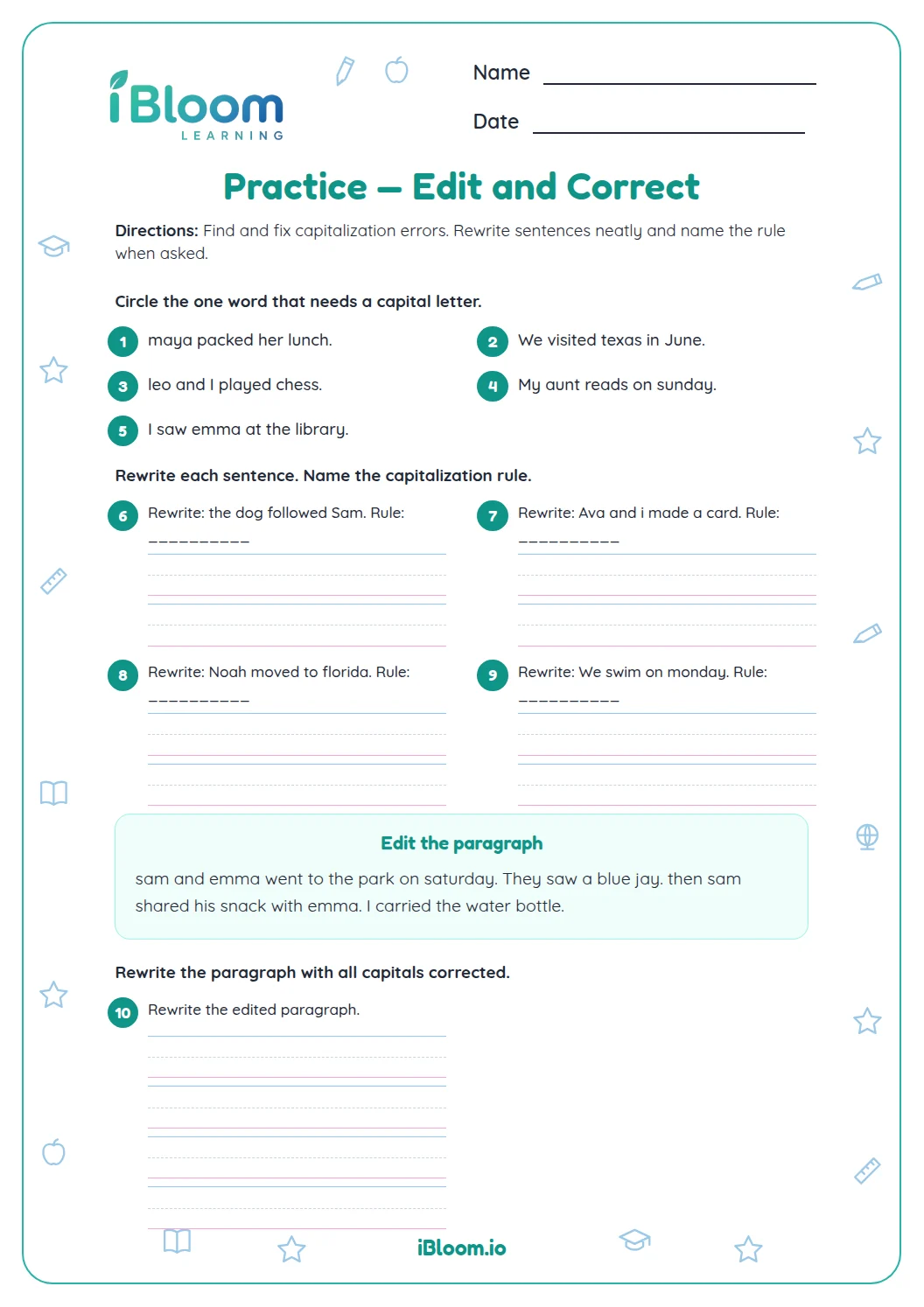
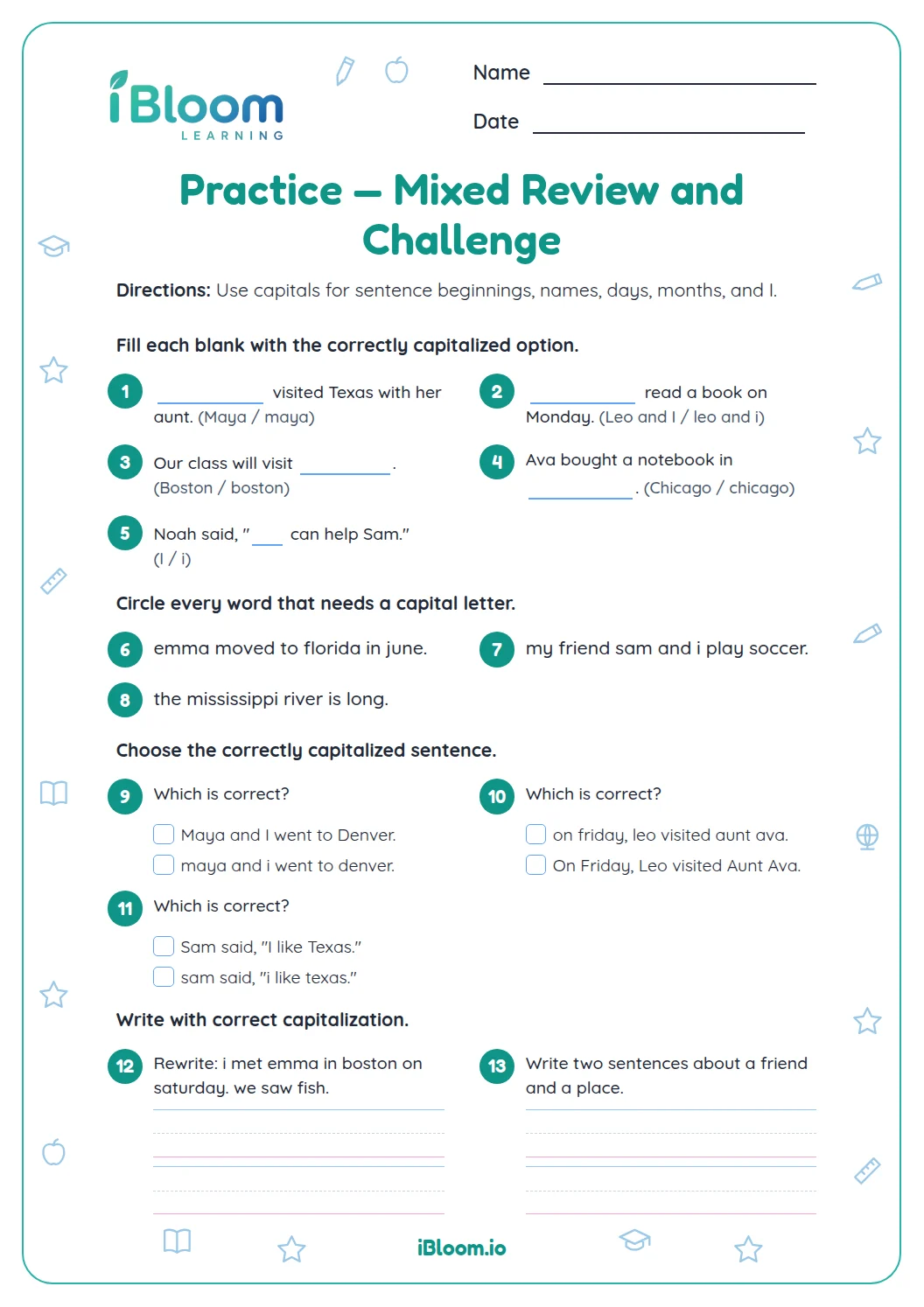
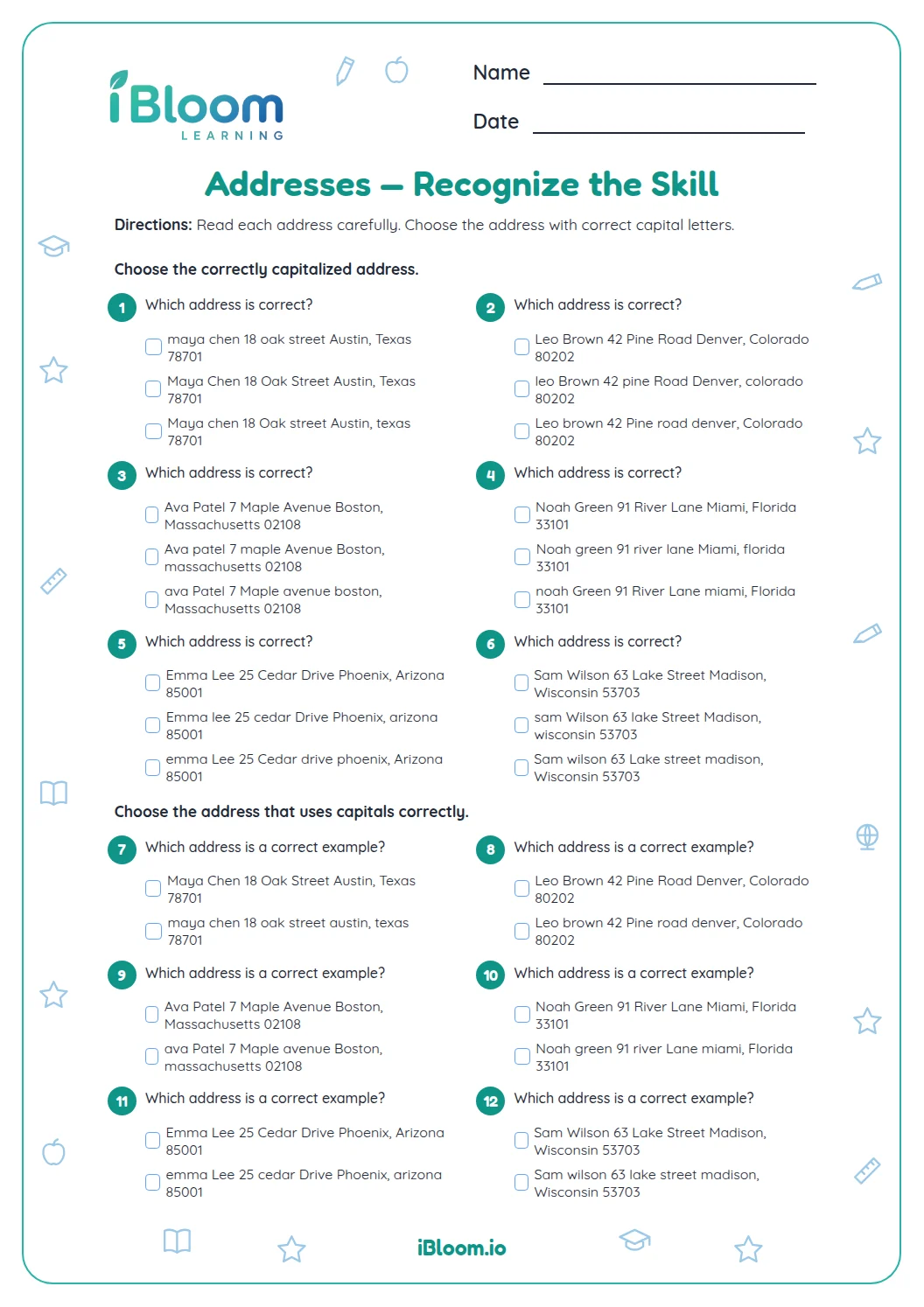
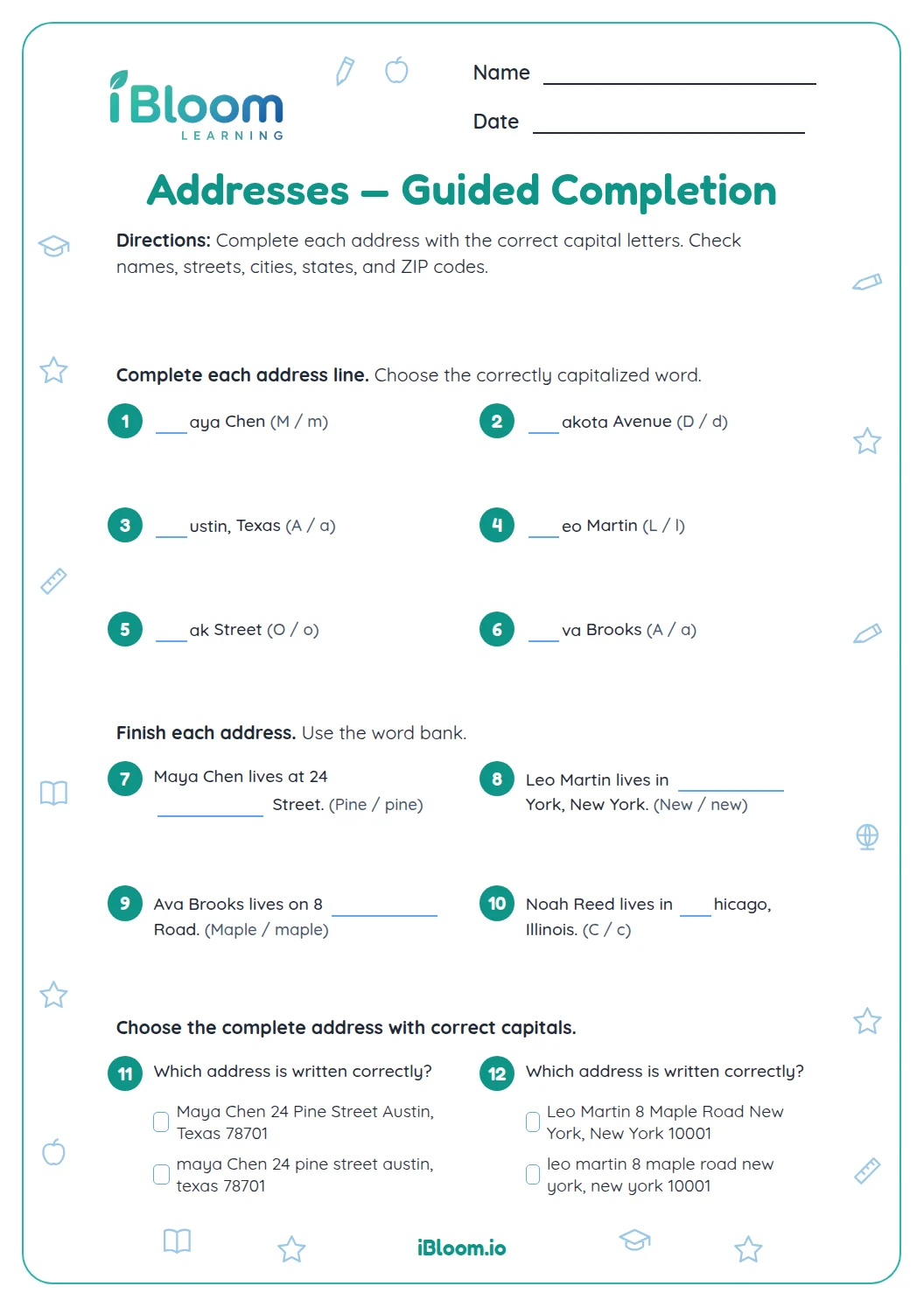
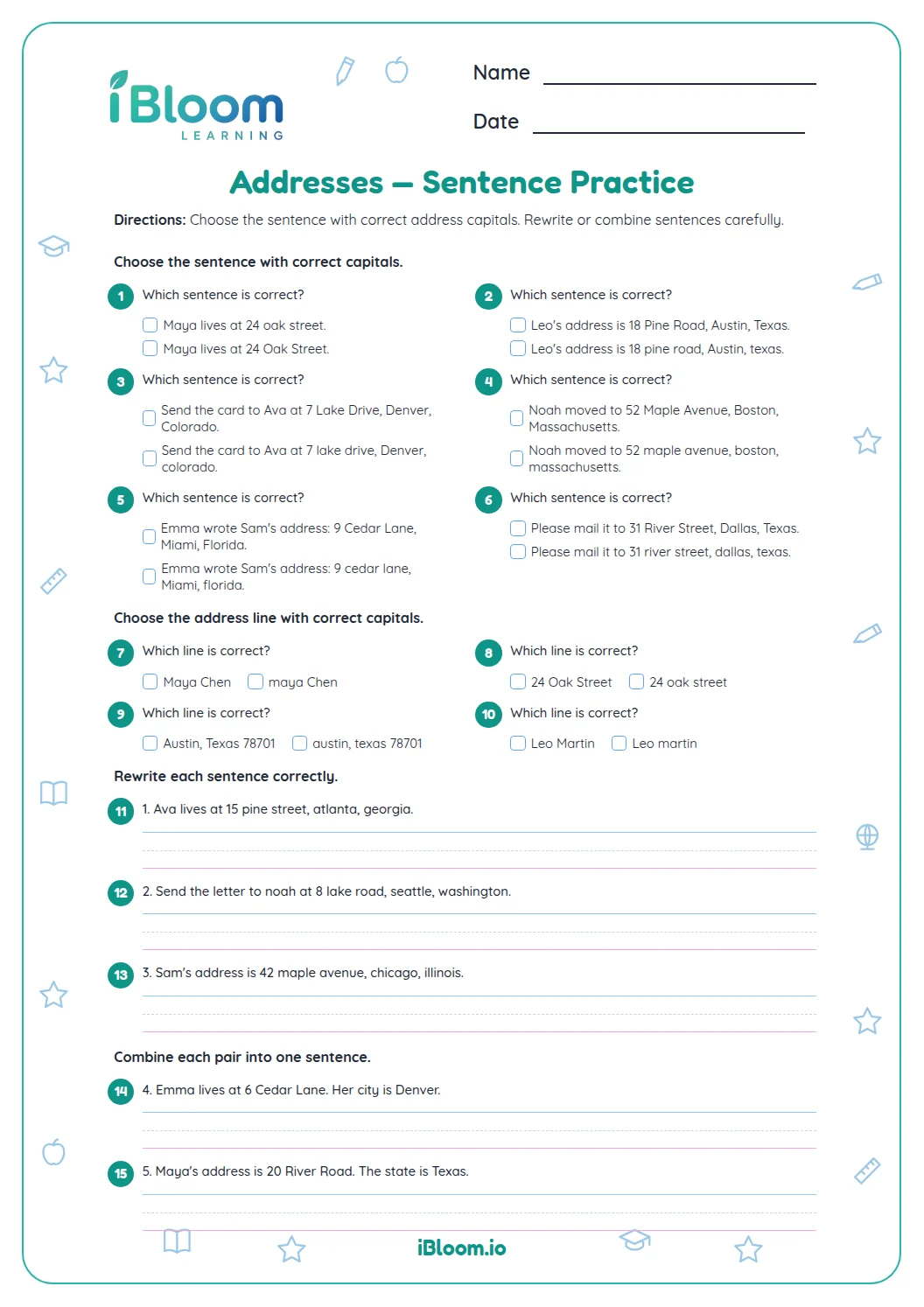
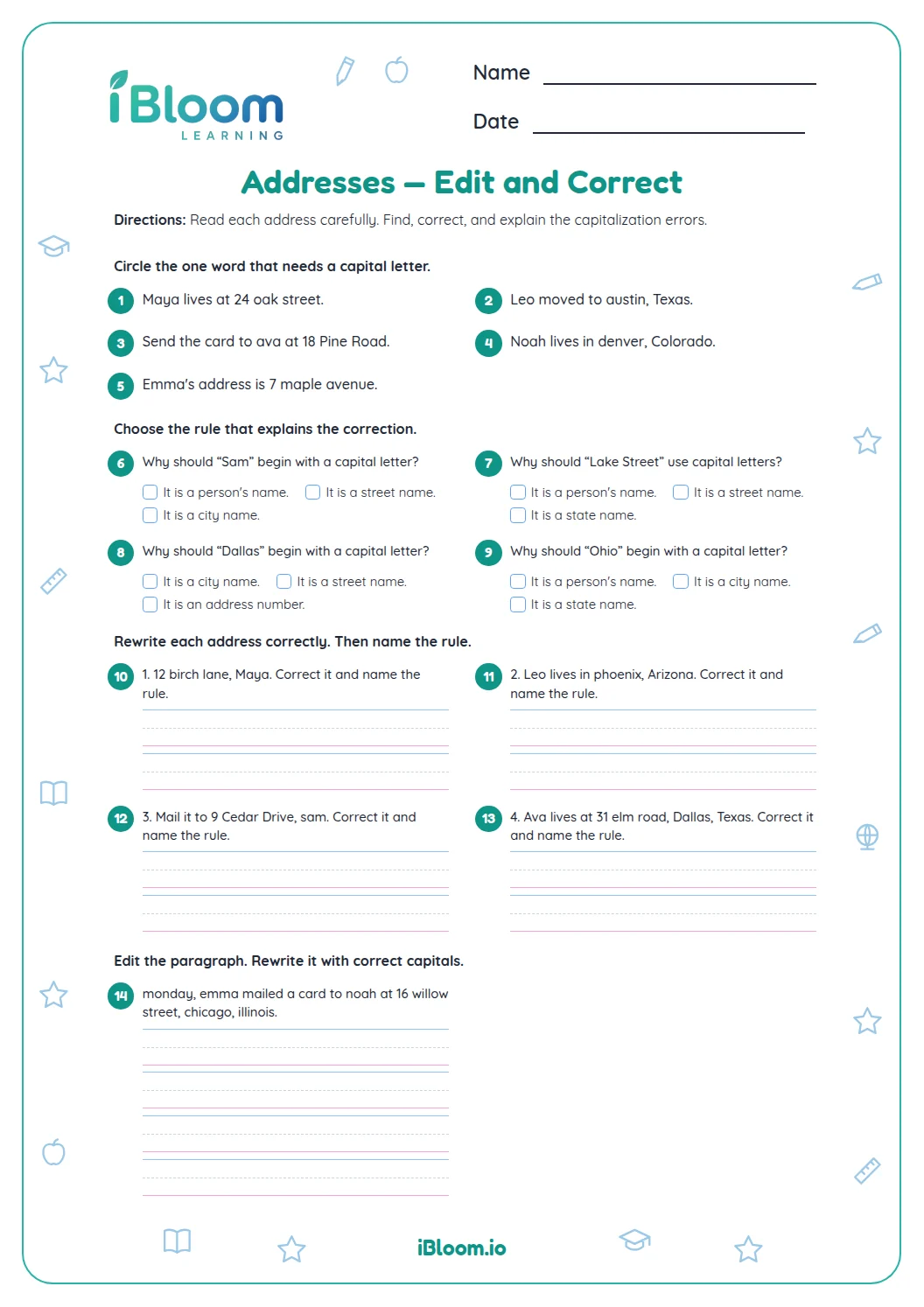
This Grade 3 printable practices capitalization in sentences. Learners supply capital letters at sentence beginnings and for I, identify names and days that need capitals, edit sentences, and combine related sentences without losing their capitals. The 15 questions move from short responses to sentence editing. A separate answer key provides the expected letters, words, or corrected sentences.
Aligned to L.2.2.a
What capitalization practice is on the sheet?
Part A asks learners to supply a missing capital letter. Part B asks them to identify words that need capitals in sentences. Part C gives sentences to edit and combine, so children apply capitalization while keeping the whole sentence readable.
- Part A: choose or supply the capital letter
- Part B: identify words that need capitals
- Part C: edit and combine complete sentences
When does a sentence need a capital letter?
Capitalize the first word of every sentence. The pronoun I is also always capitalized. In “Maya and I went to the park,” both Maya and I need capitals, even though the first word is already capitalized in the corrected sentence.
- 1maya and i went to the park.
- 2Maya and I went to the park.
Which names need capitals?
Capitalize proper names, including people, places, and days of the week. In Part B, learners identify Emma and We at the start of a sentence, Lake Erie as a geographic name, and Sunday as a day. Keep each word’s capitalization in mind when editing the complete sentence.
How can you edit or combine sentences carefully?
Read each sentence from left to right and mark its first word, the pronoun I, and proper names. When combining two sentences, keep the name capitalized and start only the new sentence with a capital. For example, “Leo read a book. Leo wrote about it.” can become “Leo read a book and wrote about it.”
How to check capitals in a sentence
- 1Read the sentence once for meaning.
- 2Check the first word and capitalize it if needed.
- 3Look for the pronoun I, people’s names, place names, and days.
- 4When rewriting, copy every word and punctuation mark carefully.
- 5When combining, keep proper names capitalized and avoid repeating a subject when it is clear.
- 6Compare with the key and reread the corrected sentence aloud.
Common capitalization mistakes
The mistake
Leaving the pronoun i lowercase in the middle of a sentence.
The fix
Scan for the standalone pronoun I wherever it appears; it always takes a capital.
The mistake
Capitalizing every important-looking word, including ordinary nouns such as park.
The fix
Capitalize sentence beginnings and specific names. A general place such as “the park” stays lowercase.
The mistake
Forgetting to capitalize the second sentence after a period.
The fix
Treat each sentence separately. In “Ava has a dog named Max. the dog is playful,” capitalize The after the period.
Common Core alignment
The worksheet practices capitalization of geographic names as part of sentence editing.
Capitalize geographic names, including the place names learners correct on this sheet.
On this sheet: Part B asks learners to identify Lake Erie, and Parts A and C include Texas, Chicago, and Boston in capitalization practice.
Show the official wordingHide the official wording
Capitalize holidays, product names, and geographic names.
What to practice next
Make more practice
Further reading
Questions parents and teachers ask
Why is the word I always capitalized?
I is the English first-person singular pronoun, and it is written with a capital letter wherever it appears in a sentence. On this worksheet, learners supply I in a sentence and correct it in a longer sentence such as “Maya and I went to the park.”
Which words are proper names on this worksheet?
The sheet includes people’s names such as Maya, Emma, Noah, and Ava, as well as geographic names such as Texas, Lake Erie, Chicago, and Boston. It also includes names used with titles and the day Sunday. The key shows the expected capitalization.
Does every noun need a capital letter?
No. Capitalize proper names and the first word of a sentence, but keep ordinary nouns lowercase unless they begin a sentence. For example, park remains lowercase in “Maya and I went to the park.” The editing part helps learners check the whole sentence rather than capitalize every noun.
How many questions are included?
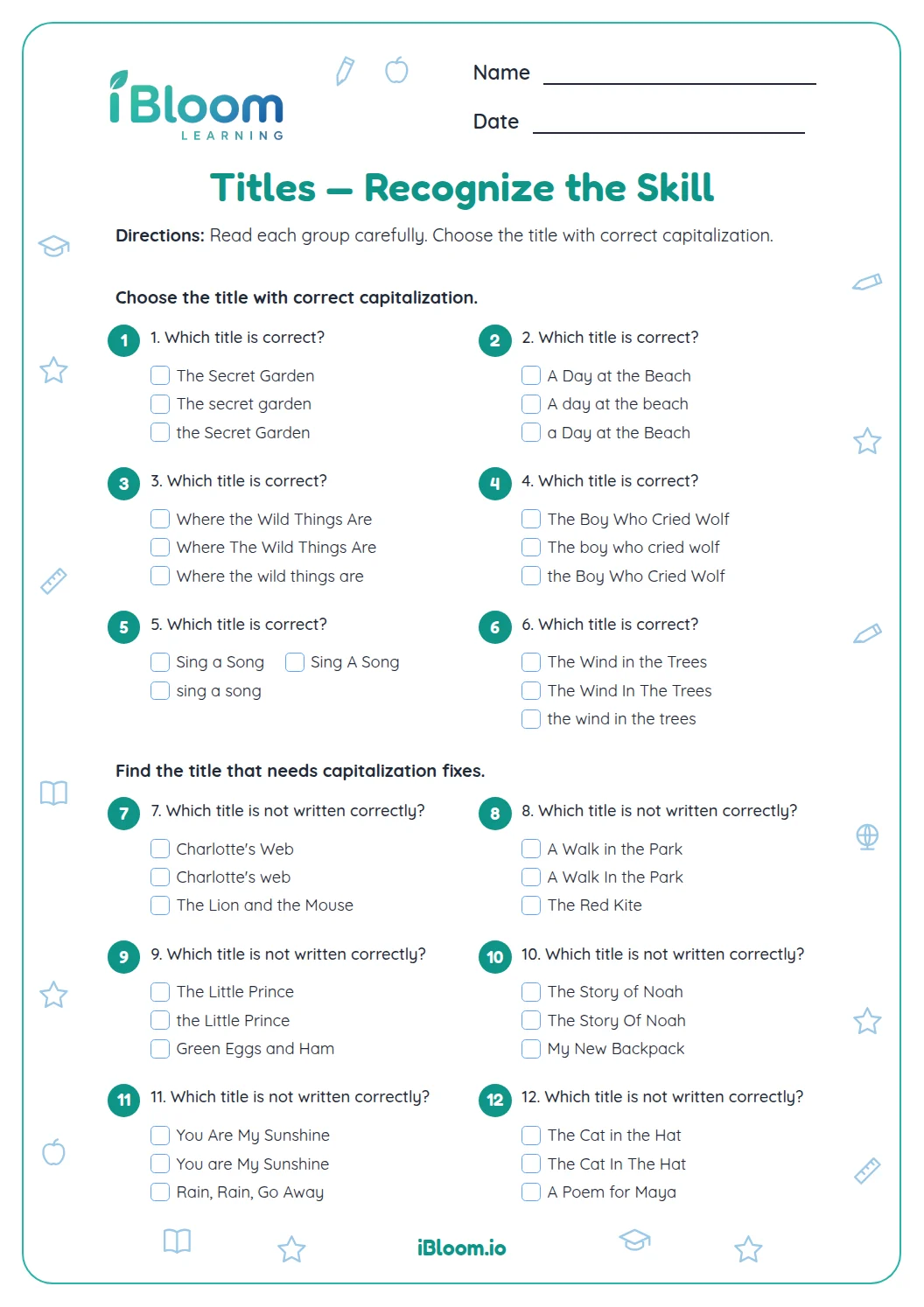
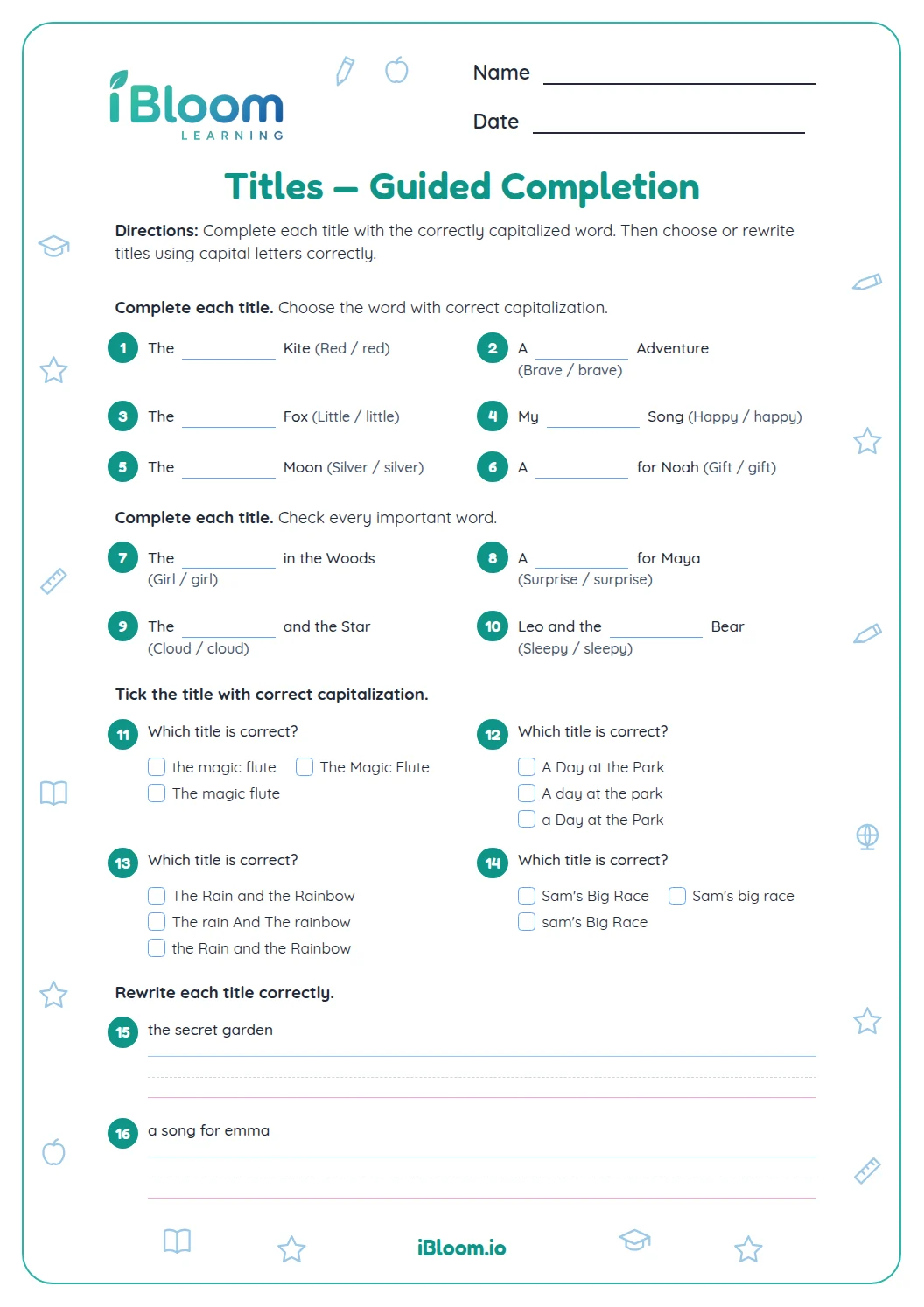
There are 15 questions in three parts, printed across two worksheet pages, plus a separate two-page answer key. Learners move from supplying a capital letter to identifying words and editing or combining sentences. Plan about 20 minutes for careful written responses.
What is the answer to the Maya sentence?
The corrected sentence is “Maya and I went to the park.” Maya begins the sentence and is a person’s name, while I is always capitalized. Park is an ordinary noun here, so it stays lowercase. The answer key gives this complete corrected sentence.
Which capitalization standard does this page practice?
The worksheet includes capitalization of geographic names, such as Lake Erie, Chicago, Boston, and Texas, which aligns with CCSS L.2.2.a. It also practices sentence beginnings, I, people’s names, and days as related classroom conventions. The standard link points to the official Common Core ELA standards.