




About this worksheet
This Grade 3 worksheet uses one informational passage describing a neighborhood park and a school garden. Students identify shared and unique details, select words that signal similarities and differences, then write comparison sentences and a short paragraph. The final writing task practices CCSS W.3.2 by organizing information clearly. An answer key includes sample responses for open-ended items.
Aligned to W.3.2
How do you find similarities and differences?
Read the passage and look for details about the same feature. The park and garden both have paths and plants, but only the park has a pond.
Question 1 asks for a shared feature. Both places have paths; only the park has a pond, and only the garden has a tool shed.
- 1Park: a wide walking path
- 2Garden: paths between the raised beds
- 3Shared feature: both places have paths
- 4The pond appears only at the park.
Which words help connect the ideas?
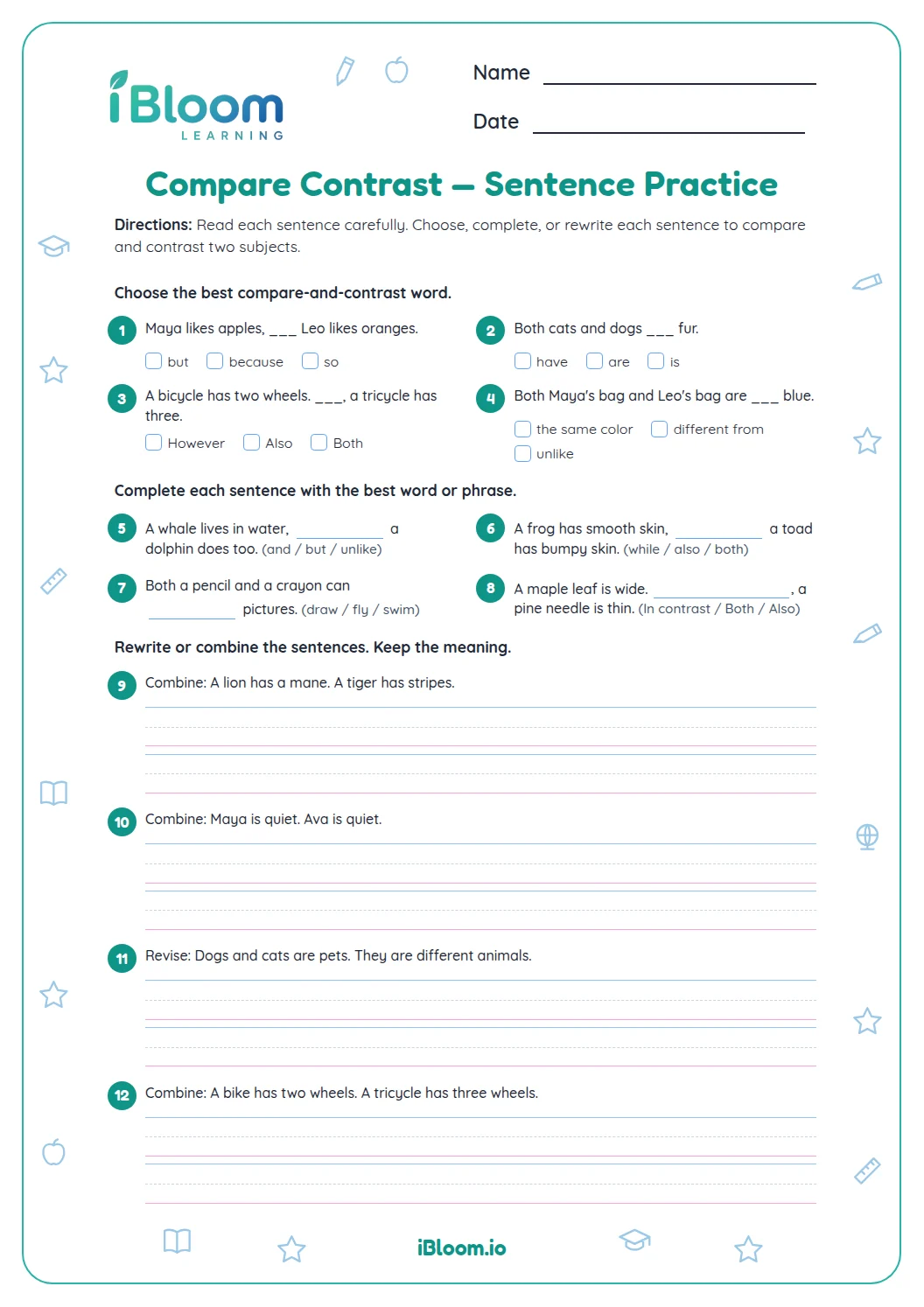
Linking words show how two details relate. “Both” and “similarly” introduce a shared feature. “Unlike,” “but” and “in contrast” introduce a difference.
In question 8, “in contrast” helps a reader expect a difference between the park and garden.
What belongs in a comparison paragraph?
Fourteen questions use one passage about two places and move from detail checks to comparison writing.
- Part B identifies shared and unique details.
- Part B practices comparison and contrast words.
- Part C turns passage details into sentences.
- Part D drafts a comparison paragraph.
How to use this worksheet
- 1Read both descriptions once for the main idea.
- 2Read again and underline details about each place.
- 3Mark details shared by both and details unique to one.
- 4Choose linking words that match the relationship.
- 5Write a topic sentence, then add evidence from both texts.
- 6Compare the paragraph with the sample responses in the key.
Common mistakes and quick fixes
The mistake
Calling a detail shared when it appears in only one text.
The fix
Point to a sentence in each text before naming a similarity.
The mistake
Using “similarly” before a difference.
The fix
Check whether the ideas match; use “in contrast” or “unlike” when they do not.
The mistake
Writing a list without explaining the relationship.
The fix
Join the details with a linking word and say how the topics compare.
Common Core alignment
The final response organizes details from the passage into clear comparison writing.
Organize details from two descriptions into clear comparison writing.
On this sheet: The final question asks students to examine two places and convey comparison details clearly in an explanatory paragraph.
Show the official wordingHide the official wording
Write informative/explanatory texts to examine a topic and convey ideas and information clearly.
What to practice next
Further reading
Questions parents and teachers ask
How do students compare two informational texts?
Read the passage and collect details about the same feature. Then identify which points describe both places and which belong to only one. This sheet compares a neighborhood park with a school garden, so students sort details before writing about how the places are alike and different.
What are examples of compare-and-contrast linking words?
Words such as both, also and similarly can introduce shared features. Unlike, but and in contrast can signal a difference. The worksheet asks students to choose a transition that matches the relationship between details, then use comparison language in their own sentences.
What should a comparison paragraph include?
A clear paragraph names both subjects and uses accurate details from the passage. It explains at least one similarity and one difference, with linking words to show how the ideas connect. The last question invites students to combine those parts in a short paragraph about the park and garden.
Are sample answers included for writing questions?
Yes. The answer key gives sample responses for the short written questions and a model comparison paragraph. Students may phrase a correct idea differently if it is supported by the passage. For open responses, check that the detail comes from the text and that the comparison is clear.
What does CCSS W.3.2 ask students to do?
CCSS W.3.2 asks students to write informative or explanatory text that examines a topic and communicates ideas clearly. The final question practices that work by asking students to organize details about the park and garden into a short comparison paragraph with linking words.