





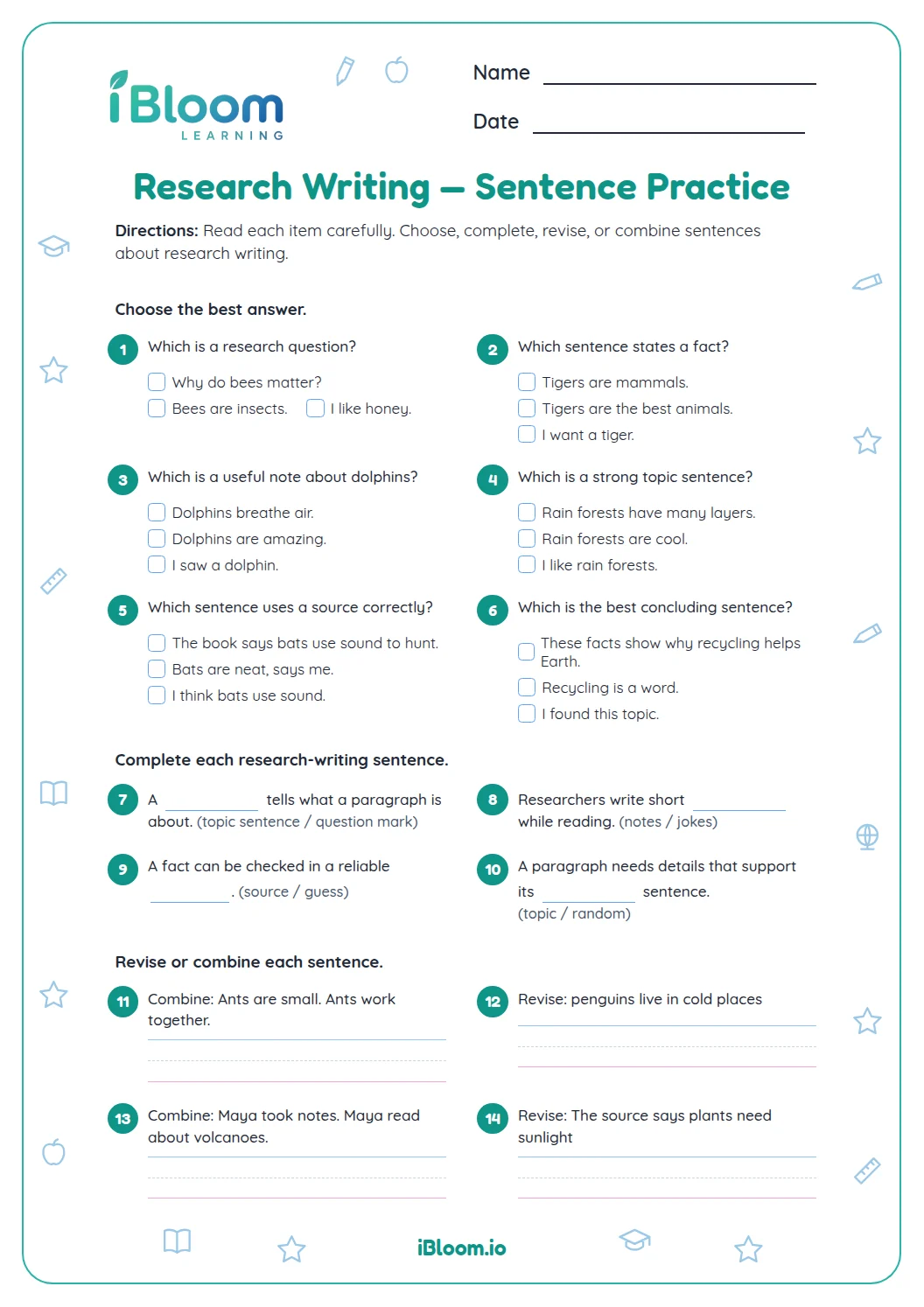
About this worksheet
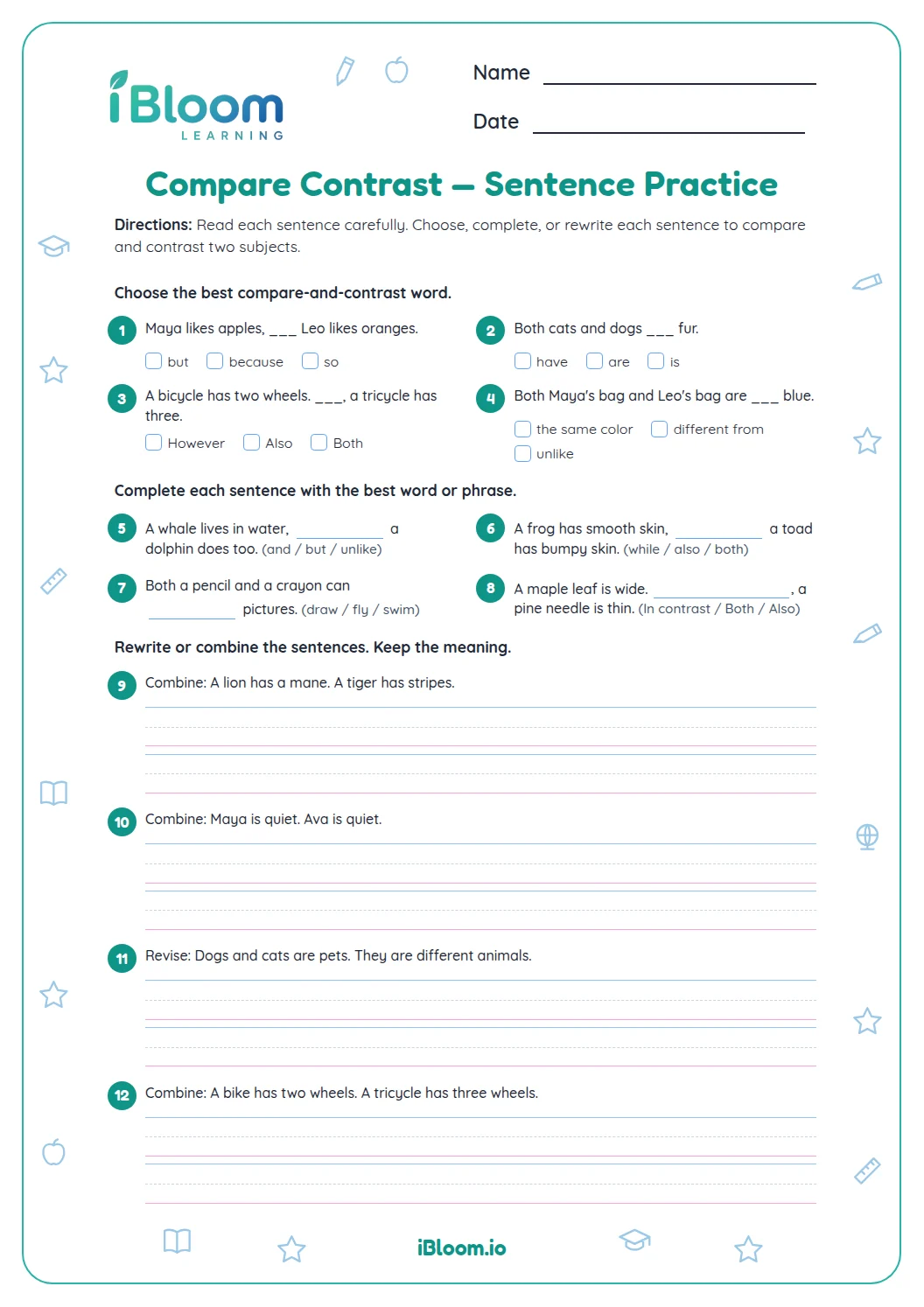
This Grade 3 worksheet gives writers guided practice completing compare-and-contrast sentences. Children read both facts, then supply a linking word or detail that shows how two subjects are alike or different. The three parts move from contrasts to shared details and then complete comparisons. The practice connects to Common Core W.3.2 by organizing facts to explain a topic.
Aligned to W.3.2
What is on this worksheet?
Sixteen short items ask students to complete comparisons about familiar animals, objects and places. Part A practices contrast words and details; Part B adds shared details; Part C completes comparisons with a fitting fact.
The examples move between similarities and differences so students must read both sides before choosing a word or detail.
- Part A: complete sentences that show differences (questions 1–8)
- Part B: add details about shared features (questions 9–12)
- Part C: complete comparisons with clear details (questions 13–16)
How do comparison words help a reader?
Words such as both, also and too point to a shared feature. Words such as unlike, but and in contrast signal a difference. Readers use these clues to follow how the writer is organizing facts.
Have your child read both sides of each sentence before choosing a word. A word can sound familiar and still express the wrong relationship.
- 1A bike has pedals. A scooter does not. → This detail shows a difference.
- 2A robin builds a nest. A blue jay does too. → This detail shows something shared.
How can you check a comparison?
Read the complete sentence after filling the blank. A shared detail should fit both subjects; a contrast should point to a real difference.
For example, “A whale is a mammal, but a shark is a fish” uses but to connect two different facts.
- 1Read both sides of the blank.
- 2Ask: alike, or different?
- 3Choose a word that signals that relationship.
How to use this worksheet
- 1Read the direction under each part before answering.
- 2Work through the questions in order and use the space to show thinking.
- 3Use the separate answer key to review answers; talk through any response that needs more than one idea.
- 4Read both facts before filling a blank, and check that the completed sentence makes sense.
Common mistakes and quick fixes
The mistake
Choosing “similarly” when the second clause gives a difference.
The fix
Read both facts and ask whether they match or differ before choosing a linking word.
The mistake
Choosing a true detail that does not compare the two subjects.
The fix
Check that the detail names both subjects or explains a feature they share.
The mistake
Using a contrast word when both facts match.
The fix
Check whether both subjects share the detail before choosing but or in contrast.
Common Core alignment
This page gives Grade 3 practice with compare and contrast writing. The cited Common Core standard describes the skill practiced here.
Write informative texts that examine a topic and clearly convey ideas and information.
On this sheet: Students organize information and use facts to develop a topic; this worksheet guides them in grouping details by similarities and differences.
Show the official wordingHide the official wording
Write informative/explanatory texts to examine a topic and convey ideas and information clearly.
What to practice next
Make more practice
Further reading
Questions parents and teachers ask
What is the difference between compare and contrast?
To compare is to tell how two things are alike. To contrast is to tell how they are different. A writer can do both in one paragraph by grouping shared features and then pointing out a meaningful difference. This worksheet practices finishing both kinds of comparisons.
Which linking words help show a comparison?
Words such as both, also, too and similarly can introduce a feature two subjects share. Words such as but, unlike and in contrast can signal a difference. Read both facts first, then choose the word that makes their relationship clear.
How can a child choose a useful detail?
A useful detail is true about the subjects and helps readers understand a similarity or difference. Saying two fruits grow on trees compares them; naming one fruit’s color alone may only describe it. The completed sentence should make the relationship easy to see.
Does a comparison paragraph need a conclusion?
A short comparison may not need a separate conclusion, but a longer paragraph can finish by reminding readers of the main similarity or difference. The important part is that each detail connects clearly to the two subjects being compared. A focused ending helps readers remember the comparison.
How can a child check a completed comparison?
Read the whole sentence aloud and ask whether its linking word matches the facts. Then check that the detail is true about both subjects or clearly distinguishes them. The final sentence should help a reader see the relationship without needing another explanation.