




About this worksheet
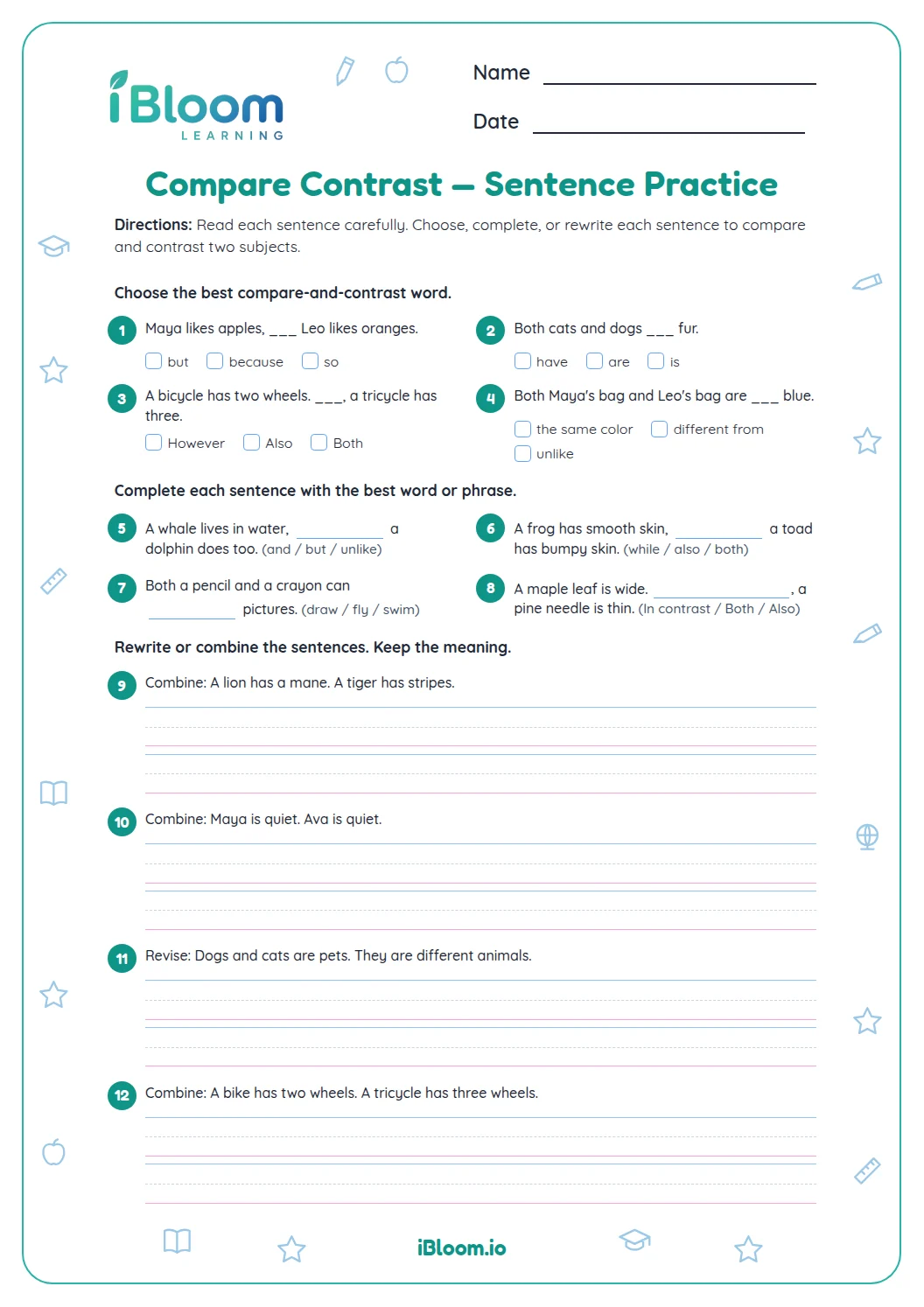
This Grade 3 worksheet practices recognizing similarities and differences in brief paired statements about animals, places, foods and objects. Learners identify shared or different details, interpret signal words and complete two sentences with a signal word. A separate key gives the intended responses. The questions use the details in the statements as evidence, aligned with Common Core RI.3.1.
Aligned to RI.3.1
How can readers spot a comparison?
A comparison names a feature two subjects share. Words such as both and also can point to a similarity. A contrast points out a difference; but, unlike and whereas often introduce one.
Question 1 says both robins and blue jays build nests in trees. The shared detail makes it a comparison. Question 2 uses but to separate a turtle’s shell from a frog’s smooth skin, so it signals a difference.
- 1Both robins and blue jays build nests in trees.
- 2Shared detail: build nests in trees
- 3Relationship: comparison
What is compared in the paired details?
Several items give two facts about animals, places or objects. Learners identify the important point that is shared or different, then use signal words to name the relationship.
How to use this worksheet
- 1Read both subjects or details before choosing.
- 2Ask which feature the sentence discusses.
- 3If the subjects share that feature, mark a similarity.
- 4If the feature differs, mark a contrast and notice words like but or unlike.
- 5For the last two items, choose a signal word that makes each sentence accurate.
Common mistakes and quick fixes
The mistake
Calling every sentence with two subjects a contrast
The fix
Check whether the named feature is the same or different. Two subjects can share a feature.
The mistake
Treating but as a similarity word
The fix
But usually signals a difference in the sentence. Read the facts on both sides of it.
The mistake
Choosing a signal word without reading both clauses
The fix
Check the relationship between the two facts, then select both for a shared feature or whereas for a difference.
Common Core alignment
This worksheet gives learners practice with the standard below.
Answer questions using details in the paired comparison statements.
On this sheet: Learners answer each question using details in the provided statements, including how subjects are alike or different.
Show the official wordingHide the official wording
Ask and answer questions to demonstrate understanding of a text, referring explicitly to the text as the basis for the answers.
What to practice next
Make more practice
Further reading
Questions parents and teachers ask
What does compare mean on this page?
To compare is to notice what two subjects share. Question 1 says robins and blue jays nest in trees, so the shared detail makes the statement a comparison. Other questions use details about transportation, animals and places. Question 3 also gives a shared feature: both carry people.
What does contrast mean?
To contrast is to identify a difference between subjects. A turtle has a shell while a frog has smooth skin, and a bicycle has two wheels while a tricycle has three. Read both details to identify what differs. For example, question 4 contrasts a dry desert with a wet rainforest.
Which signal words appear in the questions?
The page includes words such as both, but and while, and the last two blanks ask learners to choose signal words for complete statements. The word gives a clue, but the facts in each sentence determine whether the relationship is shared or different. A signal word can introduce the relationship between the clauses.
Do learners write full sentences?
The last two questions are fill-in-the-blank items, not open-ended sentence writing. One asks for a word introducing a shared detail about bikes and buses; the other asks for a word introducing a difference between maple and pine leaves. Learners fill each blank with a word that fits the facts.
What is the answer to the maple and pine blank?
The answer is whereas: “A maple has broad leaves, whereas a pine has needles.” It introduces a contrast between the two leaf descriptions. The answer key lists this word along with “Both” for the shared-detail sentence. The word connects two true details in the sentence.
How can a child check a comparison answer?
Ask which feature the sentence names, such as where food grows or how an animal moves. Then check whether both subjects share that feature or have different details. This keeps the response tied to the statement rather than to the signal word alone. This check works for both shared features and differences.