






About this worksheet
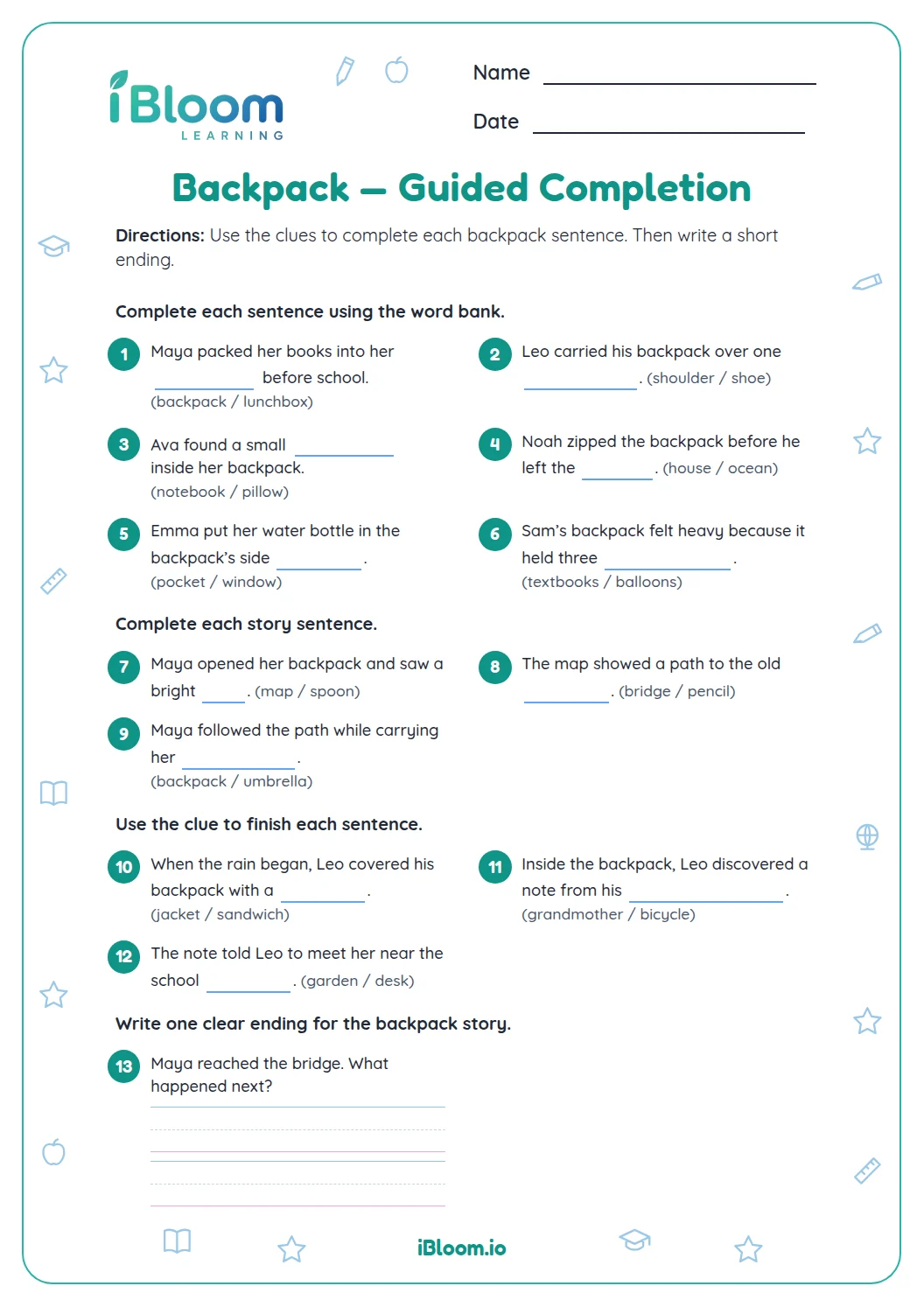
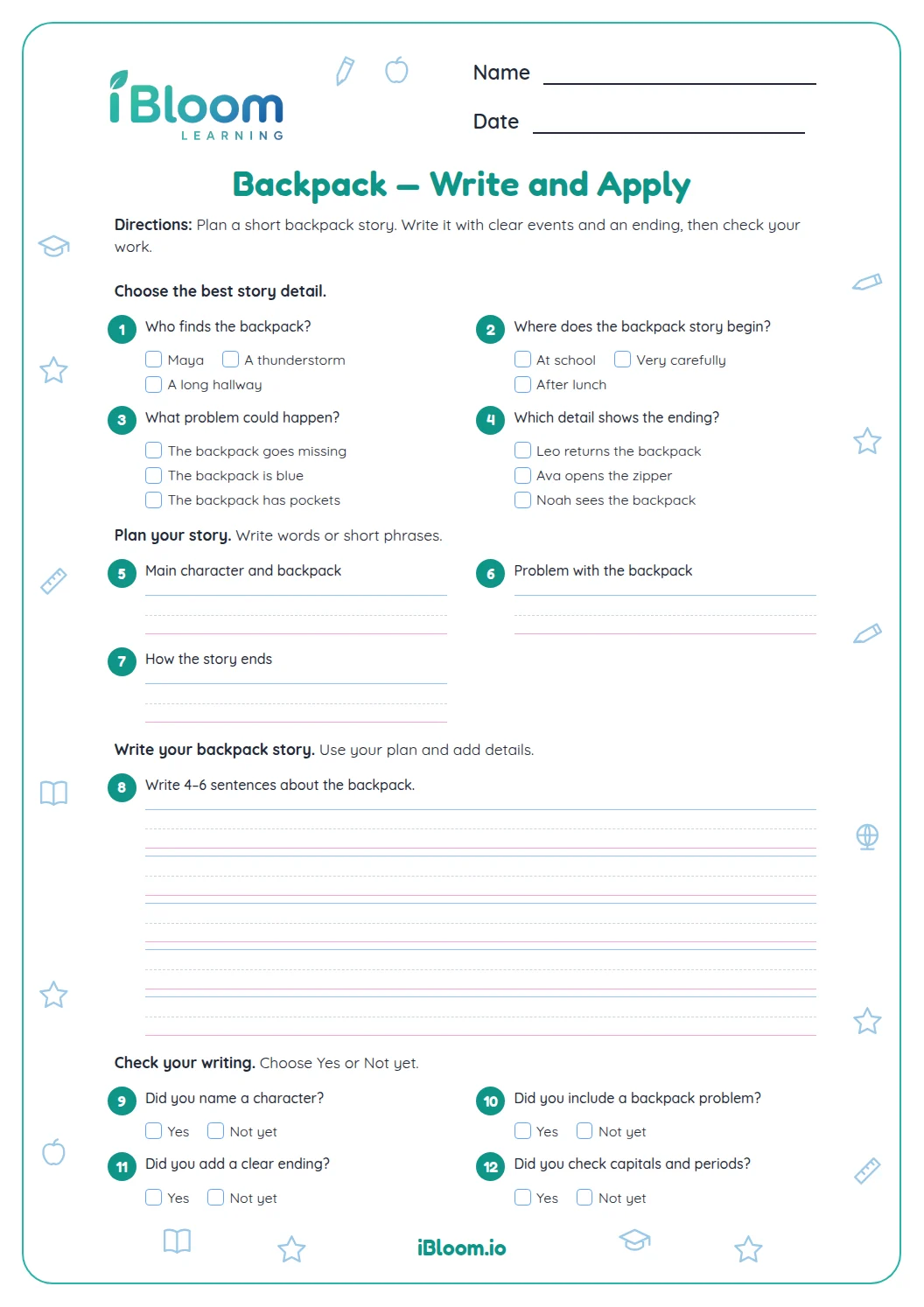
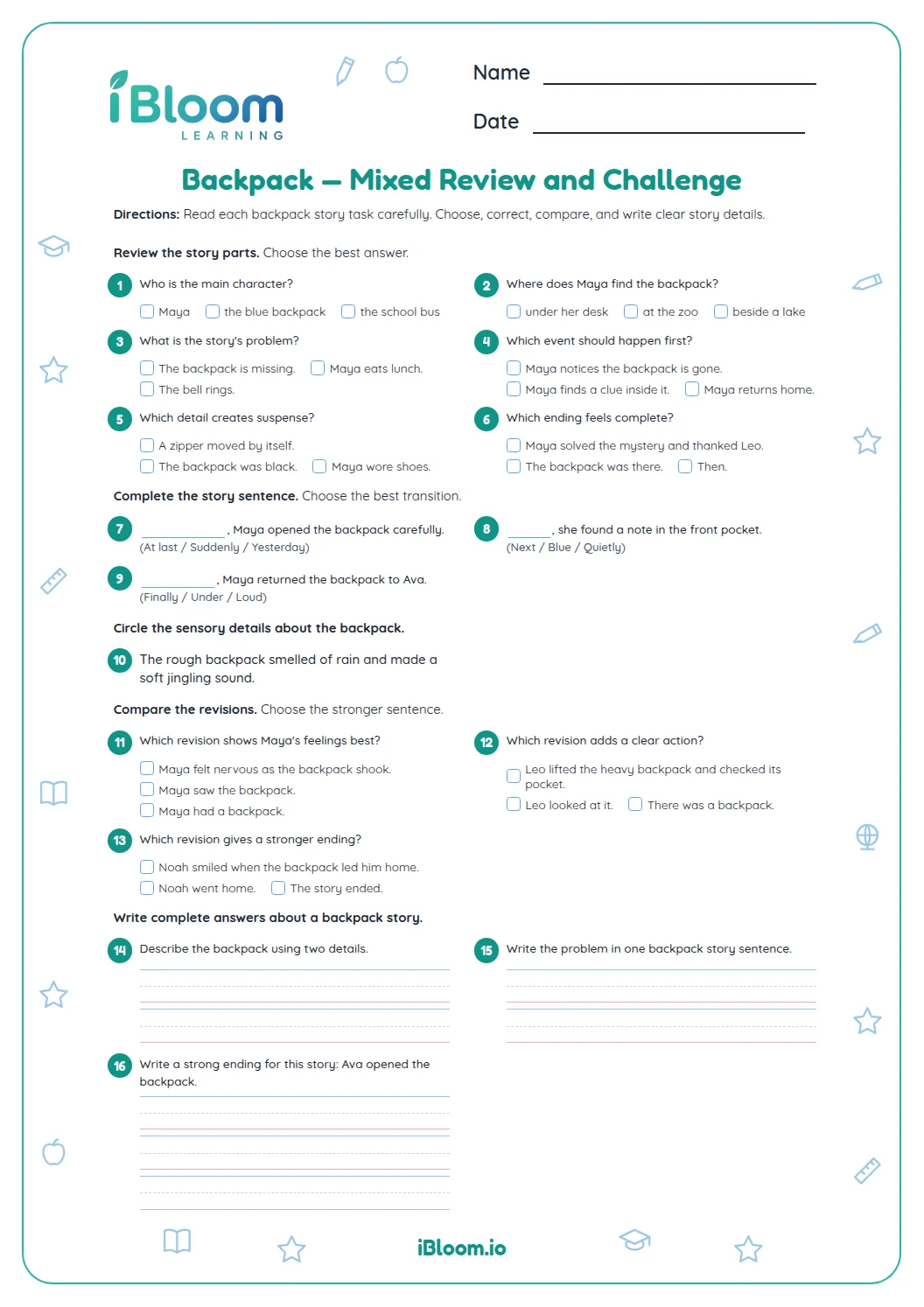
This free printable Grade 3 worksheet practices clear sentences through a backpack story. Children choose complete thoughts, add words to finish sentences, combine related details without losing either idea, and revise capitalization and punctuation. Its 14 questions move from recognition to sentence editing, with sample responses in the separate answer key.
How can you tell a sentence is complete?
A complete sentence tells a full thought. In Part A, “Maya carried her bag” has a subject and an action; “Maya’s blue backpack” names something but does not tell what happened.
- 1Which is a complete sentence?
- 2Answer: Maya carried her bag.
How do the story sentences fit together?
Part B supplies a word that completes an action or tells where something is. In Part C, keep both story details in one sentence. For question 9, “Maya packed a lunch. She packed an apple” becomes “Maya packed a lunch and an apple.”
What should a rewrite include?
The last two prompts ask children to repair capitalization and ending punctuation. Start “leo carried…” with a capital L, then finish the thought with a period. Read the corrected sentence aloud to check that it sounds complete.
How to use this sentence sheet
- 1Read each choice aloud and listen for a full thought.
- 2For a blank, try the word in the sentence and reread it.
- 3When combining ideas, keep both details from the prompt.
- 4For a rewrite, check the first letter and the ending mark.
- 5Use the key to compare the meaning, not just the wording.
Sentence slips to watch for
The mistake
Choosing a phrase that names a backpack but has no action.
The fix
Ask who or what did something, then find the action word.
The mistake
Joining two sentences with only a comma.
The fix
Use a connecting word or make two complete sentences.
The mistake
Forgetting a capital at the beginning of a rewritten sentence.
The fix
Check the first word, then add ending punctuation.
What to practice next
Make more practice
Questions parents and teachers ask
How many questions are on the Grade 3 backpack worksheet?
There are 14 questions in four parts: four complete-sentence choices, four completions, four sentence combinations, and two rewrites. Each prompt uses the backpack story. The separate answer key gives the selected sentences, completion words, and corrected models for the last two items.
What makes a sentence complete?
A complete sentence tells a full thought. In question 1, “Maya carried her bag” says who acted and what she did, while “Maya’s blue backpack” only names something. Read each choice aloud and ask whether it tells what happened.
How should a child combine the story details?
Keep the information from both original sentences in one clear sentence. For question 9, the details are that Maya packed a lunch and an apple, so “Maya packed a lunch and an apple” preserves both. The key lists the intended combination for each choice.
What should the last two answers include?
Each rewrite should begin with a capital letter and end with punctuation that fits the sentence. Question 13 can read “Leo carried his backpack to school.” Question 14 should also capitalize The and close the statement with a period.
Can an adult read the prompts aloud?
Yes. Read a sentence and its choices aloud, then ask the child to explain which option gives a complete thought or keeps both details. For the rewrite items, have the child check the first letter and final punctuation after writing the sentence.