



About this worksheet
Students begin by recognizing details that establish place, time, weather, and mood. They then interpret sensory clues and finish by adding original details to short narrative situations. The questions focus on how a setting is built through specific description, not just naming a location.
Aligned to W.3.3a
What does this worksheet practice?
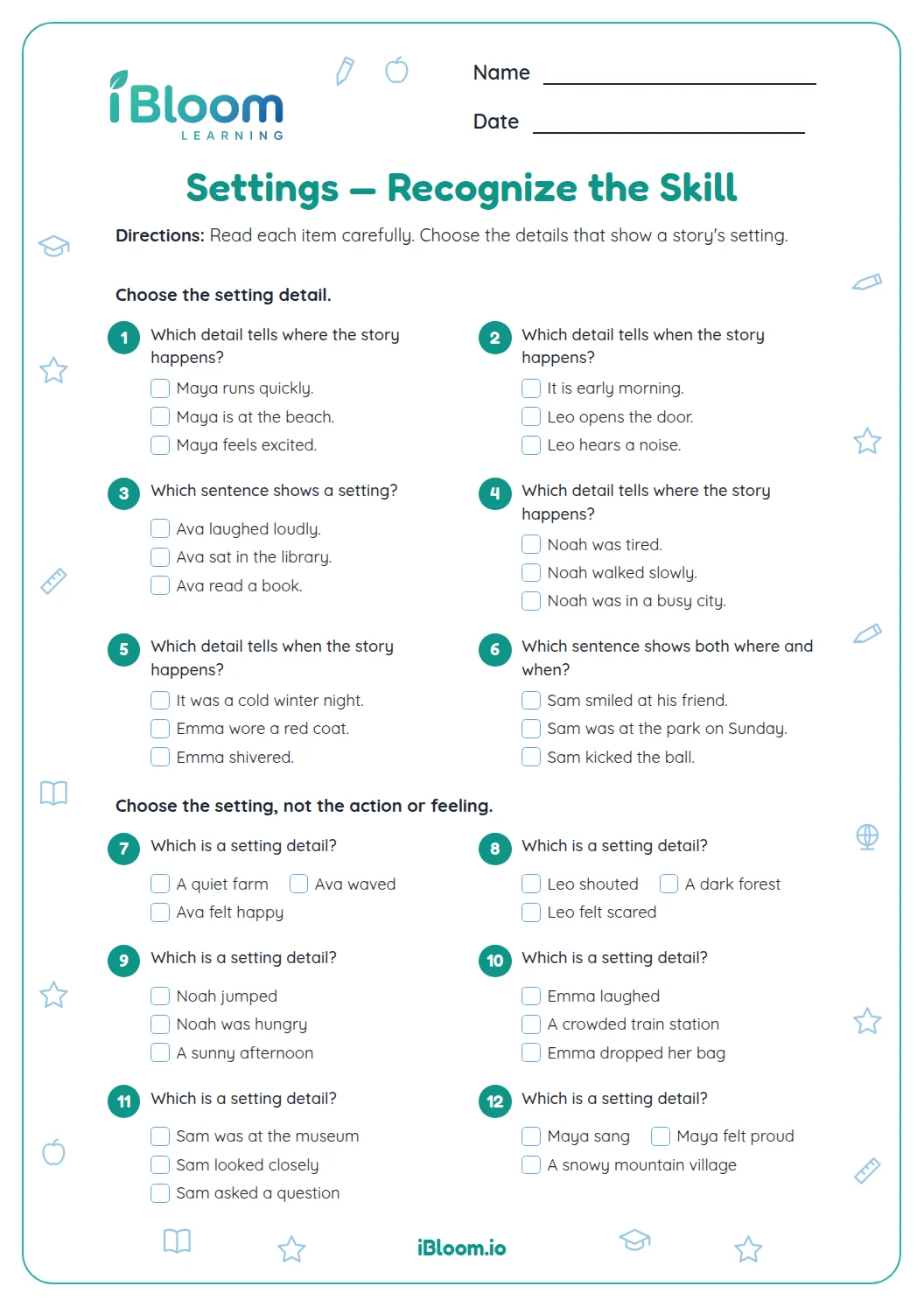
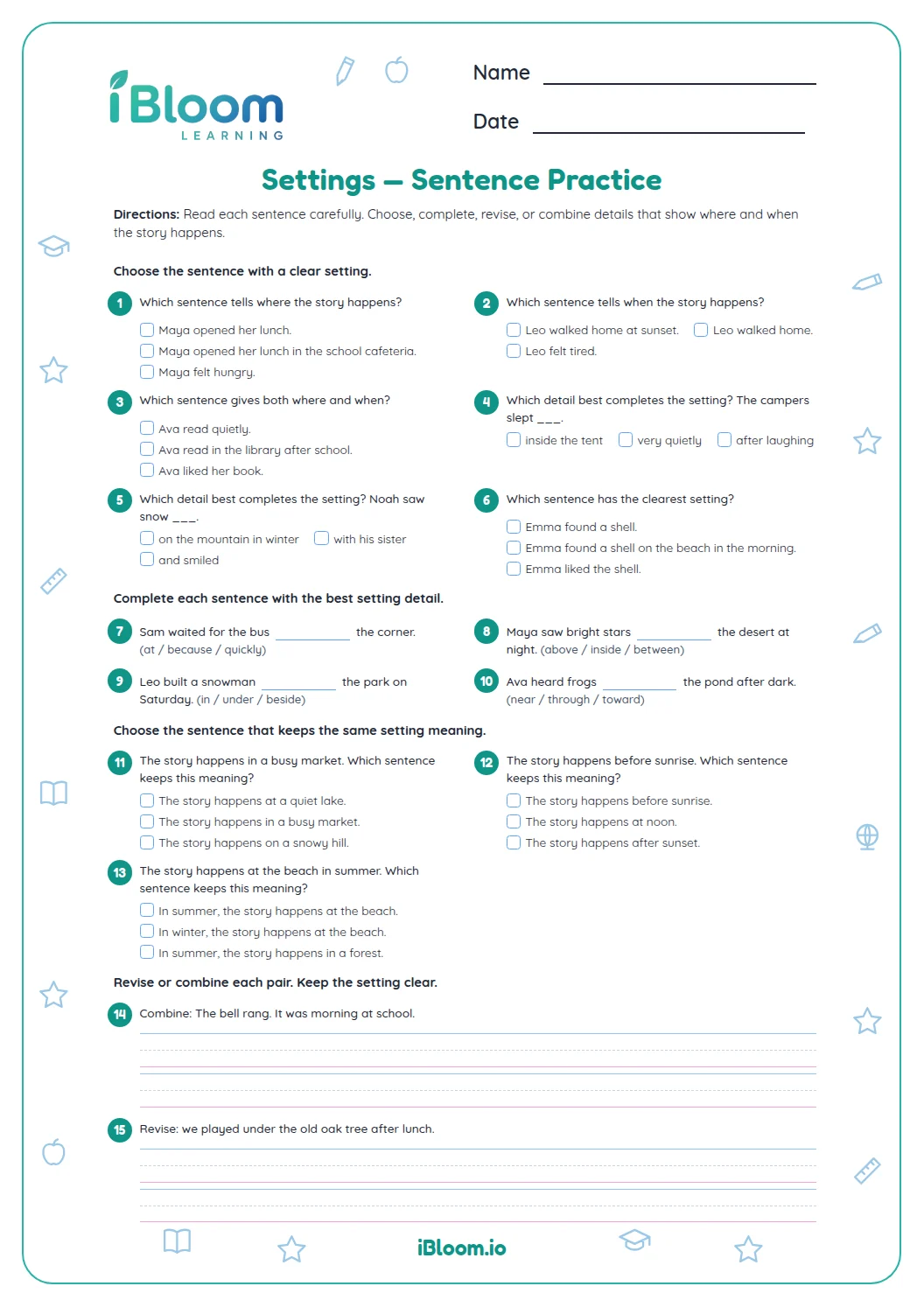
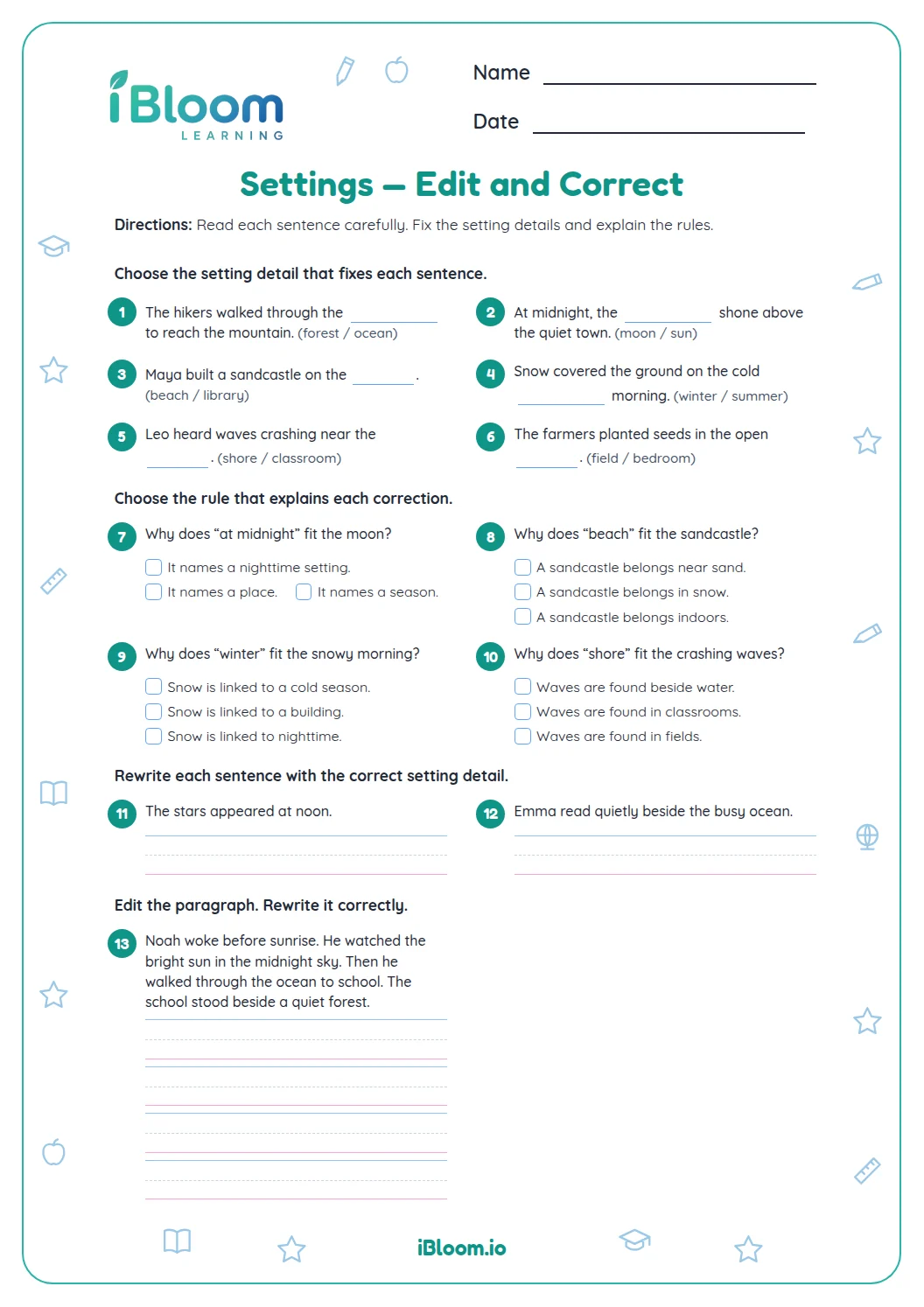
Part A helps children recognize details that establish where or when a scene happens. Part B asks them to interpret precise clues. Part C asks them to write or explain how setting details shape a scene.
- Part A: 5 multiple-choice items
- Part B: 5 short answers about place, time, and sensory details
- Part C: 6 written applications and explanations
How do details build a setting?
A place name can orient a reader, but concrete clues make the scene easier to imagine. “At the park” names a place; “cold rain tapped the slide” adds weather and a sound. Writers choose details that fit the scene.
- 1Wet sand stuck to our feet as waves rolled in.
- 2The clues are sand and waves.
- 3They point to a beach setting.
How can a setting shape a story?
The same place can feel different depending on its details. Sunlight, voices, and colorful stalls may make a market seem lively. Empty streets, fog, or long shadows can make a scene feel uncertain. Part C invites children to make a defensible choice and support it with a detail.
How to use this worksheet
- 1Read each scene carefully and underline the words that establish its setting.
- 2For Part A, decide whether the detail points to place, time, or atmosphere.
- 3For Part B, answer with words directly supported by the sentence.
- 4For Part C, use a precise sensory detail rather than a general word such as nice.
- 5Compare open-ended answers with the sample key; other clear, relevant answers may also work.
Common mistakes and quick fixes
The mistake
Naming only a country or town when asked for a setting detail.
The fix
Add a concrete clue such as weather, time, sound, or what the place looks like.
The mistake
Treating a character’s feeling as a setting detail.
The fix
Look for information about the surroundings; feelings may be affected by the setting but are not the setting itself.
The mistake
Adding a detail that does not fit the scene.
The fix
Reread the situation and choose a sound, smell, or visual clue that belongs there.
Curriculum alignment
The writing prompts support Grade 3 narrative writing by practicing how a writer establishes a situation with setting details.
Establish a situation and introduce a narrator and/or characters; organize an event sequence.
On this sheet: The worksheet focuses on establishing a story situation through setting details, including place, time, and atmosphere.
Show the official wordingHide the official wording
Establish a situation and introduce a narrator and/or characters; organize an event sequence that unfolds naturally.
What to practice next
Make more practice
Further reading
Questions parents and teachers ask
What details can establish a setting?
The setting is where and when a story happens. Place and time establish it, while weather, sounds, smells, and other sensory details can help readers picture the scene clearly. In a short scene, one clear clue may establish the place, while another clue tells readers the time or conditions.
Does a setting only mean the place?
A setting includes both where and when a story happens. A writer may also describe the weather or other conditions, such as whether a scene takes place at dawn or at night. Readers can point to the exact words rather than guess beyond what the sentence tells them.
How can setting affect mood?
Details shape how a place feels to a reader. Fog and empty streets can create unease, while sunlight and lively voices can make a place seem cheerful or welcoming. Mood is an effect of description; a reader should be able to connect that effect to details in the scene.
What grade is this worksheet for?
This worksheet is designed for Grade 3 narrative writing practice. It focuses on establishing a story situation with details about place, time, weather, and atmosphere. The examples move from recognizing a clue to making a small addition of the learner’s own.
Are there many possible answers to the writing questions?
Yes. The key gives sample answers for the written prompts. A different answer is also acceptable when it responds to the question and fits the scene described. Teachers may accept other responses when they fit the setting and give enough detail to picture it.
How many questions are included?
The printable has 16 questions in three parts and a separate answer key. Children identify setting clues, interpret details, and write descriptive additions to short scenes. The separate answer key includes sample responses for questions that can have more than one reasonable answer.