

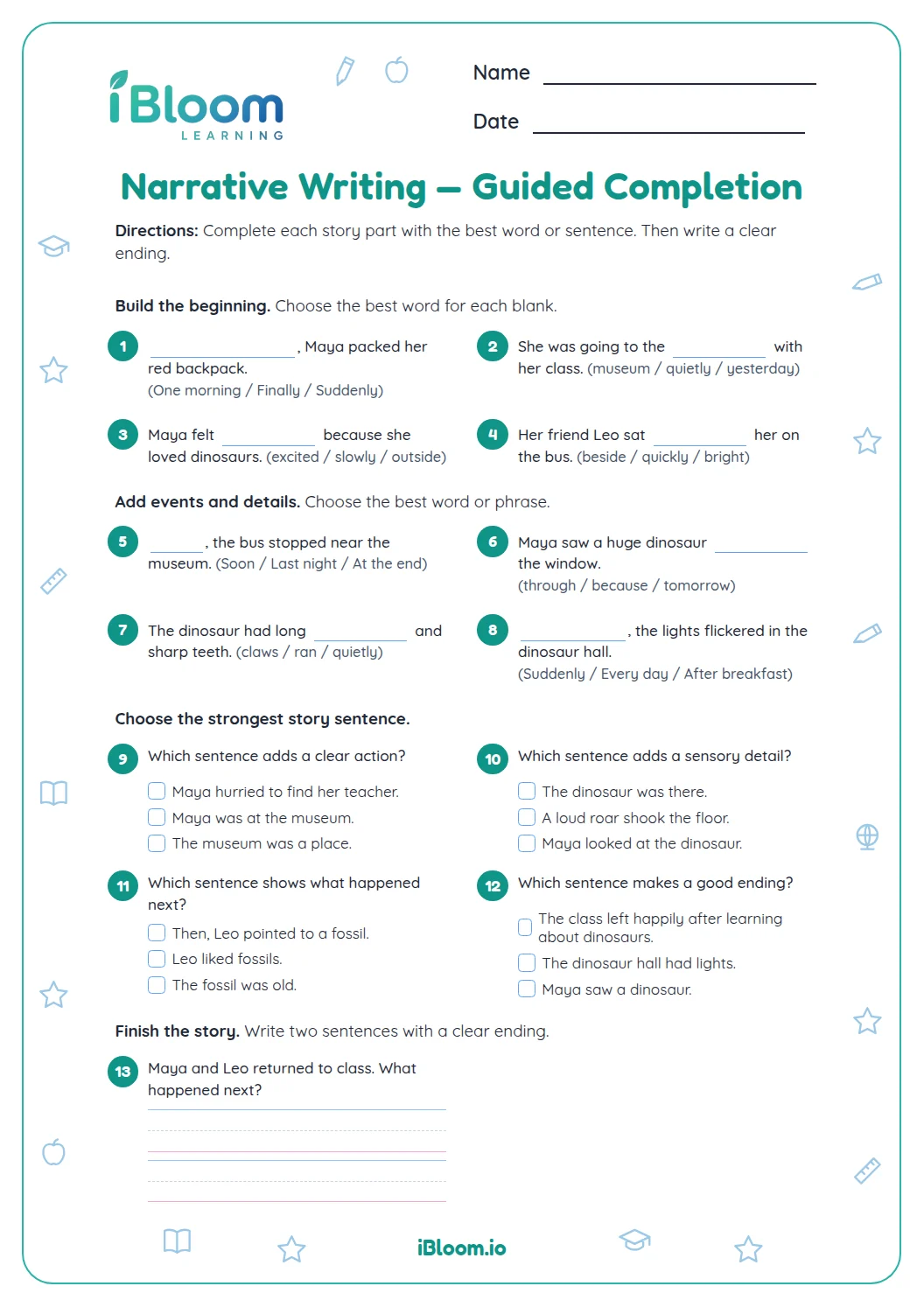


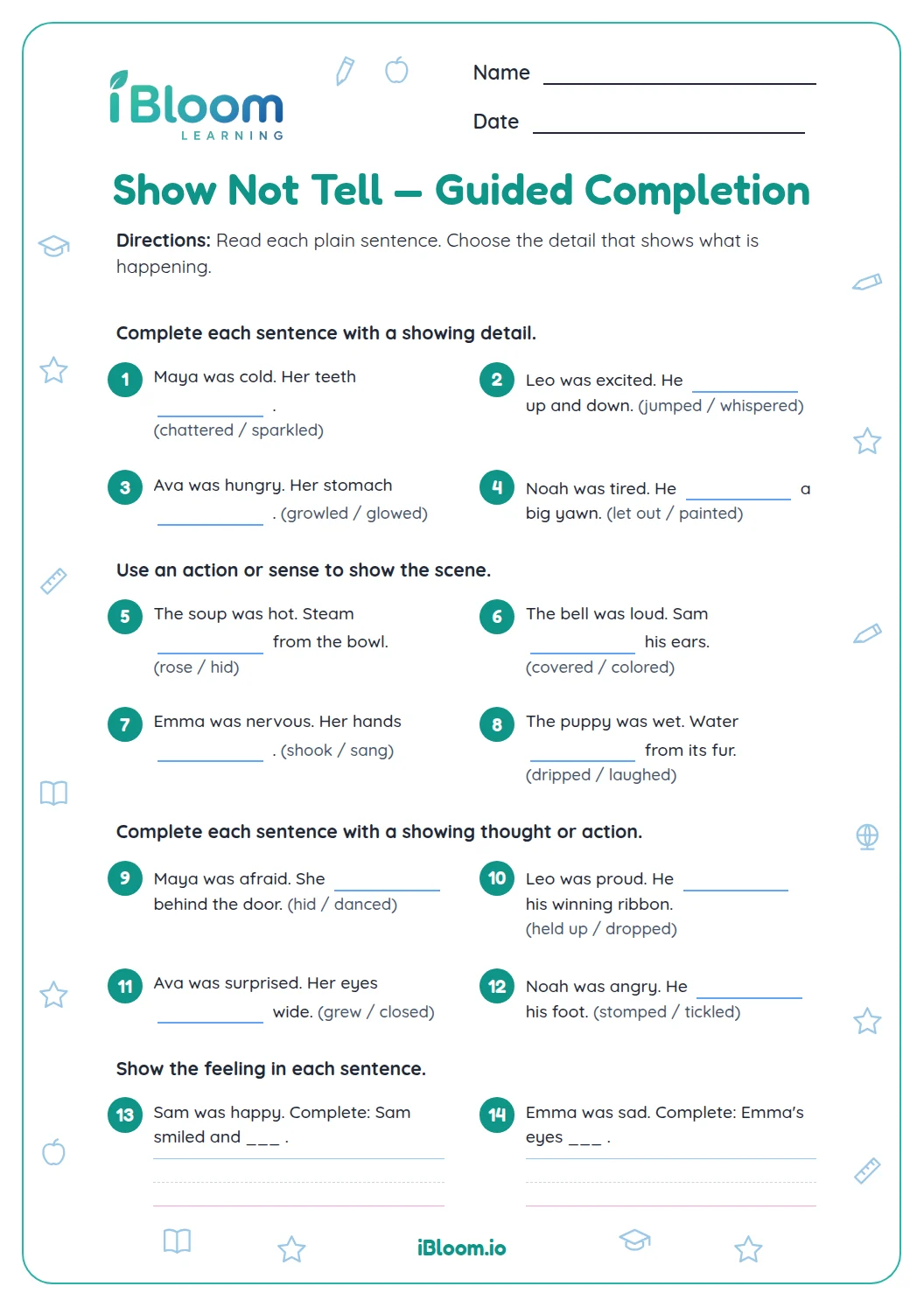
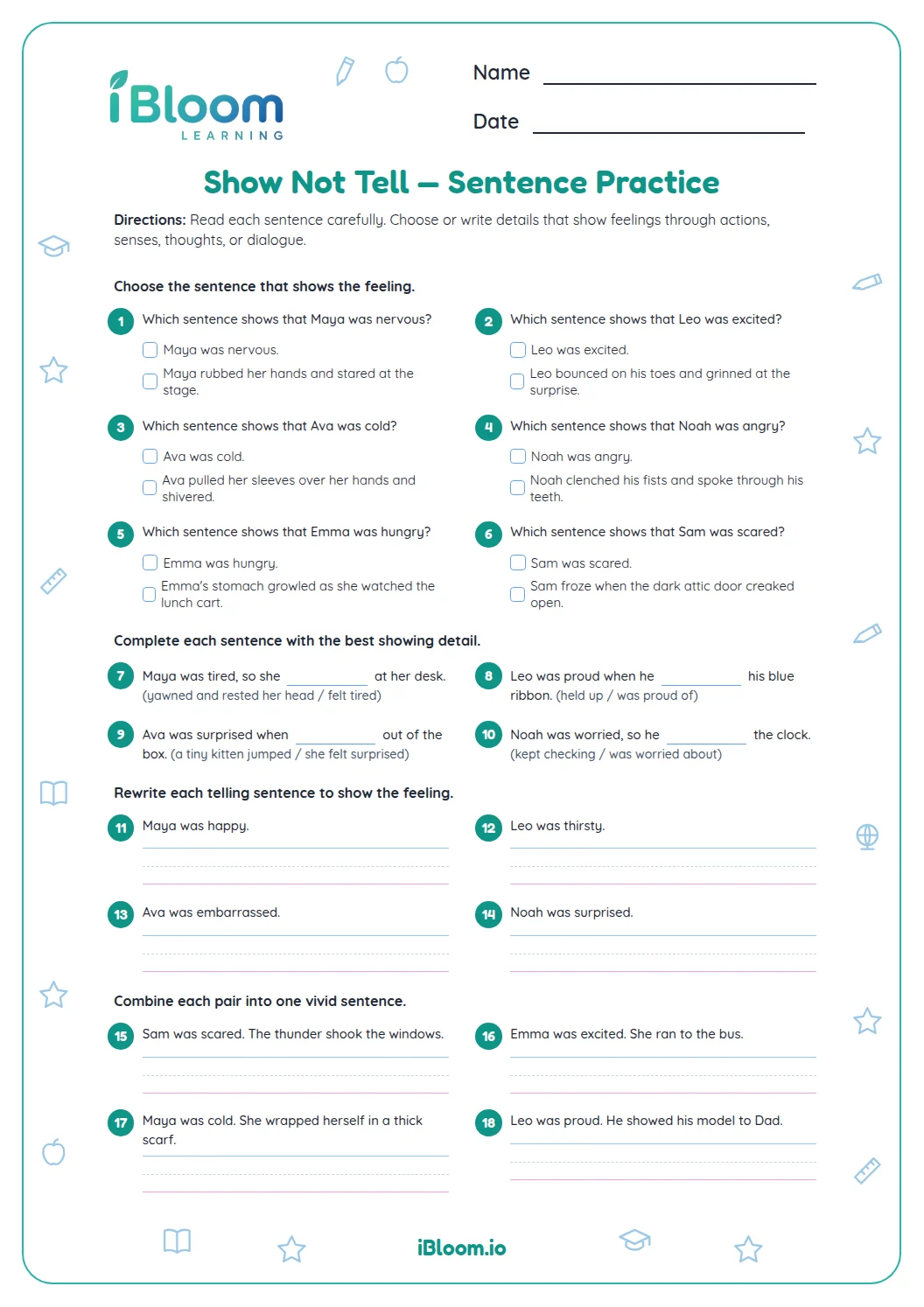

About this worksheet
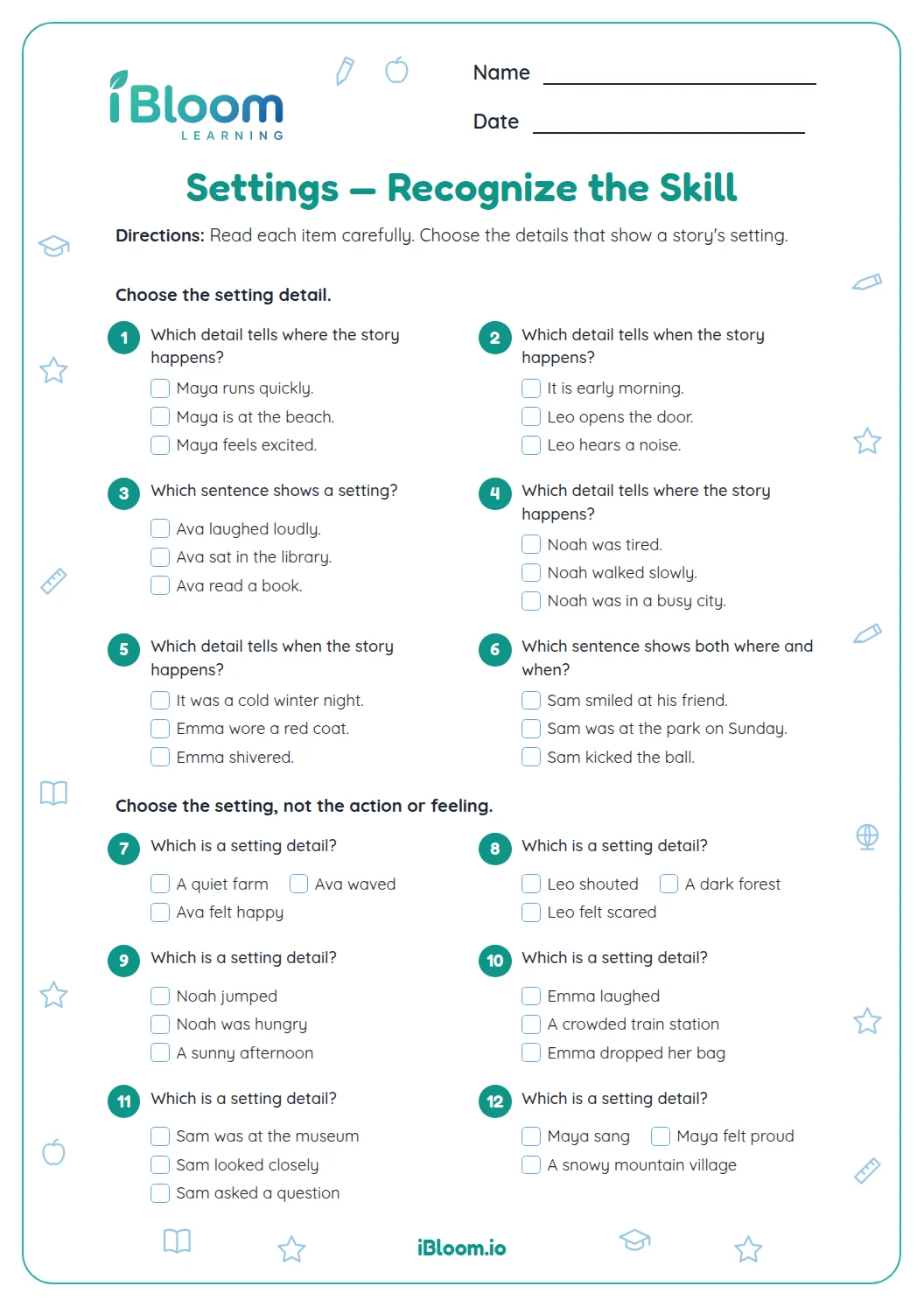
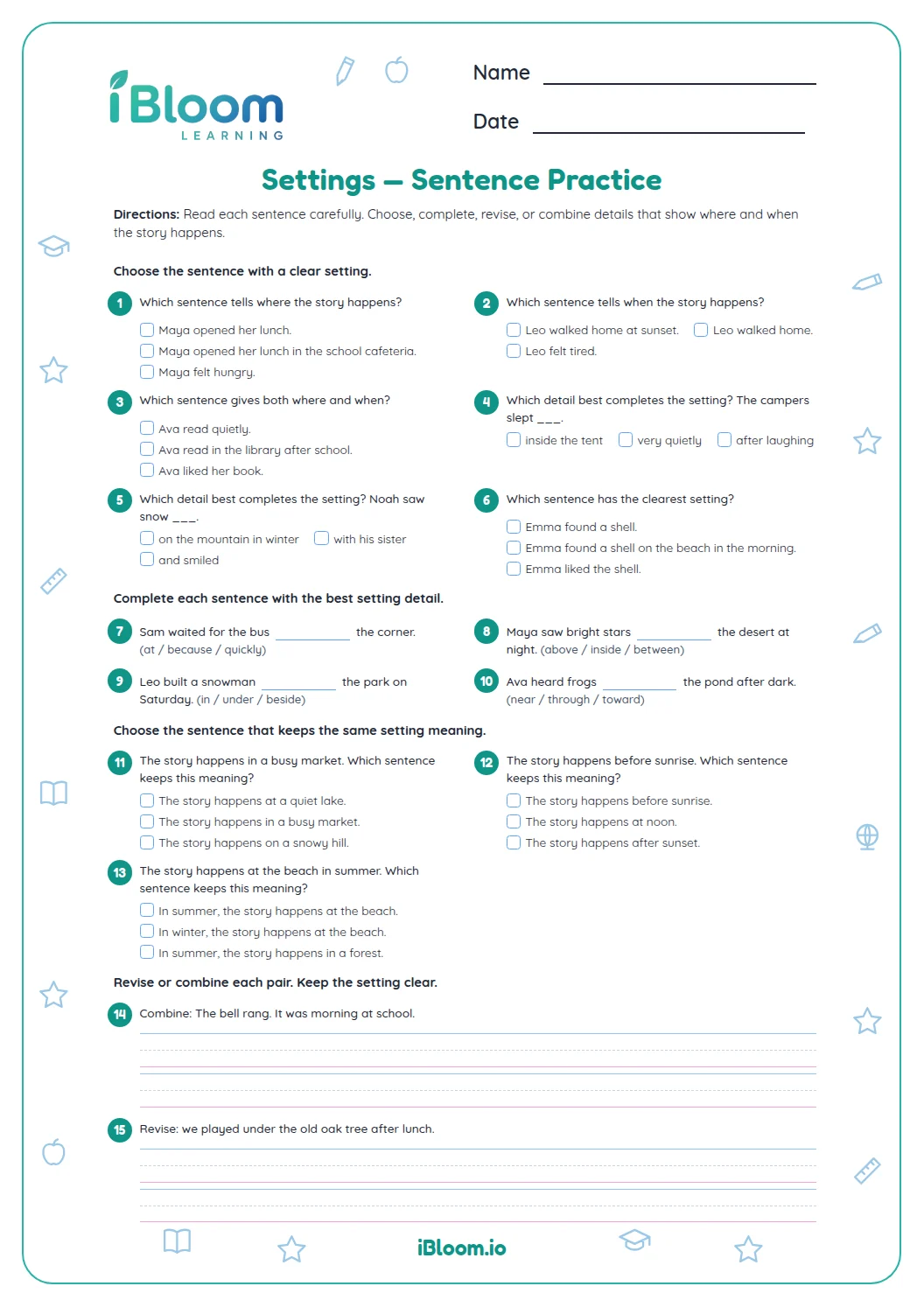
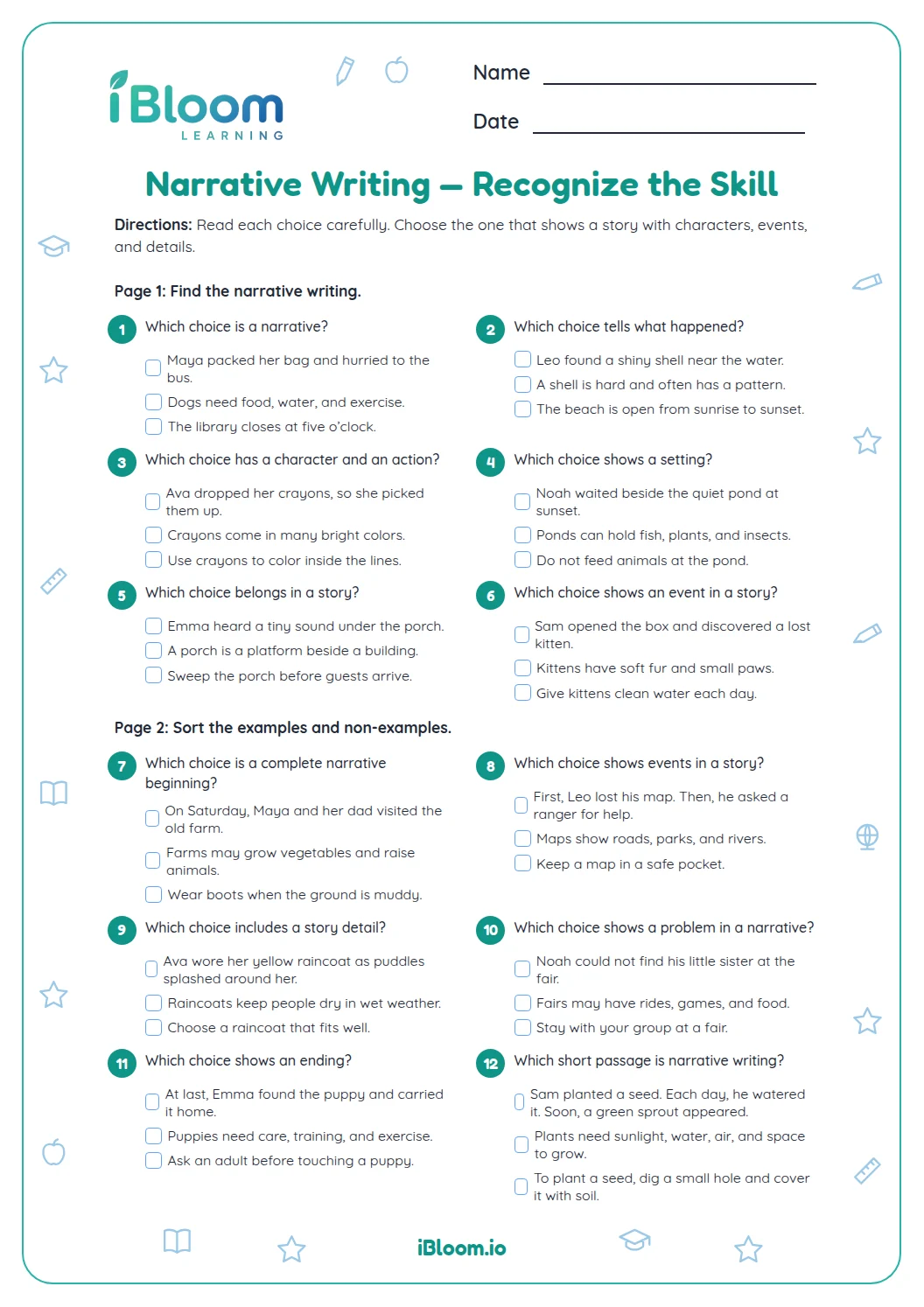
This Grade 3 writing worksheet moves from setting vocabulary into narrative openings. Students complete ten time and place clues, then write four short opening sentences that establish both. The answer key offers sample openings; students can use other specific details that fit each prompt. The writing practice supports CCSS W.3.3a.
Aligned to W.3.3a
What details establish a story setting?
A setting tells where and when story events happen. “In the schoolyard” gives a place, while “early one morning” gives a time. A clear opening can include both so readers know where the action begins.
How can a setting appear in an opening sentence?
The first part completes time and place clues. In the second part, students write four openings that establish settings of their own with concrete details.
- 1Prompt: A child arrives at a busy market.
- 2Time: early Saturday morning
- 3Place: the busy market
- 4Opening: Early Saturday morning, Maya arrived at the busy market.
How can a writer revise a setting detail?
Replace a broad phrase such as “outside” with a more specific place, then add a time clue. Reread the opening to make sure both details fit the event.
How to use this worksheet
- 1Underline the words that answer “when?” or “where?” in each Part A choice.
- 2For Part B, imagine the story moment and select one time and one place detail.
- 3Write one complete opening sentence that includes both details.
- 4Reread the sentence and check that the time and place are clear.
- 5Use the key as one model; your own relevant opening can differ.
Common mistakes and quick fixes
The mistake
Giving only a place or only a time.
The fix
Check that the opening answers both “where?” and “when?”
The mistake
Using an action as the setting.
The fix
Keep the action, but add a place and time around it.
The mistake
Writing a setting list instead of an opening sentence.
The fix
Combine the details into a complete sentence with a character or event.
Curriculum alignment
This worksheet gives learners practice with the listed standard.
Establish when and where a narrative happens in its opening.
On this sheet: Students identify setting clues and write narrative openings that establish when and where events happen.
Show the official wordingHide the official wording
Establish a situation and introduce a narrator and/or characters; organize an event sequence that unfolds naturally.
What to practice next
Make more practice
Further reading
Questions parents and teachers ask
What is a setting in a narrative?
A setting tells where and when a story happens. “In the schoolyard” gives a place, and “early one morning” gives a time. The worksheet helps students notice both kinds of detail and use them in opening sentences. A strong opening gives enough detail to picture the starting scene.
What does the writing part ask students to do?
Students write four one-sentence story openings. Each prompt gives a situation and asks for both a time and a place detail. The key provides one sample for each, while other clear, relevant openings can also work. They can invent details that fit.
How can a child check whether a setting is clear?
Reread the opening and ask “Where does this happen?” and “When does it happen?” If both answers are present, the setting is established. A specific detail such as “at the beach at sunset” is clearer than “outside sometime.” If one answer is missing, add a phrase that names it.
Does every answer have to match the key?
No. The six recognition questions have one keyed choice each. The writing prompts have sample answers, and a student’s sentence can differ if it is complete and includes a suitable time and place for the situation. The sample models the details, but students do not need to copy it.
Is an answer key included?
Yes. It shows the correct choices for the setting-clue questions and a sample opening for each writing prompt. Use the samples to check for time and place details, not to require the same character names or wording. The key shows one example, and student writing may use other wording.