



About this worksheet
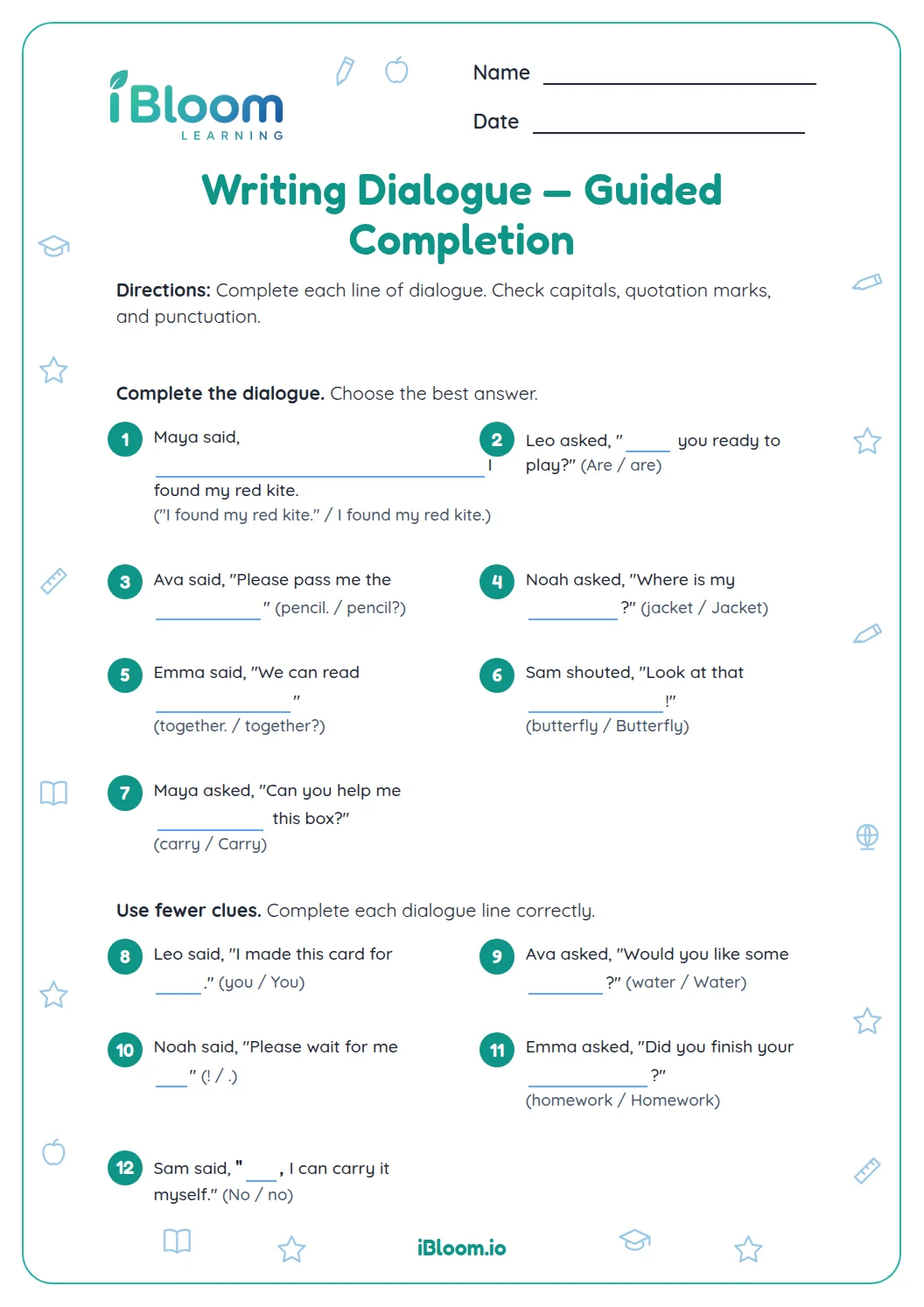
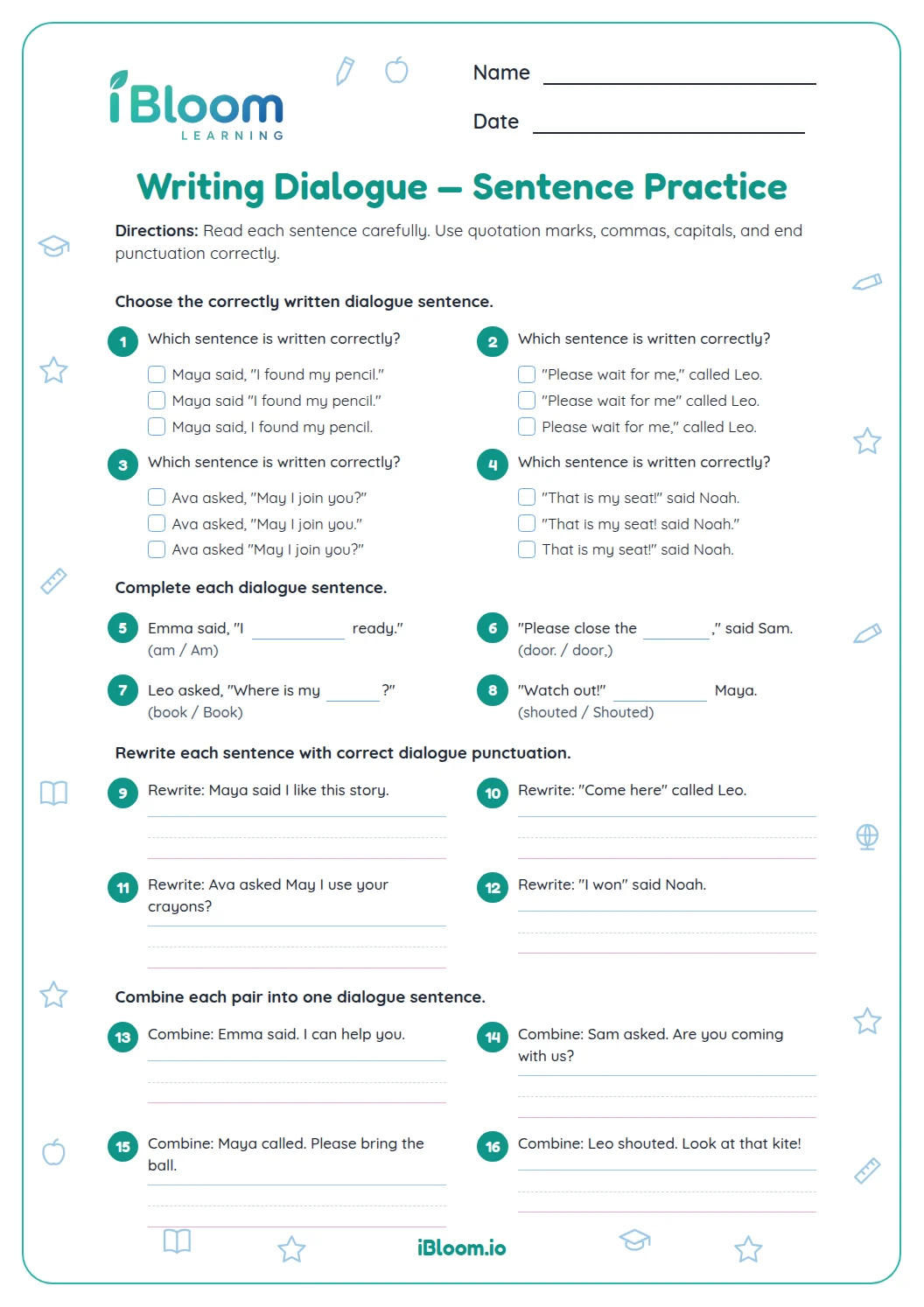
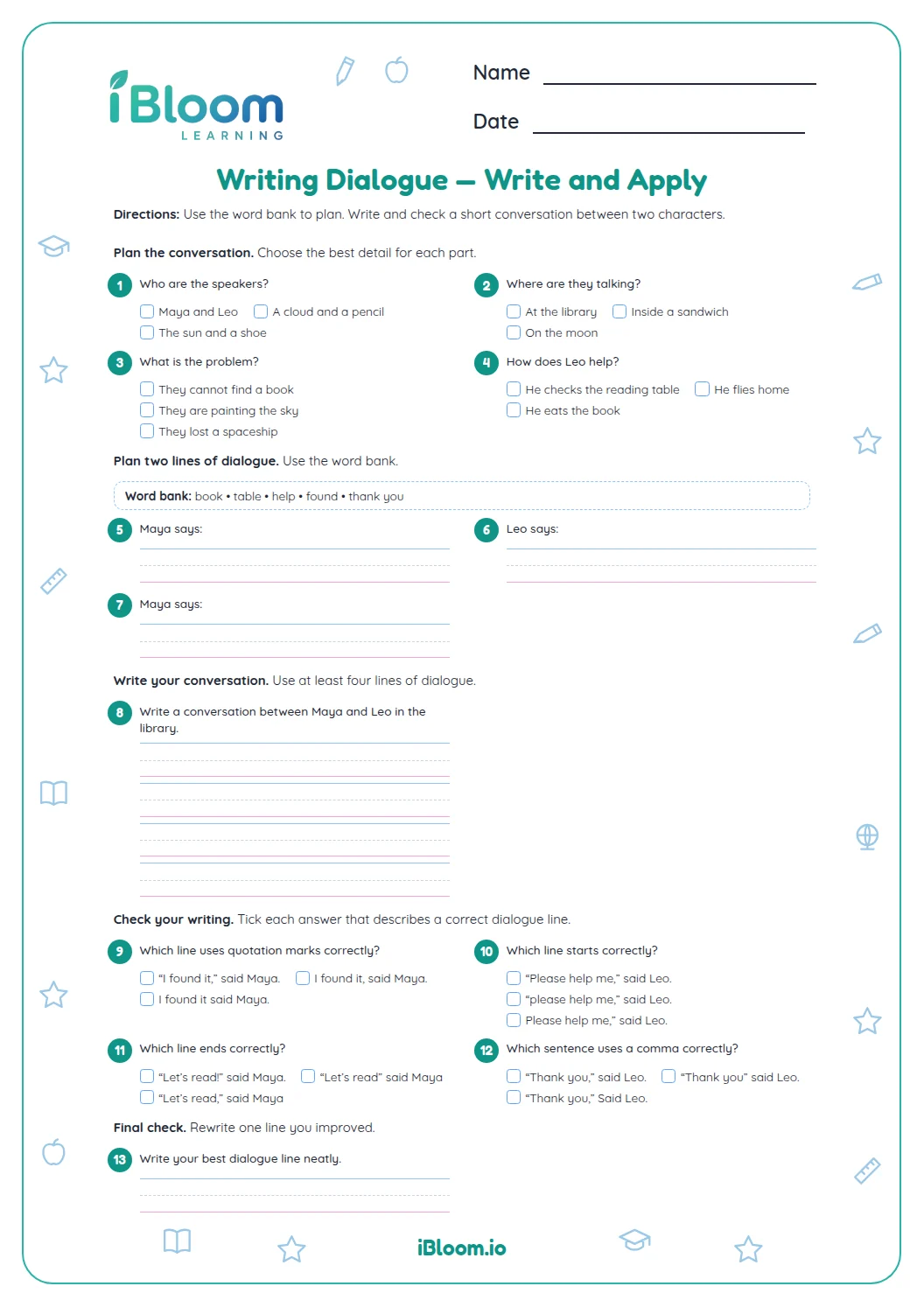
Students recognize correctly punctuated speech, revise lines with missing or misplaced marks, and write a brief exchange. Each task focuses on how spoken words and a speaker tag fit together.
Aligned to L.3.2.c
What is on this worksheet?
Part A asks students to recognize punctuation in spoken words.
Part B revises dialogue lines and speaker tags.
- Part A: build accuracy with the first set of questions
- Later parts add explanation and more demanding examples
- Answer key included
How should students approach the harder questions?
Part C asks students to write dialogue with a clear speaker turn.
- 1“I can help,” said Ava. The comma stays inside the quotation marks because the sentence continues with a speaker tag.
- 2A question mark or exclamation mark replaces the comma when it belongs to the spoken sentence.
Why practice this skill?
Punctuated dialogue helps readers follow who is speaking and how each spoken sentence ends.
How to use this worksheet
- 1Read the direction under each part before beginning.
- 2Work one question at a time and show calculations when a problem asks for them.
- 3Use the answer key to discuss any answer that was difficult to explain.
- 4Ask the student to make one new example using the same skill.
Common mistakes and quick fixes
The mistake
Putting punctuation outside the closing quotation mark.
The fix
Place commas and periods inside the closing quotation mark in standard American English.
The mistake
Leaving out the comma before a speaker tag.
The fix
When a statement continues with “said,” use a comma inside the quotation mark.
Curriculum alignment
This practice targets the stated Common Core skill for the grade.
Use commas and quotation marks in dialogue.
On this sheet: Students punctuate character speech with quotation marks, commas, and sentence-ending marks.
Show the official wordingHide the official wording
Use commas and quotation marks in dialogue.
What to practice next
Make more practice
Questions parents and teachers ask
Where does a question mark go in dialogue?
In standard American English punctuation, commas and periods go inside the closing quotation mark. A speaker tag such as “said Luis” follows the quoted speech. When a spoken statement continues with a tag, place a comma inside the quotation marks before the tag.
Does every new speaker get a new line?
When the punctuation mark belongs to the spoken words, it goes inside the closing quotation mark. A question ends with a question mark, and an exclamation ends with an exclamation point. Do not add a comma after either one before the speaker tag.
Can an exclamation point go with a speaker tag?
A question mark goes inside the quotation marks when the character asks a question. For example, in “Where is my hat?” asked Nia, the spoken words ask the question. The speaker tag does not change the question mark’s position.
What should I check when I write dialogue?
In a story, begin a new paragraph when a different character starts speaking. This gives each speaker a clear turn and helps readers follow the conversation. The printable questions focus on punctuation, while a longer story also uses paragraph breaks.