






About this worksheet
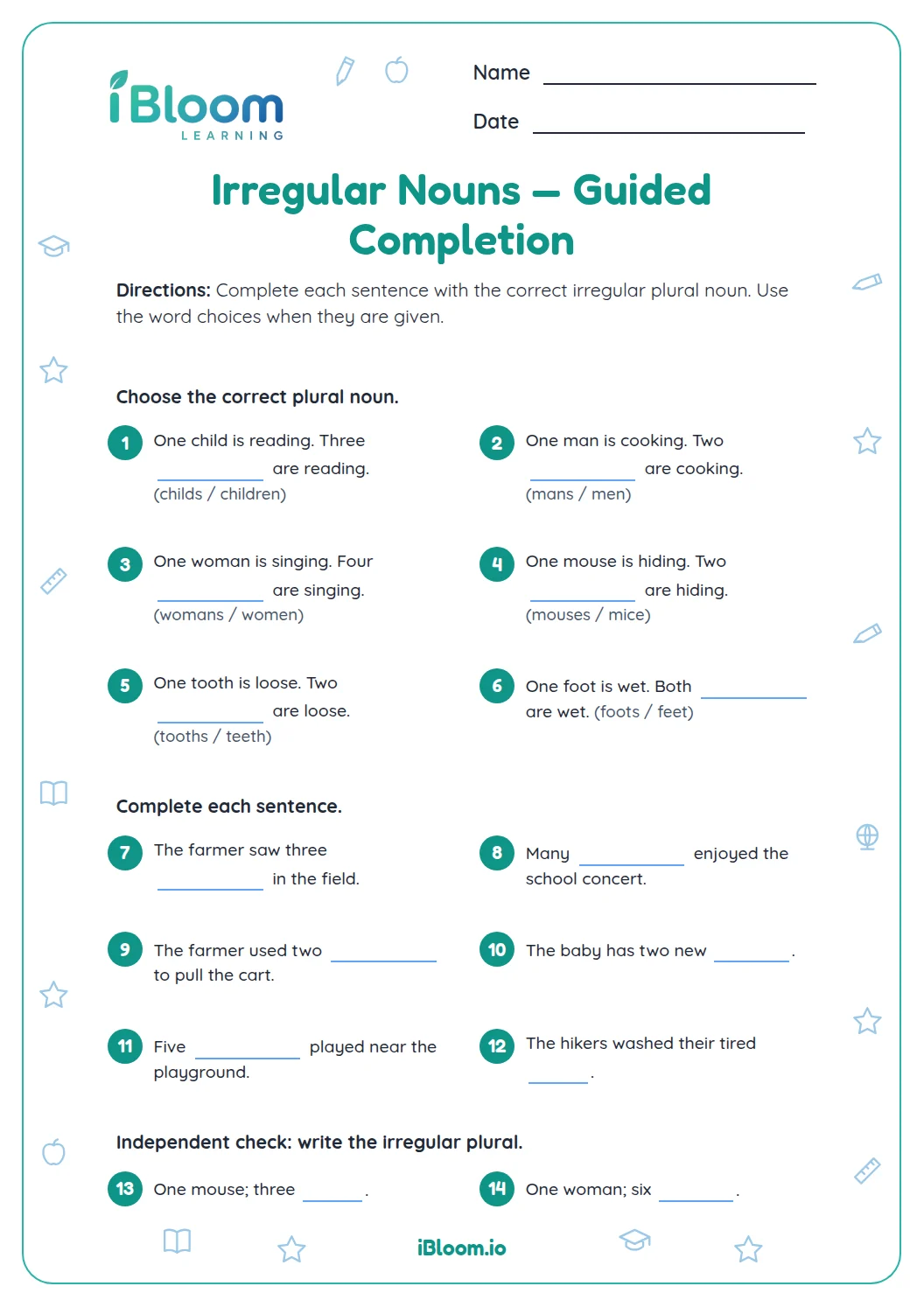
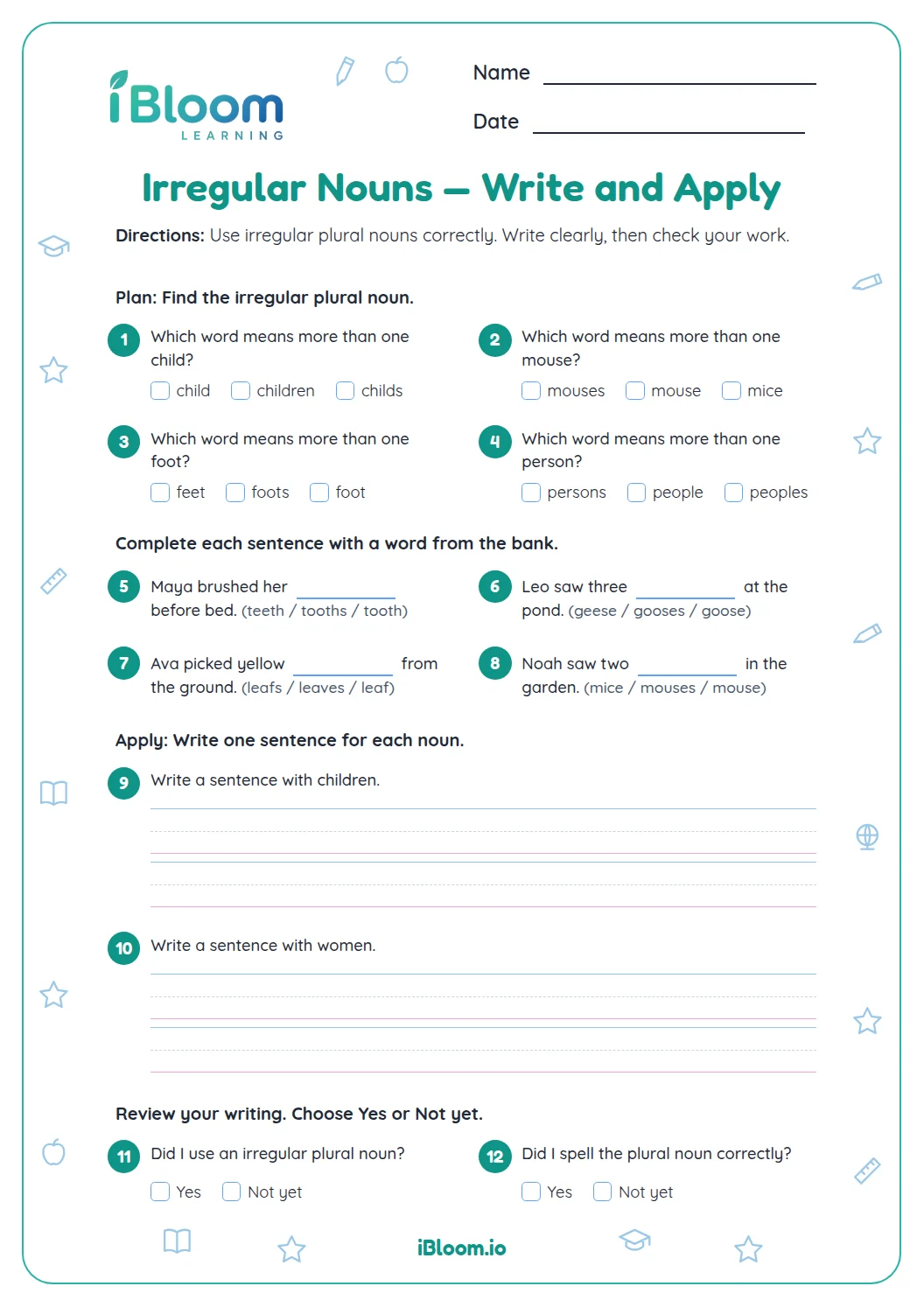
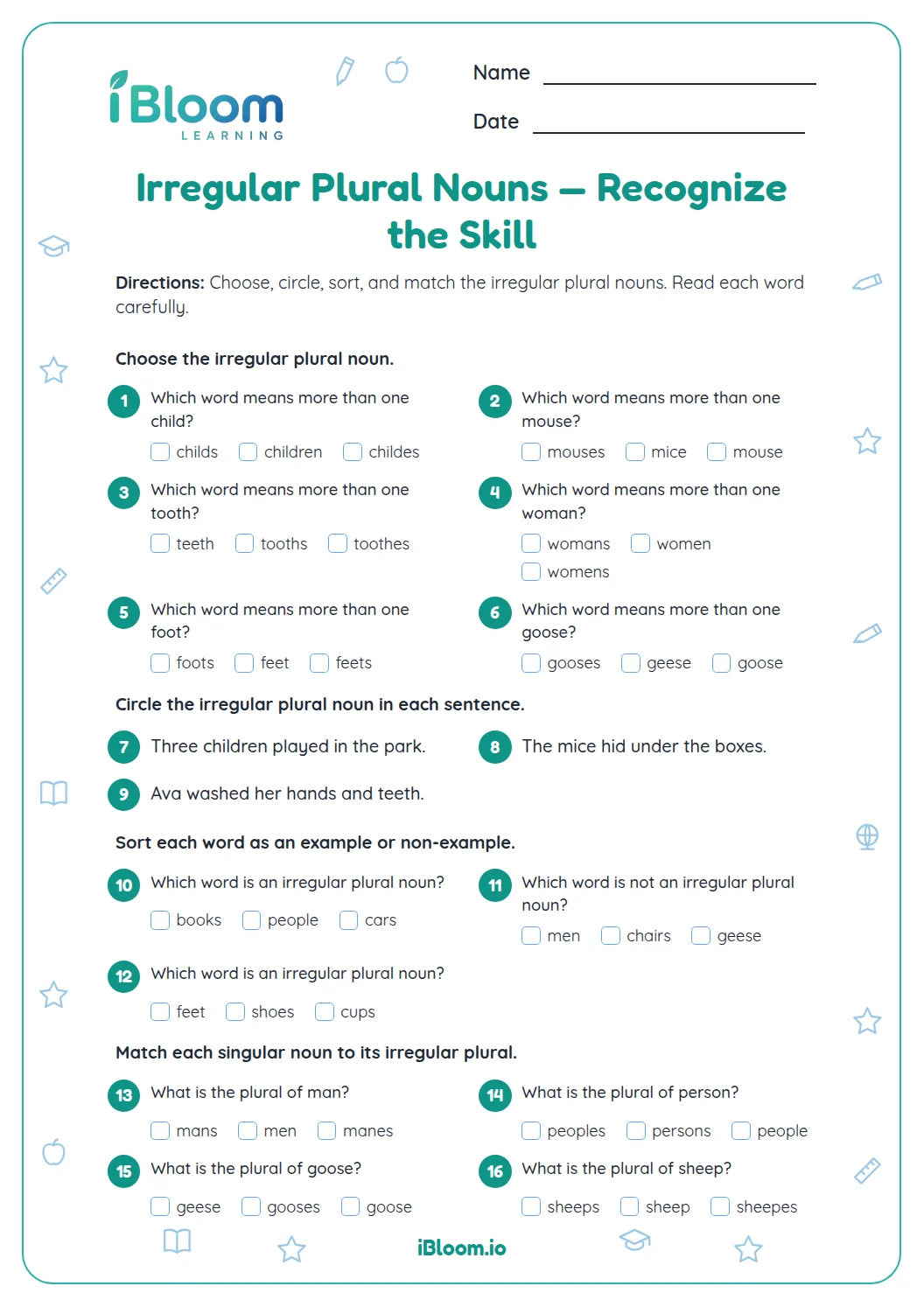
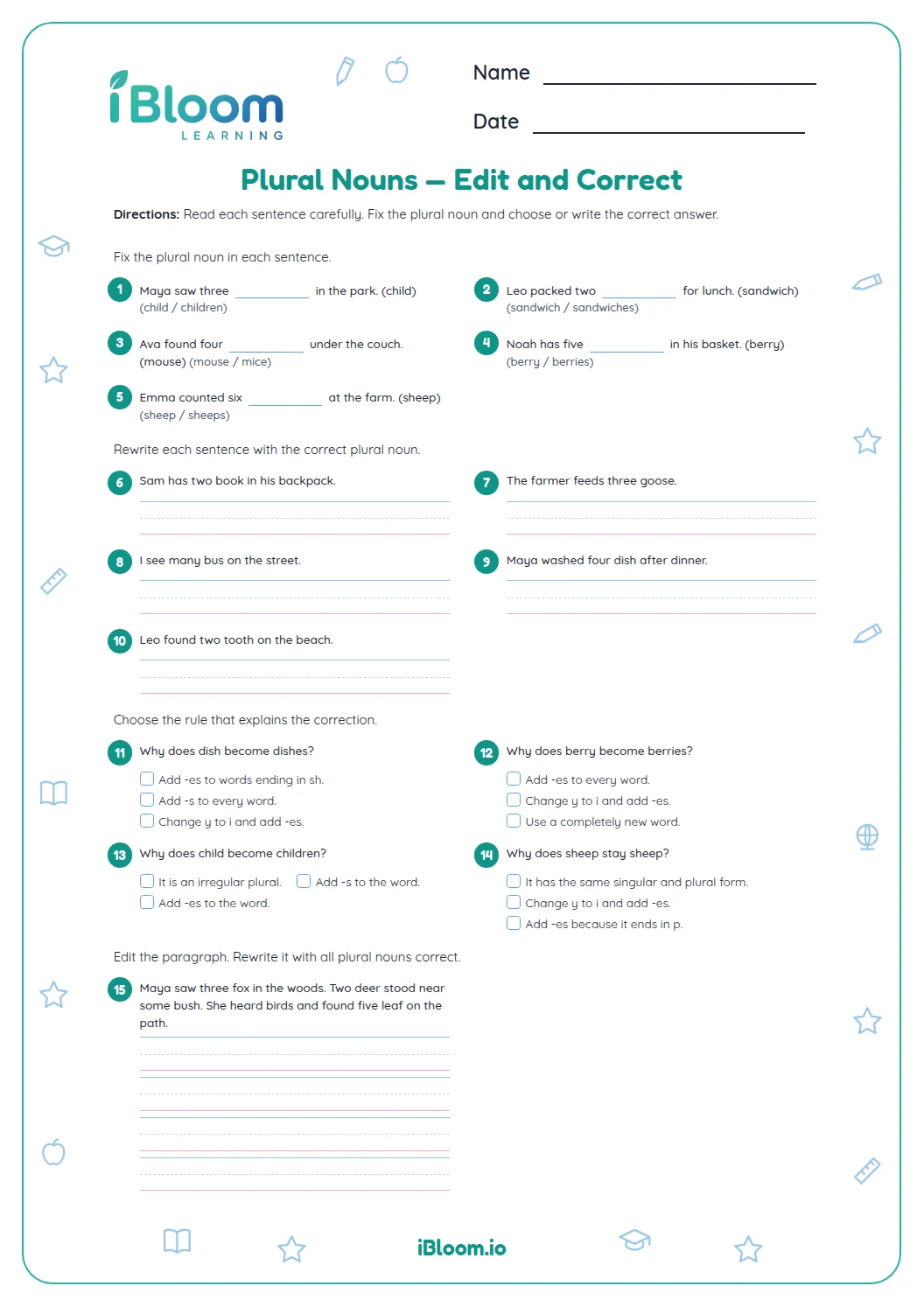
This Grade 3 worksheet reviews irregular plural nouns in three ways: write the changed form, select a plural that fits a sentence, and complete quick singular-to-plural pairs. It includes familiar changes such as child to children and mouse to mice. The answer key lists each form for easy checking.
What makes a plural noun irregular?
An irregular plural does not follow the usual pattern of adding -s or -es. The word may change inside, as in foot to feet, or take a different form, as in child to children.
- 1One mouse → mice
- 2The plural changes the word; it is not “mouses.”
How does a sentence help you choose the plural?
Words such as two, several, and many signal that the noun should name more than one. Read the whole sentence after choosing a form to make sure the meaning and grammar fit.
How can I remember the changed forms?
Group pairs that share a change, then say them aloud: tooth/teeth and foot/feet. A short personal list of tricky pairs can help children revisit the forms they miss.
How to use this worksheet
- 1Read the singular noun carefully.
- 2Say the plural aloud if you know it.
- 3Check whether the word changes instead of adding -s.
- 4In a sentence, use the quantity clue to decide singular or plural.
- 5Review missed pairs by saying both forms together.
Common mistakes and quick fixes
The mistake
Adding -s to every noun, such as “childs.”
The fix
Learn the changed form as a pair: child, children.
The mistake
Using “mouses” for the plural of mouse.
The fix
Use mice for the animal plural; check the pair aloud.
The mistake
Choosing a singular after “several.”
The fix
Look for a quantity word and make the noun plural.
What to practice next
Questions parents and teachers ask
What is an irregular plural noun?
An irregular plural noun names more than one but does not follow the usual add-s pattern. Some words change inside, such as foot to feet; others use a different form, such as child to children. This worksheet practices those changes in word pairs and short sentences.
Does mouse become mouses or mice?
For the animal, mouse becomes mice. That changed form appears in the write-the-plural part and in a short sentence choice. Children can say “one mouse, three mice” aloud to connect the singular and plural forms while noticing that the word changes.
How do I know when a sentence needs a plural?
Look for a quantity word such as two, several, or many. These clues tell the reader that the sentence means more than one. Then choose the matching plural form and read the sentence aloud to check that it makes sense.
Are all plural nouns irregular?
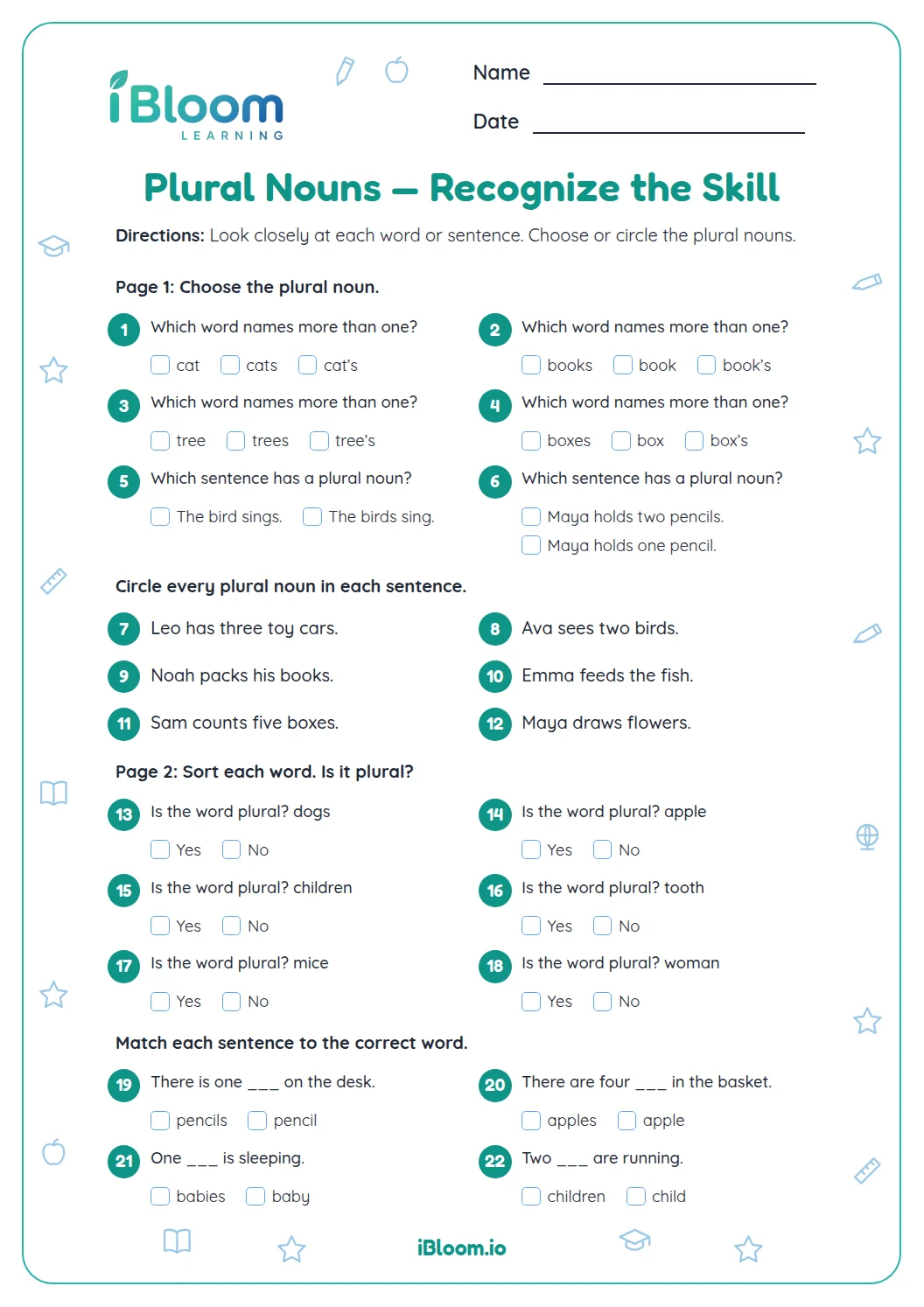
No. Many plural nouns follow regular spelling patterns, such as adding -s or -es. This page focuses on forms that change in less predictable ways, including people, teeth, and geese. A linked plural nouns worksheet gives practice with regular endings.
How many questions are on the sheet?
There are 17 questions across three parts: eight written plural forms, five sentence choices, and four mixed singular-to-plural completions. The separate answer key gives the intended form for each question, so an adult can review each set quickly. Adults can compare the child’s form directly with the listed answer.