
About this worksheet
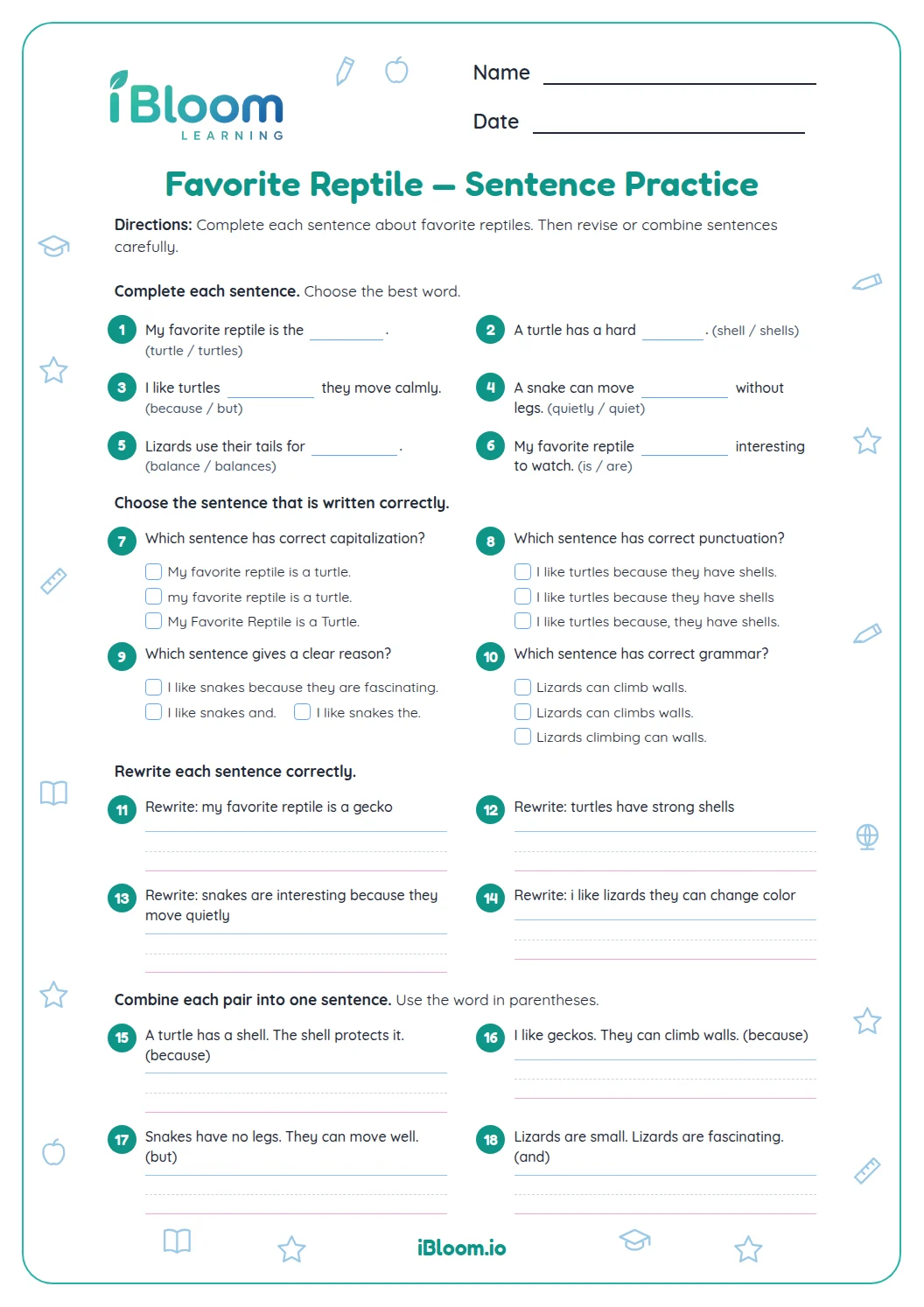
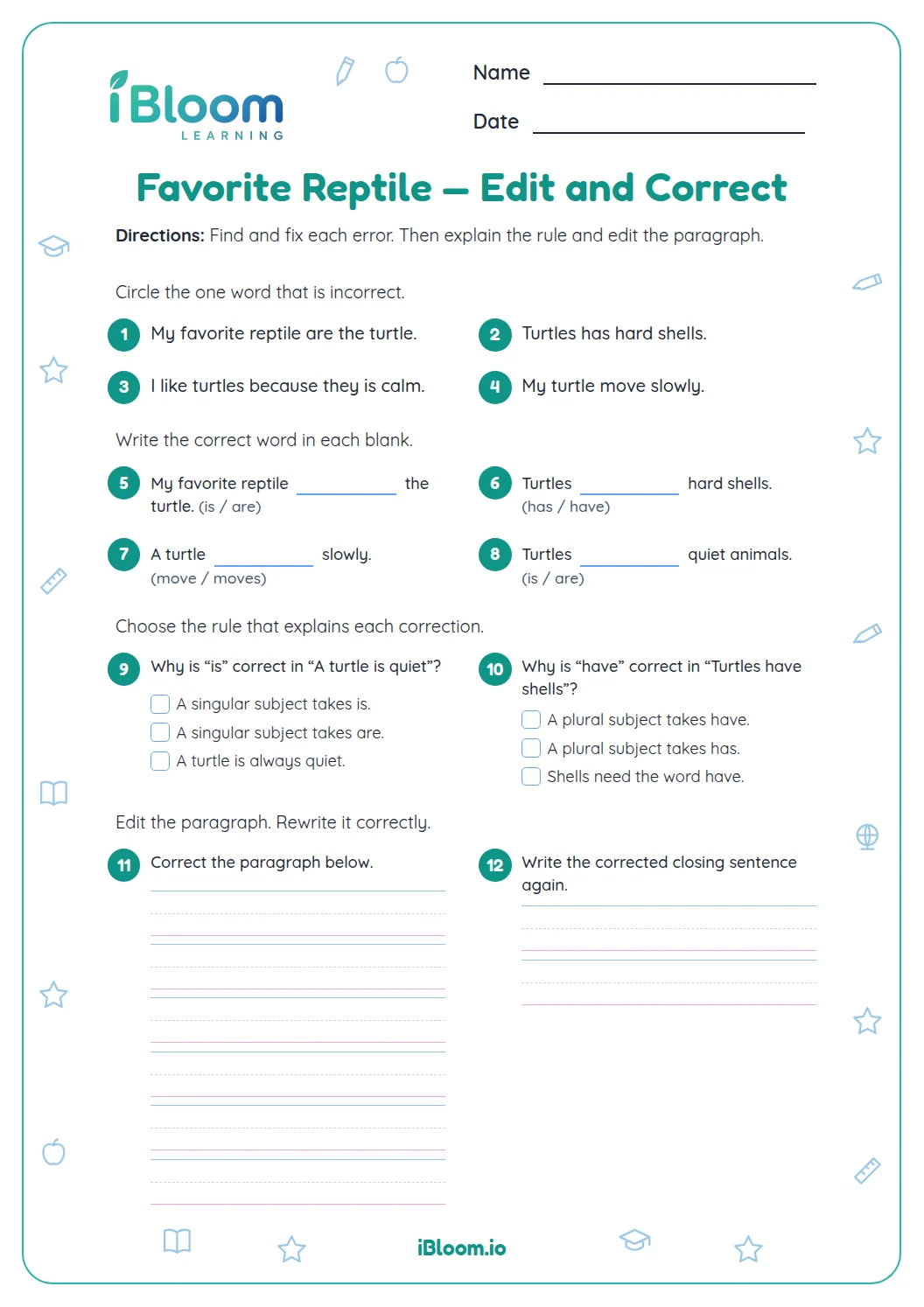
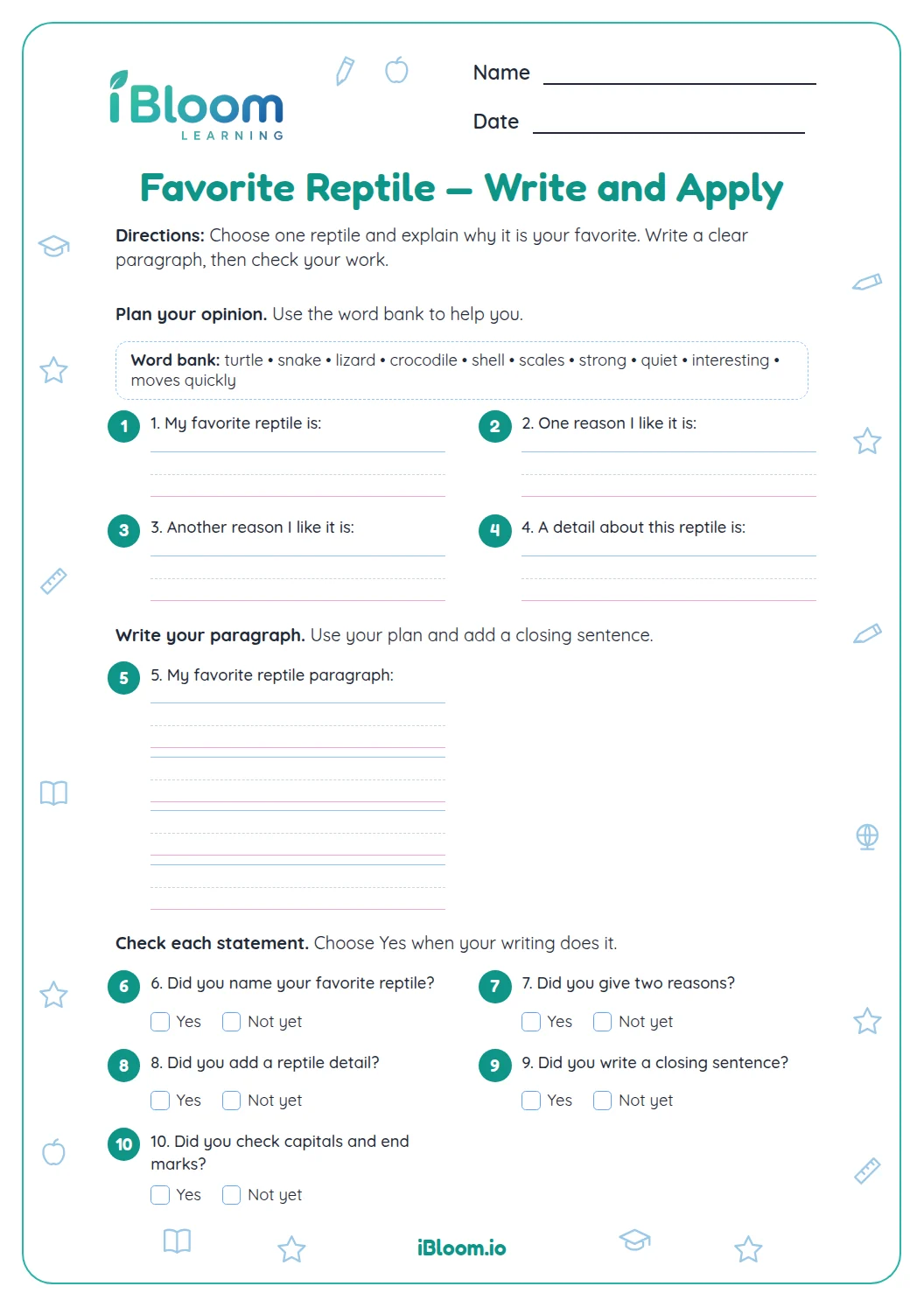
This free Grade 3 worksheet helps children explain a favorite-reptile opinion with reasons and a supporting detail. Four multiple-choice questions review opinions, reasons, details, and endings. Six blanks name writing parts and complete a connected snake example, followed by four one-sentence prompts for an opinion response. Children state an opinion, support it with a reason and detail, add a different reason, and close by returning to the opinion. Common Core W.3.1b and W.3.1c guide the work on supporting opinions and linking ideas. The answer key includes fixed answers and sample sentences.
Aligned to W.3.1b and W.3.1c
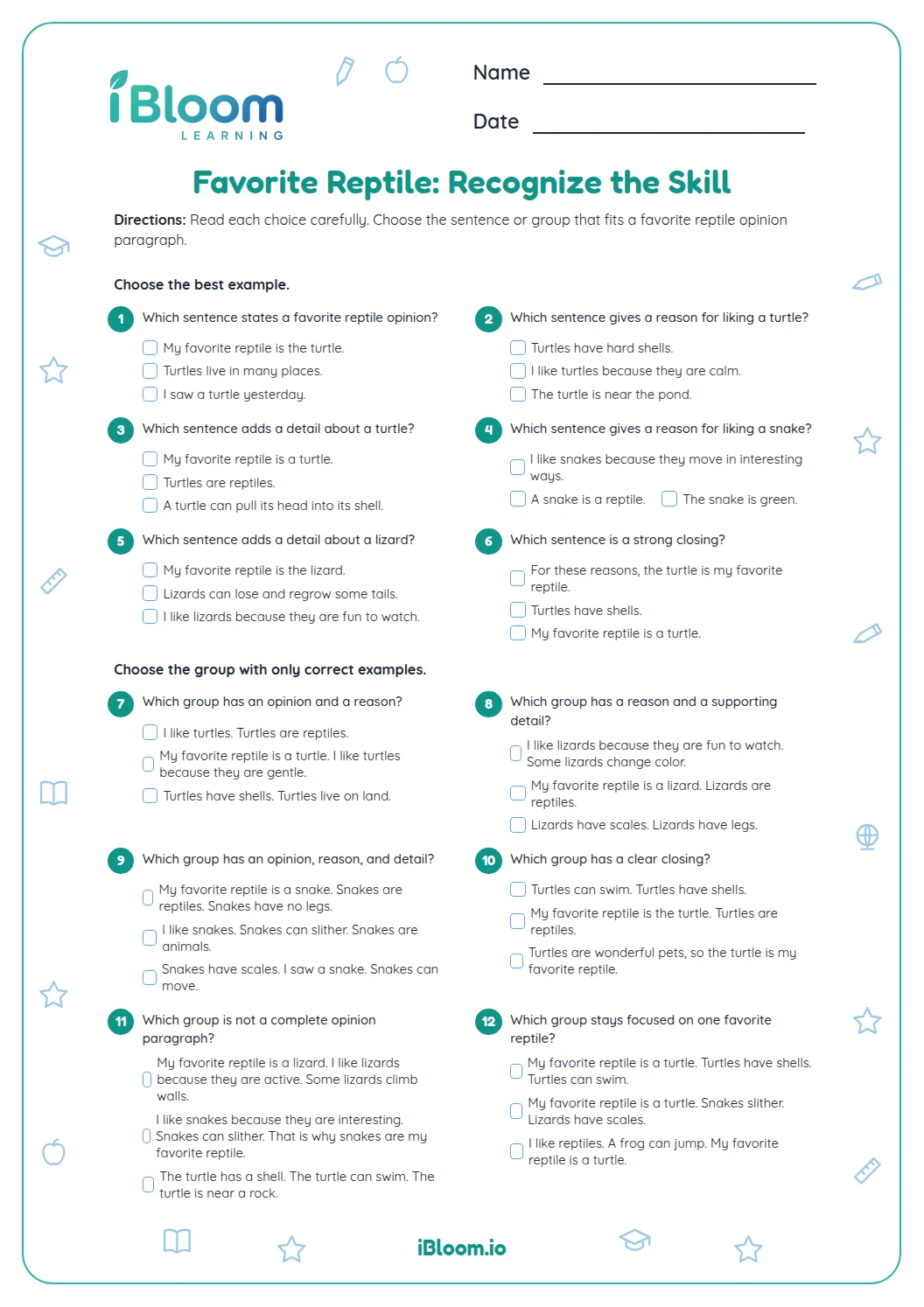
What do the first choices review?
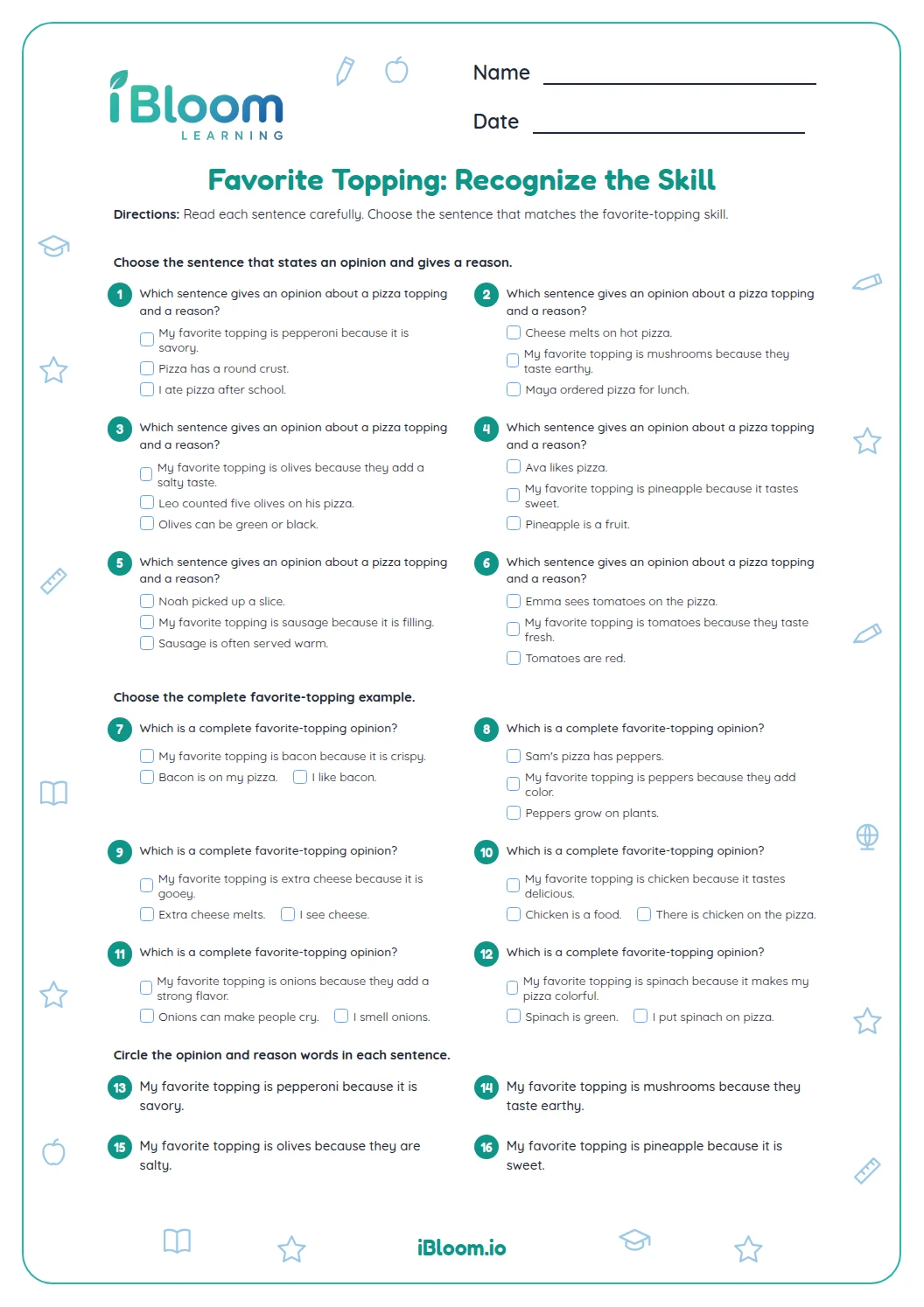
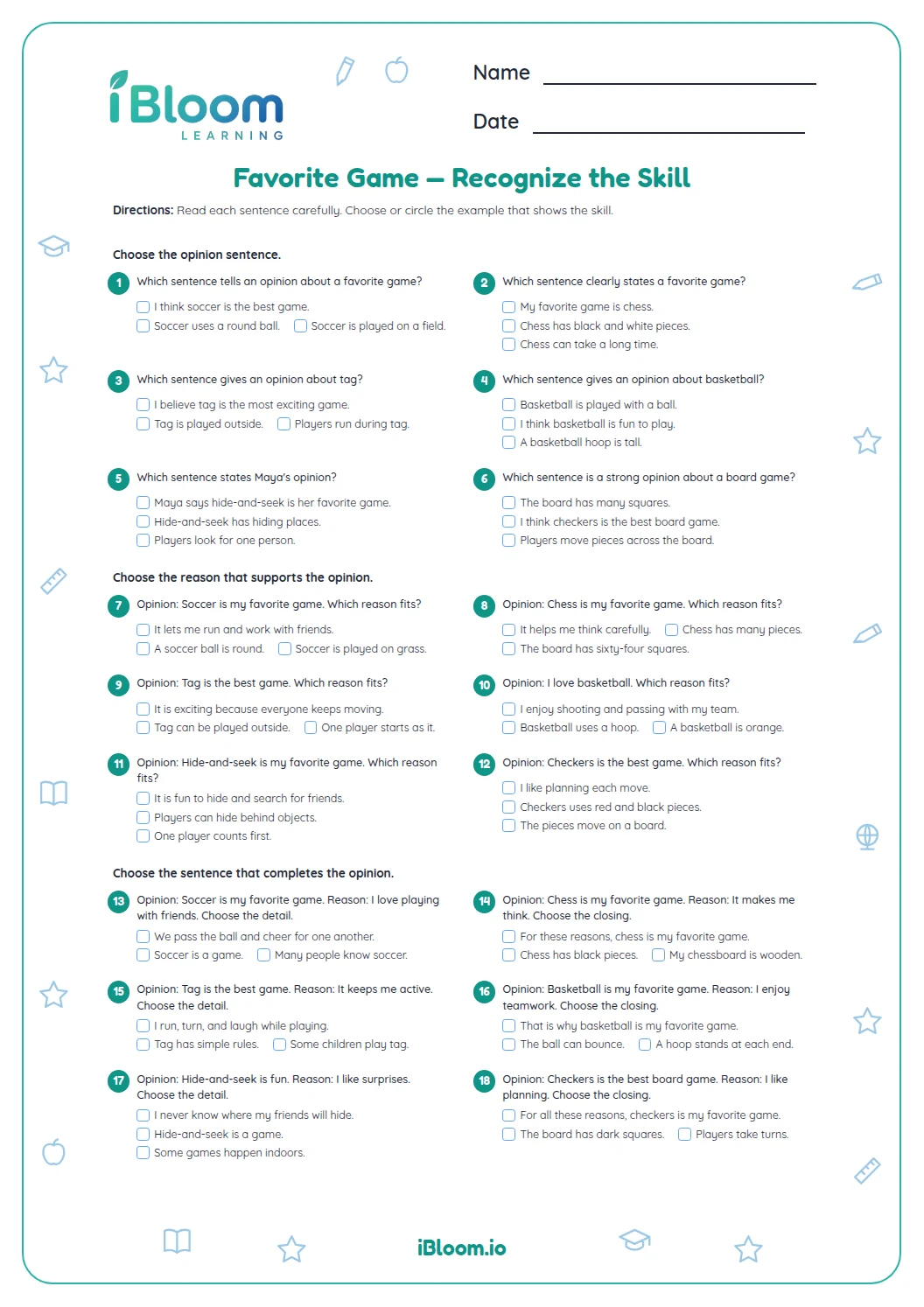
Part A has four choices about stating an opinion, selecting a reason, adding a detail, and writing a closing.
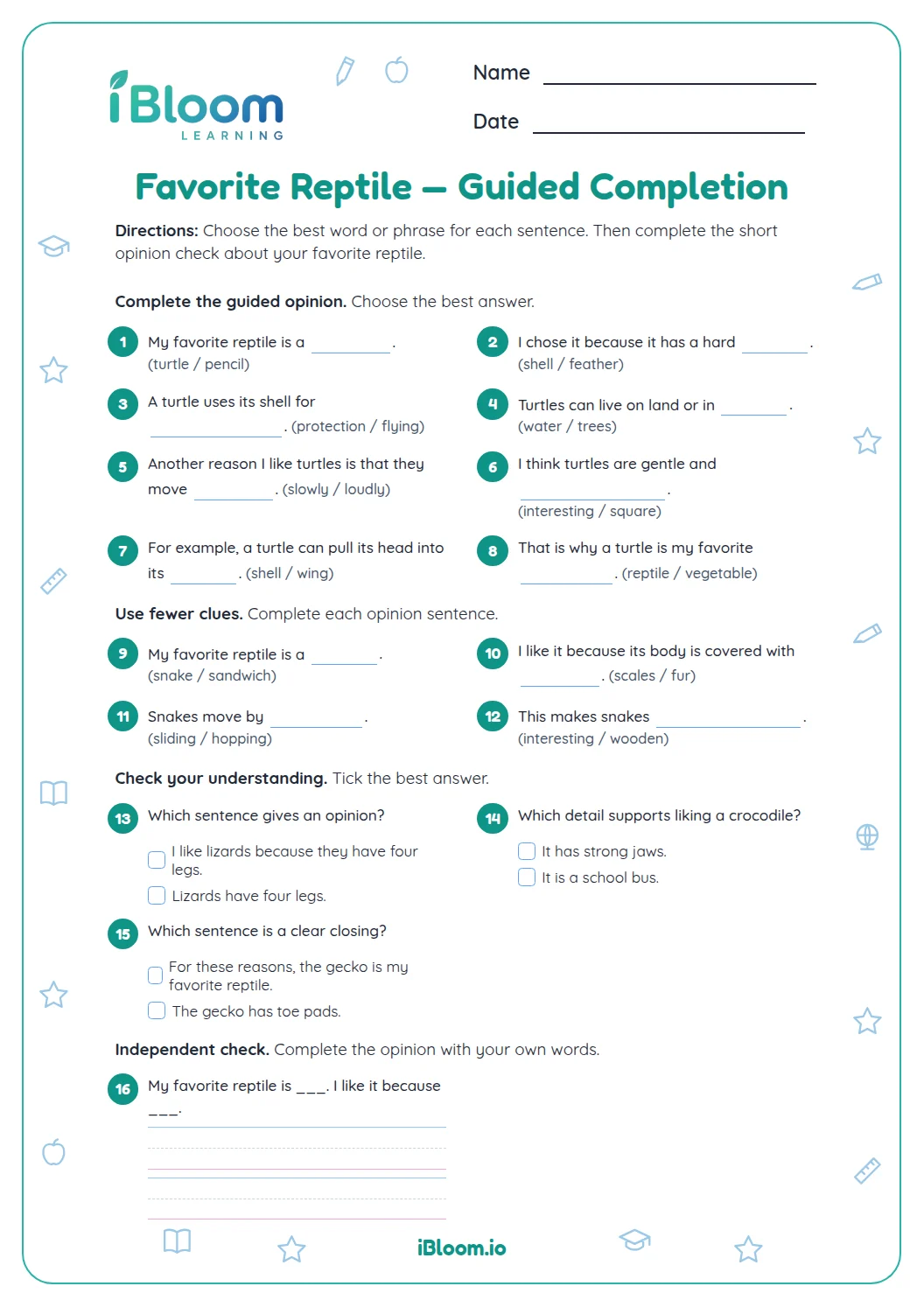
How do the word banks build an opinion?
Part B names two writing parts: an opinion and an ending. Part C uses four words to complete a short snake opinion, including because for a reason and legs for a movement detail.
- 1I like snakes ___ they move in an unusual way.
- 2A reason explains why the writer likes snakes.
- 3Answer: because
How do the final sentences build a response?
Part D asks for four connected sentences: a clear opinion, a reason linked with because and a specific detail, a different reason beginning with Also, and an ending that returns to the opinion.
- 1I like turtles because their shells have bright yellow patterns.
- 2Reason: the shells appeal to the writer.
- 3Detail: some shells have yellow patterns.
How to use this worksheet
- 1Read Part A and identify the opinion-writing move in each choice.
- 2Use each word once in Part B to name the writing parts.
- 3Complete the four blanks in Part C using the word bank.
- 4Write a clear opinion sentence in Part D.
- 5Add a reason with a detail, another reason, and a closing sentence.
- 6Use the answer key to review the choices and compare the sample sentences.
Mistakes to check together
The mistake
Repeating “I like turtles” as a reason.
The fix
Name a feature or action that explains the preference, such as their slow walk.
The mistake
Giving a second opinion instead of an example.
The fix
After a reason about beautiful shells, describe a particular color or pattern.
The mistake
Starting a new topic in the ending.
The fix
Return to the chosen reptile and the opinion supported by both reasons.
Common Core alignment
Give two specific reasons supporting a favorite-reptile opinion.
On this sheet: Part A reviews reasons and details; Part D asks children to state an opinion and support it with reasons and a detail.
Show the official wordingHide the official wording
Provide reasons that support the opinion.
Connect a reptile opinion and its reasons with linking words.
On this sheet: The word banks and Part D use because and Also to link reasons and details.
Show the official wordingHide the official wording
Use linking words and phrases (e.g., because, therefore, since, for example) to connect opinion and reasons.
What to practice next
Make more practice
Further reading
Questions parents and teachers ask
Does my child have to choose a turtle?
No, your child may choose any reptile and give reasons for that choice. The key uses turtles to show how the five sentences can connect. A child choosing a snake, lizard, or another reptile should keep that same choice throughout Part C and explain two different reasons for liking it.
What counts as a strong reason on this sheet?
A strong reason explains something specific the child likes about the chosen reptile. A shell pattern or an interesting way of moving can support a preference. Ask the child to explain why the detail matters to them, and check that the second reason adds something different from the first.
How much writing is required?
Part D asks for four connected sentences across four prompts. Children state an opinion, support it with a reason and specific detail, add a different reason, and write an ending that returns to the opinion. Parts A–C review the writing moves and words that connect the ideas.
How is a supporting detail different from a reason?
A reason explains why the writer prefers the reptile, while a detail makes that reason more specific. In the key, a turtle’s shell pattern gives a specific detail for liking turtles. Question 12 asks children to connect a reason and detail in one sentence.
How should I check the open writing questions?
Check whether the five sentences support one clear opinion. Look for the same reptile throughout, two relevant reasons, a specific example, the requested linking words, and an ending that returns to the preference. The sample key demonstrates those features; your child’s wording and choice can differ while meeting the same goals.