


About this worksheet
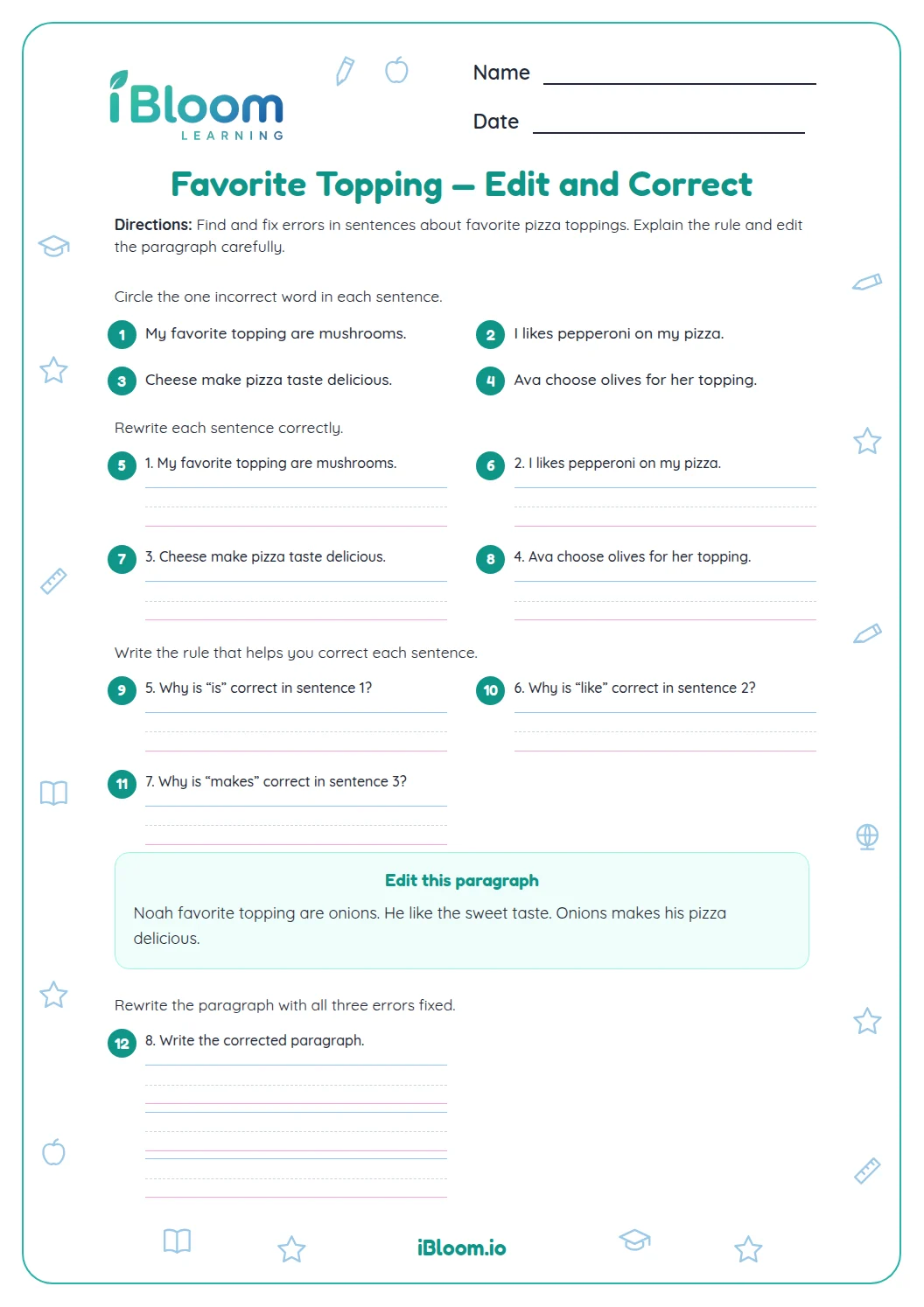
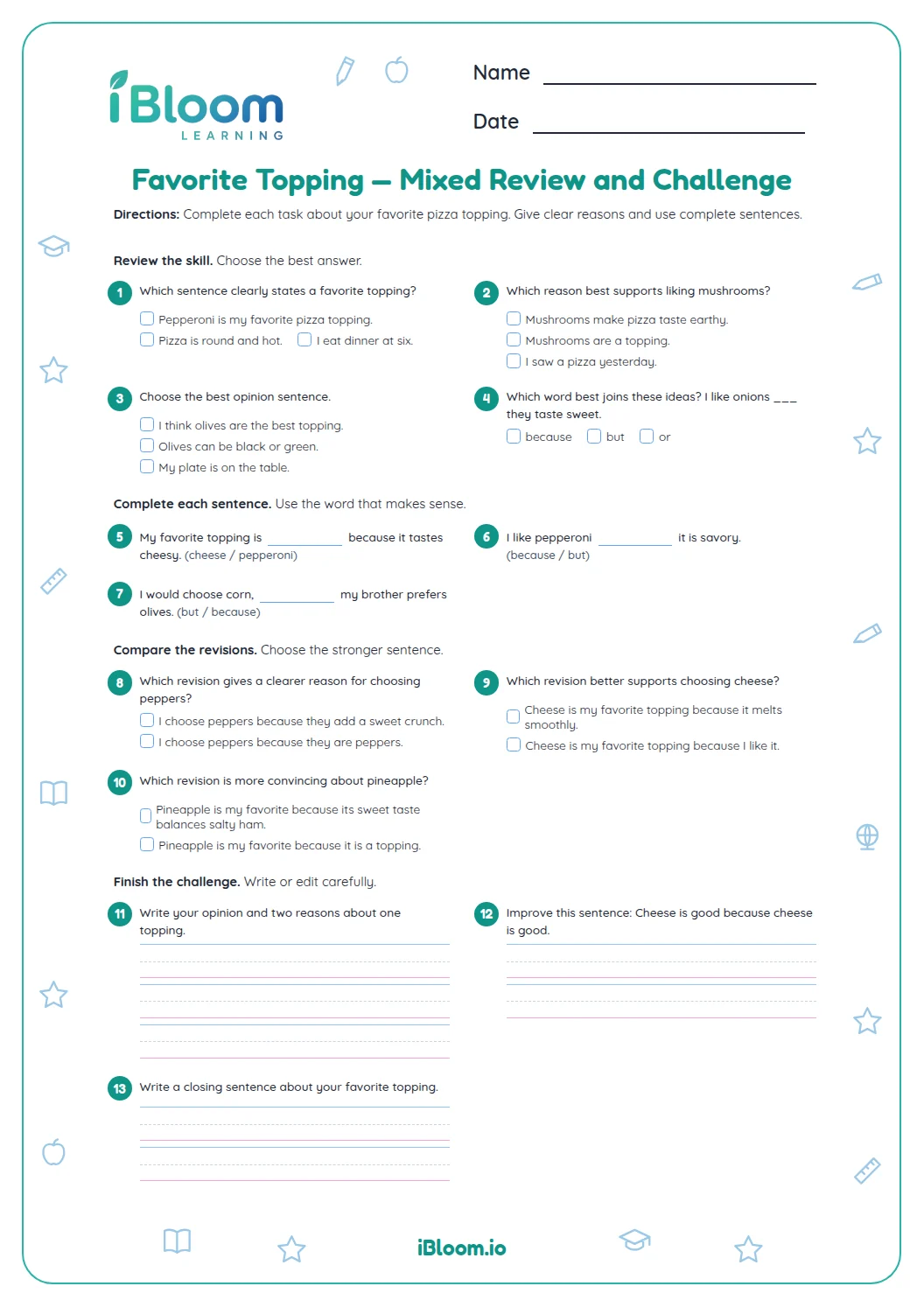
This free Grade 3 writing worksheet guides students through a short opinion about a favorite pizza topping. Students identify a clear opinion and supporting reason, complete sentence frames, add a specific detail, and write a closing thought. Responses can name different toppings, so the answer key gives sample answers rather than one required preference. The activities align with CCSS W.3.1.a and W.3.1.b: introduce a topic, state an opinion and provide reasons that support it.
Aligned to W.3.1.a and W.3.1.b
What makes a sentence an opinion with a reason?
An opinion tells what the writer thinks or prefers. A reason explains why. “Pepperoni is the best topping because it tastes savory” states a preference and supports it with a taste detail. A fact such as “The oven is hot” does not explain a topping preference.
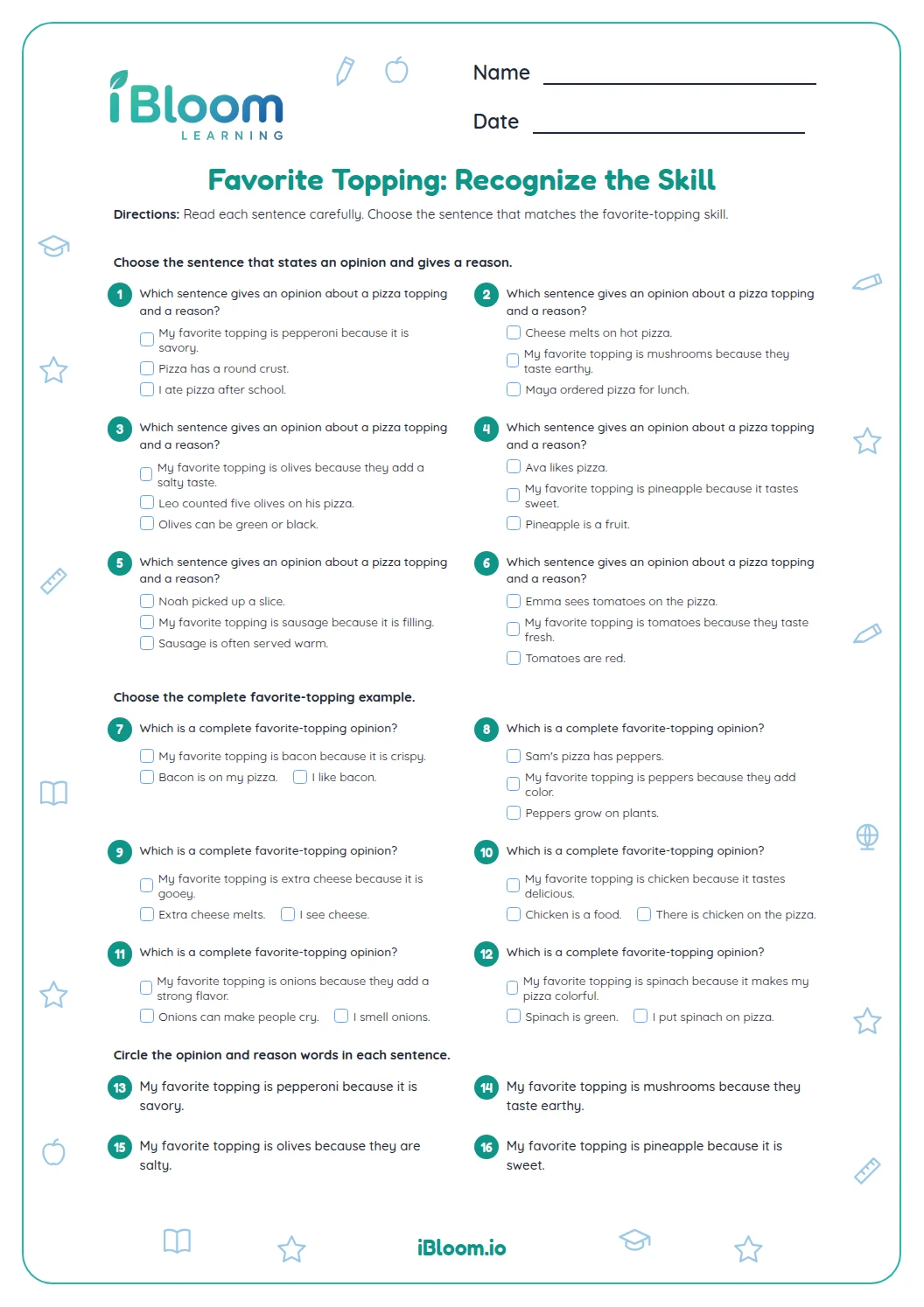
Question 1 asks students to select the sentence that states an opinion. “My pick” signals a personal preference.
- 1Question 1: Pepperoni is my pick.
- 2“My pick” states a personal preference about the topping.
How do the sentence frames guide the writing?
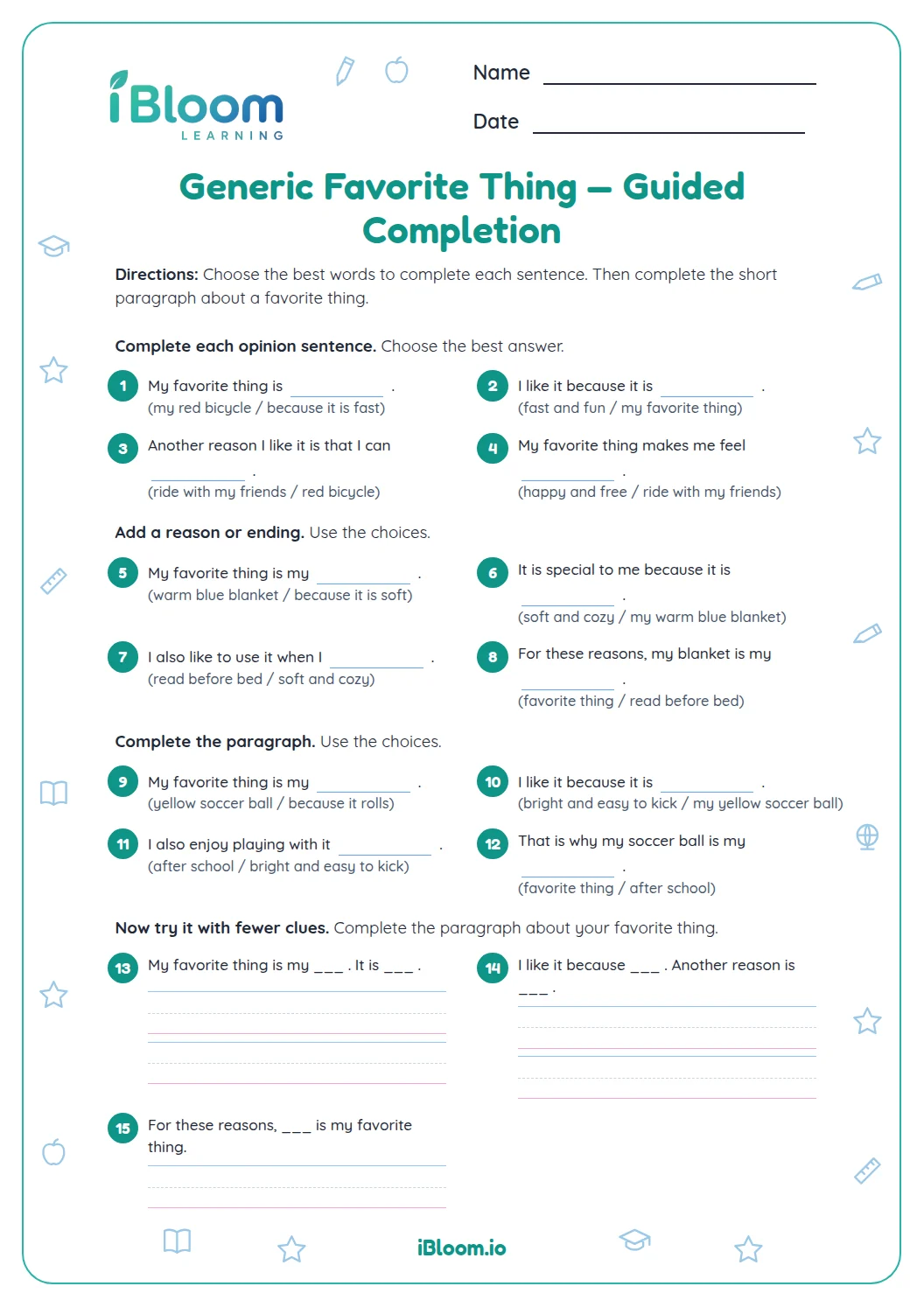
A frame gives a writer a starting point while leaving room for a specific thought. The blanks in Part B ask for a taste, a reason, an example or a conclusion. Choose details that make sense for the topping being described.
For question 6, the frame says mushrooms are a good choice ___ they add a hearty flavor. Because connects the opinion to its reason.
What makes a reason stronger?
A specific detail tells the reader more than “it is good.” Writers can name a flavor, texture or way a topping works with the rest of the pizza. A second reason should add a new point instead of repeating the first one.
Question 10 asks for another reason. Add a fresh detail rather than repeating the first reason.
How should an opinion paragraph end?
A closing sentence gives the reader a sense of finish and connects back to the opinion. It can restate the chosen topping and briefly remind the reader why it was selected.
Question 14 asks for a closing sentence. “For these reasons, mushrooms are my favorite pizza topping” returns to the preference and signals that the reasons are complete.
How to use this worksheet
- 1Read the prompt and name the preference or writing move it asks for.
- 2For a reason, explain why the topping appeals to you.
- 3Use a specific taste, texture or pairing detail.
- 4Use because or also to connect an opinion and its reasons.
- 5End with a sentence that returns to the favorite topping.
- 6Compare open responses with the sample answers; a different sensible reason can also work.
Common mistakes and quick fixes
The mistake
Writing a fact instead of a preference.
The fix
Use words such as I think, I prefer or my favorite to make the opinion clear.
The mistake
Repeating the opinion as the reason.
The fix
Add a why: name a flavor, texture or pairing that supports the choice.
The mistake
Ending with a new reason but no sense of closure.
The fix
Restate the chosen topping and signal that the opinion is complete.
Common Core alignment
The frames help students state an opinion and support it with reasons.
Introduce a favorite-topping topic, state an opinion and organize reasons.
On this sheet: Students complete a topic-and-opinion frame and choose a plan for their reasons.
Show the official wordingHide the official wording
Introduce the topic or text they are writing about, state an opinion, and create an organizational structure that lists reasons.
Complete reason sentences that support an opinion about a topping.
On this sheet: The guided writing items ask students to add relevant reasons and supporting details.
Show the official wordingHide the official wording
Provide reasons that support the opinion.
What to practice next
Make more practice
Further reading
Questions parents and teachers ask
What is an opinion in writing?
An opinion tells what a writer thinks or prefers. “Pepperoni is my favorite topping” states a preference; a reason such as “because it tastes savory” explains why. Questions 1–4 help students recognize the parts before they complete their own frames.
Can students choose a topping other than pepperoni?
Yes. The open responses invite a student to choose any favorite topping and explain the choice. The answer key offers sample responses to show one way to complete each prompt; a different clear opinion with a relevant reason is also acceptable.
What makes a reason support an opinion?
A supporting reason explains why the writer holds that opinion. A flavor, texture or pairing detail can do this: “I like olives because their salty flavor goes well with cheese.” A sentence about pizza boxes would not explain why olives are a favorite.
Why use the word because in an opinion paragraph?
Because connects a preference to its explanation. It tells the reader that the words after it give a reason for the opinion. Part B includes a sentence frame where because is the missing link between a topping choice and its hearty flavor.
What belongs in a closing sentence?
A closing sentence helps the paragraph feel finished and reminds the reader of the opinion. A student can name the favorite topping again and briefly refer to the reasons. Question 14 asks for this kind of ending, and the key provides one sample.