
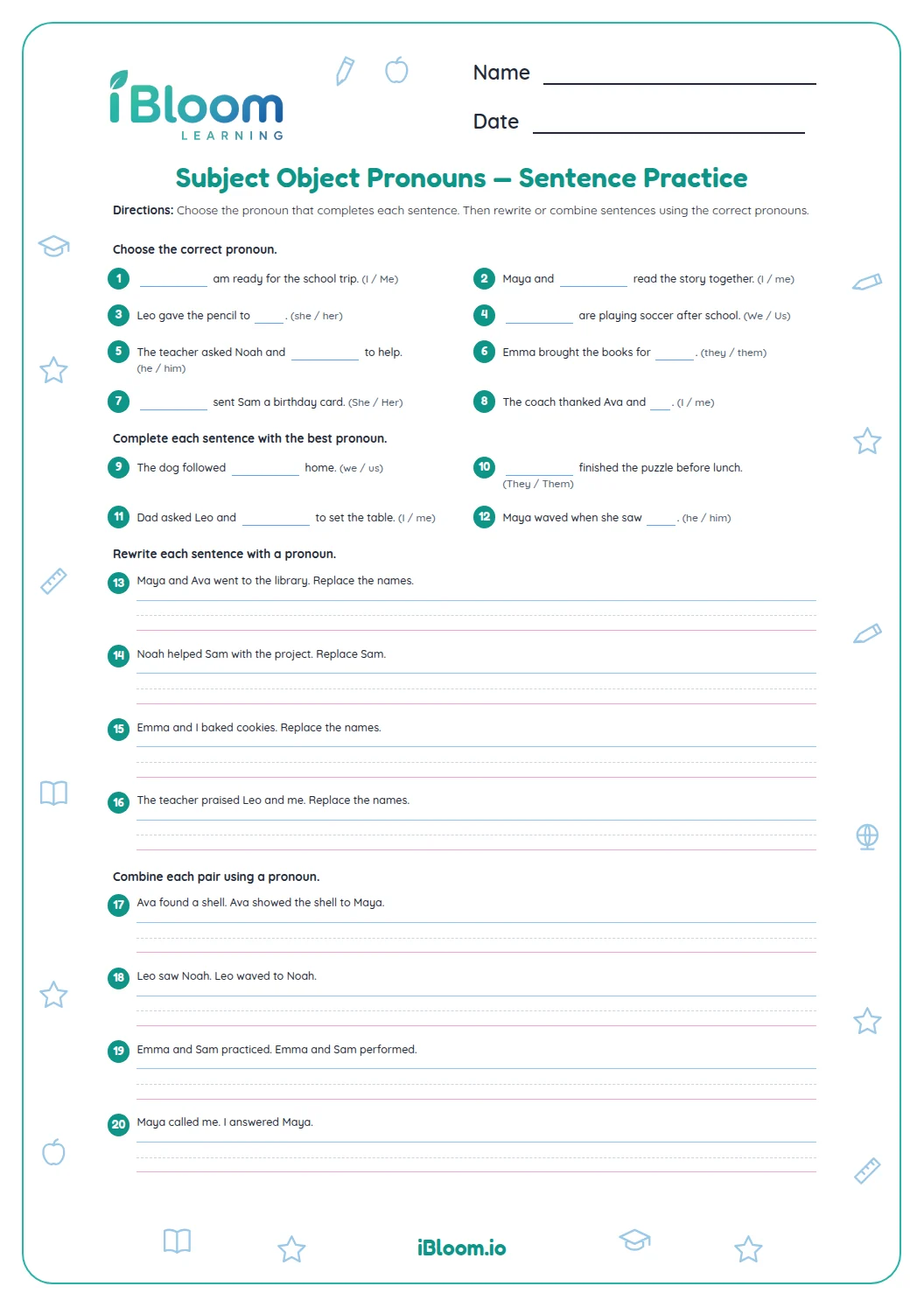
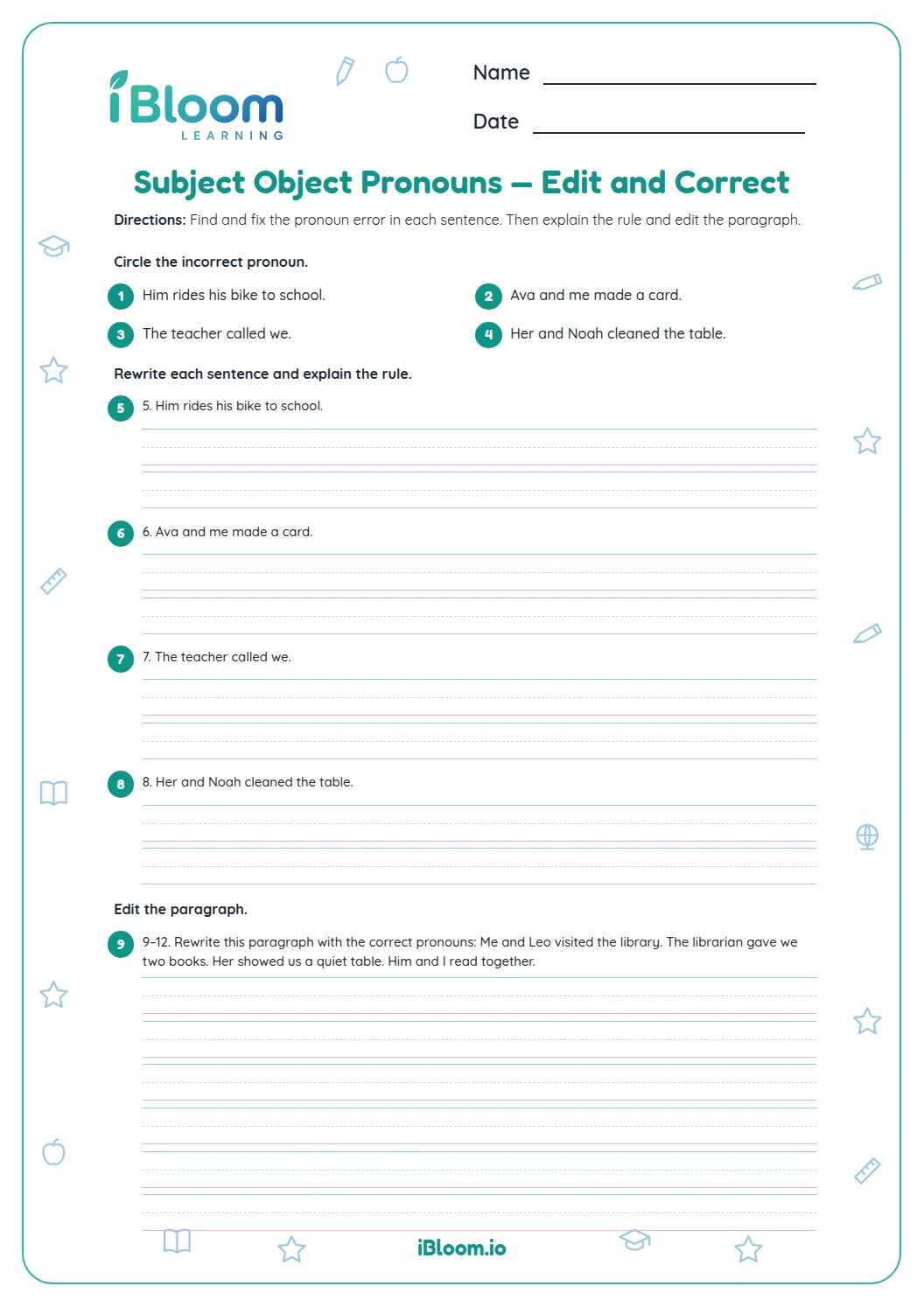

About this worksheet
This Grade 3 printable helps children choose subject and object pronouns by the job each pronoun does in a sentence. It includes 10 choice questions, four sentence revisions, and one original-writing prompt. Parts A and B move from selecting the right form to editing examples; Part C asks children to use both kinds of pronouns in their own sentences. The answer key lists each choice and sample wording for open responses. These activities practice CCSS 3.L.1 through grammar choices and sentence editing.
Aligned to 3.L.1
How do subject and object pronouns differ?
A subject pronoun does the action: “She carried the basket.” An object pronoun receives the action or follows a preposition: “The coach waved to her.”
In question 1, the blank is before the action carried, so it needs a subject pronoun.
- 1___ carried the basket.
- 2She carried the basket.
- 3She is the subject doing the carrying.
How can I check a pronoun choice?
Find the verb and ask who does it. Then check whether the pronoun follows an action verb or a word such as to, for, or with.
What does the final part ask children to do?
Children revise sentences with the wrong form and make their own example. Read the sentence aloud with the pronoun in place to hear whether the grammar fits.
How can I use this worksheet?
- 1Read the whole sentence before choosing.
- 2Find the action word.
- 3Ask who or what does the action.
- 4Use an object form after an action or a preposition.
- 5For rewrite questions, check that the pronoun still refers to the same person or group.
Common mistakes and quick fixes
The mistake
Using “Her and I” as a sentence subject.
The fix
Try the subject forms: “She and I carried the books.”
The mistake
Using “we” after “to.”
The fix
After the preposition to, use us: “to us.”
The mistake
Choosing a pronoun from sound alone without checking its role.
The fix
Identify who does the verb and who receives the action.
Common Core alignment
This worksheet practices the following Common Core skill.
Use standard English grammar when choosing and editing pronouns in sentences.
On this sheet: Demonstrate command of the conventions of standard English grammar and usage when writing or speakin
Show the official wordingHide the official wording
Demonstrate command of the conventions of standard English grammar and usage when writing or speaking.
What to practice next
Make more practice
Questions parents and teachers ask
When should a child use a subject pronoun?
Use a subject pronoun when it does the action in a sentence. “She carried the basket” uses she as the subject. The first part asks children to choose a pronoun that fits the sentence, then later items ask them to revise and write.
When should a child use an object pronoun?
Use an object pronoun when it receives an action or follows a preposition. In “The coach waved to us,” us follows to. Children can find the verb, ask who does the action, and check whether the pronoun has a subject or object role.
What does the editing section ask children to do?
Children rewrite sentences that use the wrong pronoun form, then write a sentence with a subject pronoun and an object pronoun. The key includes sample wording for open responses. Other sentences are fine when each pronoun form fits its job.
Is there an answer key?
Yes. A separate key gives the correct choices and sample rewrites. For the final writing prompt, look for a subject pronoun doing an action and an object pronoun receiving an action or following a preposition. An adult can ask the learner to explain each choice.
How can I check a pronoun after a preposition?
Look for words such as to, with, or for before the pronoun. Standard object forms follow these prepositions: “to him,” “with them,” and “for us.” Question 14 practices this pattern by correcting “The guide spoke to we” to “The guide spoke to us.”