

About this worksheet
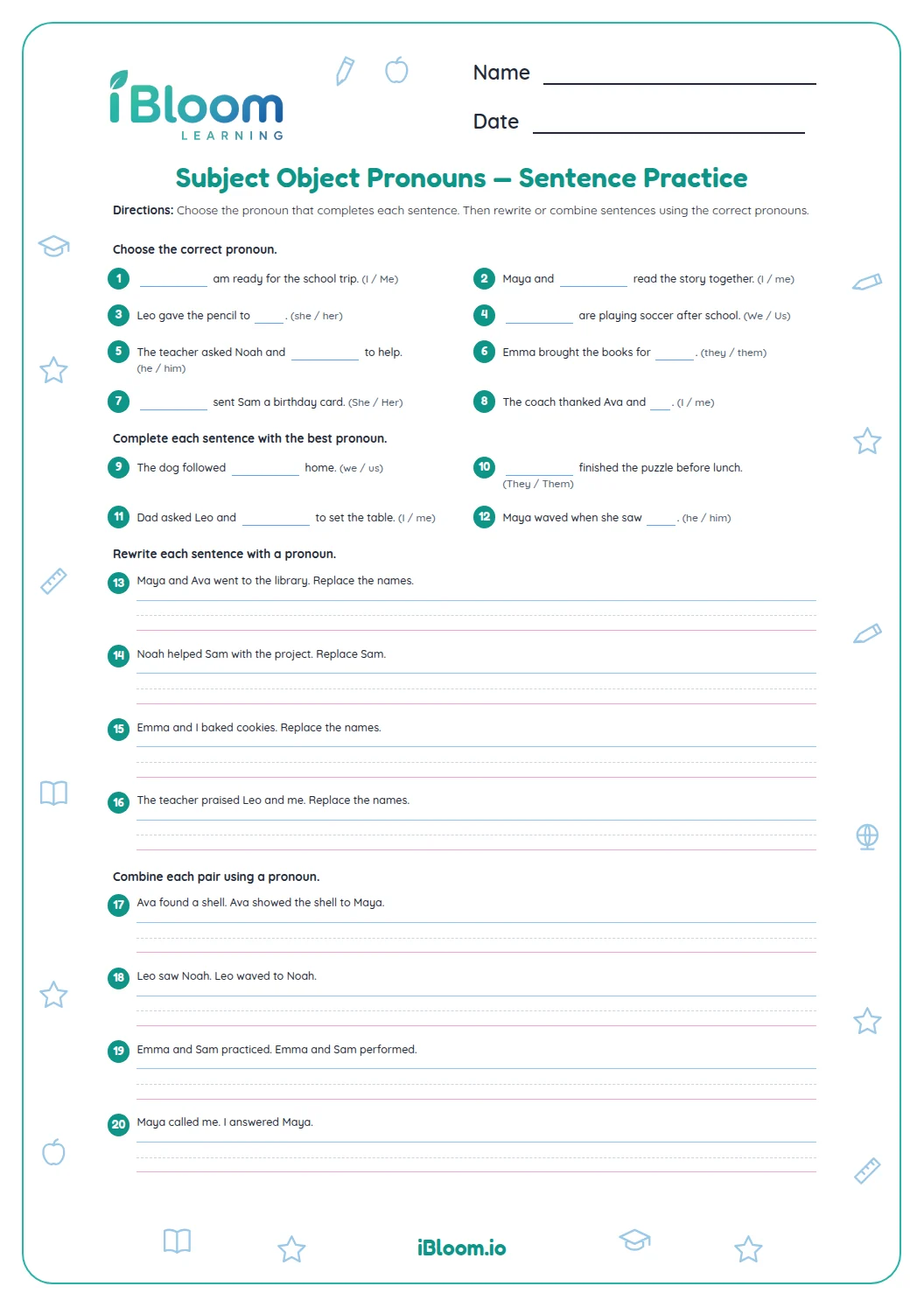
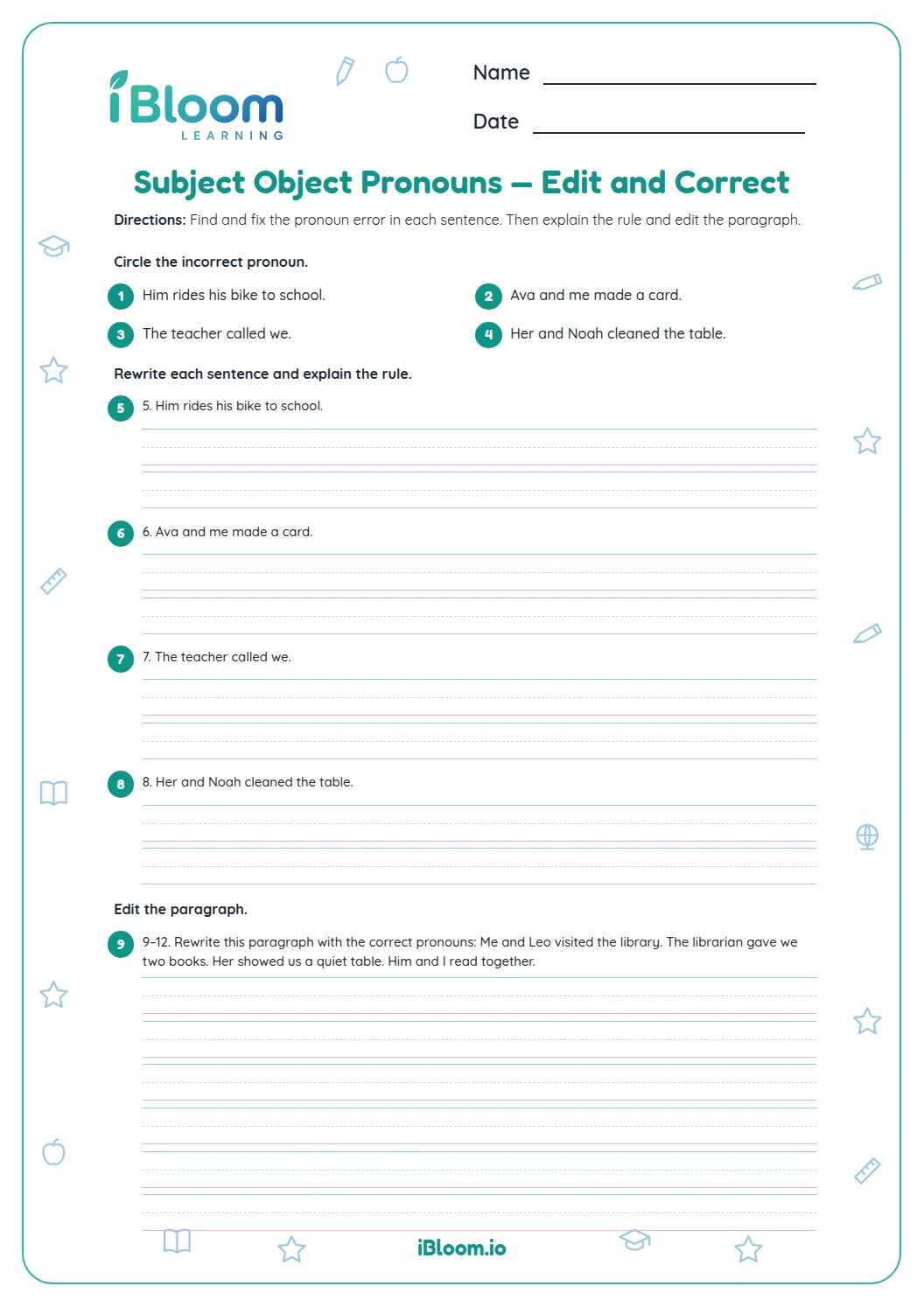
This free printable Grade 3 worksheet helps children choose a pronoun by its job in a sentence. Part A offers eight pronoun choices in short sentences. Part B has six sentence completions with named people and two suggested pronouns. Part C asks children to explain the jobs of we and us in two short sentences. The practice supports Common Core L.3.1a by connecting pronouns to their functions in particular sentences. Use it after introducing pronouns such as he, him, she, her, they and them; the separate answer key includes both exact completions and model explanations.
Aligned to L.3.1a
What does a subject or object pronoun do?
In these action sentences, a subject pronoun names who does the action. An object pronoun can receive the action or follow a preposition such as to. I, he, she, we and they are subject forms; me, him, her, us and them are object forms. You and it can do either job without changing form.
The same people can have different jobs in different sentences. In “They carried the chairs,” they do the carrying. In “Dad thanked them,” those people receive Dad’s thanks. Read the whole sentence before deciding which form belongs.
How do the sentence clues guide each answer?
Part B names the person or people first, then gives two forms of a pronoun. Children keep the meaning and choose the form that fits the second sentence. In question 10, Ava receives the call in both sentences, so her keeps that object role.
- 1The coach called Ava. The coach called ___ (she / her).
- 2Who did the calling? The coach.
- 3Who received the call? Ava.
- 4Answer: her. The coach called her.
How can I check that my child understands the job?
Ask your child to explain the last two answers using the action words. In question 15, “we” names the people doing the planting. In question 16, “us” names the people receiving the teacher’s praise. Naming the action shows how the pronoun works in that sentence.
The key gives sample explanations for these two questions. Accept another short explanation when it identifies the correct people and connects them to doing or receiving the action.
How to use this worksheet
- 1Read “They carried the chairs” aloud and identify carried as the action.
- 2Complete Part A by trying each pronoun in the sentence and naming its job.
- 3For Part B, connect the named people to the pronoun before writing it.
- 4Ask your child to finish both explanations in Part C using the action in each sentence.
- 5Check the key, then reread any corrected sentence aloud.
Mistakes to check together
The mistake
Writing “Them carried the chairs.”
The fix
The pronoun does the carrying, so use the subject form they.
The mistake
Writing “The coach called she.”
The fix
Ava receives the call. Replace Ava with the object form her.
The mistake
Explaining only that we “sounds better” in question 15.
The fix
Connect the pronoun to planted: we names the people who planted the seeds.
Common Core alignment
Choose pronouns by their sentence roles and explain who does or receives an action.
On this sheet: Children complete subject and object pronoun sentences, then explain the functions of we and us.
Show the official wordingHide the official wording
Explain the function of nouns, pronouns, verbs, adjectives, and adverbs in general and their functions in particular sentences.
What to practice next
Make more practice
Further reading
Questions parents and teachers ask
Which pronoun pairs are practiced?
The sheet practices I/me, he/him, she/her, we/us and they/them, plus you and it. Children choose pronouns in eight short sentences, then complete six sentences by replacing named people. Part B gives two forms beside each blank, so children can focus on each pronoun’s job.
Why is “her” correct in “The coach called her”?
Her is correct because it receives the action called. The coach is the person doing the calling, and Ava is the person called. In question 10, the second sentence replaces Ava with a pronoun while keeping her role the same, so the object form her fits.
Are children writing whole sentences in every part?
No, most responses are a choice or a single pronoun. Part A has eight multiple-choice questions, and Part B has six blanks with paired hints. Only the two explanations in Part C need a written sentence, allowing children to spend most of their time on pronoun decisions.
How should I mark the two explanations?
Accept an explanation that correctly connects the pronoun to the action. For question 15, we names the people doing the planting. For question 16, us names the people receiving praise. The answer key gives sample wording, but a child can express either idea clearly in different words.
Can I use the worksheet for a short guided lesson?
Yes, use the first choice as a shared example and then let your child try the remaining questions. Read a sentence aloud if needed. Ask who does the action, who receives it, or which pronoun follows to. These clues help children choose subject and object forms.