
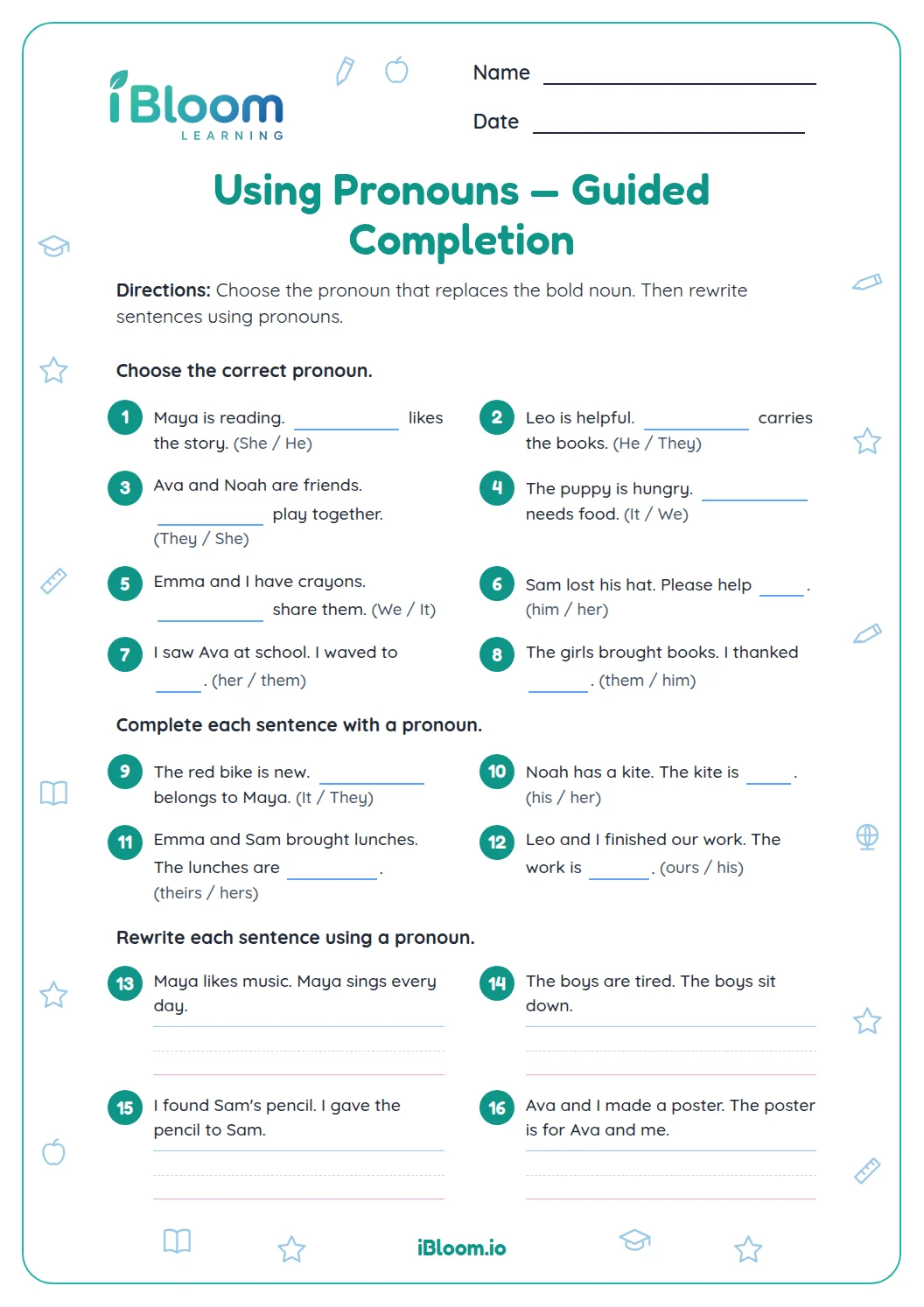
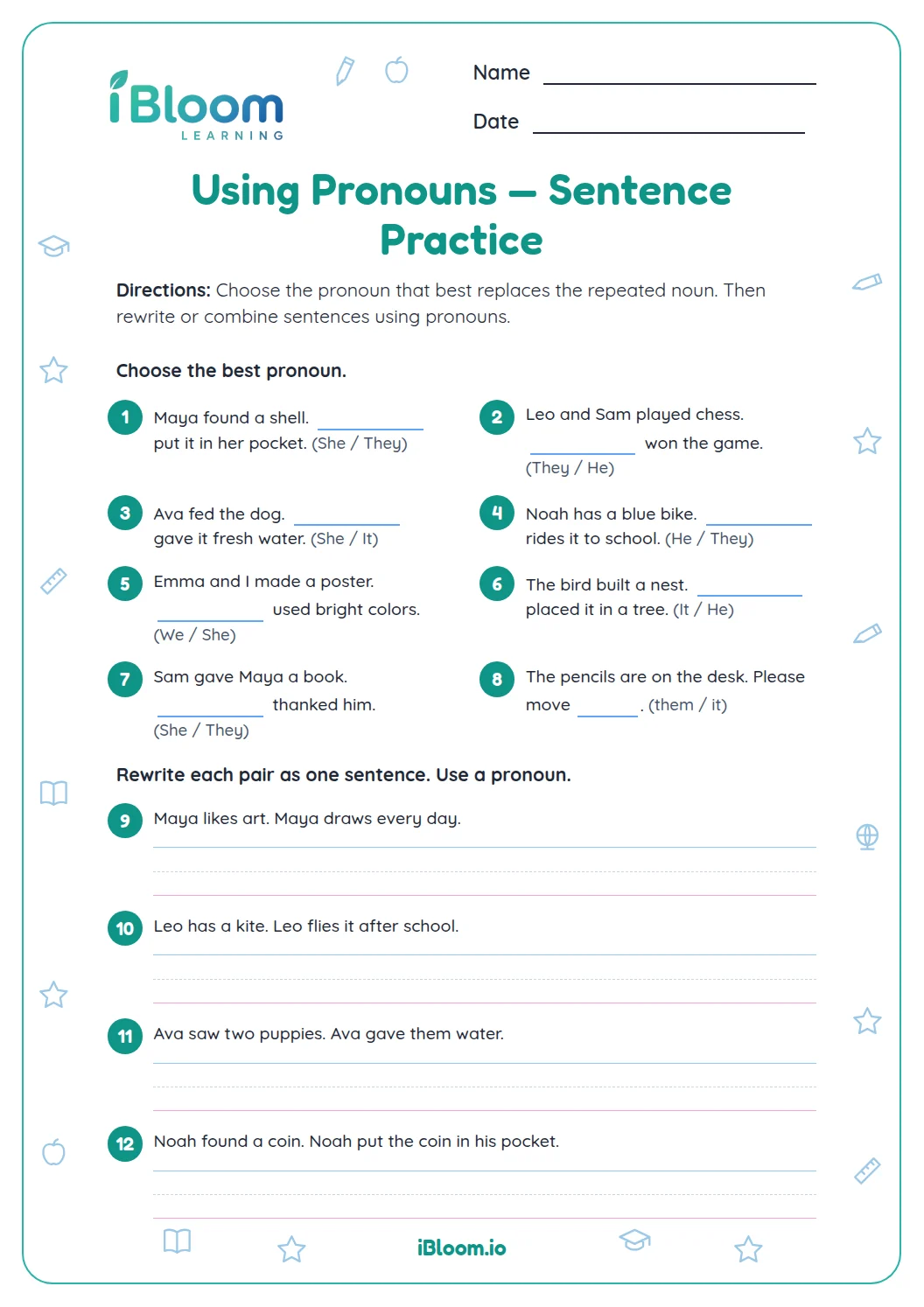
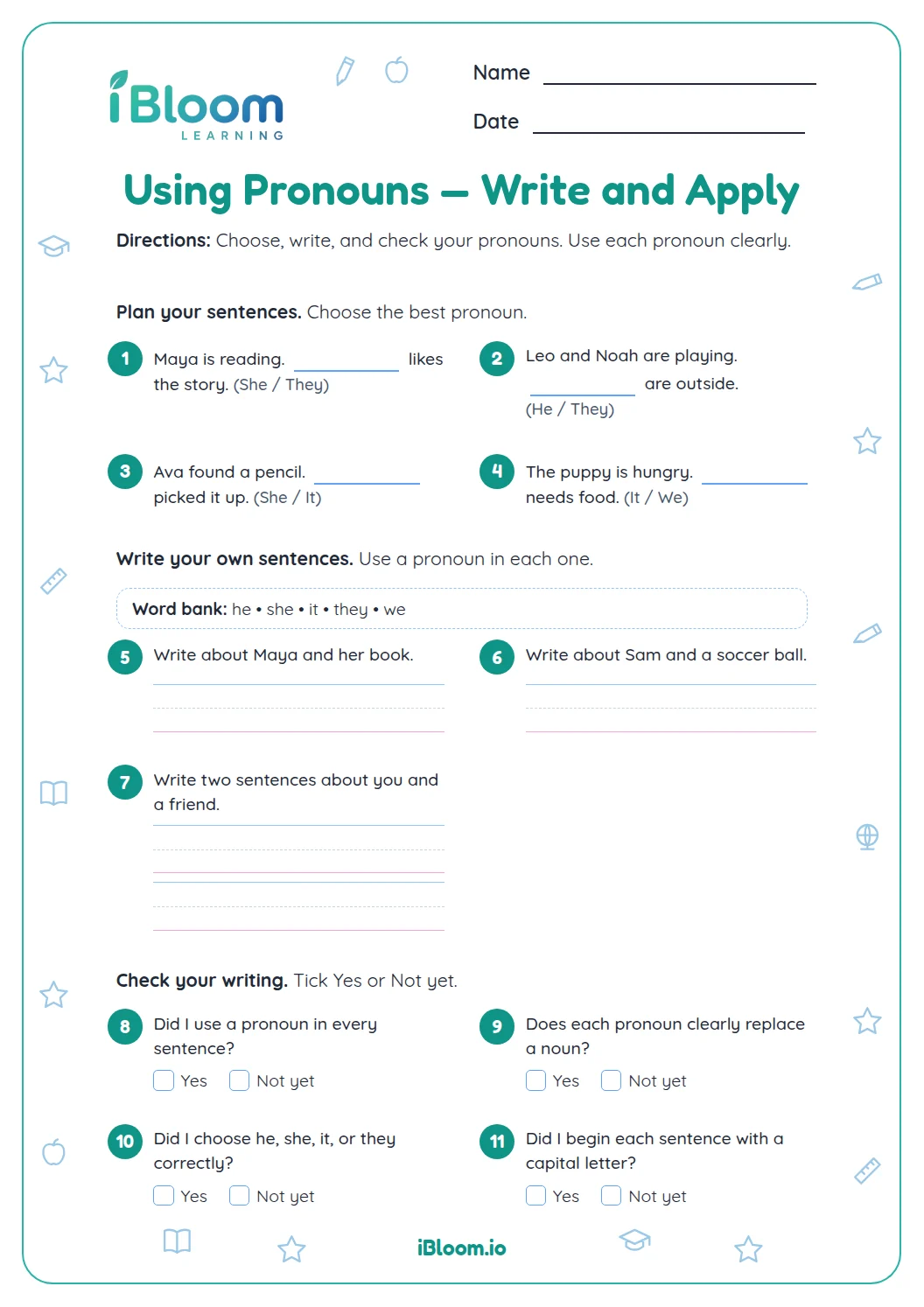
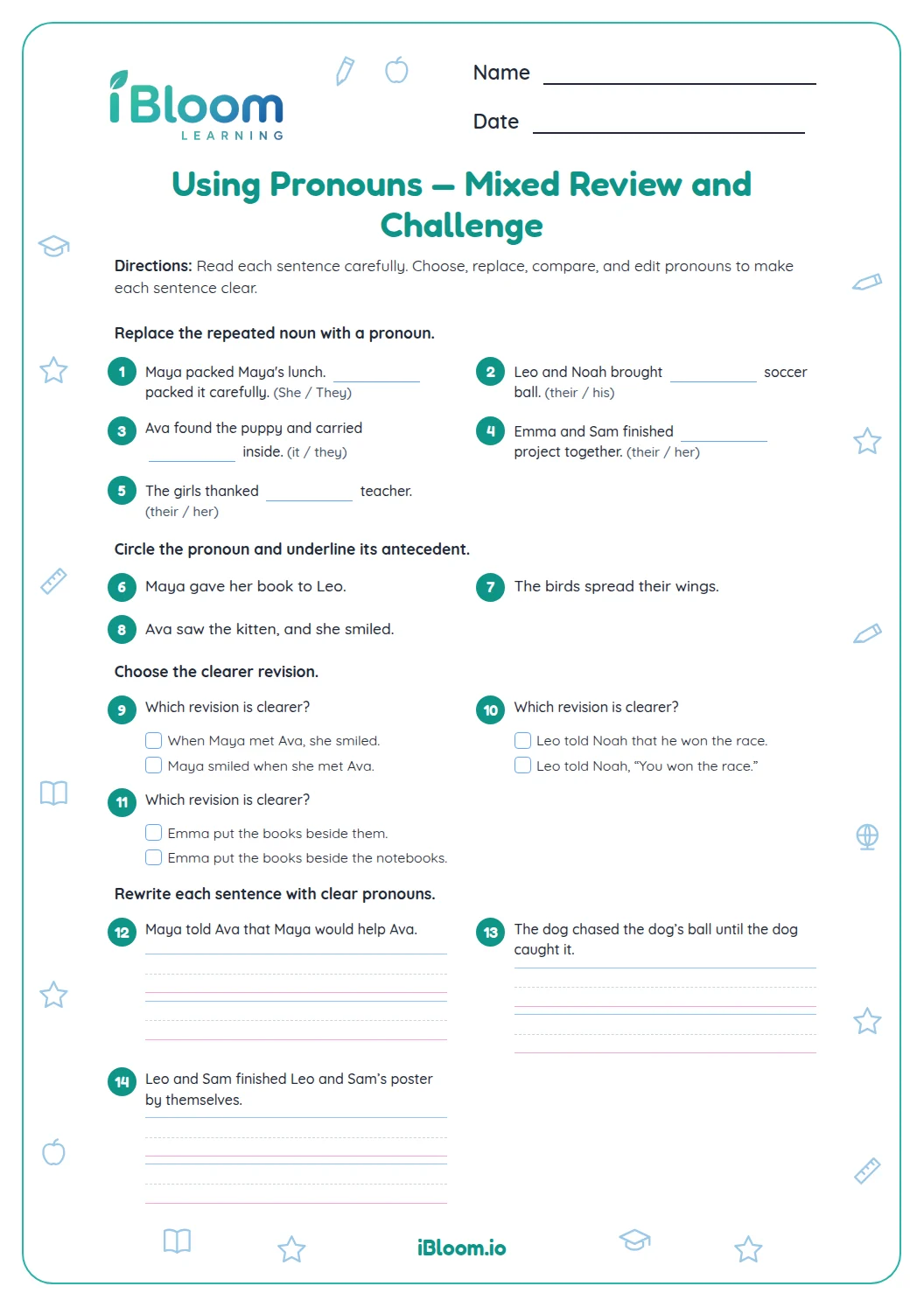
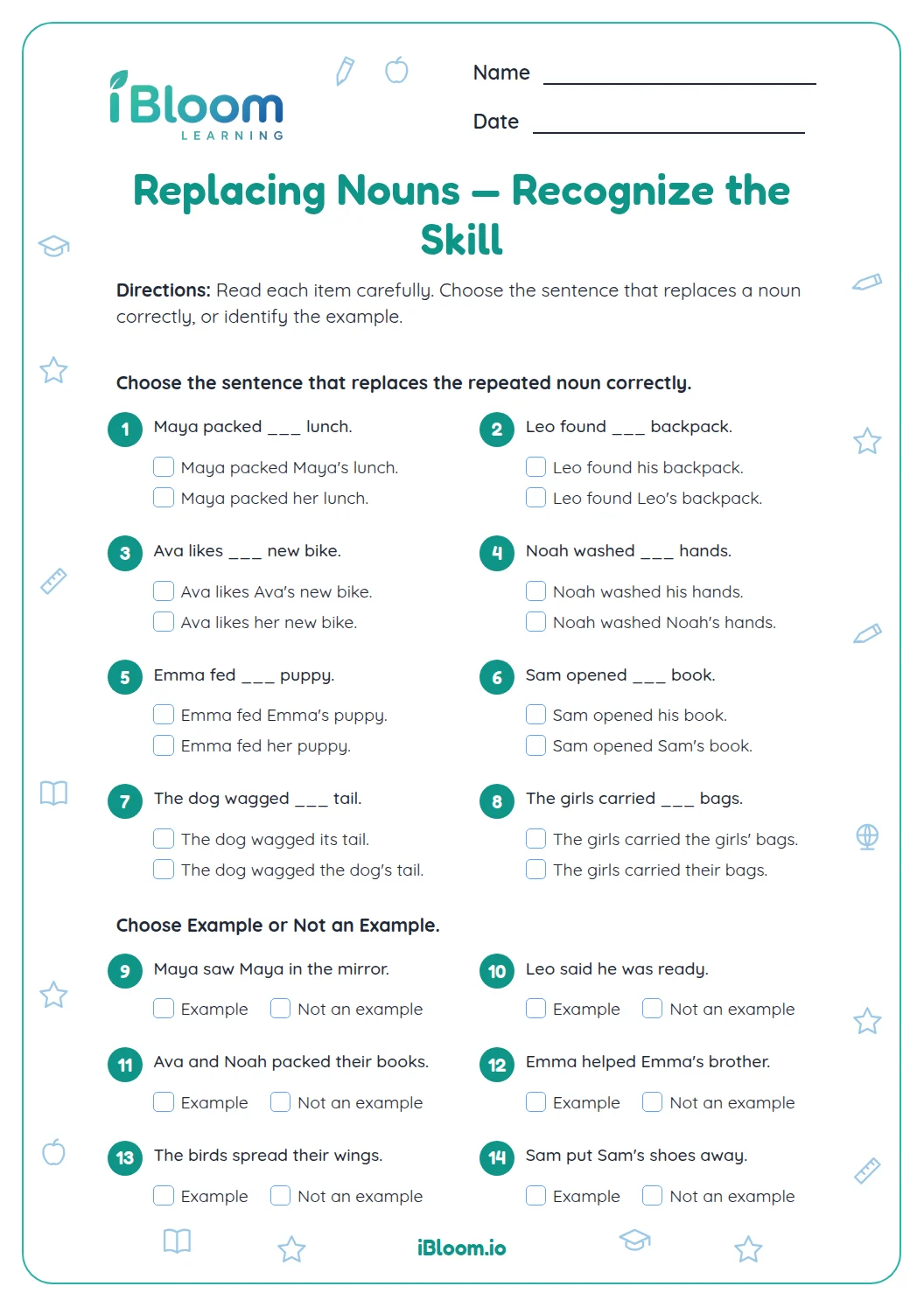
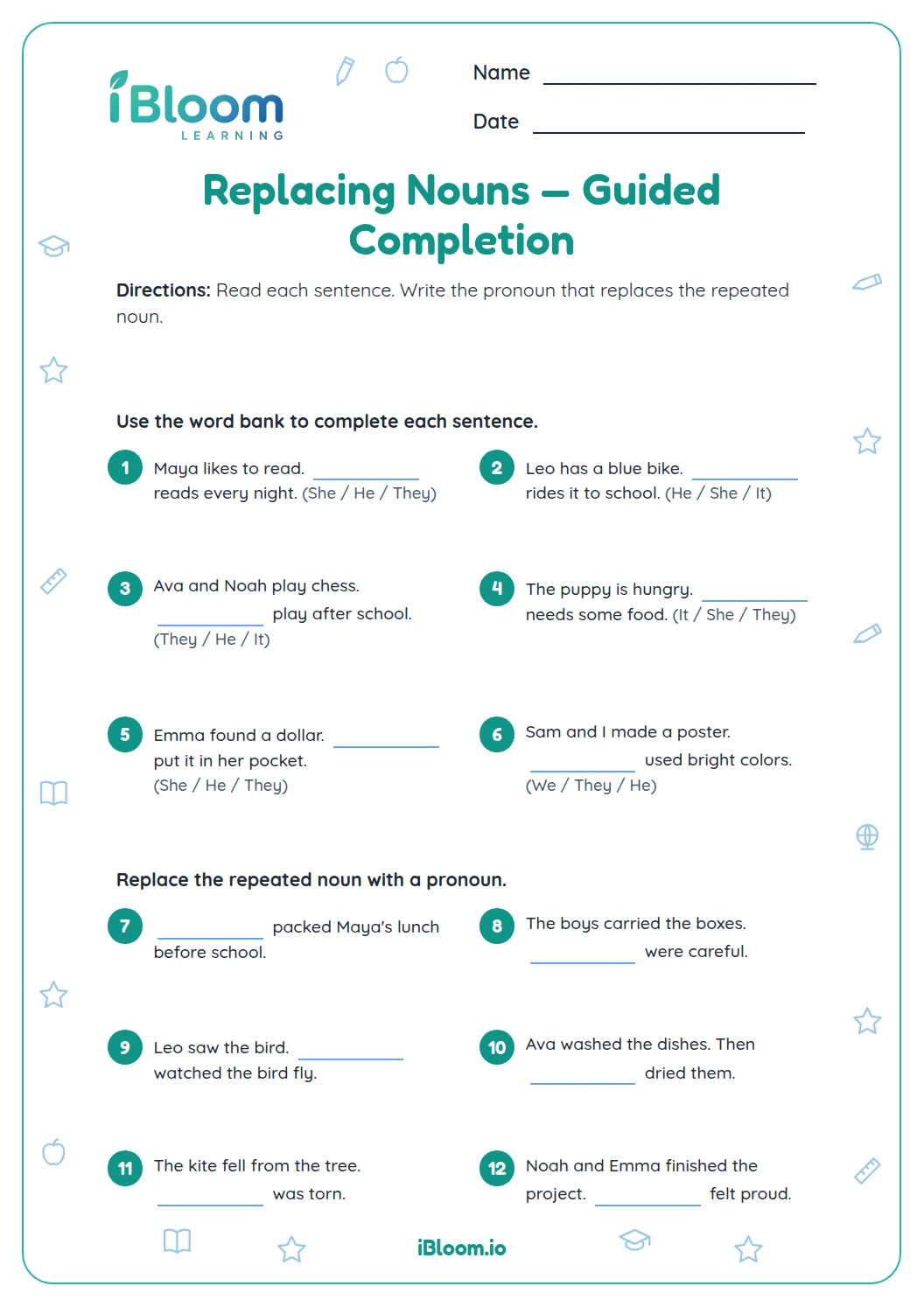
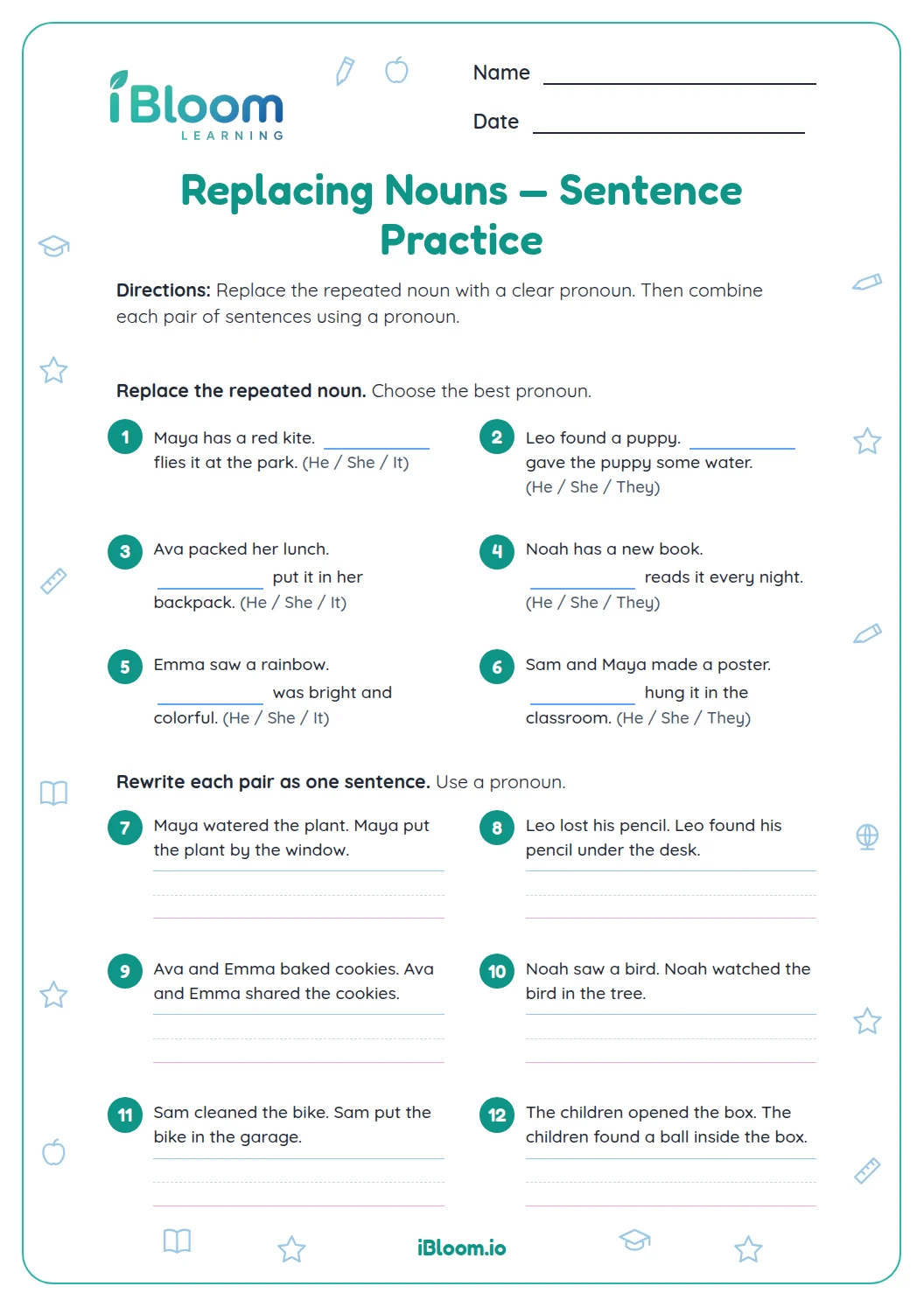
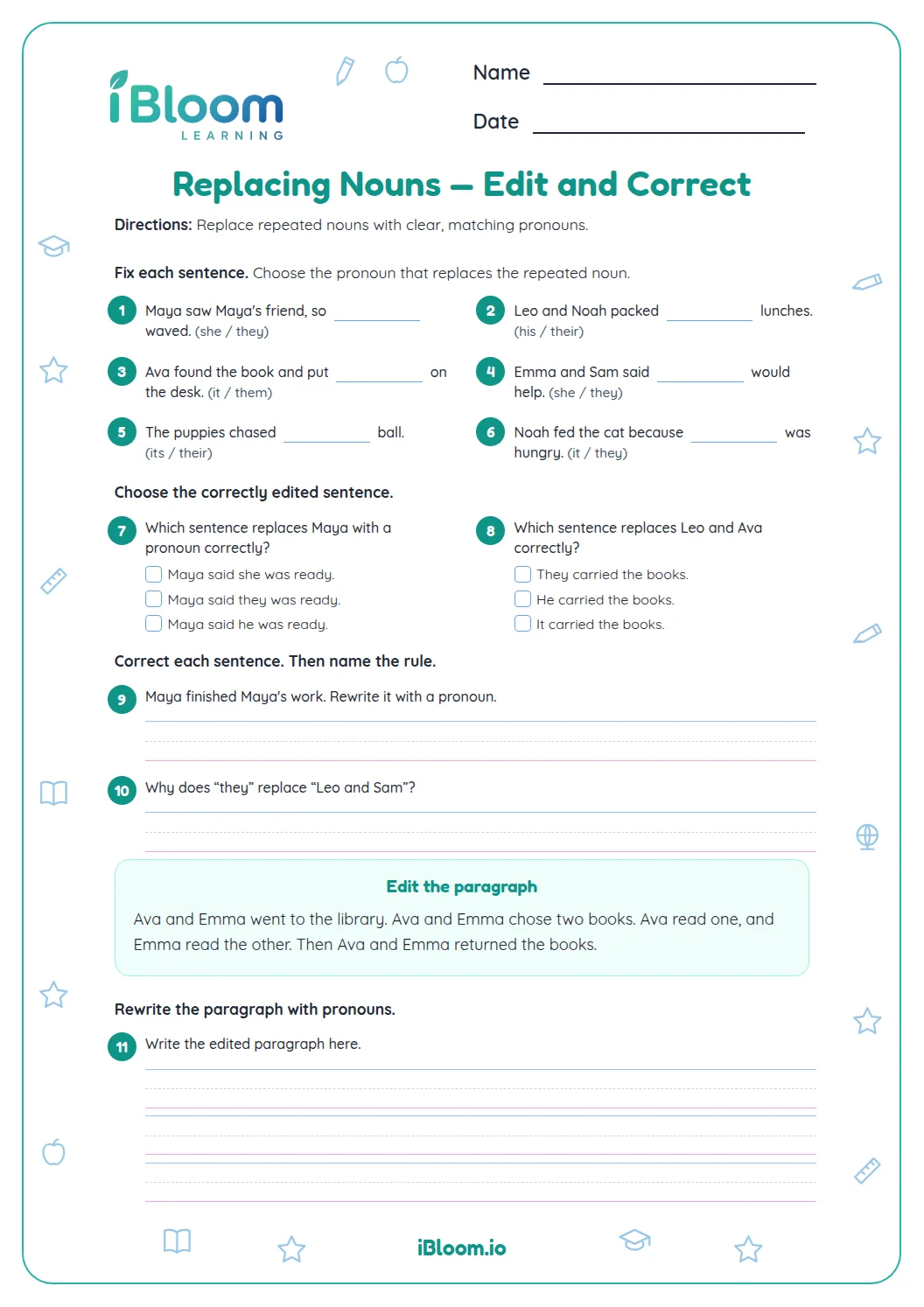
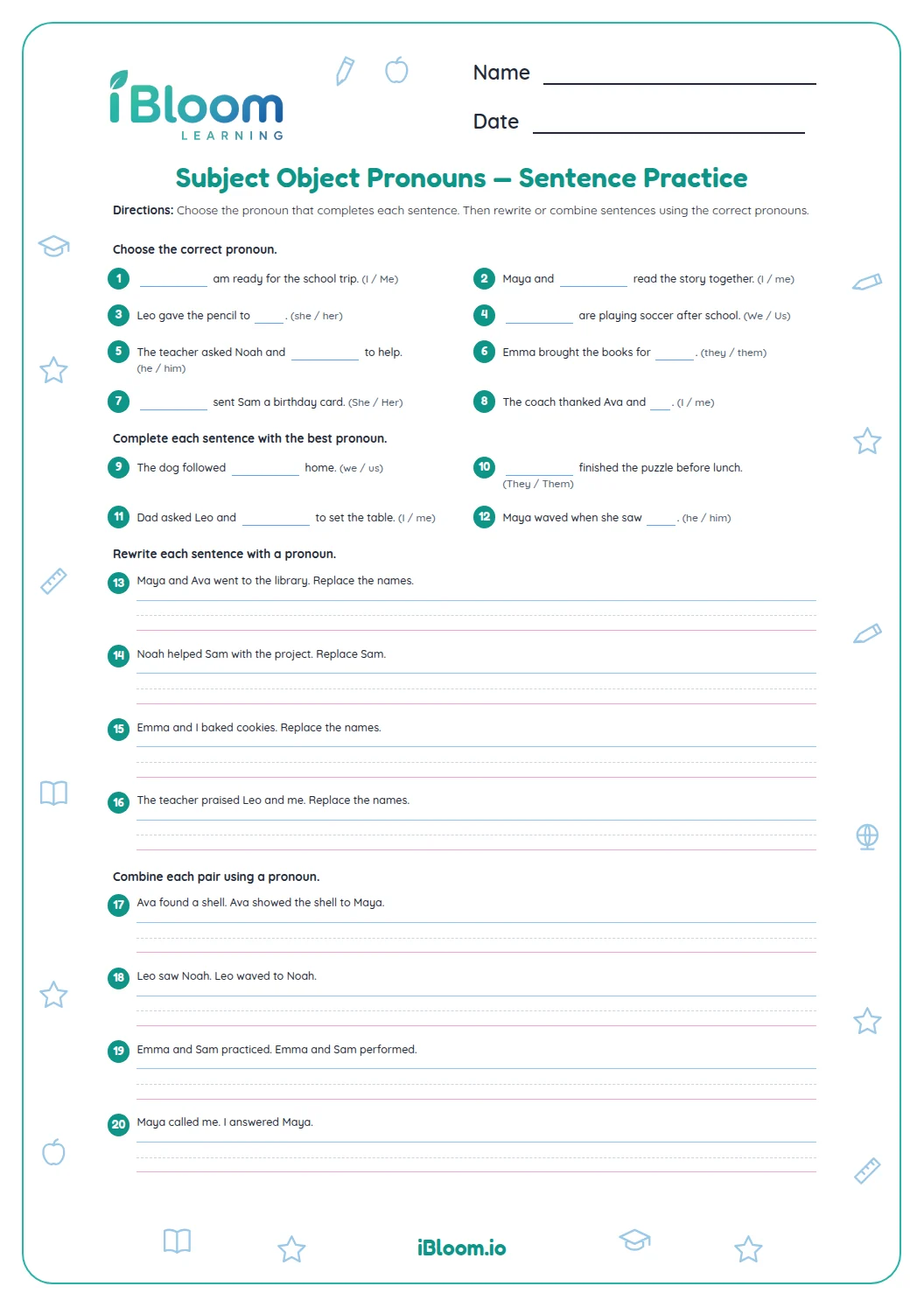
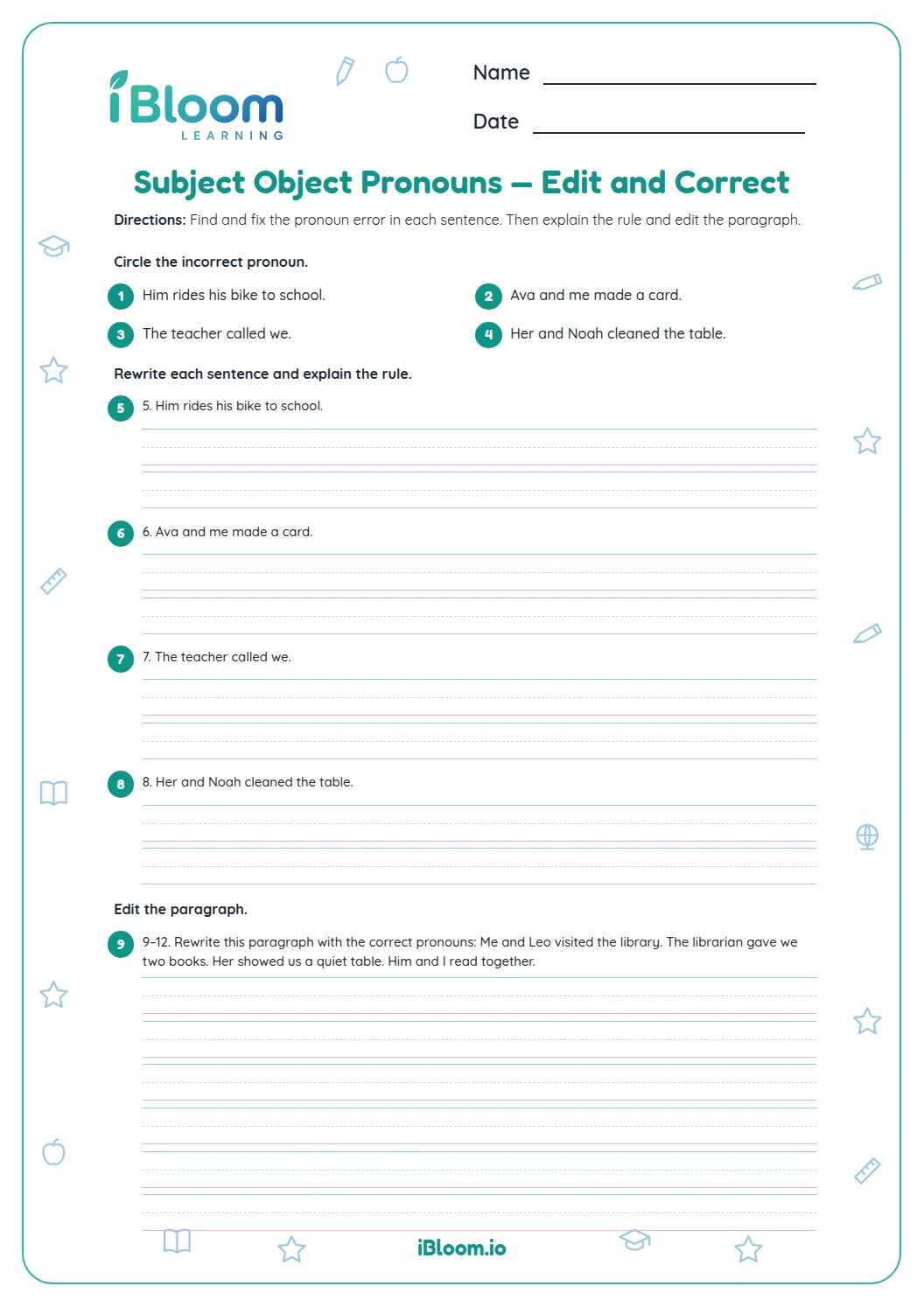
About this worksheet
This Grade 3 worksheet gives students practice choosing pronouns that agree with their antecedents and editing sentences for clear reference. Eight multiple-choice questions focus on subject, object, and possessive forms; six short editing items ask students to correct or replace repeated pronouns and nouns. A separate key offers sample revisions. This grammar practice supports Common Core language standard L.3.1.
Aligned to L.3.1
How can a pronoun make writing clearer?
A pronoun can replace a repeated noun, as in “Lena has a book. She reads it.” The reader should still be able to tell who or what each pronoun names.
When do I use I or me?
Use I when the pronoun is part of the subject: “I went with Tia.” Use me as an object: “Tia went with me.” Read the sentence structure to decide which form belongs.
What does the editing part ask students to do?
Students rewrite sentences to correct an unclear or mismatched pronoun or to replace a repeated noun. Several revisions can be correct if the pronoun clearly matches its antecedent.
How to use this worksheet
- 1Read the full sentence and find the noun the pronoun refers to.
- 2Choose a pronoun that matches the noun and its role.
- 3In the editing part, replace repeated nouns or correct the pronoun.
- 4Read your revision aloud to check that the reference is clear.
- 5Compare your response with the sample key; other clear revisions may work.
- 6Review all 14 questions.
Common mistakes and quick fixes
The mistake
Choosing a subject form after an action word
The fix
Use an object form after a verb or preposition, as in “Dad gave the book to me.”
The mistake
Using a plural pronoun for one animal
The fix
Match the pronoun to the noun: “The dog wagged its tail.”
The mistake
Replacing a noun without a clear reference
The fix
Make sure the reader can tell which person or thing the pronoun stands for.
Curriculum alignment
This worksheet gives practice with the named skill through its printed questions.
Use standard English grammar and usage in writing and speaking.
On this sheet: Children select subject and object pronouns that fit a sentence, then edit repeated nouns and pronoun errors.
Show the official wordingHide the official wording
Demonstrate command of the conventions of standard English grammar and usage when writing or speaking.
What to practice next
Make more practice
Further reading
Questions parents and teachers ask
What is an antecedent?
An antecedent is the noun a pronoun refers to. In “Maya has a kite. She flies it,” Maya is the antecedent of she, and kite is the antecedent of it. Clear antecedents help readers follow a sentence. Read the sentence again to confirm the pronoun has a clear noun reference.
What is the difference between I and me?
I is used as a subject, as in “I went.” Me is used as an object, as in “She saw me” or “with me.” Check the pronoun’s job in the sentence before choosing. Read the sentence again to confirm the pronoun has a clear noun reference.
Can editing questions have more than one good answer?
Some rewrites can differ while remaining correct. The key gives a sample, and a student’s version works if the pronoun has a clear antecedent and fits the sentence grammatically. Read the sentence again to confirm the pronoun has a clear noun reference.
How many questions are included?
There are 14 questions in two parts: eight choices and six sentence edits. The separate answer key gives the intended choices and sample edits. Read the sentence again to confirm the pronoun has a clear noun reference. This gives a quick check.
Does the worksheet include an answer key?
Yes. The key lists each multiple-choice answer and sample corrections for the written edits. Because a sentence may have more than one clear revision, compare the meaning and grammar rather than requiring identical wording. Read the sentence again to confirm the pronoun has a clear noun reference.