
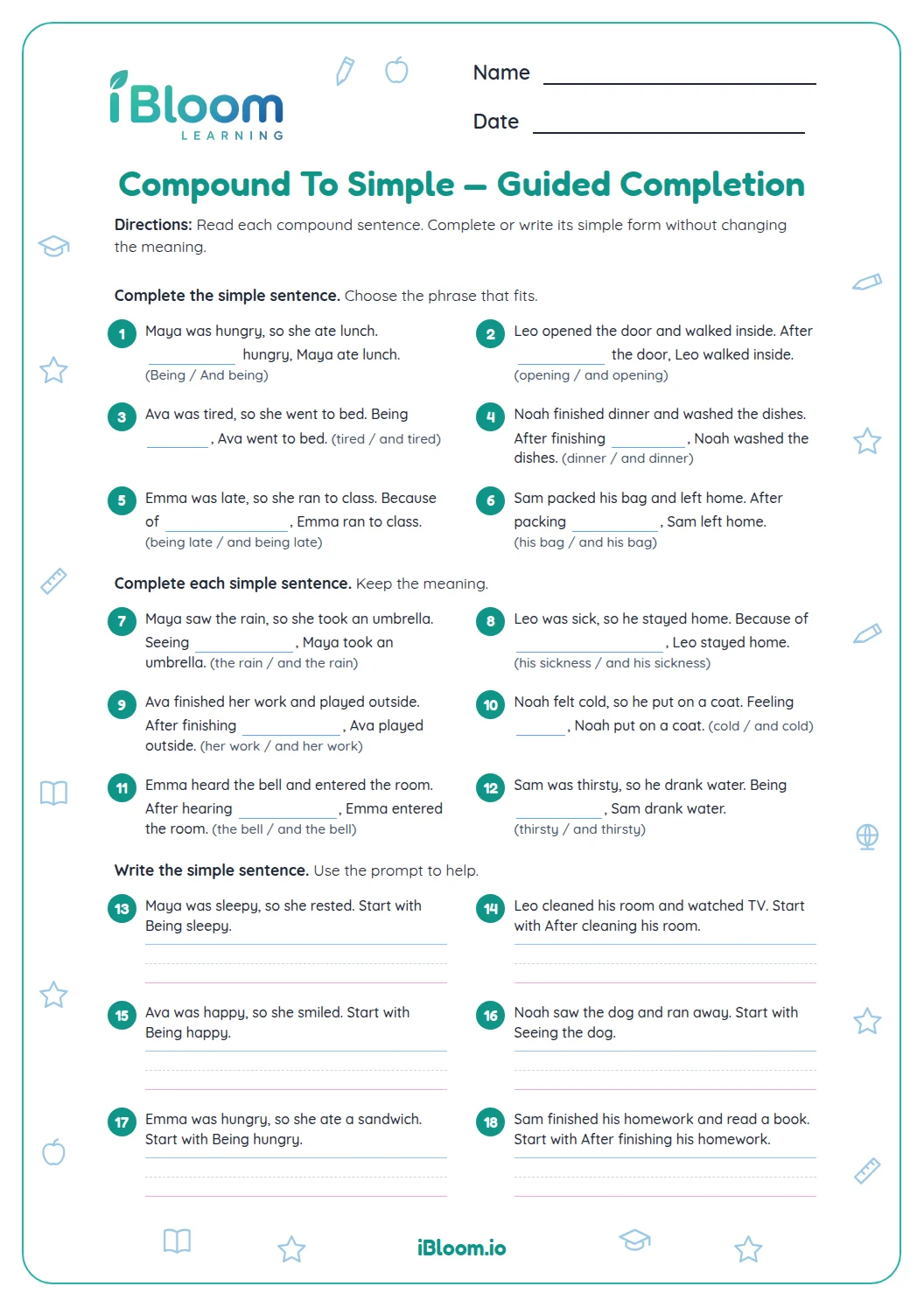

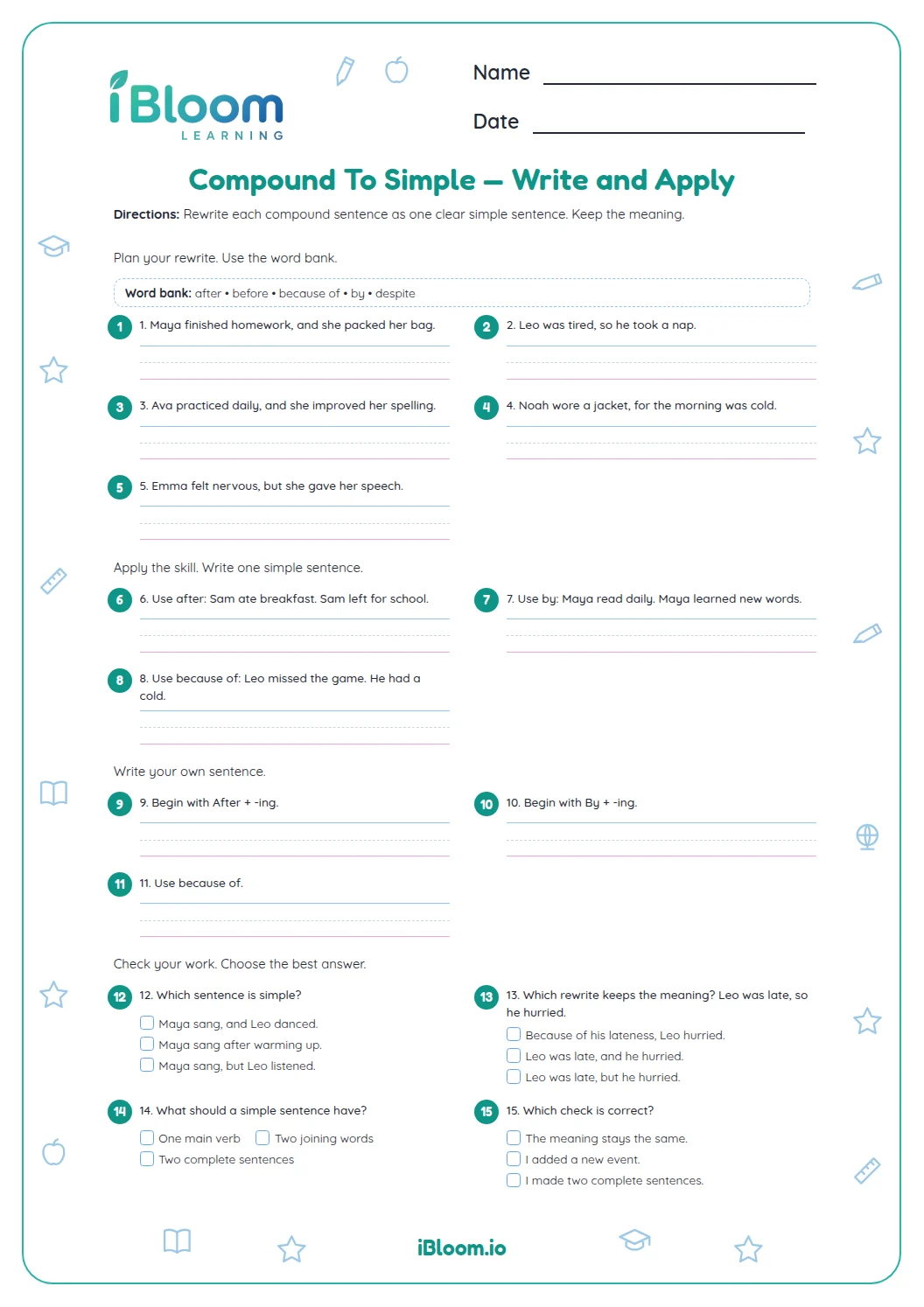
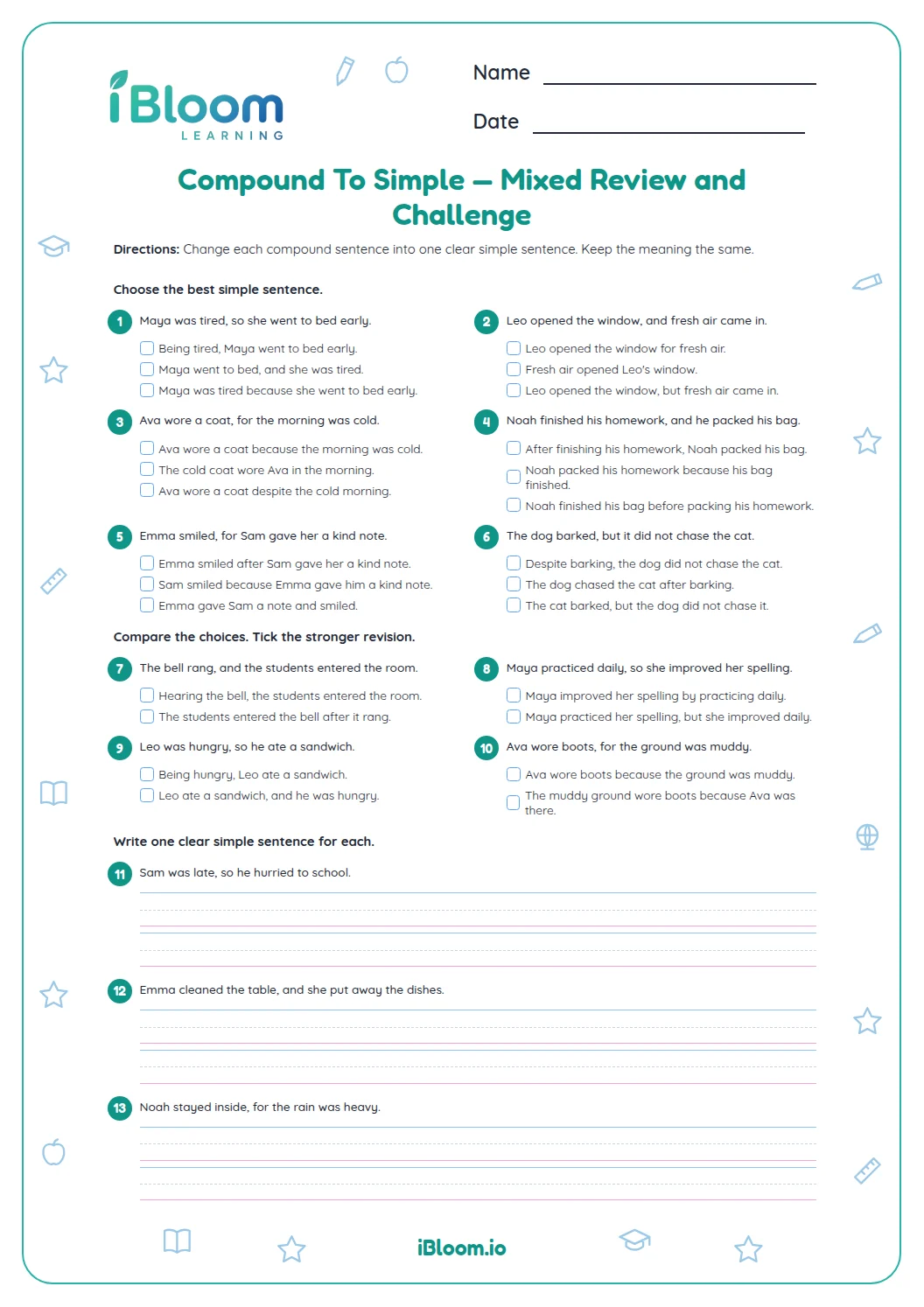

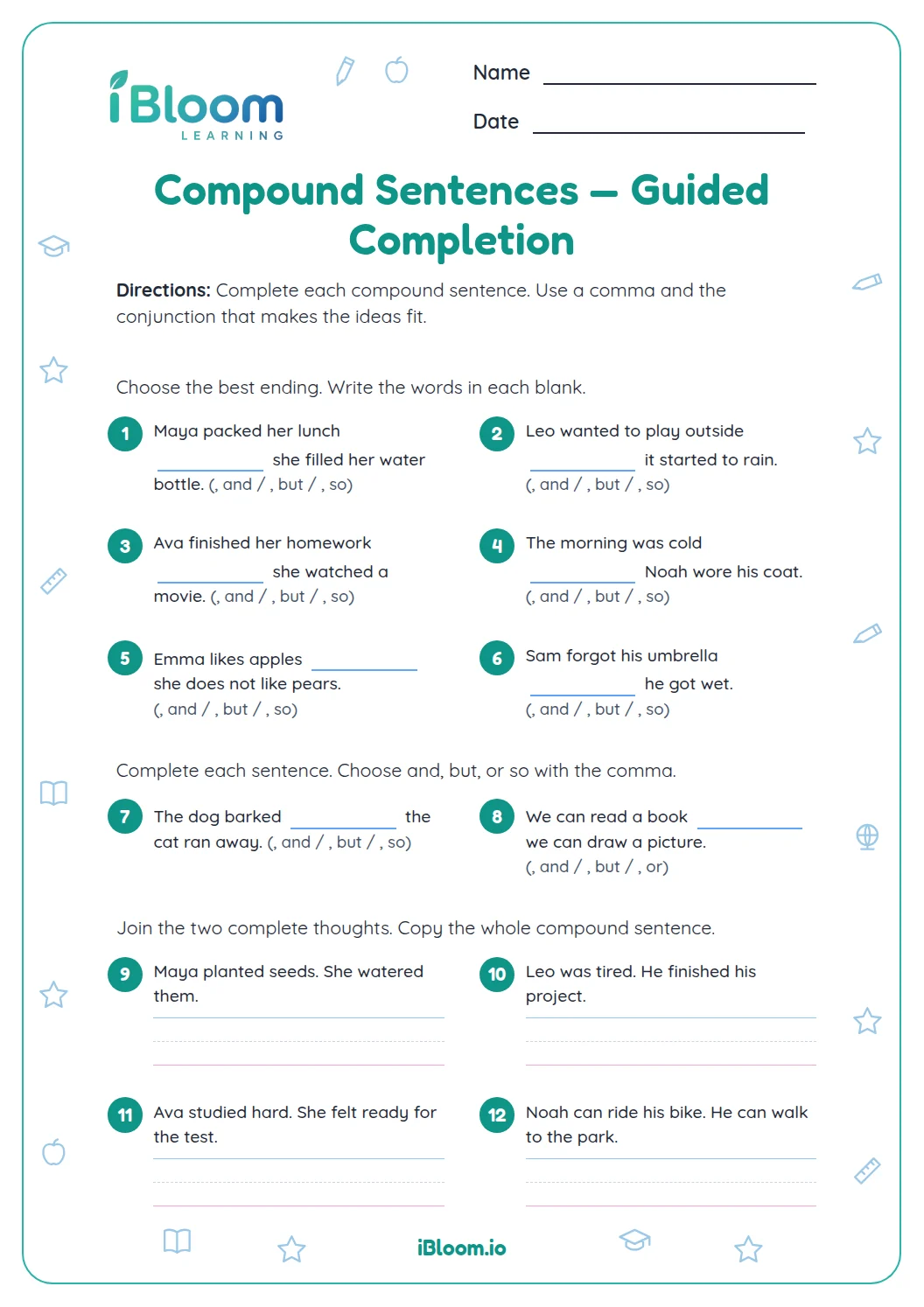



About this worksheet
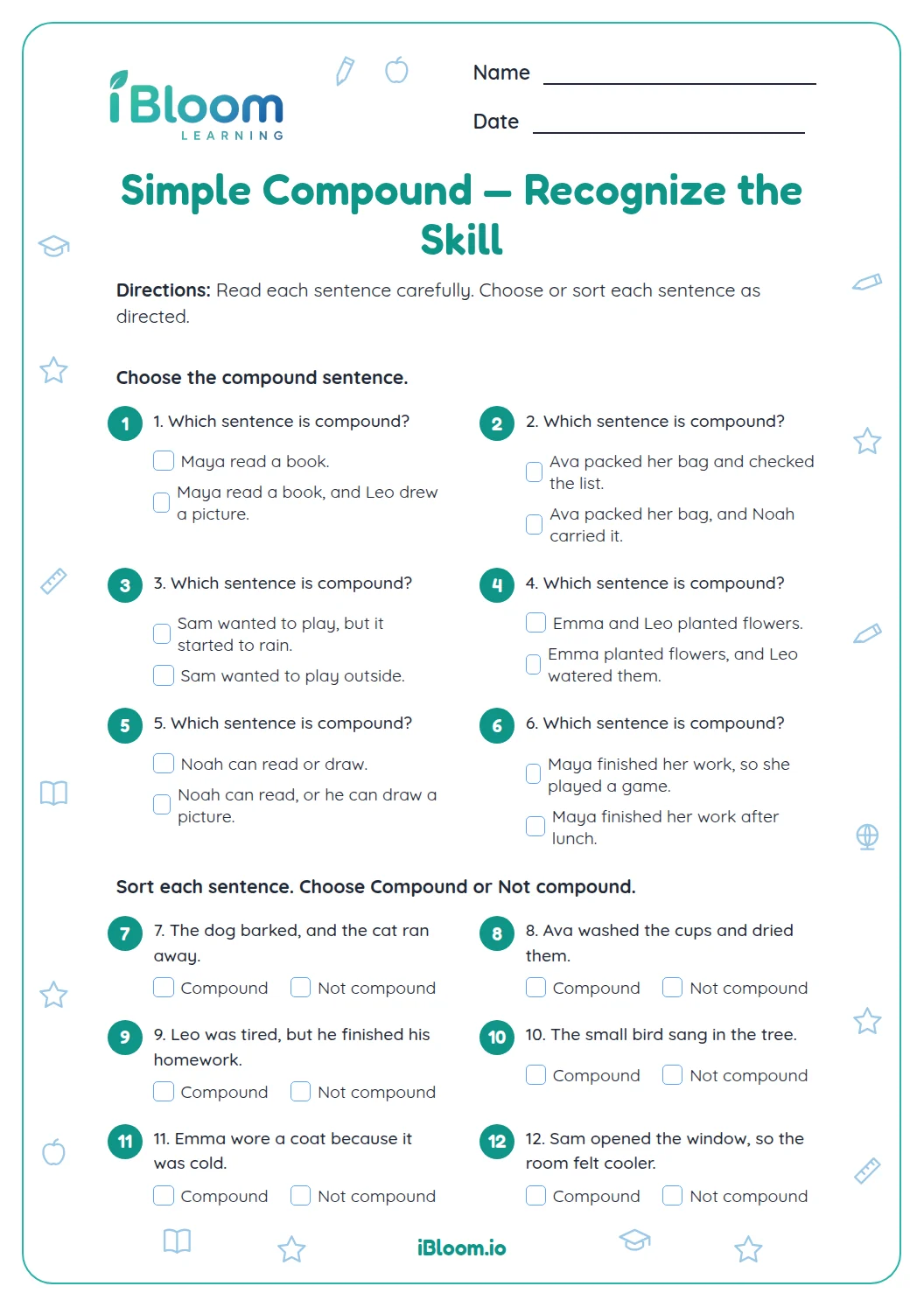
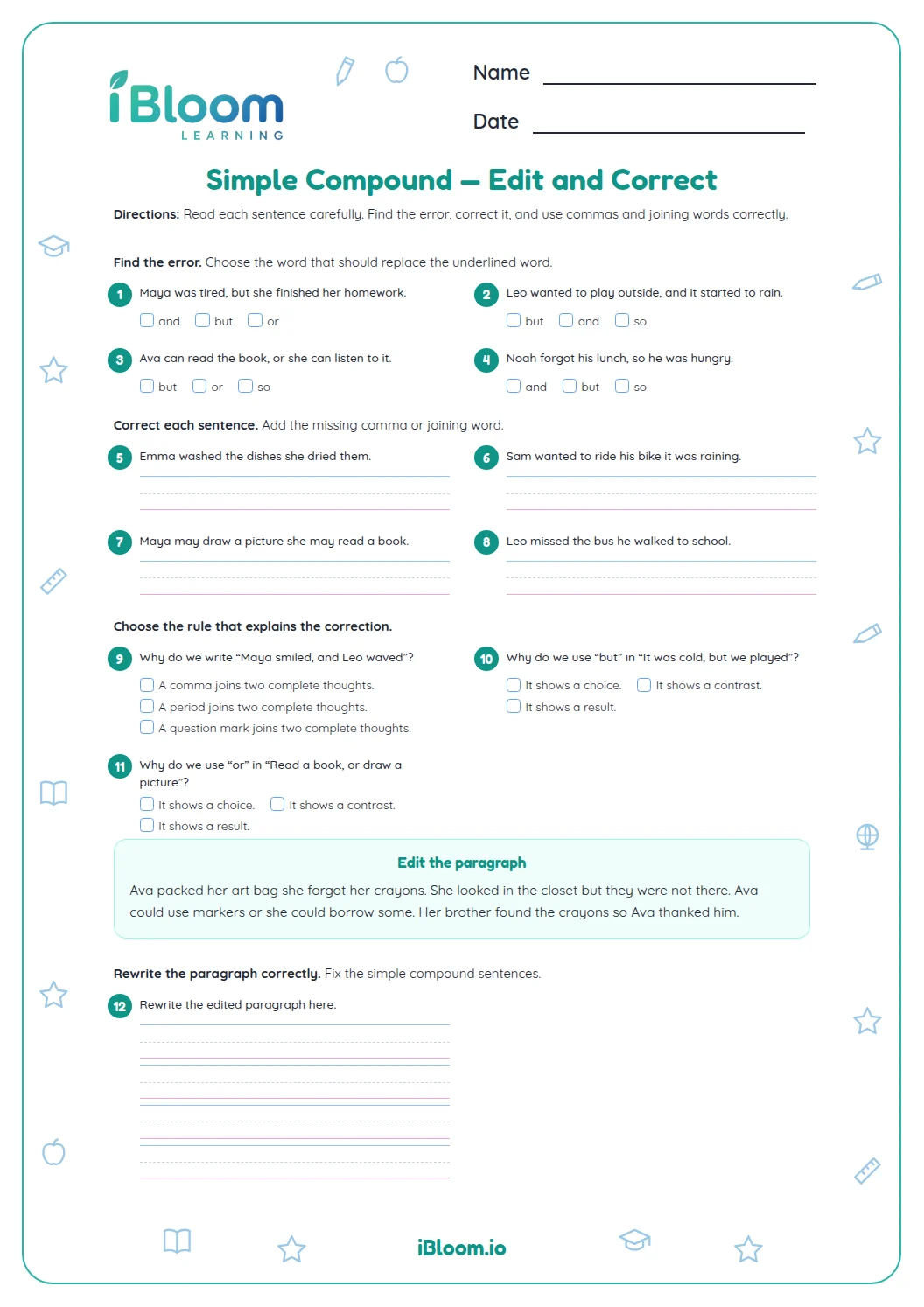
This free Grade 3 printable practices changing compound sentences into two simple sentences and recognizing simple versus compound sentences. Children rewrite eight examples, then classify six more. The worksheet spans two pages with a separate two-page answer key. These tasks practice producing simple and compound sentences, as described in CCSS L.3.1.i.
Aligned to L.3.1.i
What counts as a simple sentence?
A simple sentence has one complete thought with a subject and a verb. A compound sentence joins two complete thoughts, often with a comma and a coordinating conjunction. To split it, keep each complete idea and give it its own capital and end mark.
- 1The bell rang, so we lined up.
- 2The bell rang. We lined up.
- 3Each new sentence has its own subject and verb.
How can a rewrite keep the original meaning?
Separate at the joining word, then read each part on its own. A fragment needs a subject or verb restored from the original idea. Punctuation and capitalization may change, but both ideas should remain.
What will children practice?
Part A has eight compound sentences to split; Part B has six sentences to classify. The answer key accepts clear rewrites that keep both original ideas.
- Part A: choose a rewrite that keeps both ideas
- Part B: write two complete simple sentences
- Part C: identify simple or compound sentences
- Use the answer key as a model, not the only possible wording
How to use this worksheet at home or in class
- 1Read the instruction and section heading before starting each part.
- 2Work through the first example together and name the steps aloud.
- 3Let the learner complete the next questions independently.
- 4Pause after each part to check that the answers make sense.
- 5Use the separate answer key to review; revisit any missed item with the worked steps.
Common mistakes and quick fixes
The mistake
Making one fragment by splitting at the conjunction.
The fix
Check that each new sentence has its own subject and verb.
The mistake
Changing or losing one of the original ideas.
The fix
Keep both ideas and move only what is needed for complete sentences.
The mistake
Calling every sentence with “and” compound.
The fix
A compound sentence joins two complete thoughts; one subject with two verbs can still be simple.
Common Core alignment
This worksheet practices the following Common Core skills through its printed questions.
Produce simple and compound sentences and revise compound sentences into two simple ones.
On this sheet: The sheet identifies sentence types and rewrites compound ideas as simple sentences.
Show the official wordingHide the official wording
Produce simple, compound, and complex sentences.
What to practice next
Make more practice
Further reading
Questions parents and teachers ask
What makes a sentence compound?
A compound sentence joins two complete thoughts, each with its own subject and verb. In “The bell rang, so we lined up,” both sides can stand as sentences. Part B asks children to notice whether an example has one complete thought or two.
How can a compound sentence become two simple sentences?
Find the two complete thoughts, separate them, and give each one a capital letter and ending punctuation. Question 3, “The bell rang, so we lined up,” can become “The bell rang. We lined up.” Keep both ideas from the original.
Can a simple sentence include “and”?
Yes. A sentence can have a compound subject or verb and still express one complete thought. For example, “Maya and Leo read” is simple. On this worksheet, look for two complete clauses, not just a joining word, when classifying. This distinction helps avoid guessing from “and.”
What does the worksheet ask children to do?
Part A asks for eight rewrites from compound to simple sentences. Part B asks children to classify six examples as simple or compound. The separate answer key provides the expected classifications and sample rewrites, with acceptable wording noted for open responses.
How should the rewrites be checked?
Check that the rewrite has two complete sentences, preserves both original ideas, and uses capitals and end marks. The exact wording can vary. For example, “The dog barked, but the cat slept” may be split into those same two simple sentences.