







About this worksheet
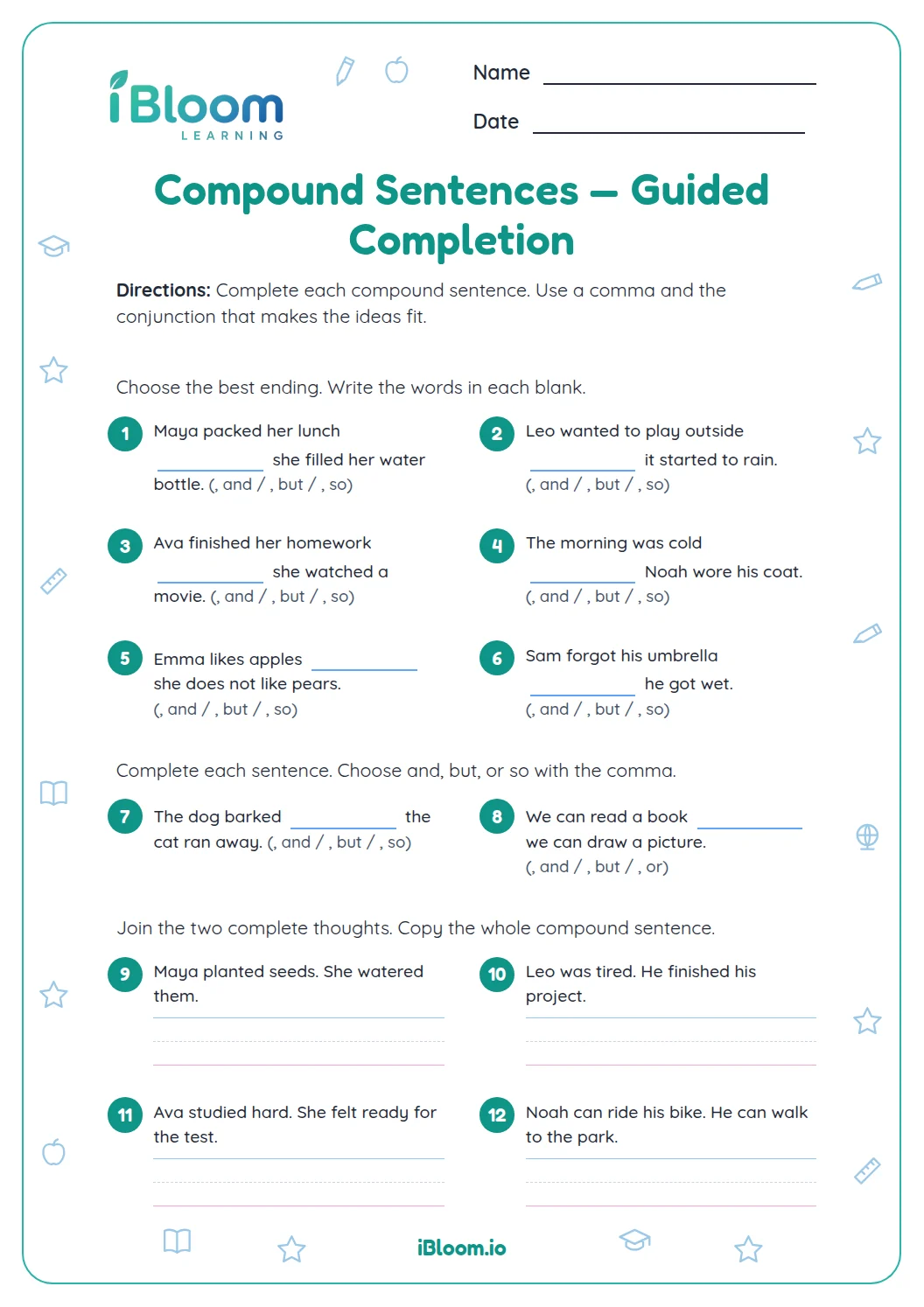
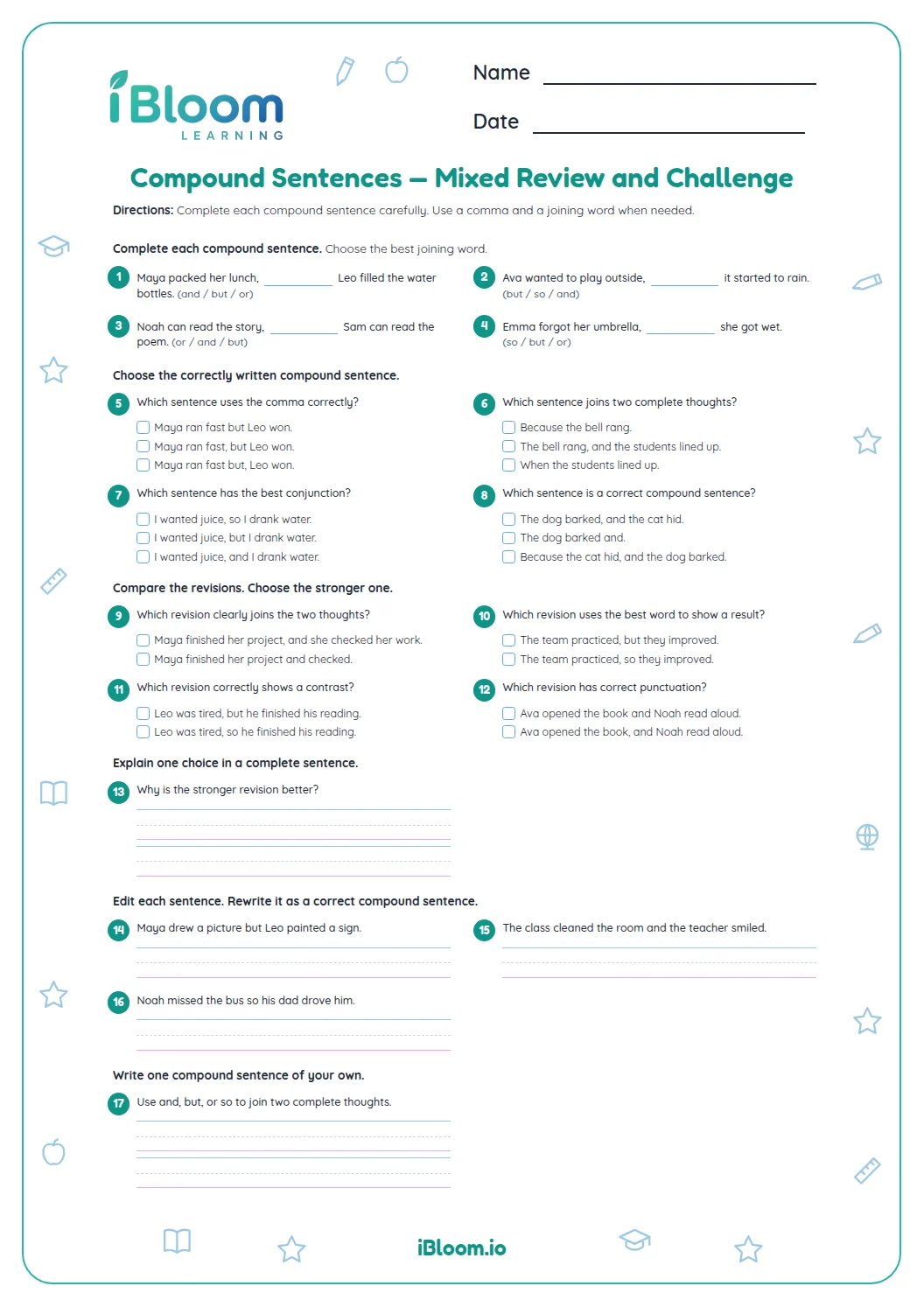
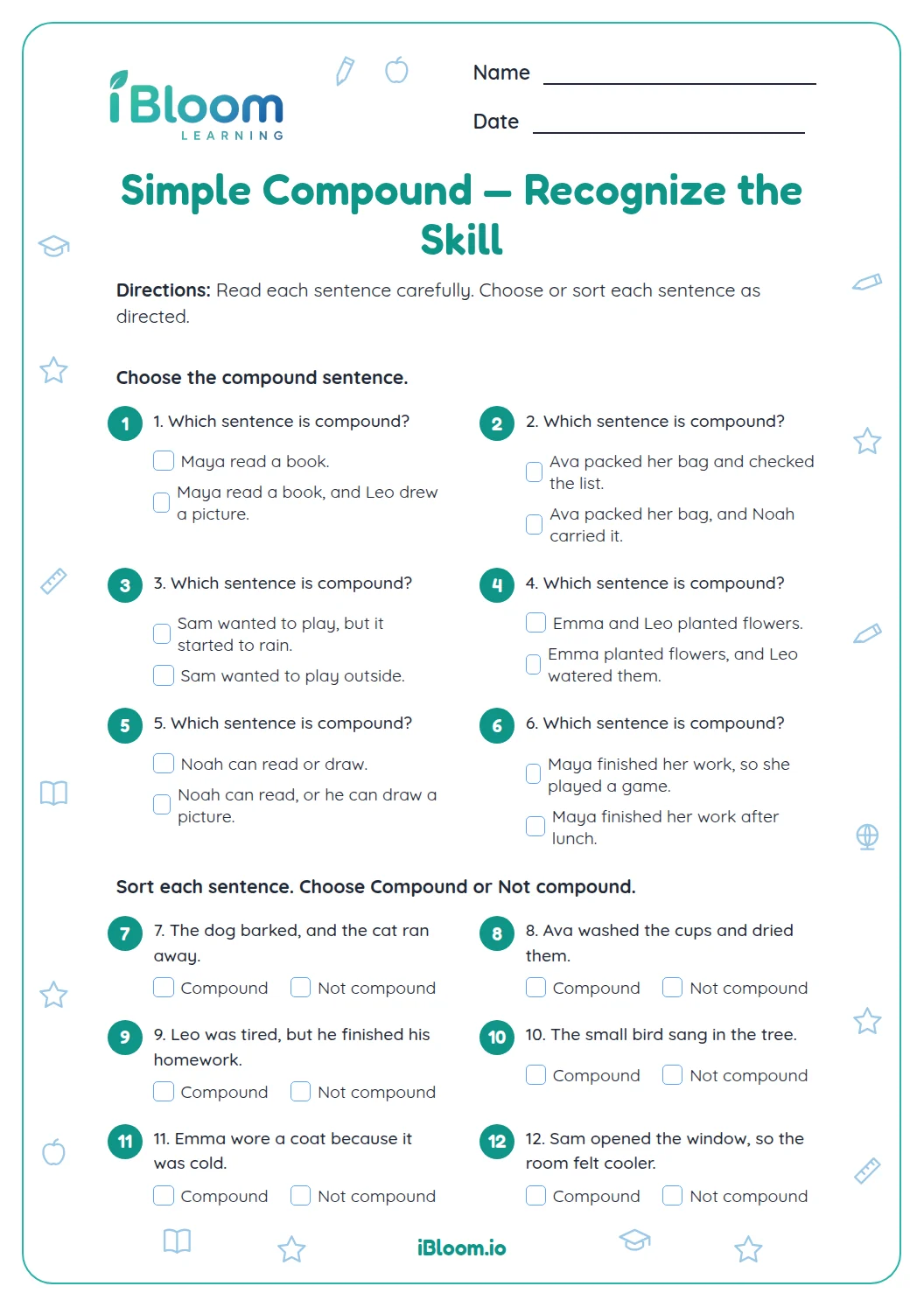
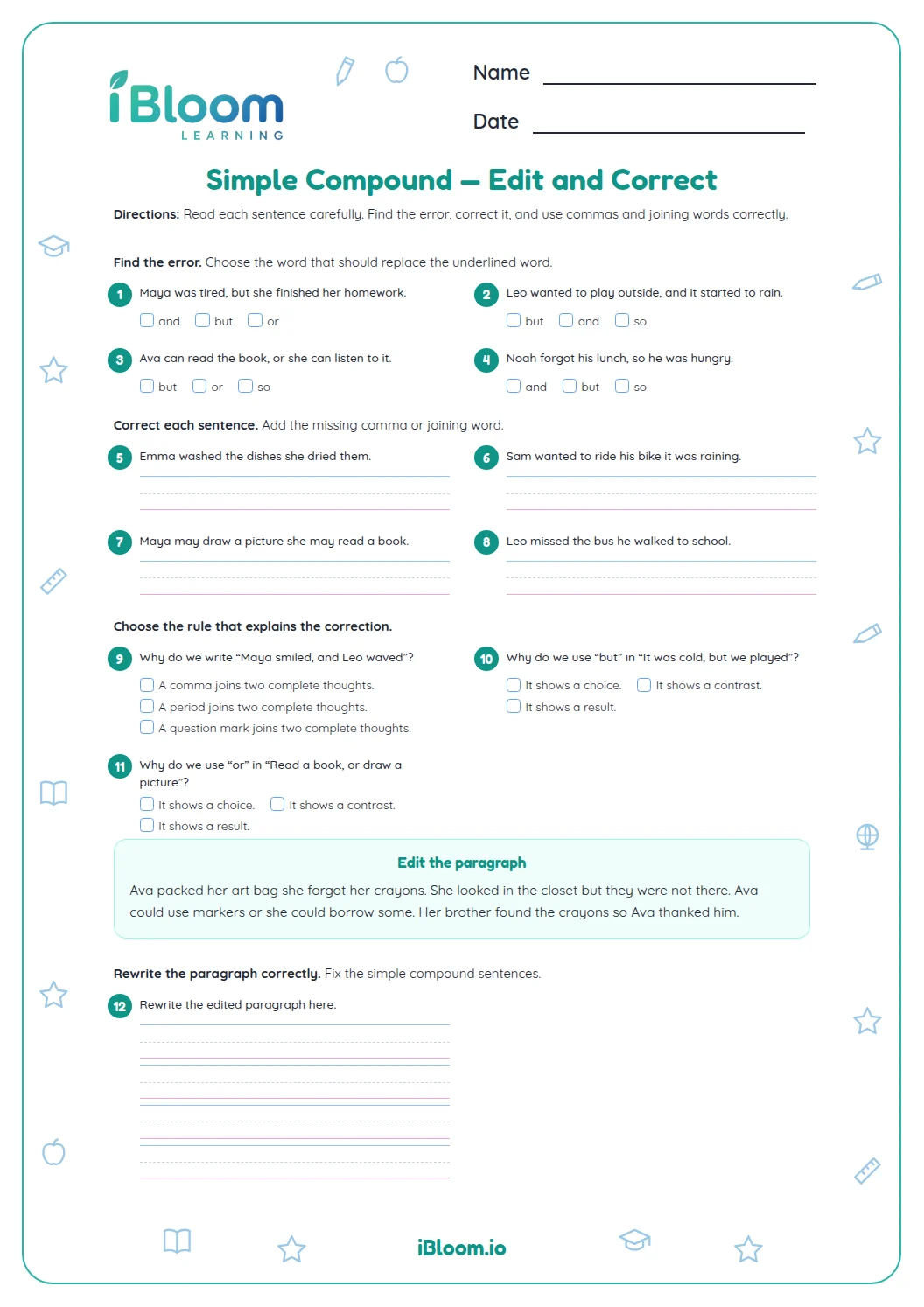
This Grade 3 sentence-practice worksheet moves from recognizing compound sentences to completing and writing them. Students identify complete thoughts joined by a coordinating conjunction, fill a conjunction blank, edit a comma error, and combine short sentence pairs. Writing prompts allow more than one sensible response, so the key gives model answers. The practice supports Common Core L.3.1.i: producing simple, compound, and complex sentences.
Aligned to L.3.1.i
How can you spot a compound sentence?
Look for two complete thoughts joined by a conjunction. Each thought can stand on its own as a sentence. In most worksheet examples, a comma comes before the conjunction.
- 1The rain stopped, and the sun came out.
- 2Thought 1: The rain stopped.
- 3Thought 2: The sun came out.
How do you combine two thoughts?
Choose a conjunction that shows how the ideas fit. Use and to add an idea, but to show a contrast, or to offer a choice, and so to show a result. Put a comma before the conjunction when it joins two complete thoughts.
How to use this worksheet
- 1Check that both thoughts can stand alone as sentences.
- 2Choose a conjunction that shows the relationship between them.
- 3Put a comma before the conjunction.
- 4Read the new sentence aloud and check that it sounds complete.
Common mistakes and quick fixes
The mistake
Joining a complete sentence to a fragment.
The fix
Read each side by itself; each side needs a subject and a verb and must express a complete thought.
The mistake
Putting the comma after the conjunction.
The fix
Place the comma before the joining word: “The bell rang, so we lined up.”
The mistake
Choosing a conjunction that changes the meaning.
The fix
Decide whether the ideas add, contrast, offer a choice, or show a result before choosing and, but, or, or so.
Common Core alignment
This worksheet helps students produce compound sentences in their own writing.
Produce compound sentences by joining complete thoughts with conjunctions.
On this sheet: Students recognize, complete, edit, and produce compound sentences.
Show the official wordingHide the official wording
Produce simple, compound, and complex sentences.
What to practice next
Make more practice
Further reading
Questions parents and teachers ask
What is a compound sentence?
A compound sentence joins two complete thoughts, often with a comma and a coordinating conjunction. In “The rain stopped, and the sun came out,” both “The rain stopped” and “the sun came out” can stand alone as sentences. This worksheet practices that structure.
Which conjunctions do students practice?
The worksheet uses and, but, or, and so. And adds a related thought, but shows a contrast, or gives a choice, and so can show a result. Students choose words that fit the relationship between two ideas before joining them.
Where does the comma go?
When joining two complete thoughts, place the comma before the conjunction: “The bus was late, so we waited.” One editing item asks students to add this comma; the writing items ask them to include it while joining thoughts. The answer key models the punctuation.
What grade is this worksheet for?
This worksheet is written for Grade 3 and supports Common Core L.3.1.i, which asks students to produce simple, compound, and complex sentences. The practice focuses on compound sentences through recognition, completion, editing, and writing, with an answer key for checking.
How should I grade the writing prompts?
Use the answer key as a model rather than the only acceptable wording. A response is successful if it joins two complete thoughts, uses the conjunction named in the prompt, and places a comma before that conjunction. The open prompts accept varied sentences that keep the same meaning.