





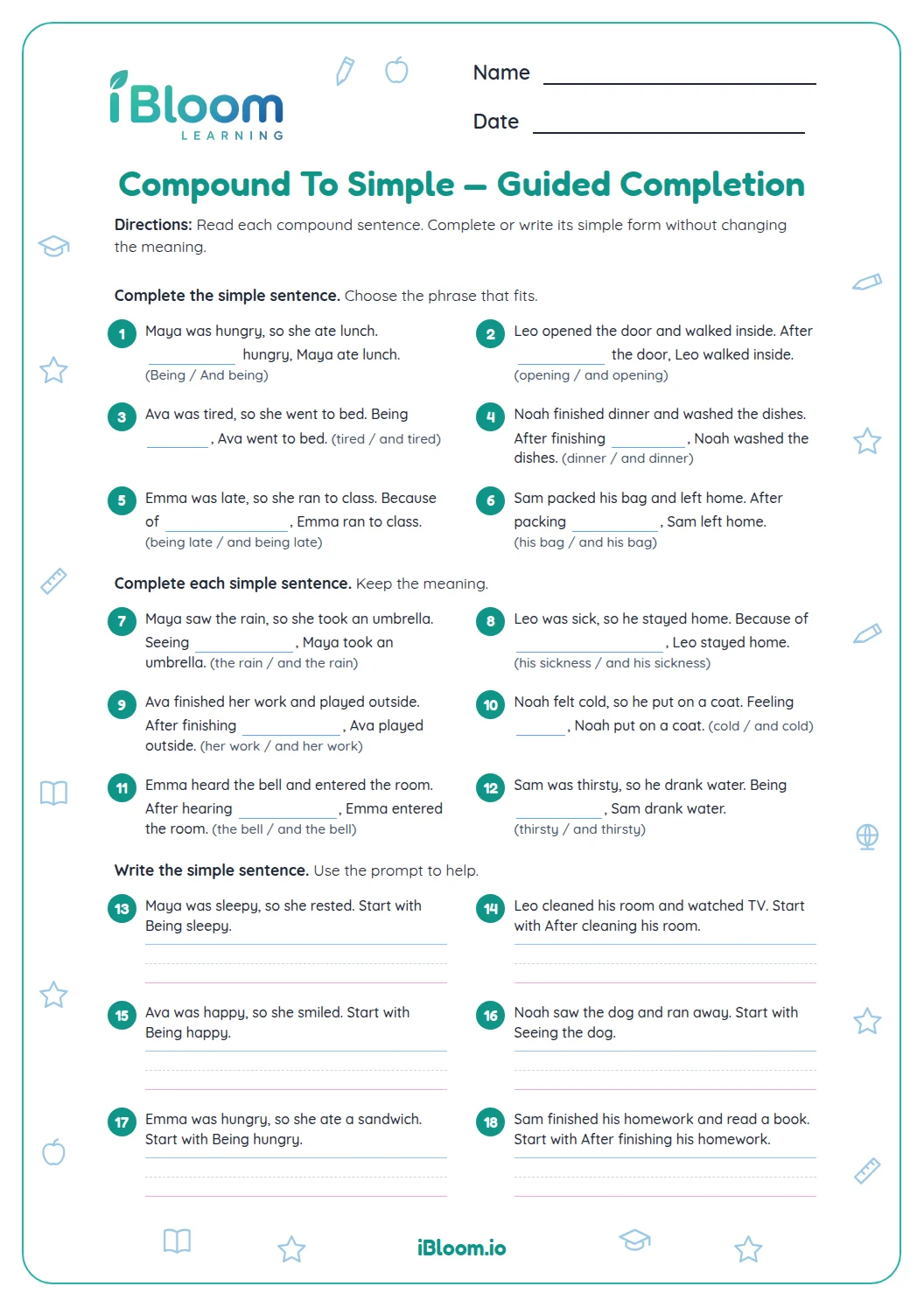

About this worksheet
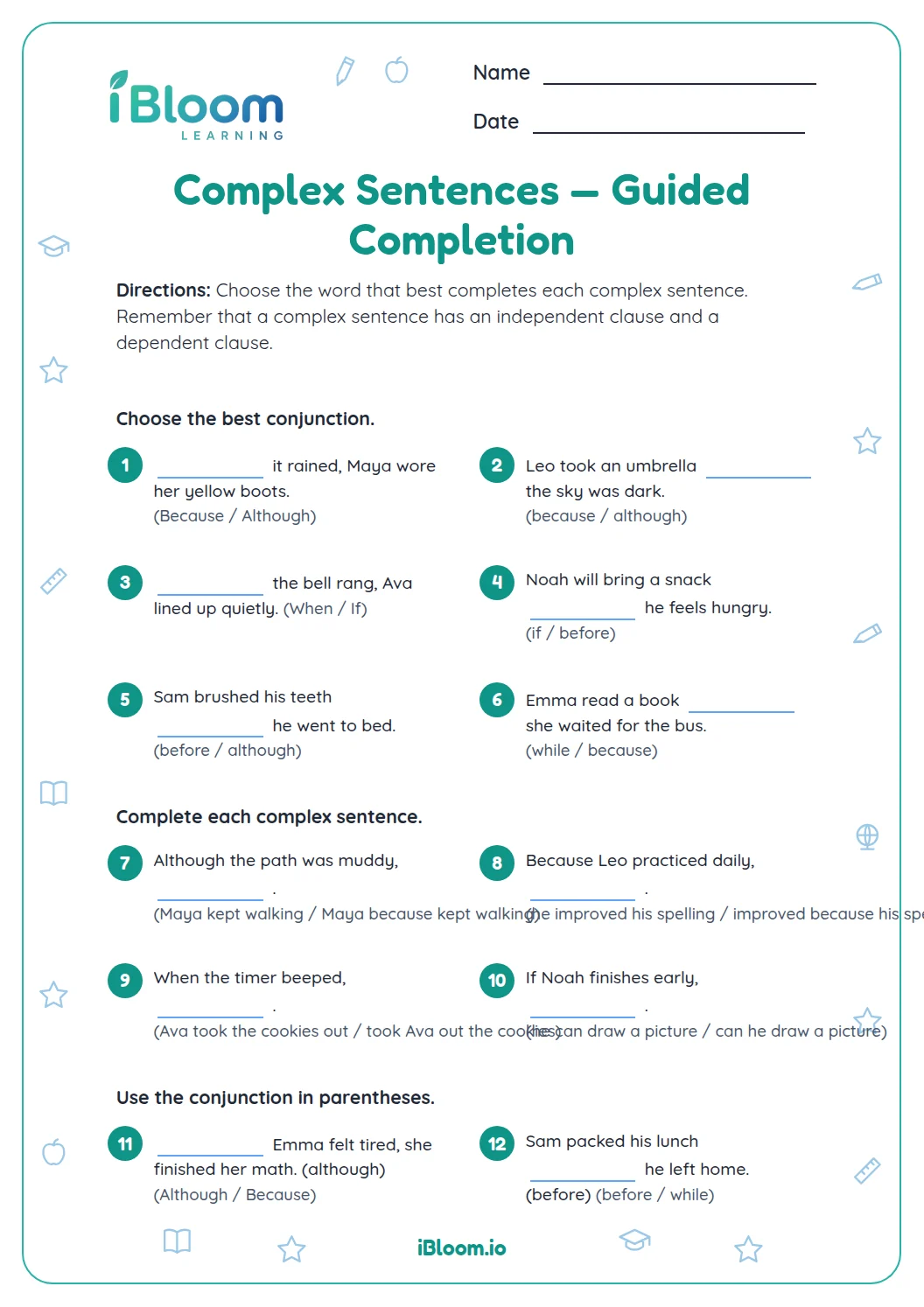
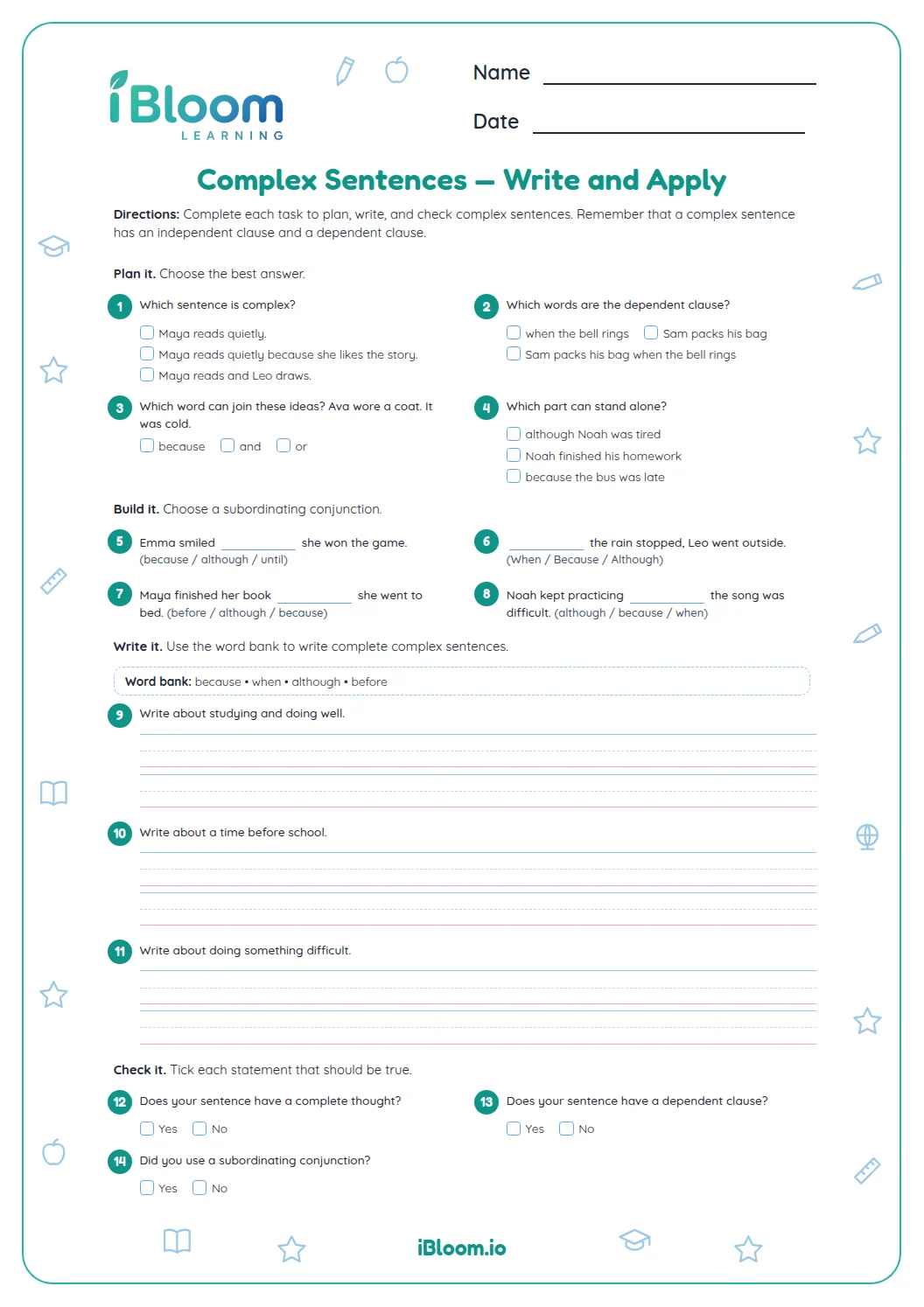
This Grade 3 worksheet builds complex-sentence practice from recognition to writing. Learners identify complete and dependent ideas, choose joining words such as because and when, and combine related thoughts with clear punctuation. Sixteen questions provide both selected-response and written practice, with sample answers in the key. The page aligns with CCSS L.3.1, command of standard English grammar and usage when writing or speaking.
Aligned to L.3.1
How can you spot a complex sentence?
Look for one idea that can stand alone and another idea that depends on a joining word such as because, when, after, although, or if.
How do joining words connect ideas?
A joining word shows how the ideas relate. Read the whole sentence after choosing the word to make sure both parts fit and the meaning is clear.
How do you combine two ideas?
Keep both original ideas, connect them with the requested word, and add punctuation. If the dependent idea comes first, place a comma after it.
- 1Join the ideas with because: The dog barked. It heard a sound.
- 2The dog barked because it heard a sound.
How to use the page
- 1Read the directions and look at the first example prompt.
- 2Complete one part at a time, reading each whole sentence or situation.
- 3For writing items, say the answer aloud before putting it on the line.
- 4Review the answer key and revisit any item that needs a second try.
Common mistakes and quick fixes
The mistake
Treating a dependent clause as a complete sentence.
The fix
Check whether it can stand alone as a full thought.
The mistake
Choosing a joining word that changes the relationship between ideas.
The fix
Read the sentence with the word inserted and check its meaning.
The mistake
Leaving out punctuation after an opening dependent clause.
The fix
Add a comma before the main clause when the dependent clause comes first.
This page practices the following standard.
Use standard English grammar when writing or speaking.
On this sheet:
Show the official wordingHide the official wording
Demonstrate command of the conventions of standard English grammar and usage when writing or speaking.
What to practice next
Make more practice
Further reading
Questions parents and teachers ask
How many questions are included?
The sheet has 16 questions across three worksheet pages, with a separate three-page answer key. It includes identification, joining-word choices, clause recognition, and sentence-combining practice. These formats move from selecting a model to writing complete sentences with punctuation.
What is a dependent idea?
Questions use because, when, after, although, and if. Learners use each word to connect ideas and show the relationship between the parts of a complex sentence. Reading the full sentence aloud can help check the choice and its meaning.
Which joining words appear?
Check that the response keeps both given ideas, uses the requested joining word, and reads as a complete complex sentence. The key provides models; equivalent clear sentences are fine when the meaning stays intact. Have the learner reread punctuation too.
How should written sentences be checked?
About 20 minutes is a useful estimate for reading and answering these questions. Sentence-combining items may take longer because learners plan and write a complete sentence. A second read helps check punctuation and meaning before checking the key.
How long should practice take?
About 20 minutes is a useful estimate for reading and answering these questions. Sentence-combining items may take longer because learners plan and write a complete sentence. A second read helps check punctuation and meaning before checking the key with an adult.