








About this worksheet
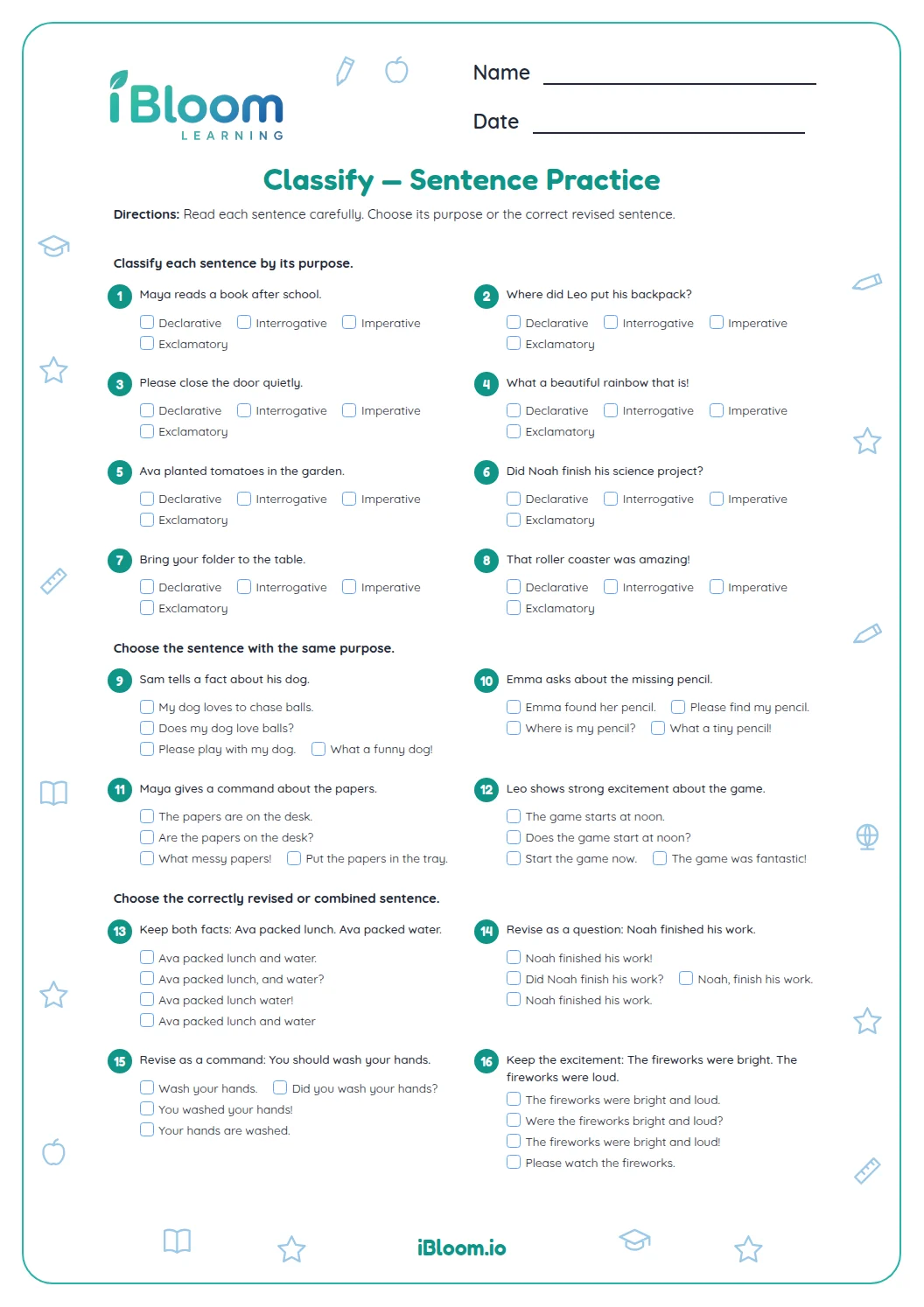
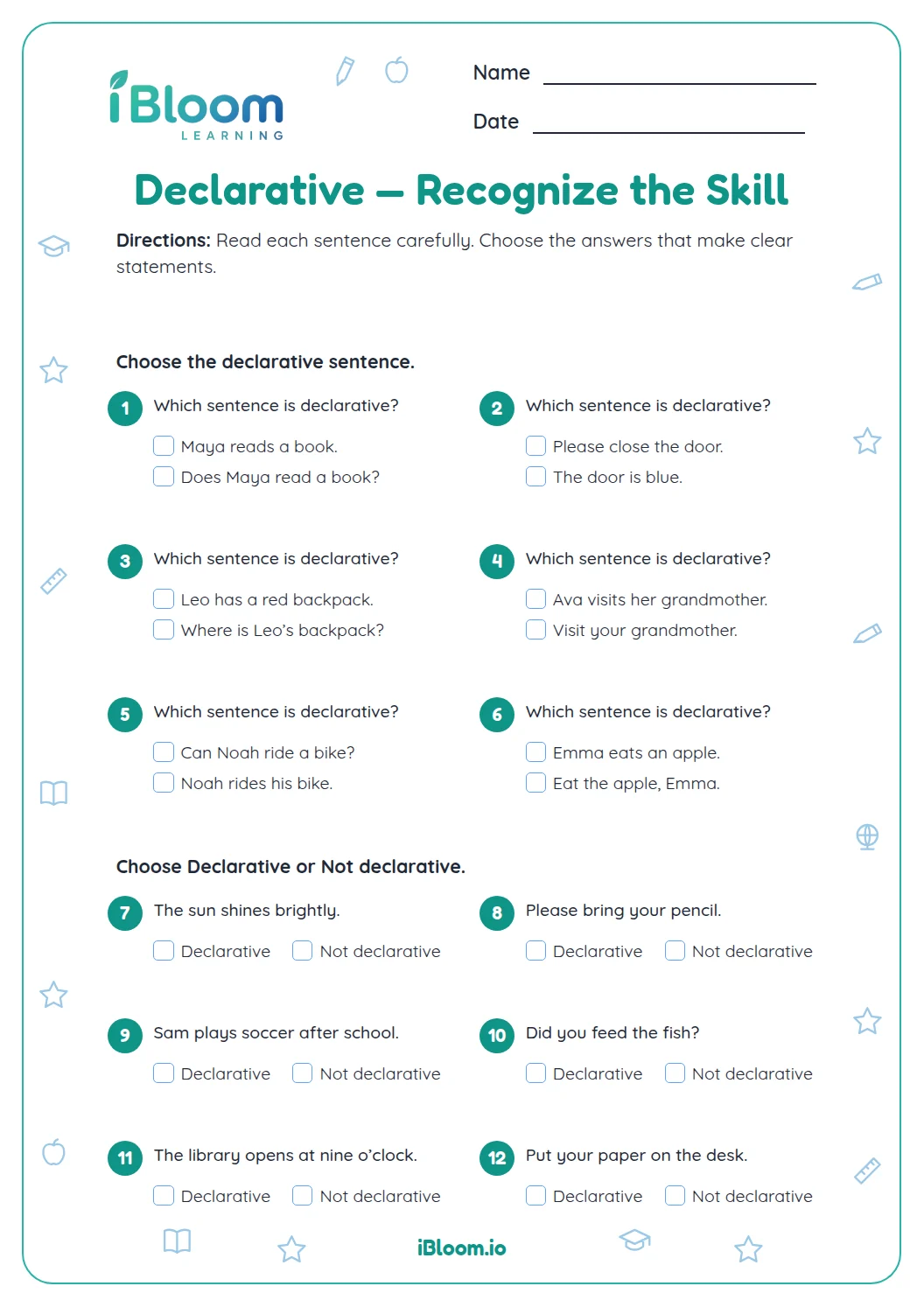
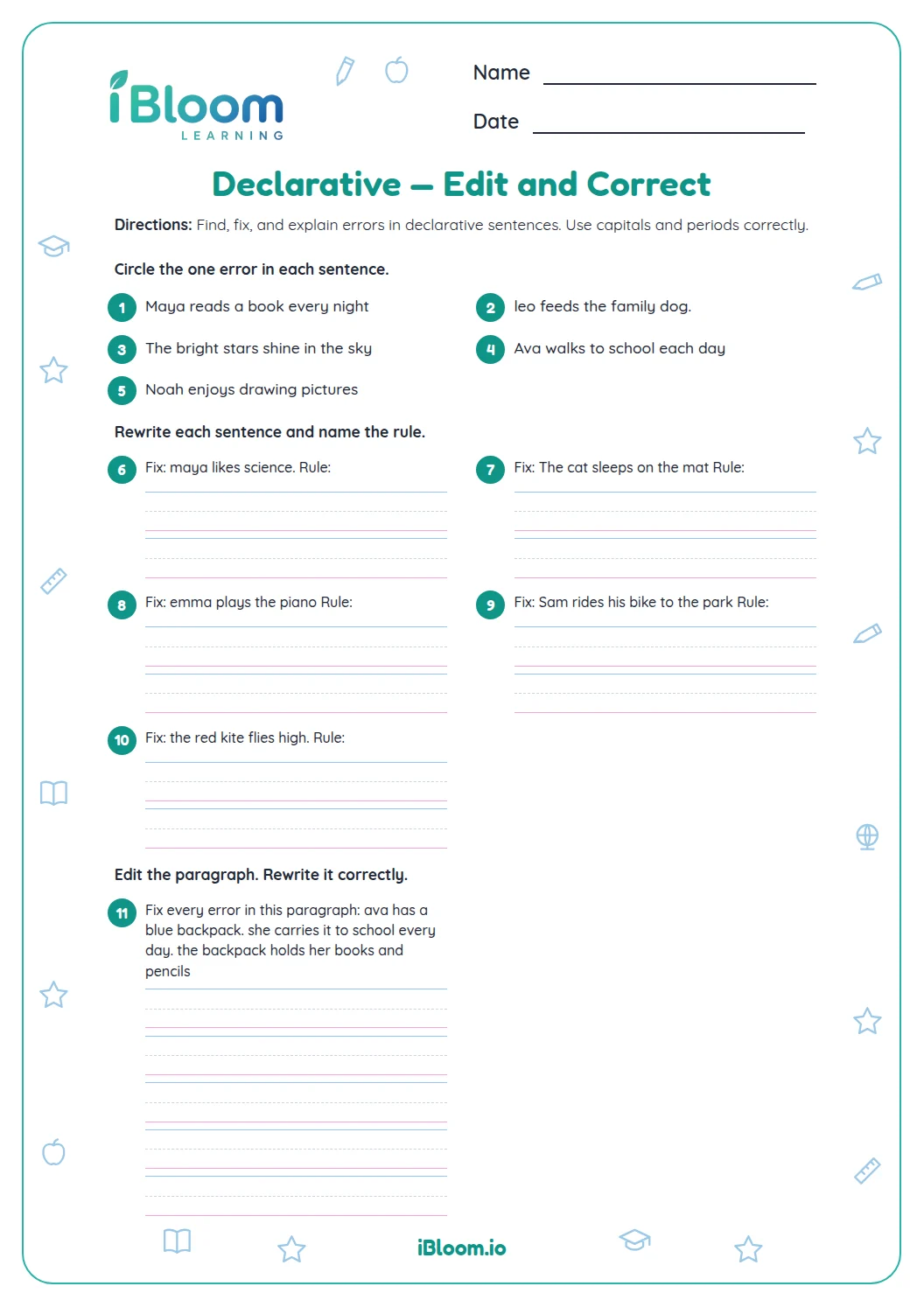
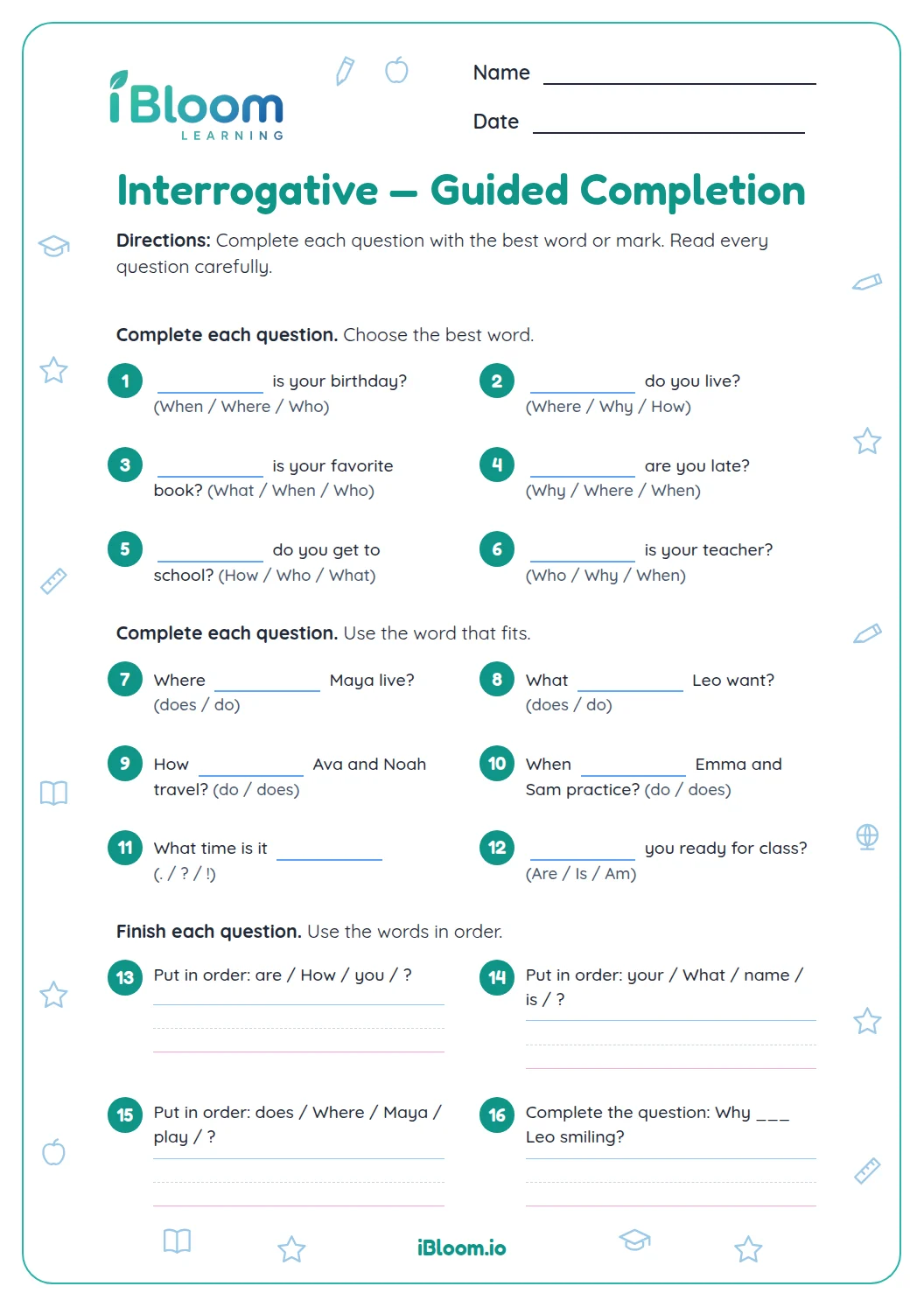
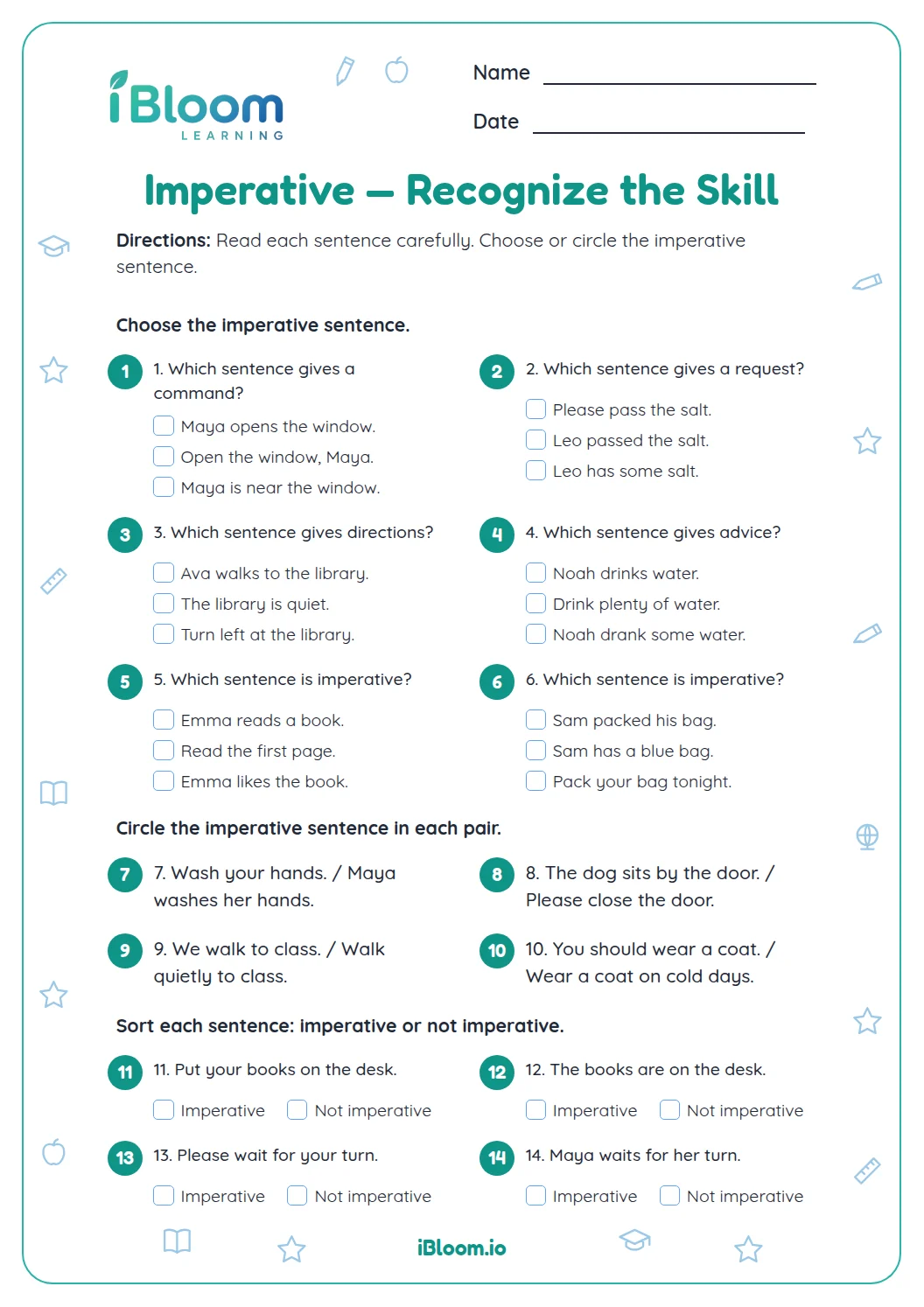
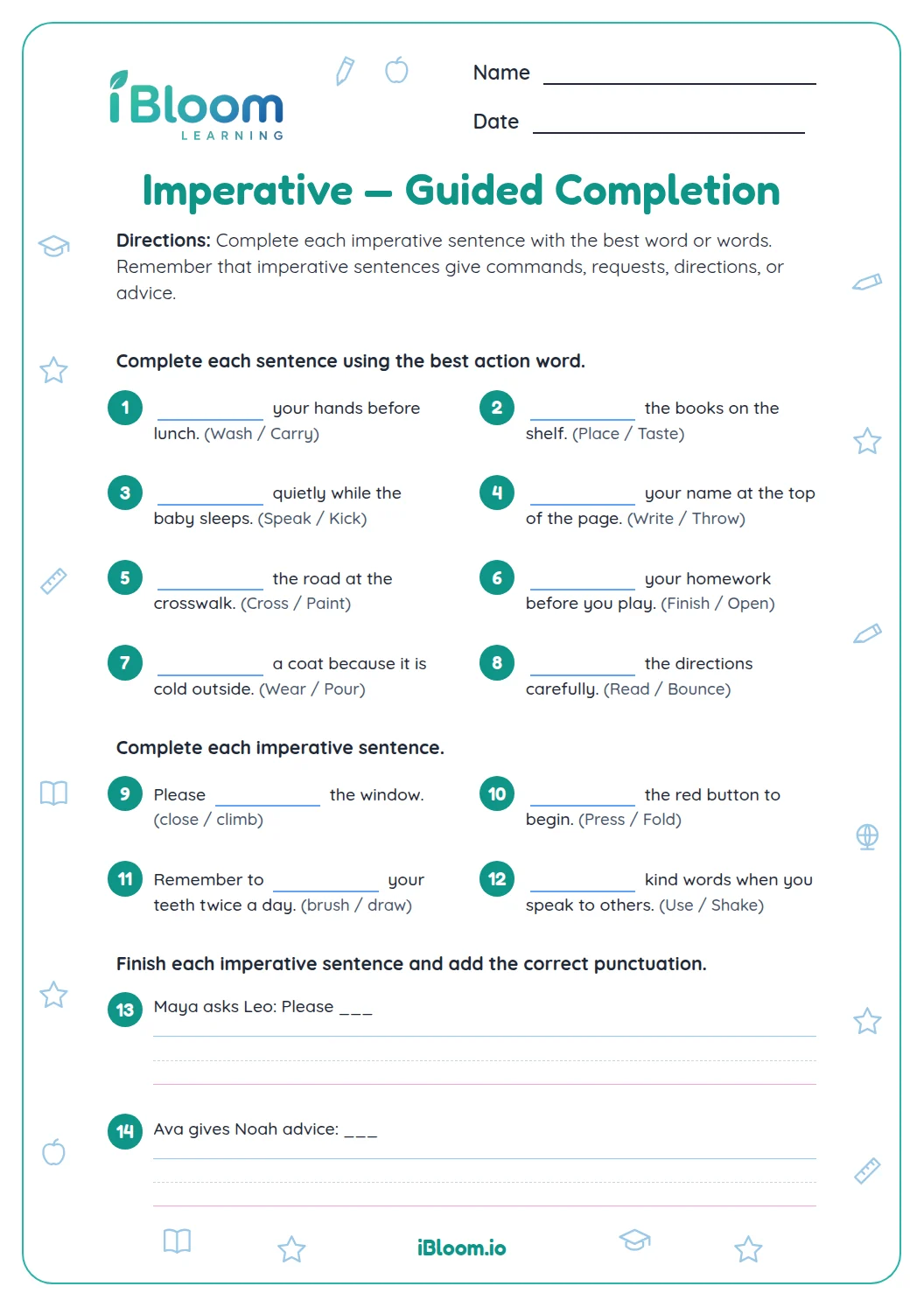
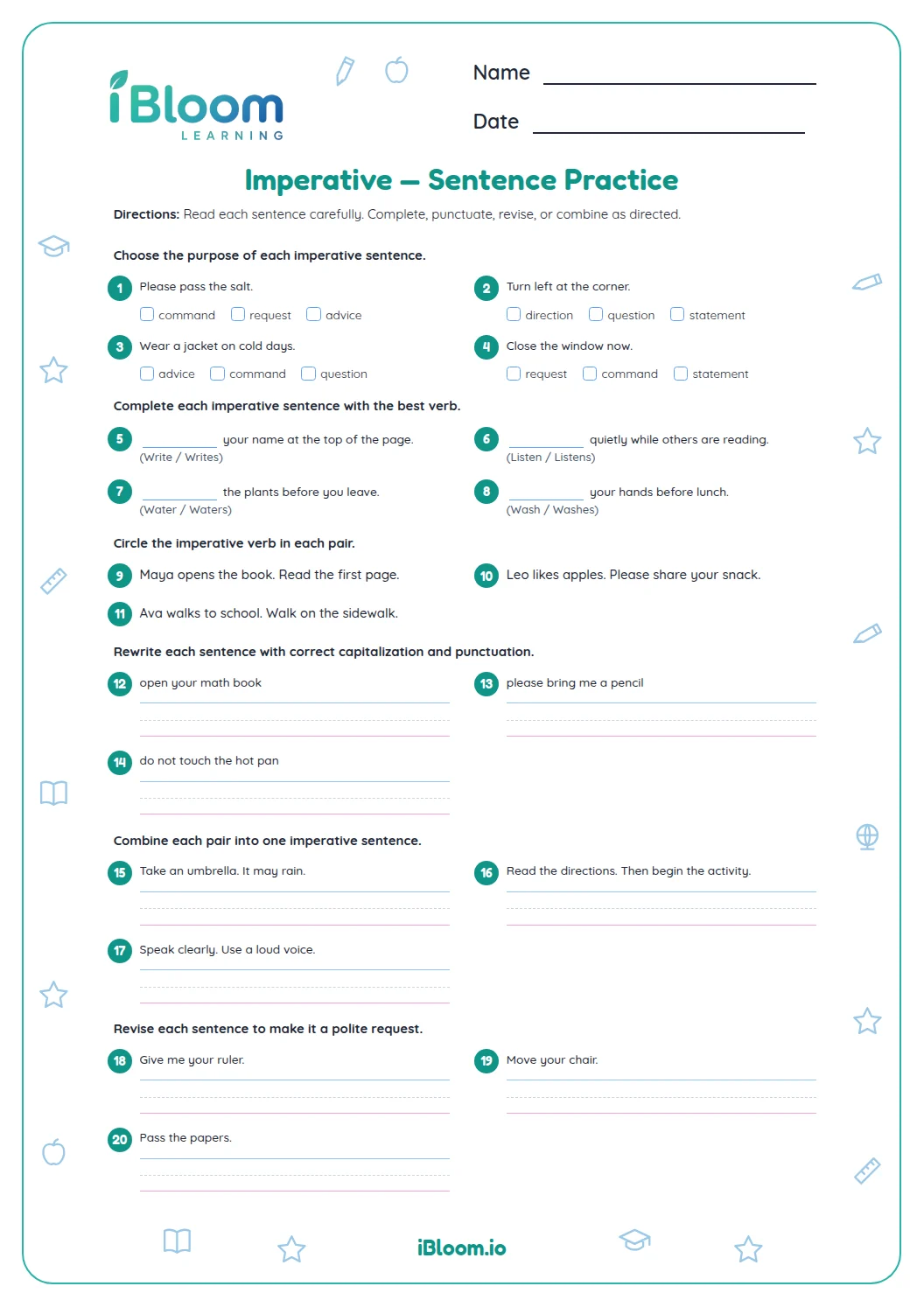
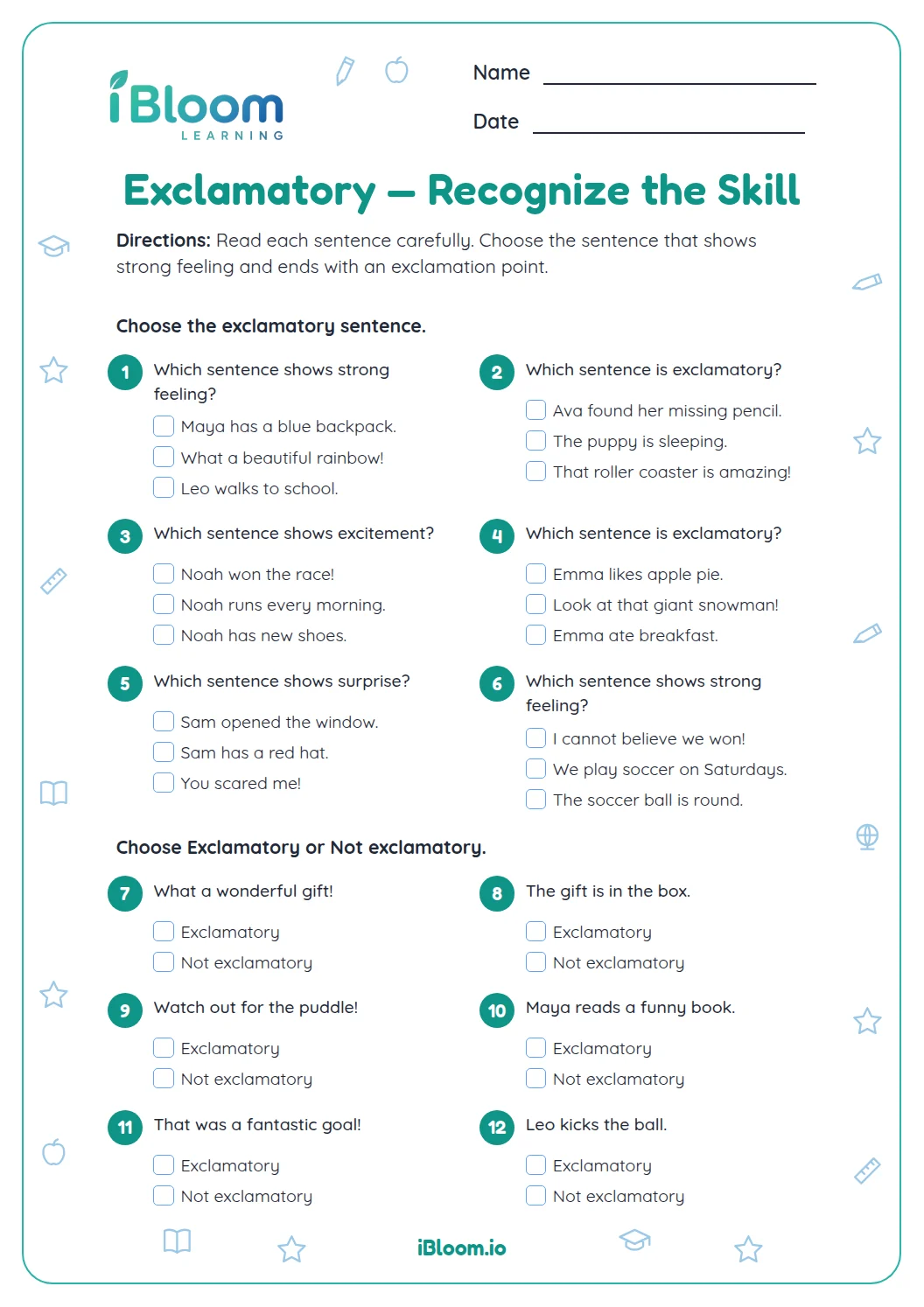
This free Grade 3 printable gives children focused practice identifying sentence purpose and editing sentence conventions. It includes 15 garden-themed questions: eight sentence classifications, five edits for capitalization and end punctuation, and two short writing prompts. The activities connect sentence reading and writing to CCSS L.3.1.i and L.3.2. A separate answer key lists the classifications, corrected sentences, and sample responses.
Aligned to L.3.2
How do I tell sentence types apart?
Look at what the sentence does. A statement tells something, a question asks, a command gives a direction, and an exclamation shows strong feeling. The first word alone does not always tell the type; use the whole sentence.
- 1Where did you put the seed packets
- 2It asks for information.
- 3It is interrogative and needs a question mark.
Which punctuation mark belongs at the end?
A period ends most statements and commands. A question mark ends a direct question. An exclamation point can show strong feeling. In editing, check the first word for a capital and names such as Monday for capitals too.
How can I check a sentence I wrote?
Read it aloud and decide whether it tells, asks, directs, or exclaims. Then check that its punctuation matches. The final questions ask for a command and an exclamation, so the answer key shows one possible sentence for each.
What is included on the printable?
There are 15 questions in three parts: classify eight examples, edit five sentences, and write two of your own. The examples use a garden theme so the sentences stay connected while their purposes change.
How can I use this worksheet?
- 1Read each sentence all the way through before classifying it.
- 2Ask whether it tells, asks, directs, or exclaims.
- 3For edits, fix the beginning capitals before checking the ending mark.
- 4Read your own sentences aloud and check their purpose.
- 5Use the key to review each choice and correction.
What mistakes should children check?
The mistake
Calling every sentence with a period declarative.
The fix
Check whether it gives a direction; an imperative can end with a period.
The mistake
Using an exclamation point for every loud-sounding sentence.
The fix
Use it when the words express strong feeling, not simply because they are long.
The mistake
Forgetting a capital in a day name such as Monday.
The fix
Scan for proper names as well as the first word of each sentence.
Common Core alignment
The worksheet combines sentence reading with editing and sentence writing.
Edit sentence beginnings and end punctuation using standard English conventions.
On this sheet: Children classify sentence purposes and correct capitals and end marks.
Show the official wordingHide the official wording
Demonstrate command of the conventions of standard English capitalization, punctuation, and spelling when writing.
What to practice next
Make more practice
Further reading
Questions parents and teachers ask
What are the four sentence types on this sheet?
The worksheet uses declarative, interrogative, imperative, and exclamatory sentences. A declarative sentence tells something, an interrogative sentence asks, an imperative sentence gives a direction or request, and an exclamatory sentence expresses strong feeling. Children classify eight examples before editing and writing.
How can my child tell a command from a statement?
Ask whether the sentence gives someone a direction. “Please carry the watering can carefully” is an imperative sentence because it tells someone what to do. A statement such as “The class planted beans” simply tells information. Both can end with a period.
Does every exclamatory sentence need an exclamation point?
For this worksheet, use an exclamation point when a sentence expresses strong feeling or excitement. “What a tall sunflower that is!” shows excitement. Read the sentence aloud, decide what it communicates, and then match the ending mark to its purpose.
What should children check when editing?
Check the first word for a capital, proper names such as Monday for capitals, and the ending punctuation. Then read the sentence again to see whether the punctuation fits its purpose. Questions 9 through 13 give practice with statements, requests, questions, and exclamations.
What happens in the final two questions?
Children write one imperative request about helping in a garden and one exclamatory sentence about a surprise. The answer key gives sample sentences. Other complete sentences are acceptable when they match the requested purpose and use suitable punctuation.
How many questions are on the worksheet?
There are 15 questions: eight sentence classifications, five editing items, and two original sentence prompts. The printable has worksheet pages and a separate answer key. The first section uses multiple-choice responses; the later sections invite corrections and writing.