






About this worksheet
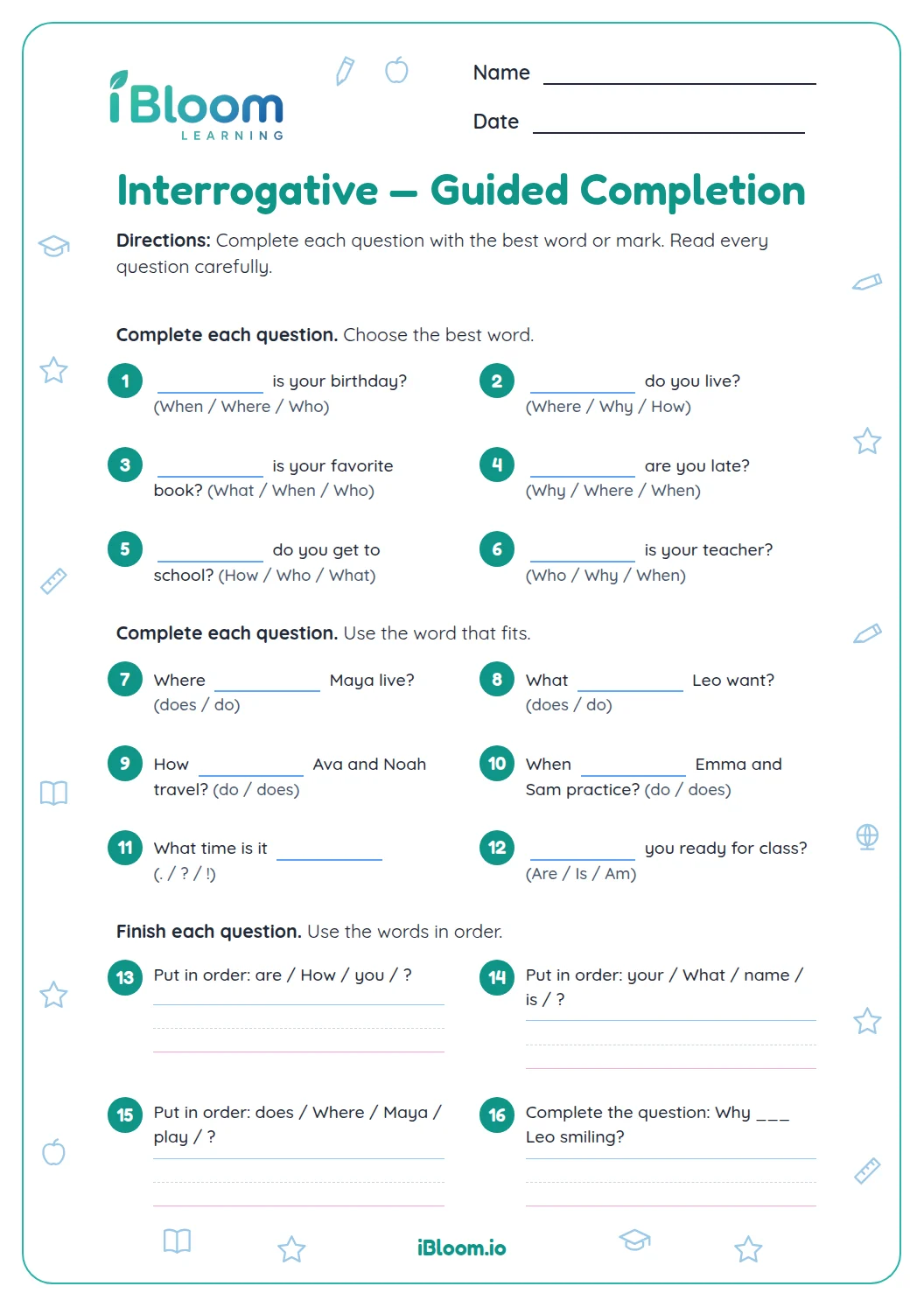
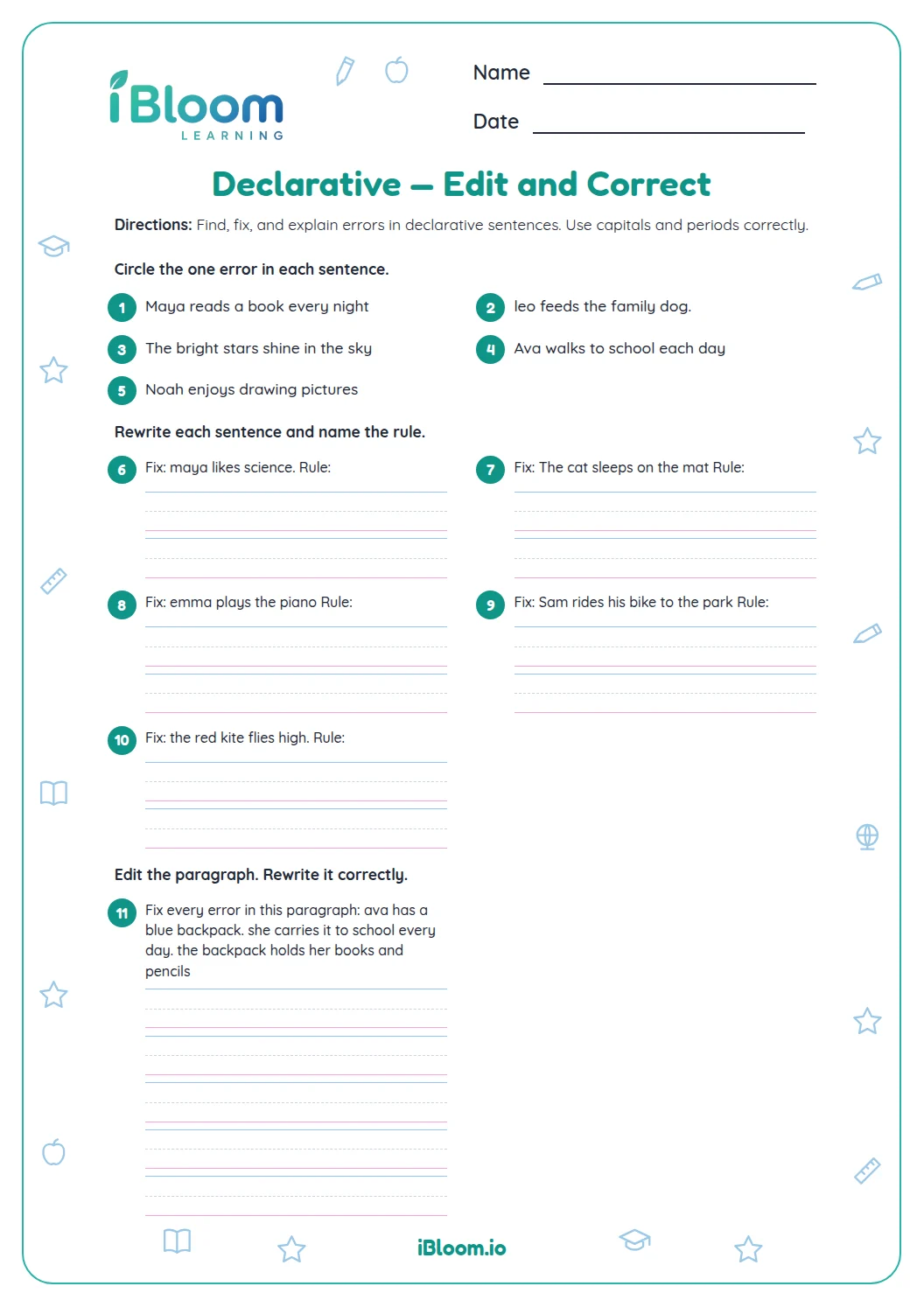
This Grade 3 grammar worksheet focuses on interrogative sentences: sentences that ask questions. Students rewrite 14 short prompts, adding capitalization and question marks to make complete interrogative sentences. The work practices conventions named in CCSS L.3.2, and a separate answer key gives the corrected questions.
Aligned to L.3.2
How can you recognize an interrogative sentence?
An interrogative sentence asks something. The sentence “Did Sam bring his lunch?” asks for information, while “Sam brought his lunch.” tells something. A question mark at the end helps the reader see that the sentence is asking.
What should students fix when editing?
Begin the first word with a capital letter, capitalize the pronoun I, and place a question mark at the end. For example, “where is my folder” becomes “Where is my folder?”
Why do some questions begin with different words?
Questions may start with who, what, when, where, why, or how, or with a helping verb such as can, did, or is. The opening word changes, but the sentence still asks something and needs a question mark.
How to use this worksheet
- 1Read each sentence aloud and listen for what it asks.
- 2Check the first word; capitalize it.
- 3Capitalize I wherever it appears.
- 4Read the final mark and replace a period with a question mark when needed.
- 5Reread the full question to make sure the words form a complete thought.
Common mistakes and quick fixes
The mistake
Using a period at the end of a question.
The fix
Ask whether the sentence requests information; if so, finish with a question mark.
The mistake
Forgetting to capitalize I.
The fix
The pronoun I is always capitalized, including in “May I borrow…?”
The mistake
Capitalizing every word.
The fix
Use a capital at the start and for names or I; keep ordinary words lowercase.
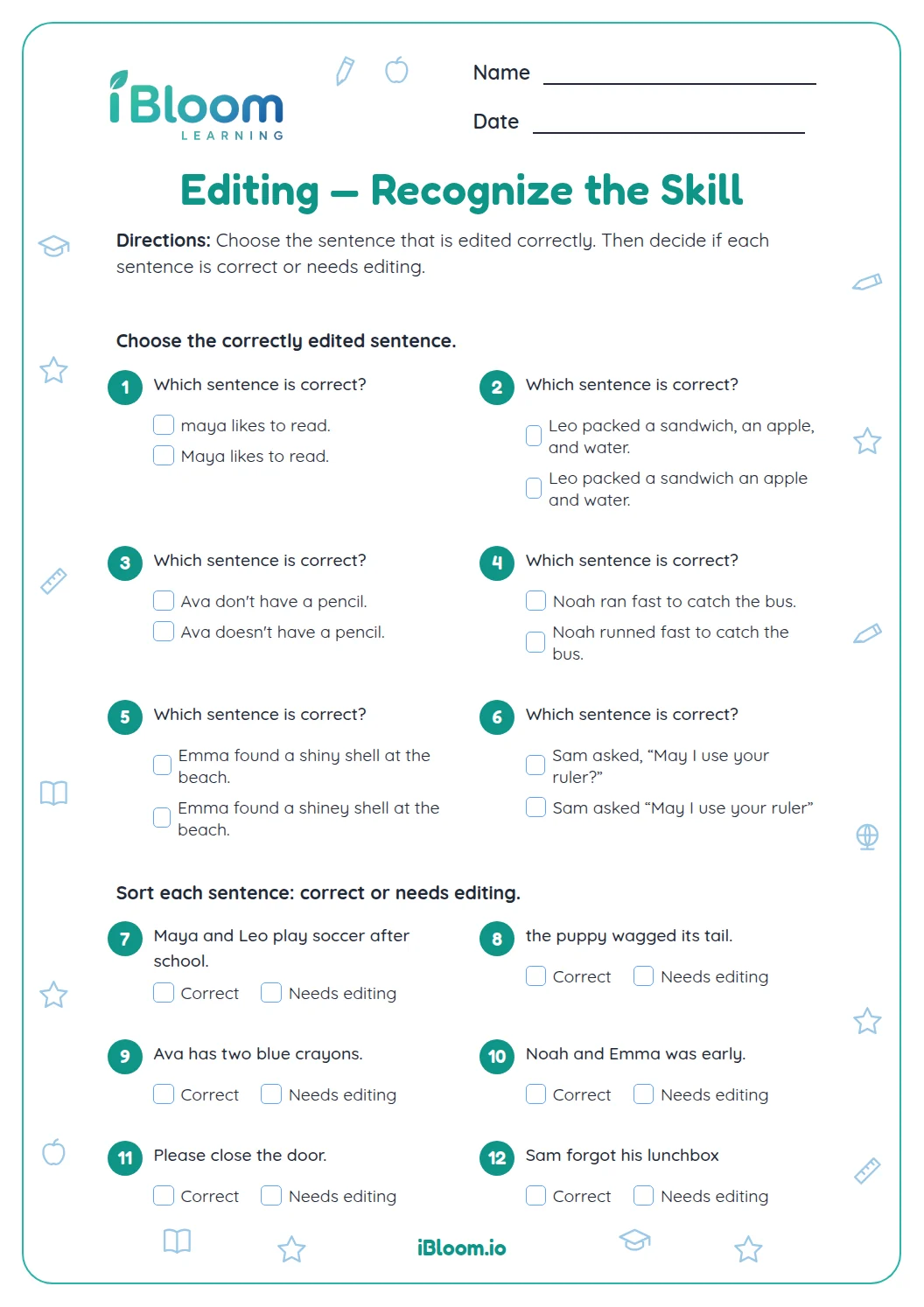
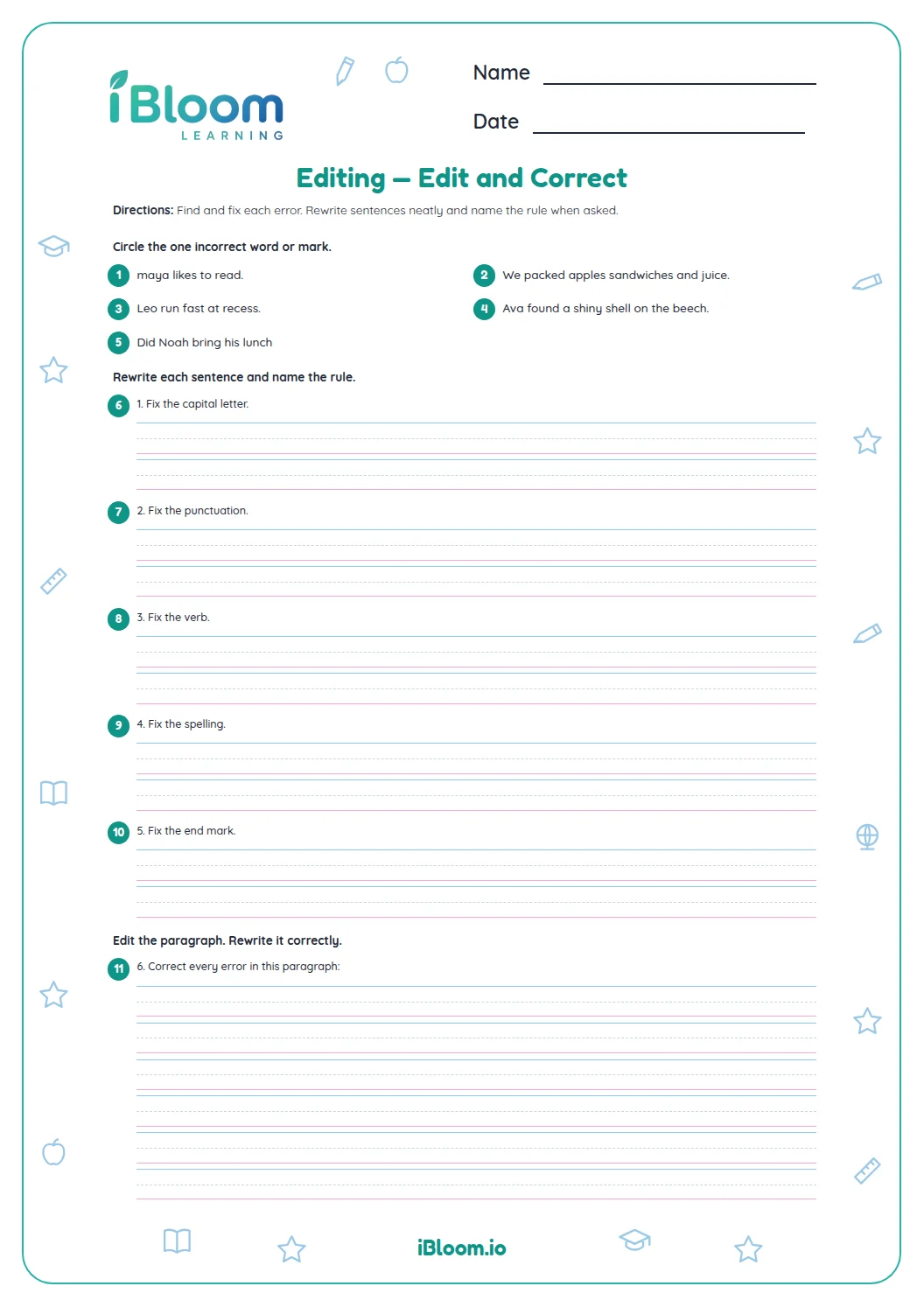
This worksheet practices capitalization and punctuation while students edit question sentences.
Capitalize the first word and use a question mark when editing each question.
On this sheet:
Show the official wordingHide the official wording
Demonstrate command of the conventions of standard English capitalization, punctuation, and spelling when writing.
What to practice next
Make more practice
Further reading
Questions parents and teachers ask
What is an interrogative sentence?
An interrogative sentence asks a question. It may begin with a word such as who, what, when, where, why, or how, or with a helping verb such as can or did. In edited writing, it begins with a capital and ends with a question mark.
How many questions are on the sheet?
There are 14 questions across two parts. Students rewrite each prompt as a complete interrogative sentence, correcting capitalization and punctuation as needed. A separate answer key gives each corrected question. Children can check the first letter and final mark after they finish.
What is the corrected version of “where is my folder”?
The corrected sentence is “Where is my folder?” Capitalize the first word, keep the other words lowercase, and add a question mark at the end. Question 6 practices this edit. It is a complete question because it asks for information about the folder.
Should every question start with a question word?
No. A question can start with a question word, as in “Where is the folder?” It can also start with a helping verb, as in “Can we feed the ducks?” Both sentence forms ask something and end with a question mark.
Why is the word I capitalized in the middle of a sentence?
I is the first-person singular pronoun, and standard English always writes it as a capital letter. Question 10 uses it in “May I borrow a marker?” The opening word is capitalized too, because it begins the sentence. The key highlights both changes for checking.
What standard does the worksheet support?
The worksheet supports CCSS L.3.2, which asks students to use standard English capitalization and punctuation when writing. Students apply those conventions by rewriting question prompts with correct sentence capitals and question marks. The separate key lists each corrected sentence.