





About this worksheet
This free printable is for Grade 3 learners practicing declarative sentences. It includes 16 questions across the worksheet’s different parts, followed by a separate answer key. The items move from guided recognition to applying the skill in short tasks. Use it for independent practice, a small group, or a quick review together.
Aligned to L.3.1.i and L.3.2
What kinds of sentences appear first?
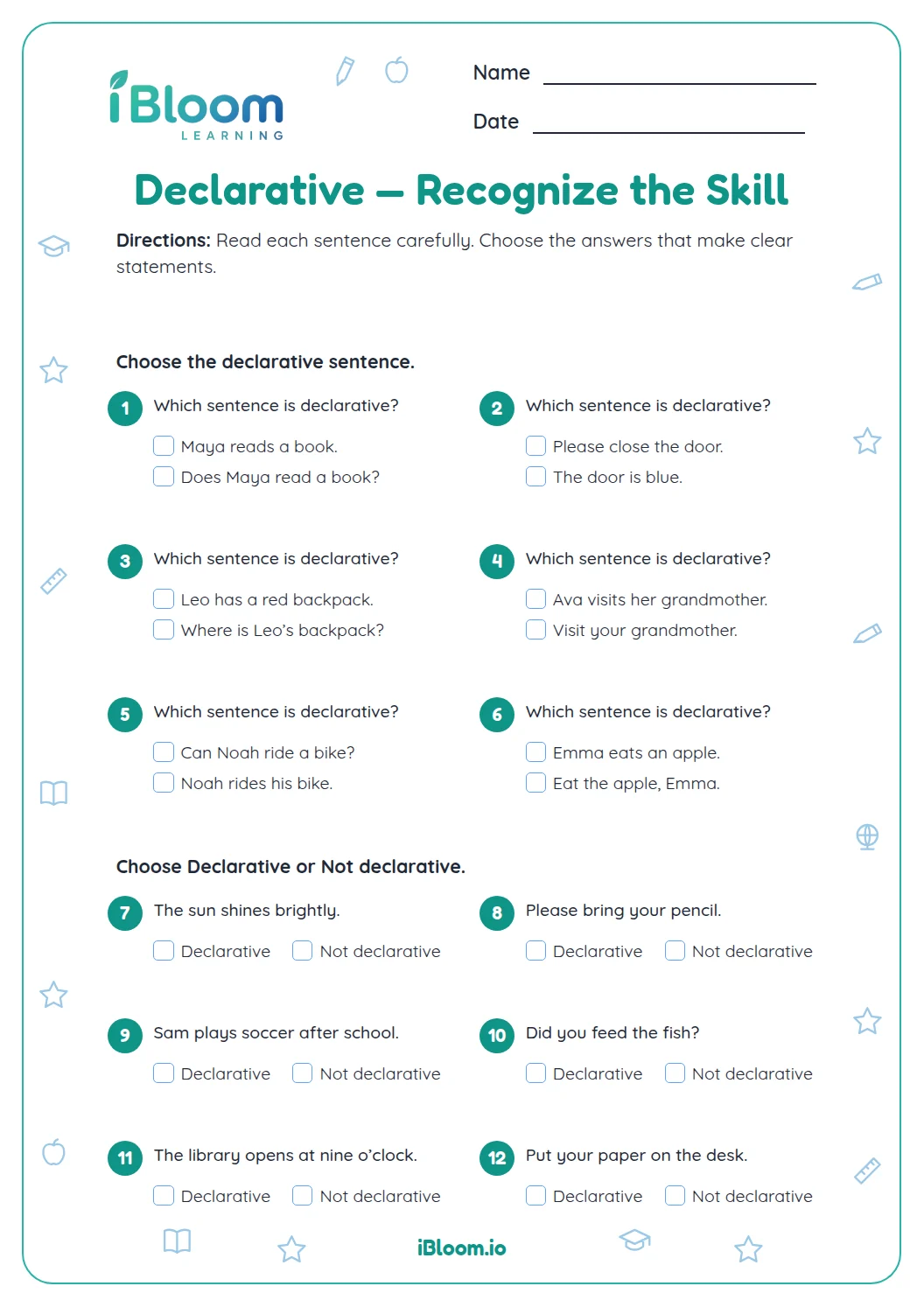
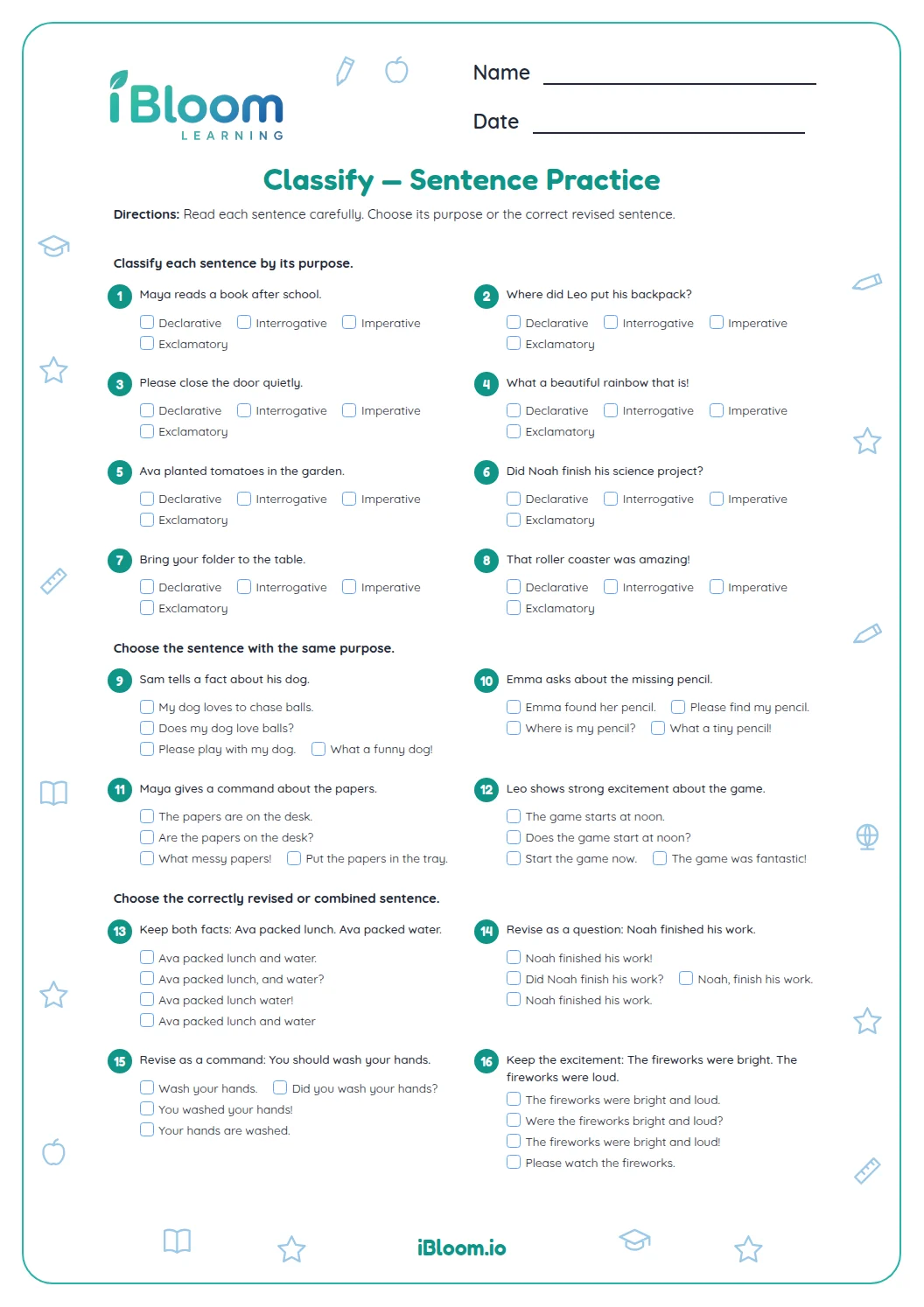
The first five items ask learners to distinguish statements from questions, commands, and exclamations. The next three ask them to spot a declarative sentence among other sentence types.
- 1Classify this sentence: The library closes at five o’clock. → statement
How do learners edit a telling sentence?
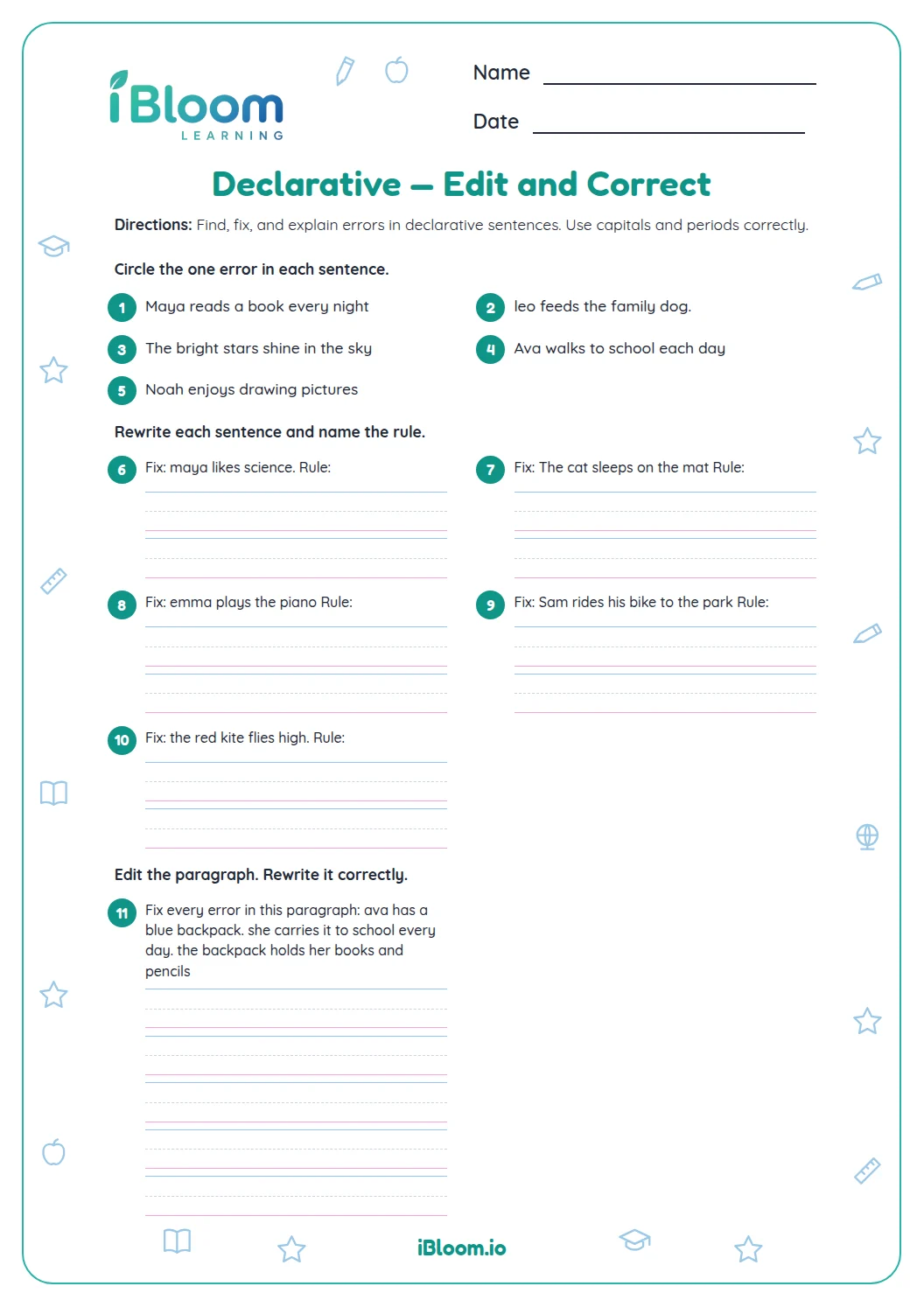
Items 9–12 begin with lowercase letters and need a capital at the start and an appropriate end mark. The last four items ask learners to combine related ideas into one declarative sentence.
How can the answer key help?
Use the key to check the sentence type, capitalization, and punctuation. For combined sentences, compare the meaning and make sure both original ideas remain.
How to use this worksheet
- 1Read the sentence aloud and listen for its purpose.
- 2Name whether it tells, asks, commands, or exclaims.
- 3For an editing item, add the capital and period.
- 4When joining ideas, keep both ideas and make one complete sentence.
- 5Compare the sentence with the key.
Common mistakes and quick fixes
The mistake
Confusing a statement with a question because it mentions a question word.
The fix
Check whether the sentence asks something and ends with a question mark.
The mistake
Leaving the first word lowercase.
The fix
Capitalize the first word of the sentence.
The mistake
Joining ideas but leaving out one.
The fix
Check that the combined sentence keeps both original ideas.
Curriculum alignment
Write simple and compound sentences when combining ideas.
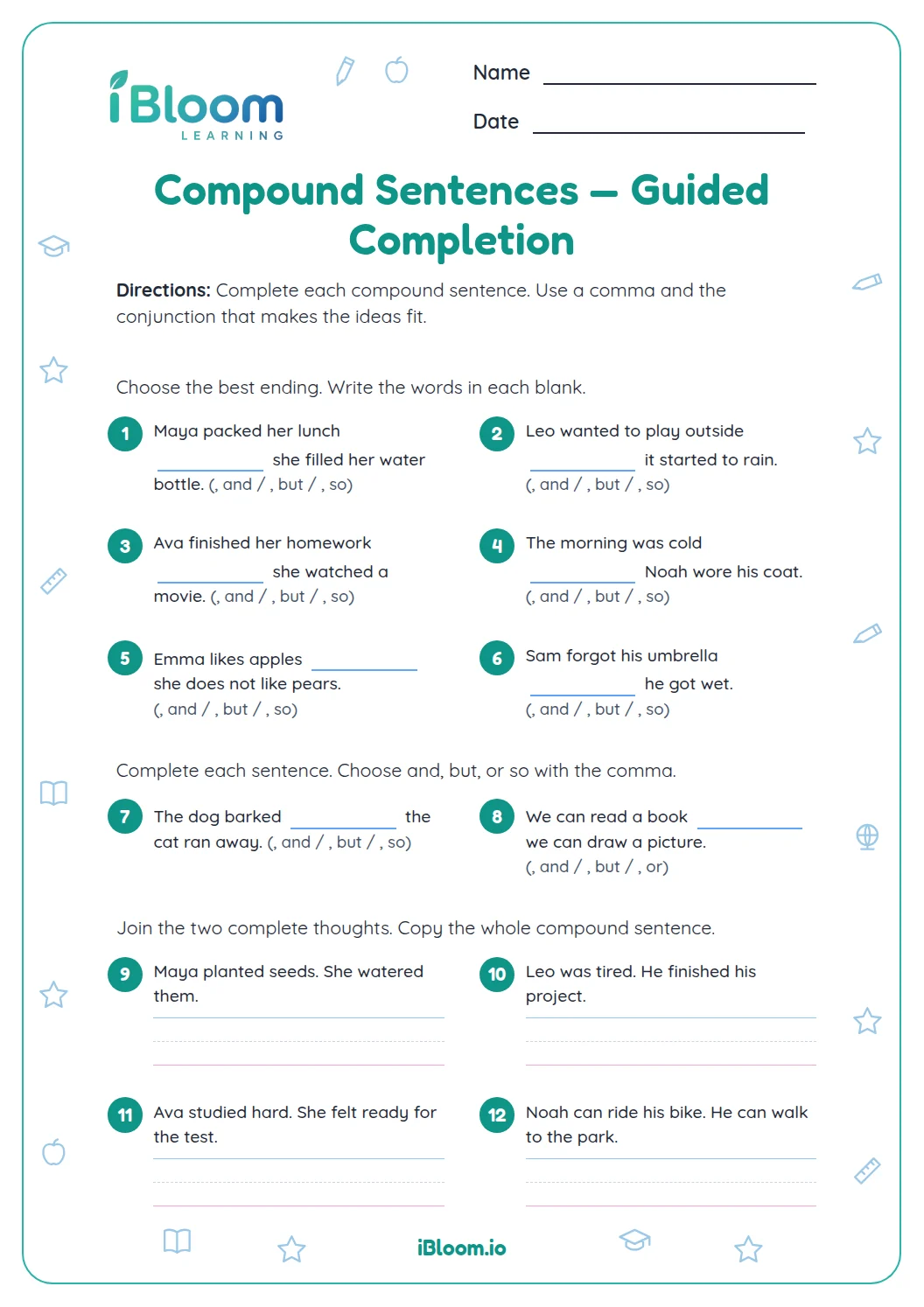
On this sheet: The last part combines two ideas into a declarative sentence.
Show the official wordingHide the official wording
Produce simple, compound, and complex sentences.
Use correct capitalization and punctuation when revising sentences.
On this sheet: The editing questions ask learners to capitalize the first word and add a period.
Show the official wordingHide the official wording
Demonstrate command of the conventions of standard English capitalization, punctuation, and spelling when writing.
What to practice next
Make more practice
Further reading
Questions parents and teachers ask
What sentence types does this page ask learners to identify?
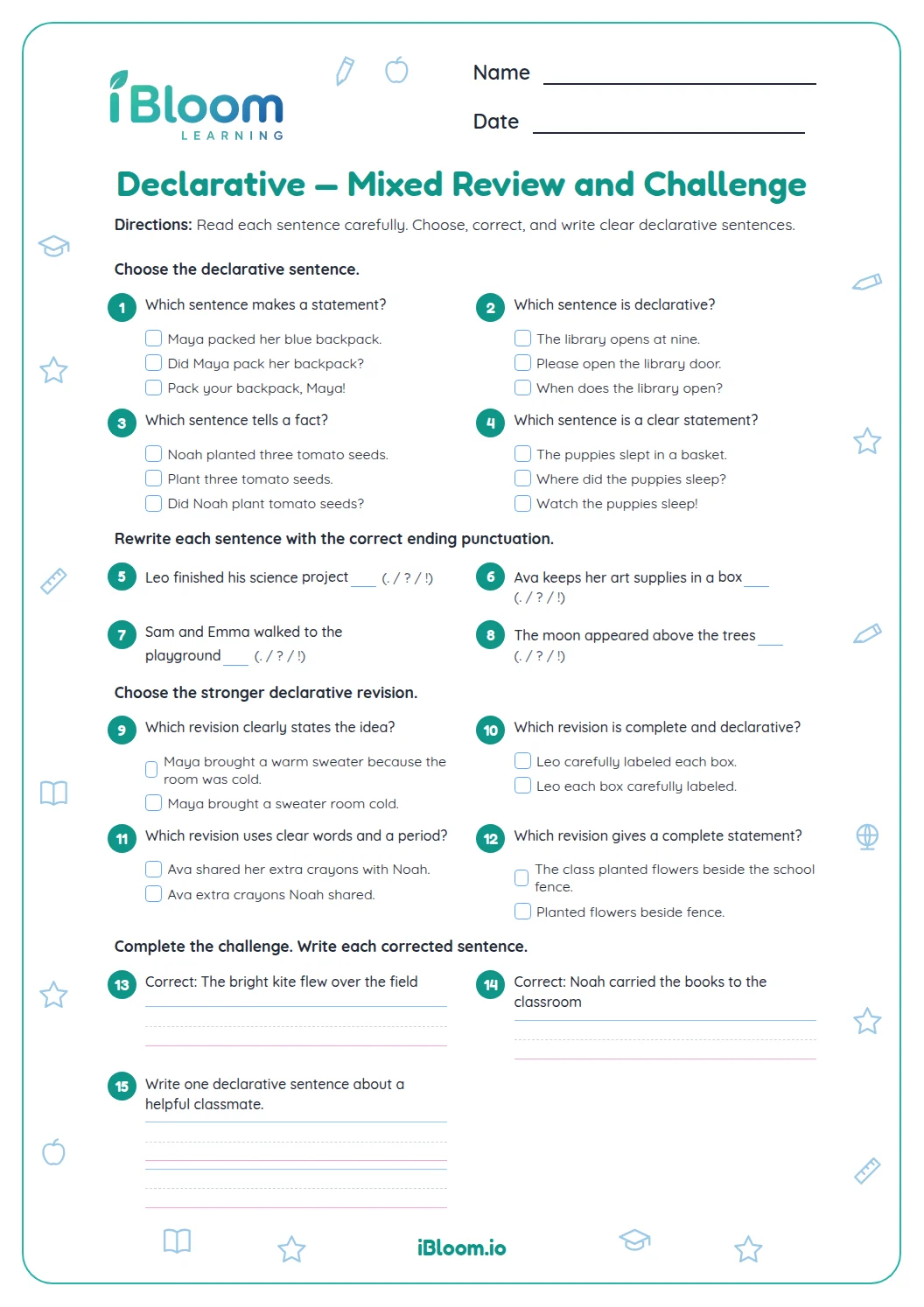
The first part includes statements, questions, commands, and exclamations. Later items focus on choosing and writing declarative sentences. The examples use everyday topics such as books, gardens, and music. The separate answer key offers a quick way to review each response.
How many questions are on the printable?
There are 16 questions across three parts, followed by a separate answer key. Learners identify sentence types, edit telling sentences, and combine pairs of related ideas. The final four answers may use different wording if both ideas remain clear. The separate answer key offers a quick way to review each response.
What does a declarative sentence do?
A declarative sentence tells or states an idea. In this worksheet, “The library closes at five o’clock” is a statement, while “Where did the class put its books?” asks a question. Learners practice identifying and writing statements. The separate answer key offers a quick way to review each response.
How should I check a combined sentence?
Check that the new sentence includes both original ideas and reads as one complete statement. A joining word such as “and” can connect two related ideas. Compare with the key, which gives one model answer. The separate answer key offers a quick way to review each response.
Can learners use a different answer from the key?
Yes, for the sentence-combining items, another complete declarative sentence can be correct if it preserves both ideas and uses appropriate punctuation. The editing questions have specific corrections, and the identification questions have one sentence type as the answer. The separate answer key offers a quick way to review each response.