






About this worksheet
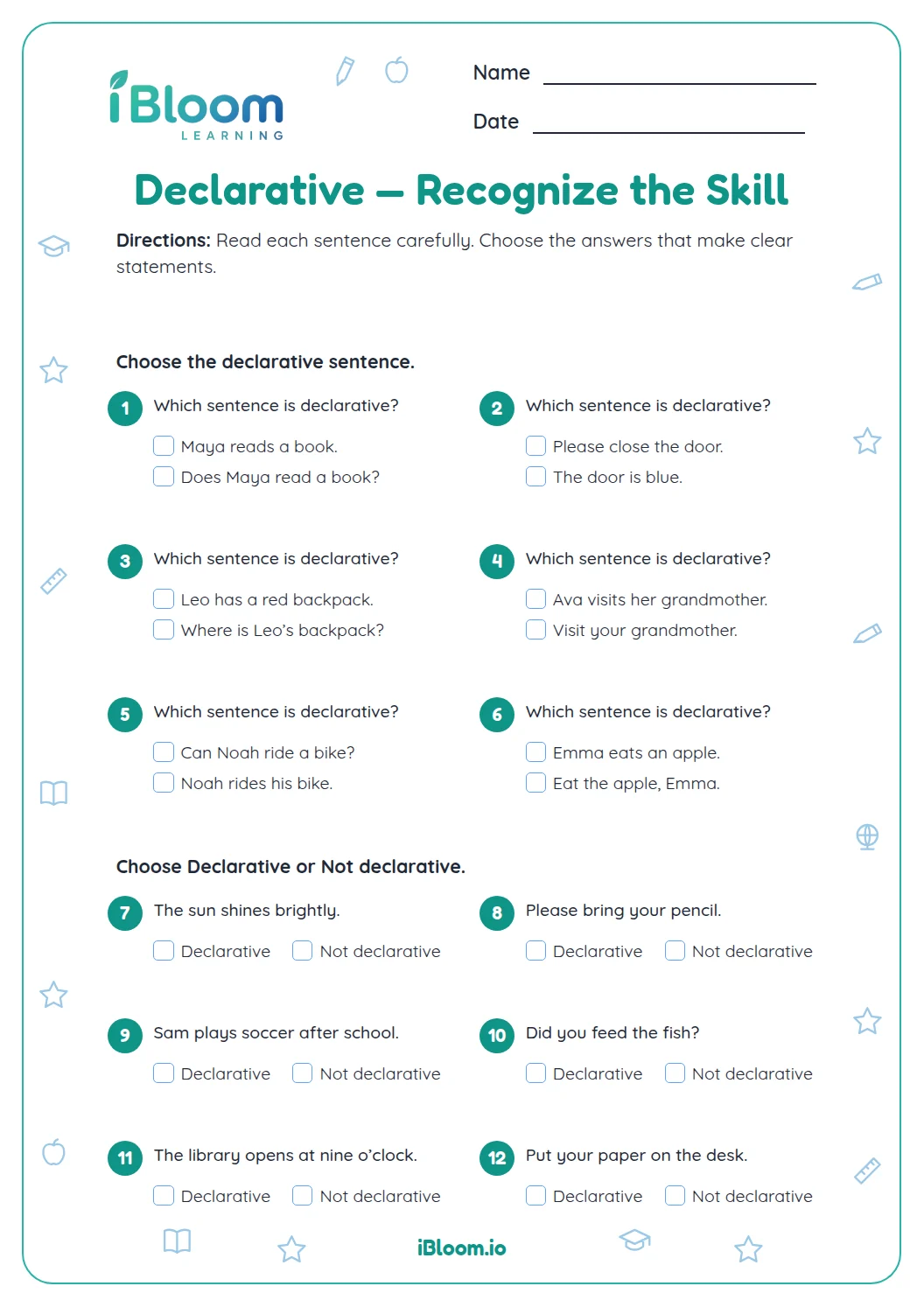
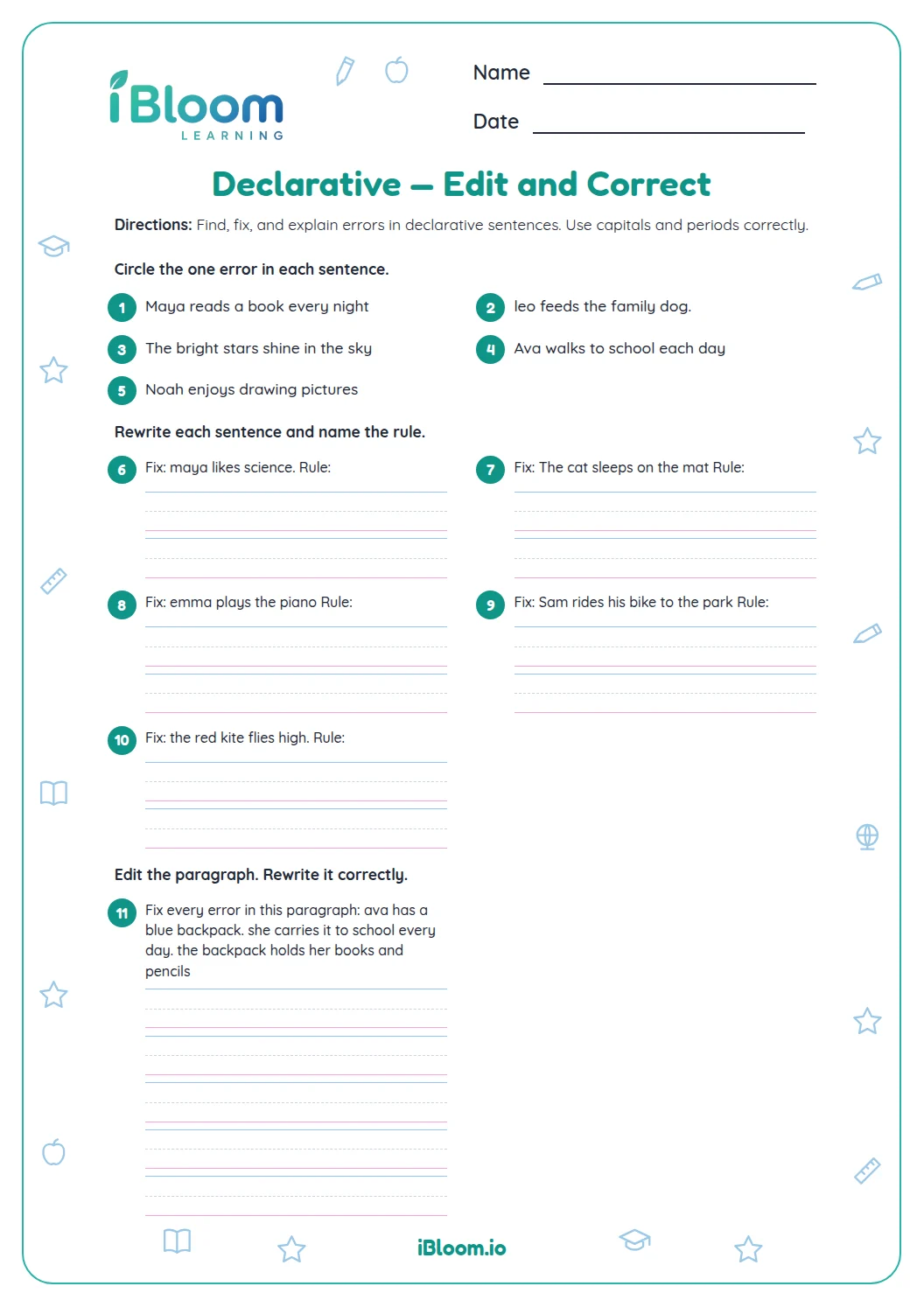
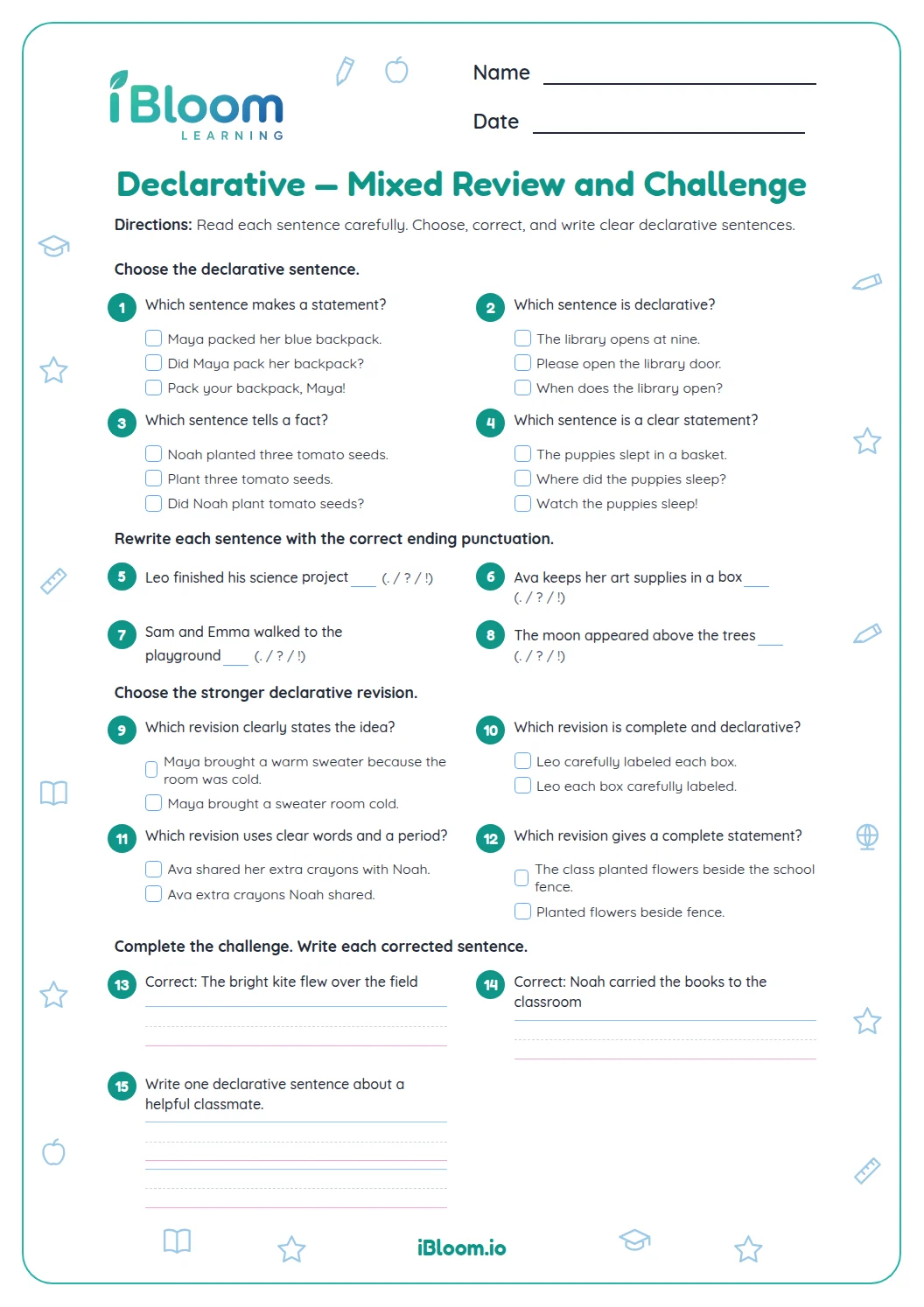
This free Grade 3 printable helps students recognize and complete declarative sentences, the sentences that tell or state something. Part A separates statements from questions, commands and fragments. Part B asks students to choose a verb that completes each statement. The 14 questions move from recognition to completion and independent sentence writing, and an answer key is included. The practice connects to CCSS L.3.1.i, which asks students to produce simple, compound and complex sentences.
Aligned to L.3.1.i
How can a student spot a declarative sentence?
A declarative sentence states an idea or gives information. It usually ends with a period. A question asks, a command tells someone what to do, and a fragment leaves the thought unfinished.
Part A mixes these forms so students look at both meaning and completeness. “The puppy naps” tells a complete thought; “Under the table” does not name a complete action or idea.
What makes a sentence completion work?
A good ending fits the subject, keeps the thought complete and makes the sentence a statement. Read the whole sentence aloud to check the meaning and punctuation.
For example, q6 becomes “The little bird rested in its nest.” The subject bird matches the verb rested, and the sentence tells what happened.
- 1The little bird ___ in its nest.
- 2Choose rested: “The little bird rested in its nest.”
Why do meaning and punctuation both matter?
A sentence’s purpose and its ending punctuation work together. A statement ends with a period; changing the word order or punctuation can turn it into a question or command.
Students can use a quick check: Does it tell something? Is there a subject and a predicate? Does the punctuation match?
How to use this worksheet
- 1Read all three choices before selecting an answer.
- 2In Part A, decide whether each choice tells something, asks, commands or leaves a fragment.
- 3In Part B, reread the subject and choose the verb that fits.
- 4Say the completed sentence aloud to check that it sounds complete.
- 5Check the key and explain why a distractor is a question, command or fragment.
Common mistakes and quick fixes
The mistake
Choosing “Under the table” because it sounds like a sentence ending.
The fix
Ask who or what is under the table; the phrase does not give a complete thought on its own.
The mistake
Calling every sentence with a period declarative.
The fix
Check the meaning too. A complete sentence must tell something, not just have a period.
The mistake
Ignoring the subject when choosing a verb.
The fix
Read the subject with the verb: “The library opens,” not “The library open.”
Common Core alignment
Build complete simple, compound and complex sentences with statement meaning.
On this sheet: Students identify complete statements and select endings that create complete declarative sentences.
Show the official wordingHide the official wording
Produce simple, compound, and complex sentences.
What to practice next
Make more practice
Further reading
Questions parents and teachers ask
What does declarative mean?
Declarative means the sentence declares or tells something. “Our class planted seeds” is declarative because it gives information. A declarative sentence typically ends with a period and has a complete thought, including a subject and what the subject does or is.
Can a declarative sentence be long?
Yes. A declarative sentence can be short or can include several details. The important features are that it tells something and expresses a complete thought. This practice starts with clear, short statements so students can focus on meaning and sentence completion.
What is the difference between a fragment and a sentence?
A sentence expresses a complete thought, while a fragment is missing something important, such as a subject or a predicate. “The kite flew high” is complete. “When the kite flew” leaves the reader waiting for what happened next. A complete sentence can stand alone and makes sense without waiting for more information.
Why are questions and commands included?
They help students compare sentence purposes. A question asks for information, and a command gives a direction. A declarative sentence tells something. Comparing the forms makes it easier to recognize the statement even when the topic words are similar. Their purpose and punctuation give readers clues about how each sentence works.
How should students use the answer key?
Use the key after a first try. For each item, read the chosen sentence aloud and check that it tells a complete thought. For a wrong choice, name the issue: it might ask a question, give a command or leave the idea unfinished.
What can students practice next?
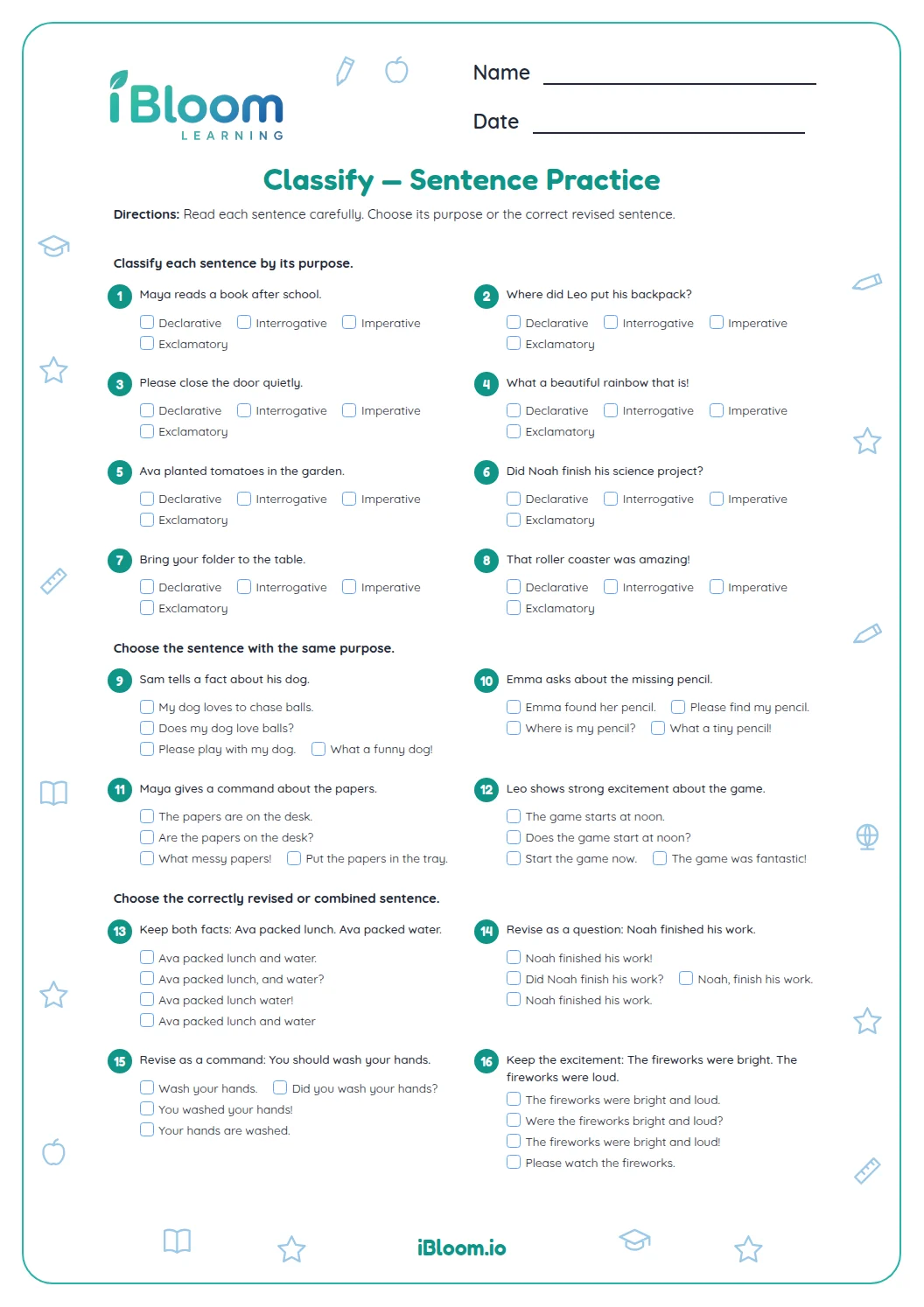
Students can classify sentences by purpose, identify subjects and predicates, or compare declarative sentences with questions and commands. Related activities build on reading the whole sentence and noticing what it does. Ask the student to explain how the ending makes the thought complete.