






About this worksheet
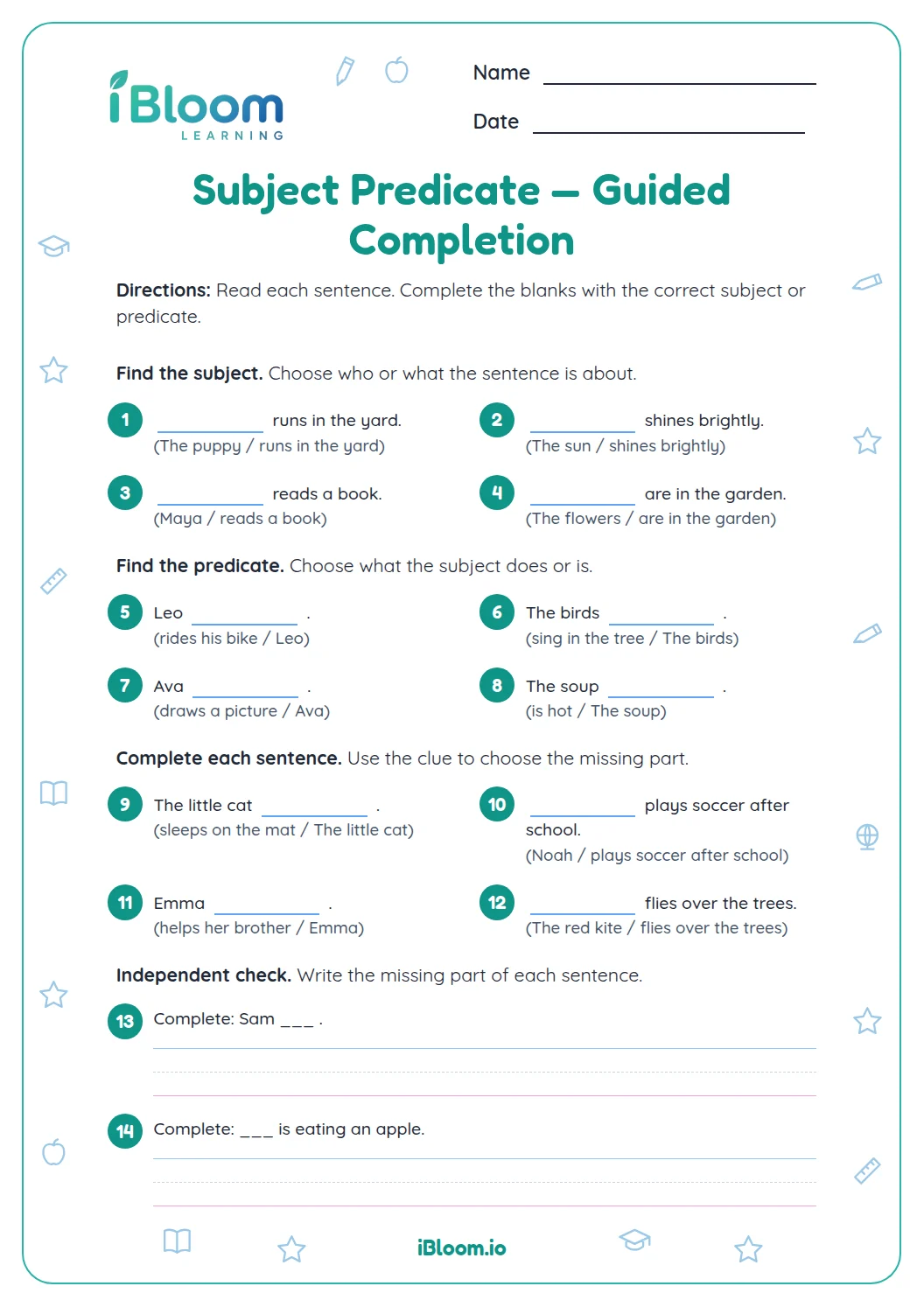
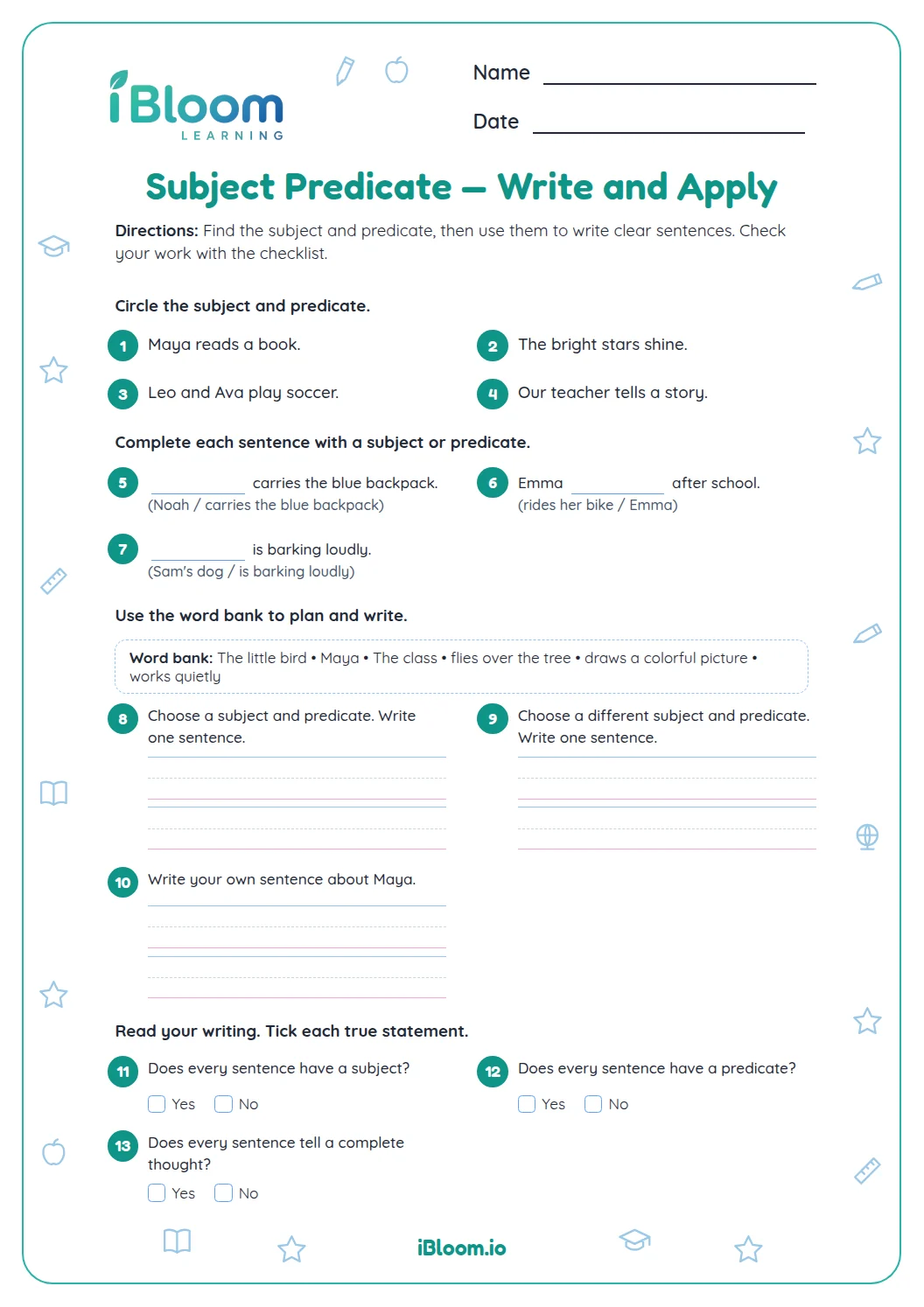
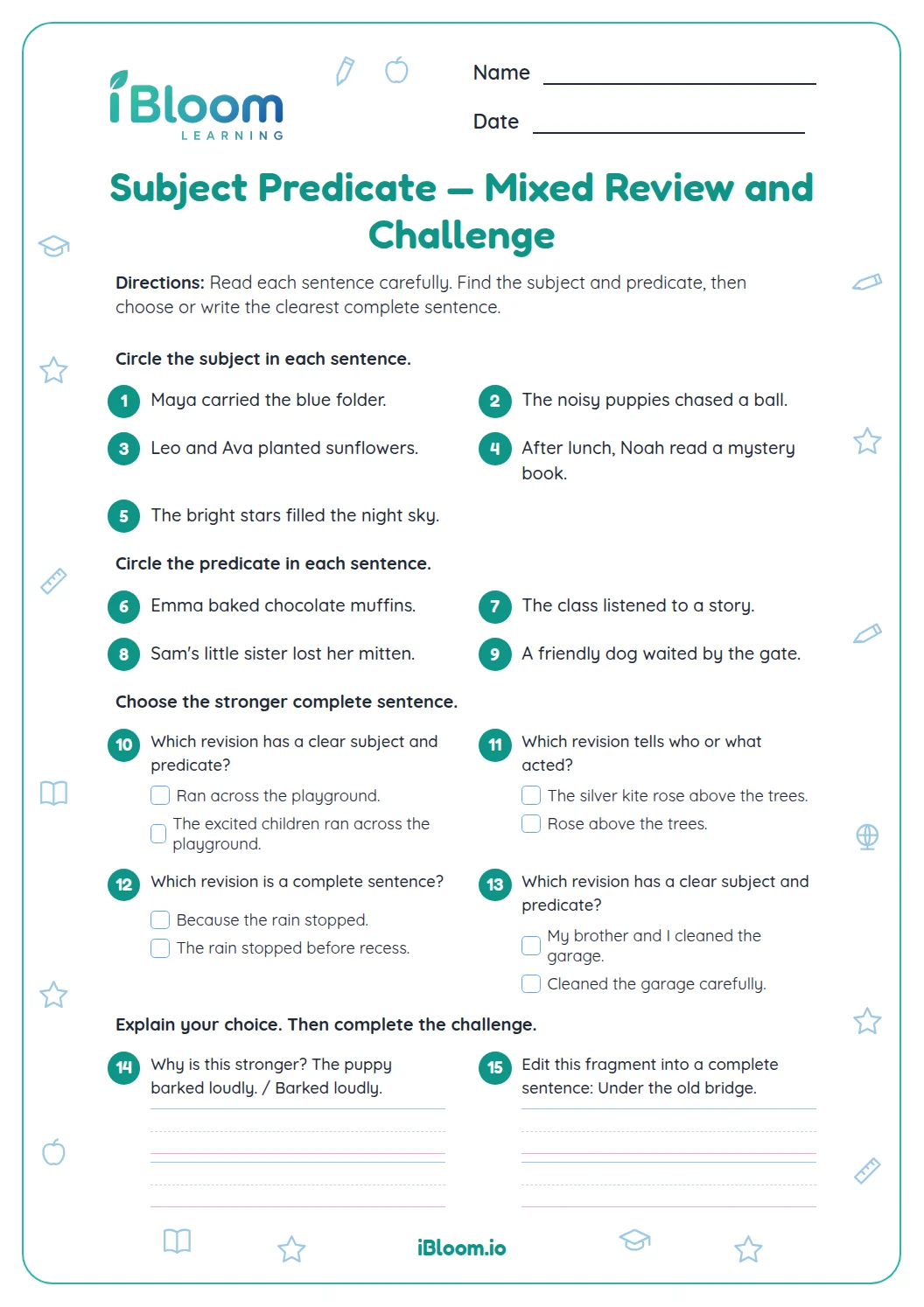
This Grade 3 printable helps children recognize subjects and predicates in complete sentences. Part A has nine multiple-choice items about sentence parts and complete thoughts; Part B has seven sentence completions that ask for a subject or predicate. The answer key lists correct choices and sample completions. Children can ask who or what the sentence is about, then identify what that subject does or is.
Aligned to L.3.1.i
What is a subject or predicate?
The subject tells who or what a sentence is about. The predicate tells what that subject does or is. In “The birds built a nest,” “The birds” is the subject and “built a nest” is the predicate.
How can children complete Part B?
Read the whole sentence frame before writing. For “The puppy ___,” add a predicate that tells what the puppy did, such as “chased a leaf.” Reread the completed sentence to check that it expresses a full thought.
How should I check the answers?
Compare the words in each response with the part requested. A subject or predicate completion may have more than one sensible answer; check that it forms a complete sentence with the printed words.
How to use this worksheet
- 1Read the whole sentence before choosing.
- 2Ask who or what the sentence is about.
- 3Find the words that tell what the subject does or is.
- 4For a blank, add only the requested sentence part.
- 5Reread the completed sentence as a full thought.
Common mistakes and quick fixes
The mistake
Including only one word from a multiword subject.
The fix
Include all words that name who or what the sentence is about.
The mistake
Stopping the predicate before its object or other needed words.
The fix
Include the full group of words that tells what the subject does.
The mistake
Writing a fragment in a sentence frame.
The fix
Read the completed sentence aloud and check that it expresses a whole thought.
Common Core alignment
This worksheet practices identifying and producing complete sentence parts.
Identify and produce complete simple sentences through subject-and-predicate practice.
On this sheet: Children distinguish complete sentence thoughts and identify the parts that express who or what and what happened.
Show the official wordingHide the official wording
Produce simple, compound, and complex sentences.
What to practice next
Make more practice
Further reading
Questions parents and teachers ask
What is a subject?
A subject names who or what a sentence is about. In “The birds built a nest,” the subject is “The birds.” Part A asks children to identify subjects in complete sentences, and Part B asks them to supply a subject that fits a sentence frame.
What is a predicate?
A predicate tells what the subject does or is. In “The birds built a nest,” the predicate is “built a nest.” Children identify predicates in Part A and write fitting predicates for sentence frames in Part B. In a completion, use every word needed to say what the subject does or is.
What does this worksheet include?
There are 16 items in two parts. Part A uses nine multiple-choice questions about subjects, predicates, and complete sentences; Part B has seven fill-in sentence frames. The answer key lists the correct choices and examples for open completions. Each question has one requested answer form.
Can a sentence completion have more than one right answer?
Yes. Several Part B prompts allow different subjects or predicates that make a sensible complete sentence. The answer key provides one sample; check that a child’s words fit the frame and supply the requested sentence part. Reread the full line with the proposed answer in place to hear whether it makes sense.
How can I help a child find the predicate?
Have the child first name the subject, then ask what that person, animal, or thing does or is. In “The children opened the gate,” the words “opened the gate” tell what the children did, so they form the predicate. Sentence frames are printed beside each blank.