




About this worksheet
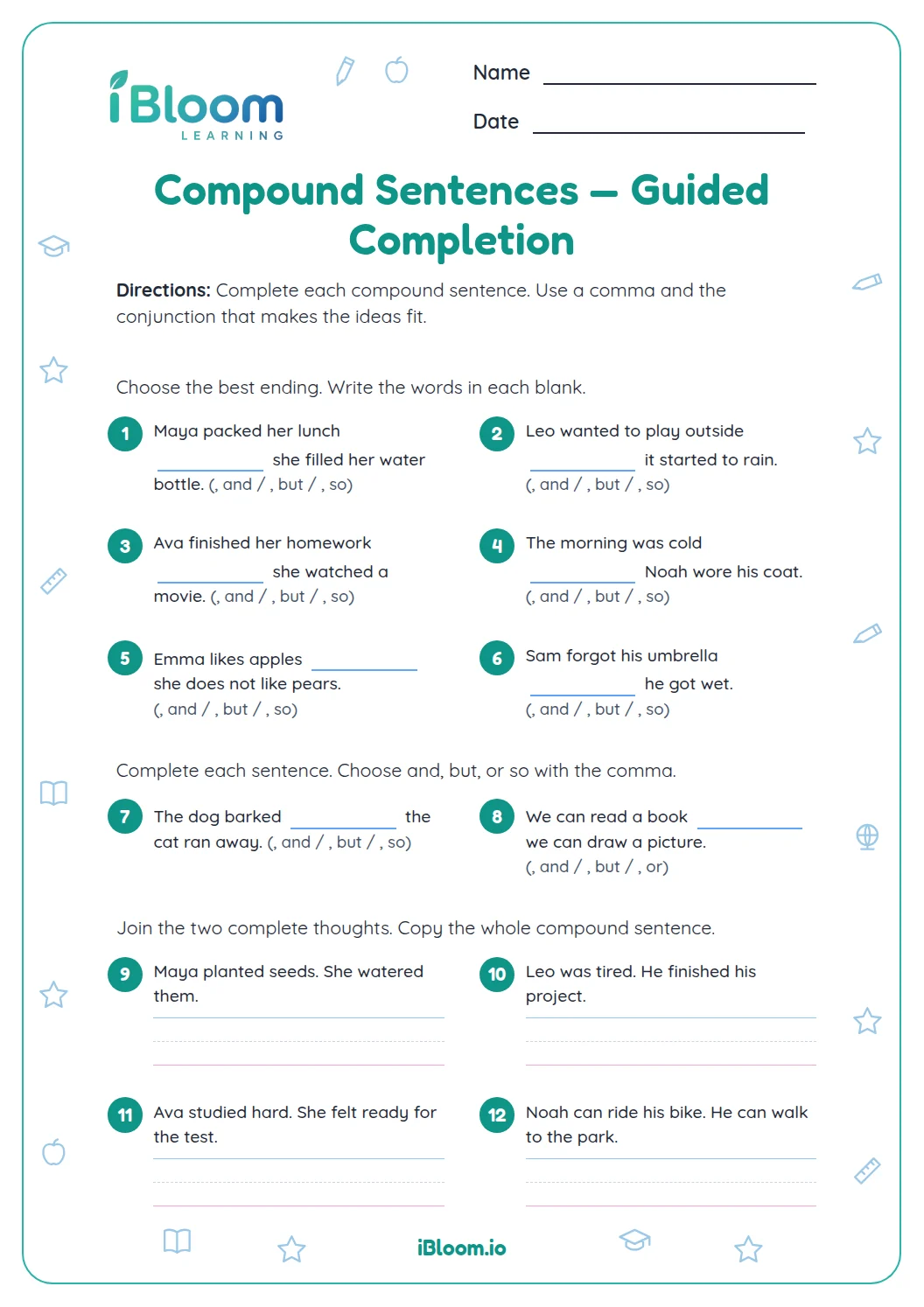
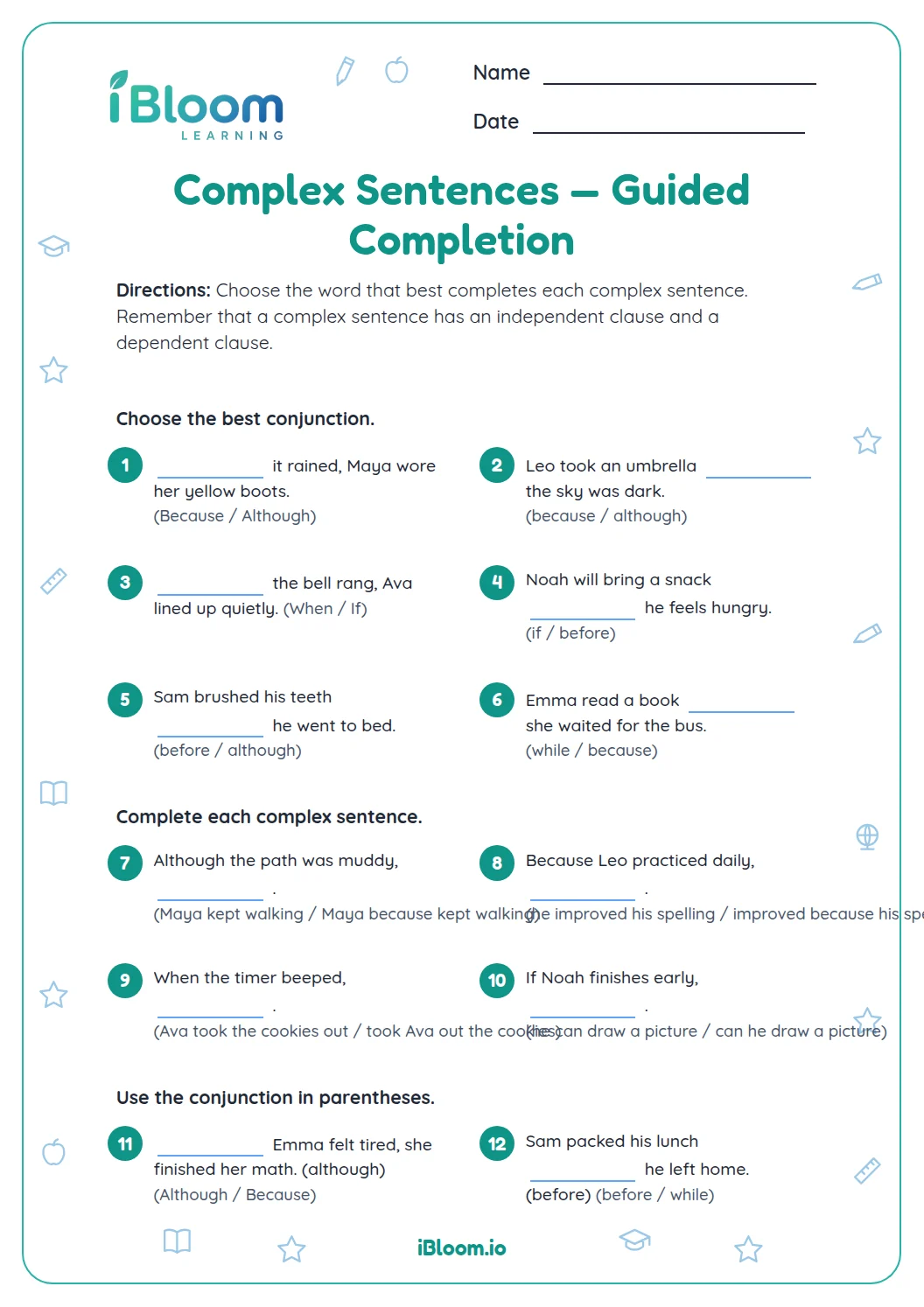
This Grade 3 worksheet gives students 14 questions about compound and complex sentence patterns. They identify two complete thoughts, spot dependent clauses, name connectors, and compare sentence structures. A compound sentence joins complete thoughts; a complex sentence includes a dependent clause. The practice aligns with CCSS L.3.1.i, which asks students to produce simple, compound, and complex sentences.
Aligned to L.3.1.i
How do compound and complex sentences differ?
A compound sentence joins two independent clauses, or complete thoughts. A complex sentence has an independent clause and at least one dependent clause. The title phrase “compound-complex” describes the broader sentence-pattern topic; this Grade 3 sheet practices identifying compound and complex examples.
- 1Compound: The bell rang, so the class lined up.
- 2Complex: Although the rain stopped, the field stayed wet.
How can you spot a dependent clause?
A dependent clause has a subject and a verb but does not express a complete thought on its own. Words such as because, although, when, before, until, and since often introduce one. In question 7, “Before the game began” needs the rest of the sentence to complete the thought.
What clues should readers check?
First find the clauses. Then decide whether each clause can stand alone. Connectors such as and, but, and so can join complete thoughts; a dependent-clause word signals that one part relies on another. Punctuation helps, but the clause meaning is the clearest clue.
How to recognize the sentence pattern
- 1Read the full sentence once.
- 2Find each subject and verb to locate its clauses.
- 3Ask whether each clause can stand alone as a complete thought.
- 4Notice whether a connector joins complete thoughts or begins a dependent clause.
- 5Use the clause pattern to classify the sentence.
- 6Check copied clauses against the answer key.
What can make these patterns tricky?
The mistake
Calling every sentence with and compound.
The fix
Check that both sides of and can stand alone as complete thoughts.
The mistake
Treating a dependent clause as a complete sentence.
The fix
Read it alone; if the thought feels unfinished, it depends on another clause.
The mistake
Choosing by punctuation alone.
The fix
Find the clauses and their connectors before using commas or semicolons as clues.
Common Core alignment
Students practice recognizing compound and complex sentence patterns that support sentence production.
Produce simple, compound, and complex sentences using sentence patterns.
On this sheet: Students identify and compare compound and complex sentence examples as models for sentence production.
Show the official wordingHide the official wording
Produce simple, compound, and complex sentences.
What to practice next
Make more practice
Further reading
Questions parents and teachers ask
What makes a sentence compound?
A compound sentence joins two independent clauses, or complete thoughts. In question 3, “The bell rang” and “the class lined up” can each stand alone, and so connects them. The worksheet asks students to find this pattern in several examples.
What makes a sentence complex?
A complex sentence includes an independent clause and a dependent clause. The dependent clause cannot stand alone. Question 4 begins with “Although the rain stopped,” which needs the complete thought that follows. A clue word can help students find that dependent part.
How many questions are included?
The worksheet has 14 questions across two printable practice pages, followed by a separate four-page answer key. Students identify patterns, find dependent clauses, name connectors, and compare sentence structures. Each part builds from clause clues to sentence-pattern choices.
Are compound-complex sentences included?
The page title names the broader compound-complex topic, while these Grade 3 items focus on recognizing compound and complex patterns. Students distinguish complete clauses from dependent clauses and use connectors as clues. The examples provide models for sentence production.
How should I check a copied clause?
Check that the response includes the requested clause and no extra clause. For question 7, “Before the game began” is dependent because it does not finish the thought by itself; the comma and main clause complete the sentence.