




About this worksheet
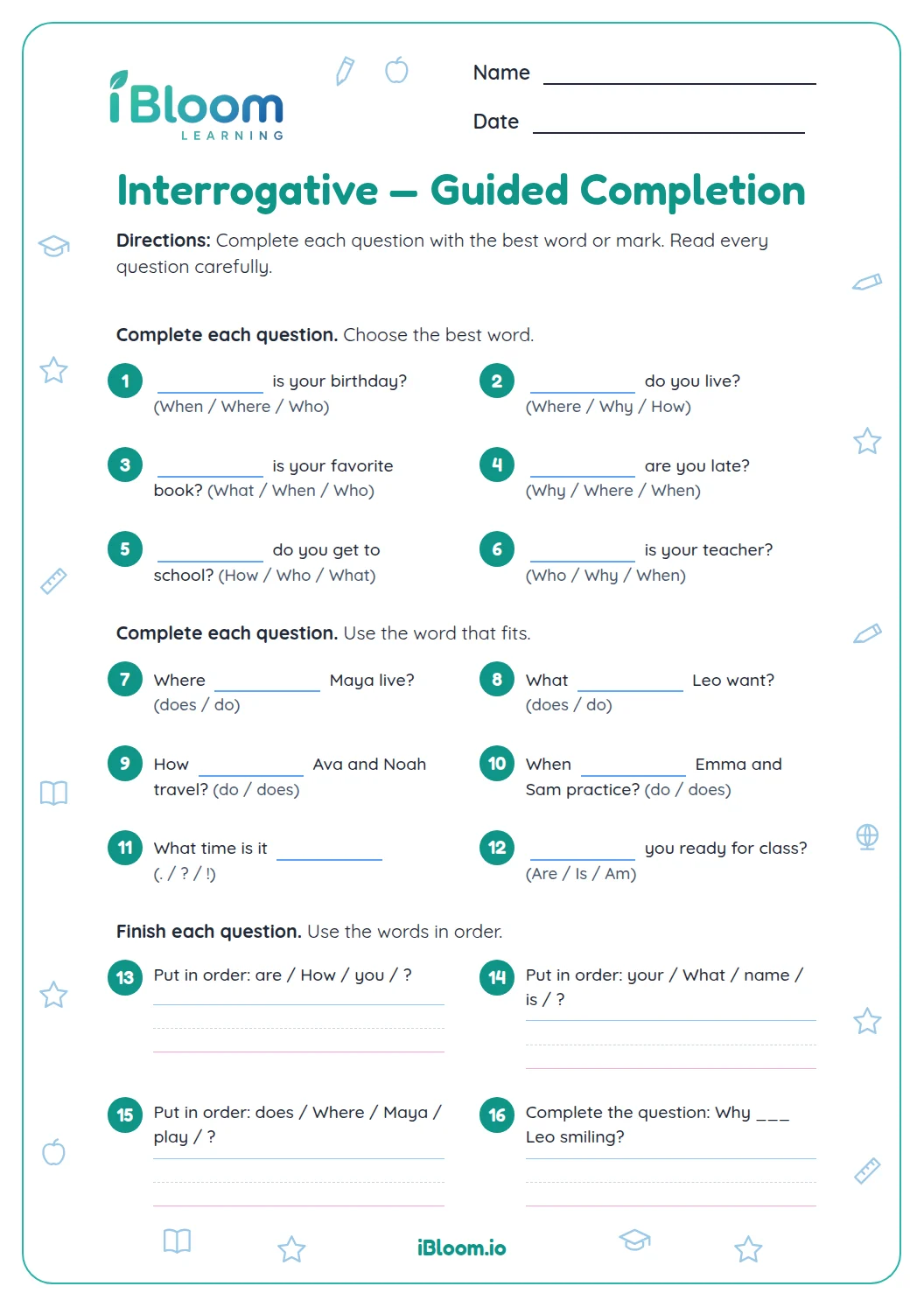
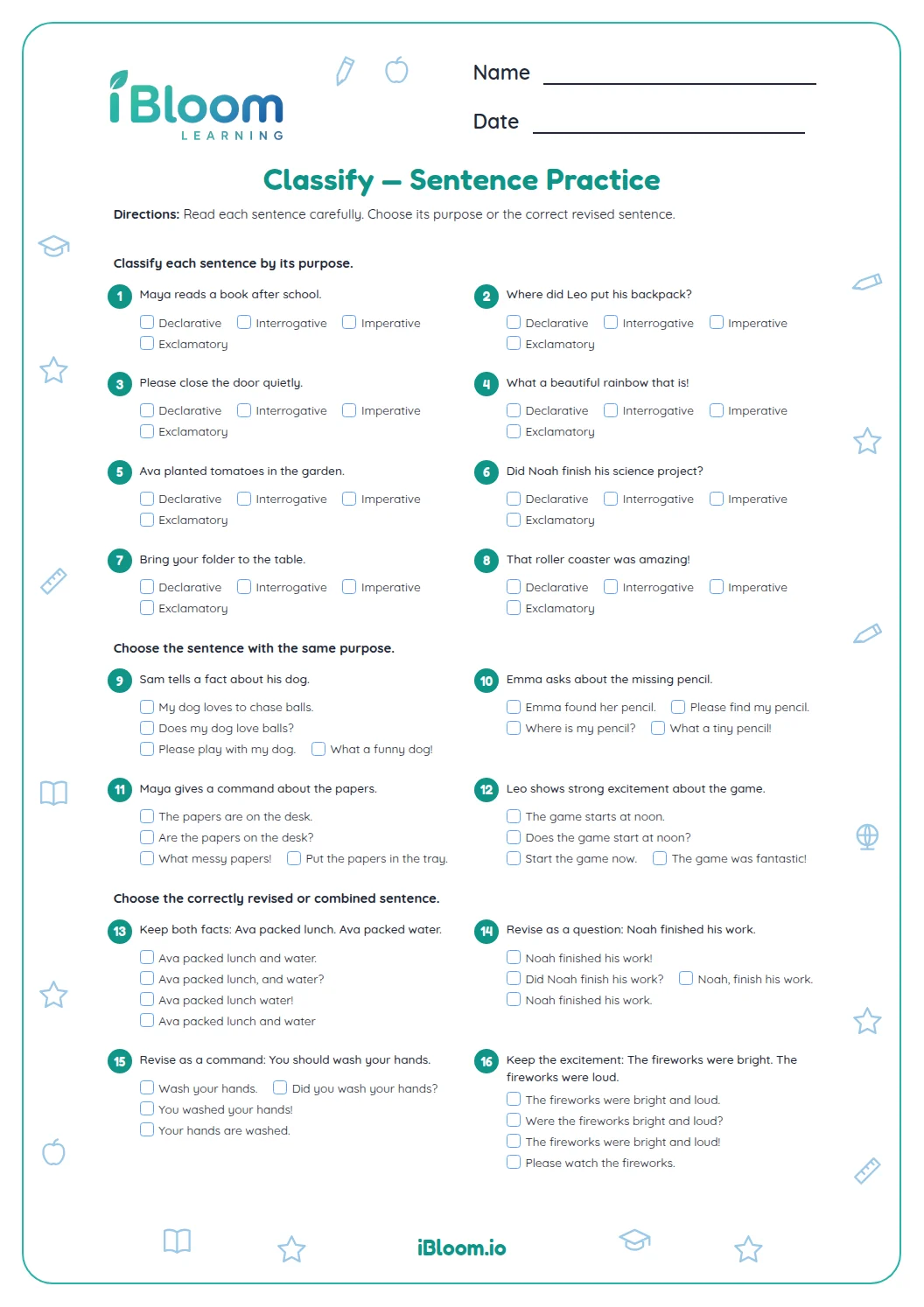
This Grade 3 grammar worksheet helps students recognize interrogative sentences, choose question marks, complete question forms and write one question for a purpose. It has 14 items across three parts, followed by a separate answer key. The practice supports CCSS L.3.1, the standard for using standard English grammar and usage when writing or speaking.
Aligned to L.3.1
How can I tell if a sentence is interrogative?
Ask whether the sentence requests information or an answer. Questions often begin with who, what, where, when, why, or how, or with a helping verb such as can or did.
How does a question begin?
A question can begin with a question word or a helping verb. In Part B, “___ the bus stop near the park?” takes Does; adding the question mark completes the sentence.
How to use this worksheet
- 1Read the whole sentence aloud.
- 2Ask whether it requests an answer.
- 3Check that the question begins with a capital letter.
- 4Use a question mark at the end.
- 5For open prompts, make the question match the requested purpose.
Common mistakes and quick fixes
The mistake
Adding a question mark to every sentence.
The fix
Check the meaning first: “Please close the gate” gives a direction, so it is not a question.
The mistake
Using a period after a question word.
The fix
Read the sentence aloud and listen for the asking voice; use a question mark.
The mistake
Changing punctuation but leaving statement word order.
The fix
Try a helping verb at the beginning, as in “Are we ready?”
Common Core alignment
This page gives focused practice with the skills named in these standards.
Recognize how question sentences work in context.
On this sheet: The practice identifies, punctuates, and writes interrogative sentences.
Show the official wordingHide the official wording
Demonstrate command of the conventions of standard English grammar and usage when writing or speaking.
What to practice next
Make more practice
Further reading
Questions parents and teachers ask
What makes a sentence interrogative?
An interrogative sentence asks a question. It may begin with a question word, as in “Where did the blue jay build its nest?” or a helping verb, as in “Did you bring your lunch?” A question mark shows the reader that the sentence asks something.
Does every question start with a question word?
No. Many questions start with a helping verb such as can, does, or are. Part B practices choosing a fitting beginning, including “Does the bus stop near the park?” Read the whole sentence to see which word makes a complete question.
How many items are on the worksheet?
There are 14 items in three parts. Students identify question sentences, complete questions with missing punctuation or an opening word, and write one question about when the art show begins.
Is “Could you pass the paper?” a question or a command?
It is written as a question: it begins with Could and ends with a question mark. A speaker may use that form to make a polite request, but the sentence still has interrogative form.
What does the answer key show for the writing prompt?
The key gives one sample: “When does the art show begin?” Other wording can work if it clearly asks when the art show begins and uses a question mark.