





About this worksheet
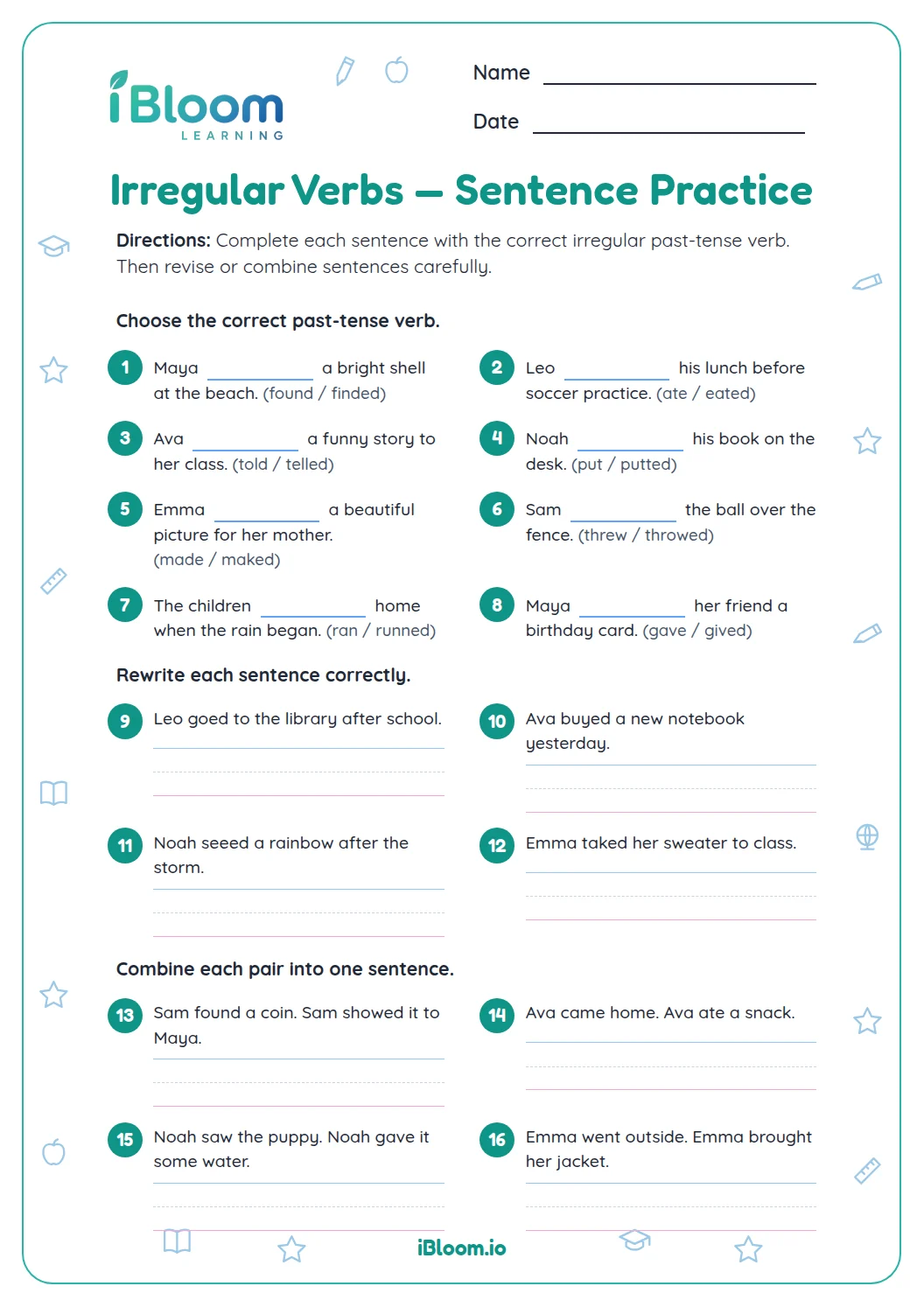
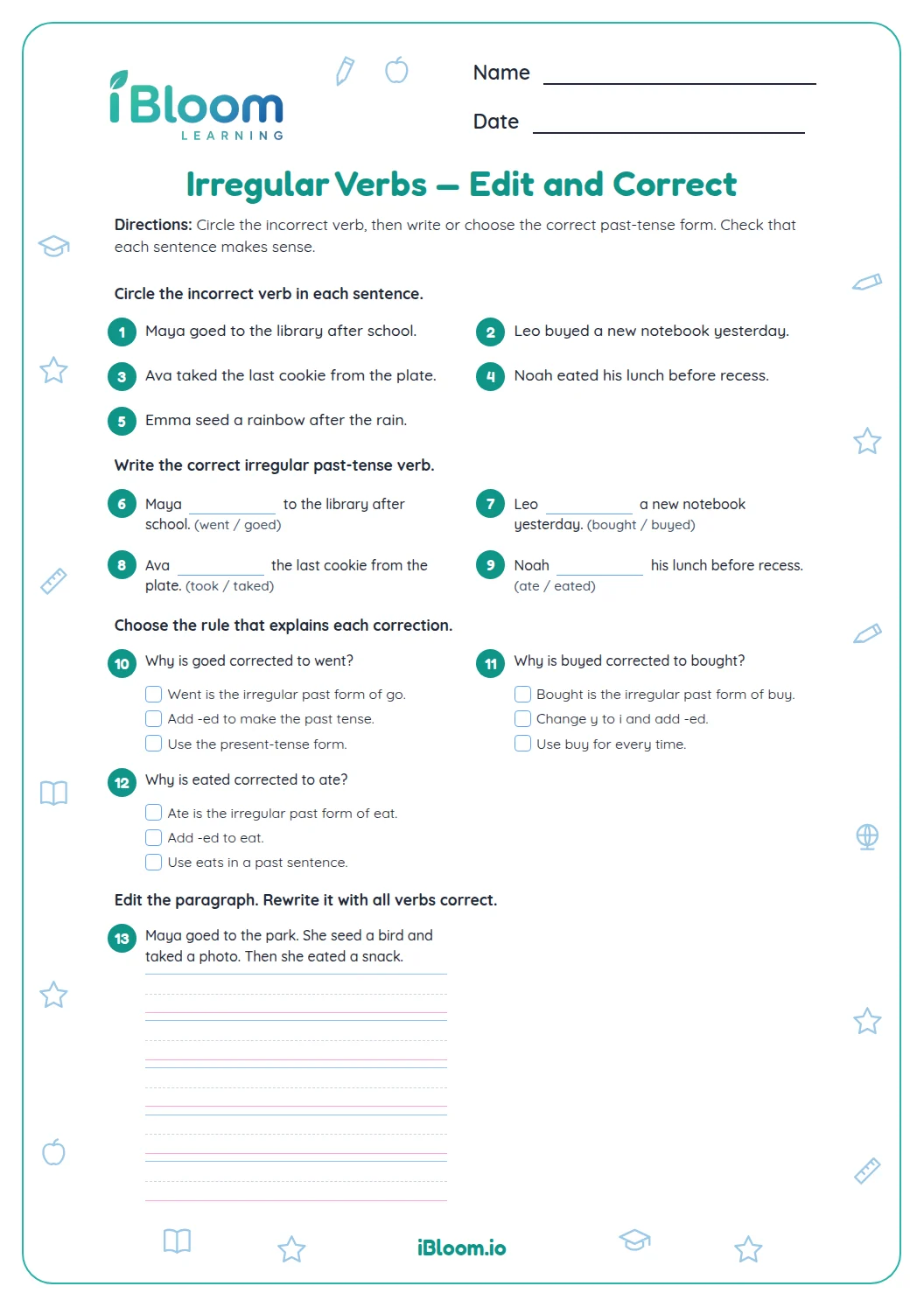
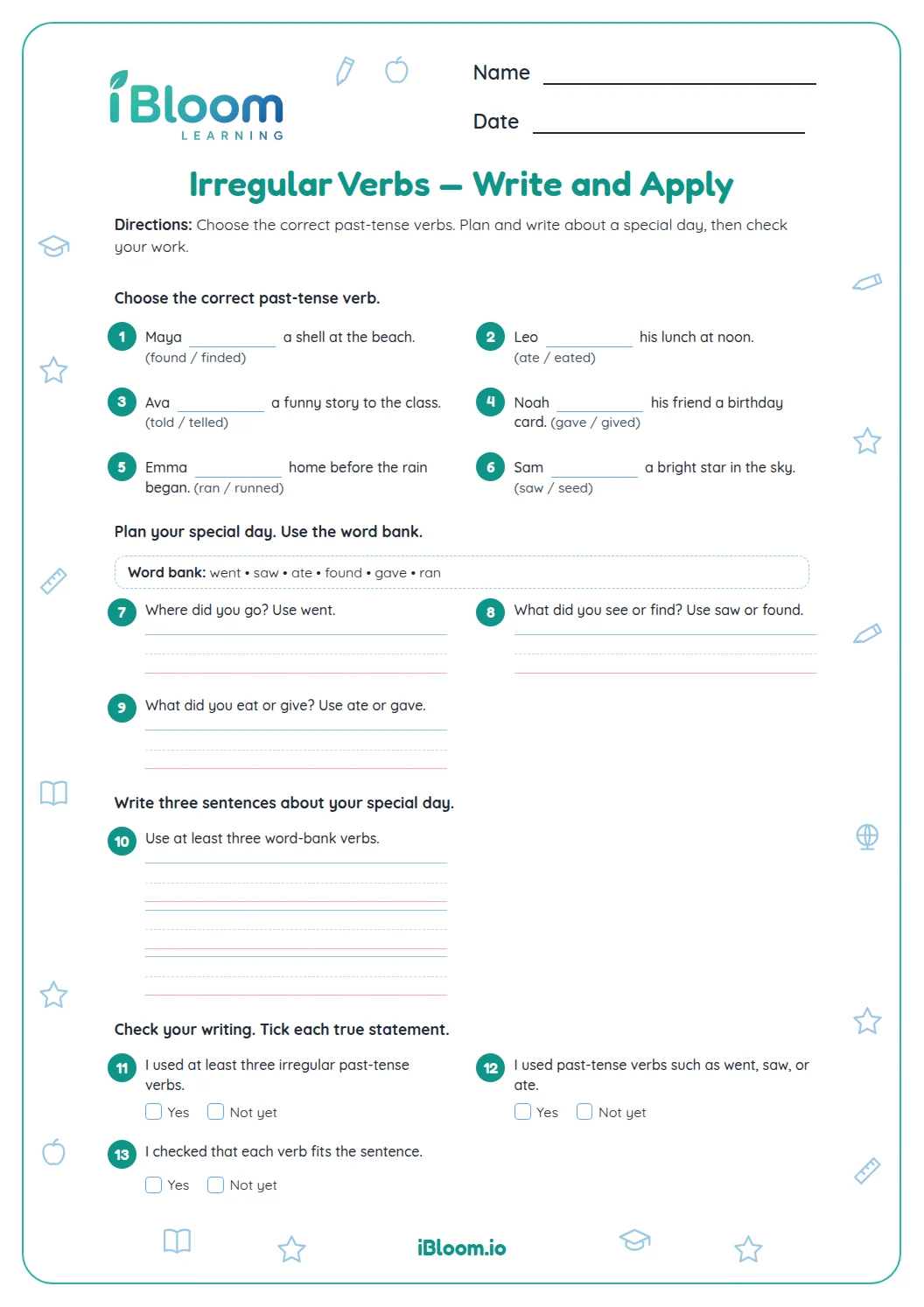
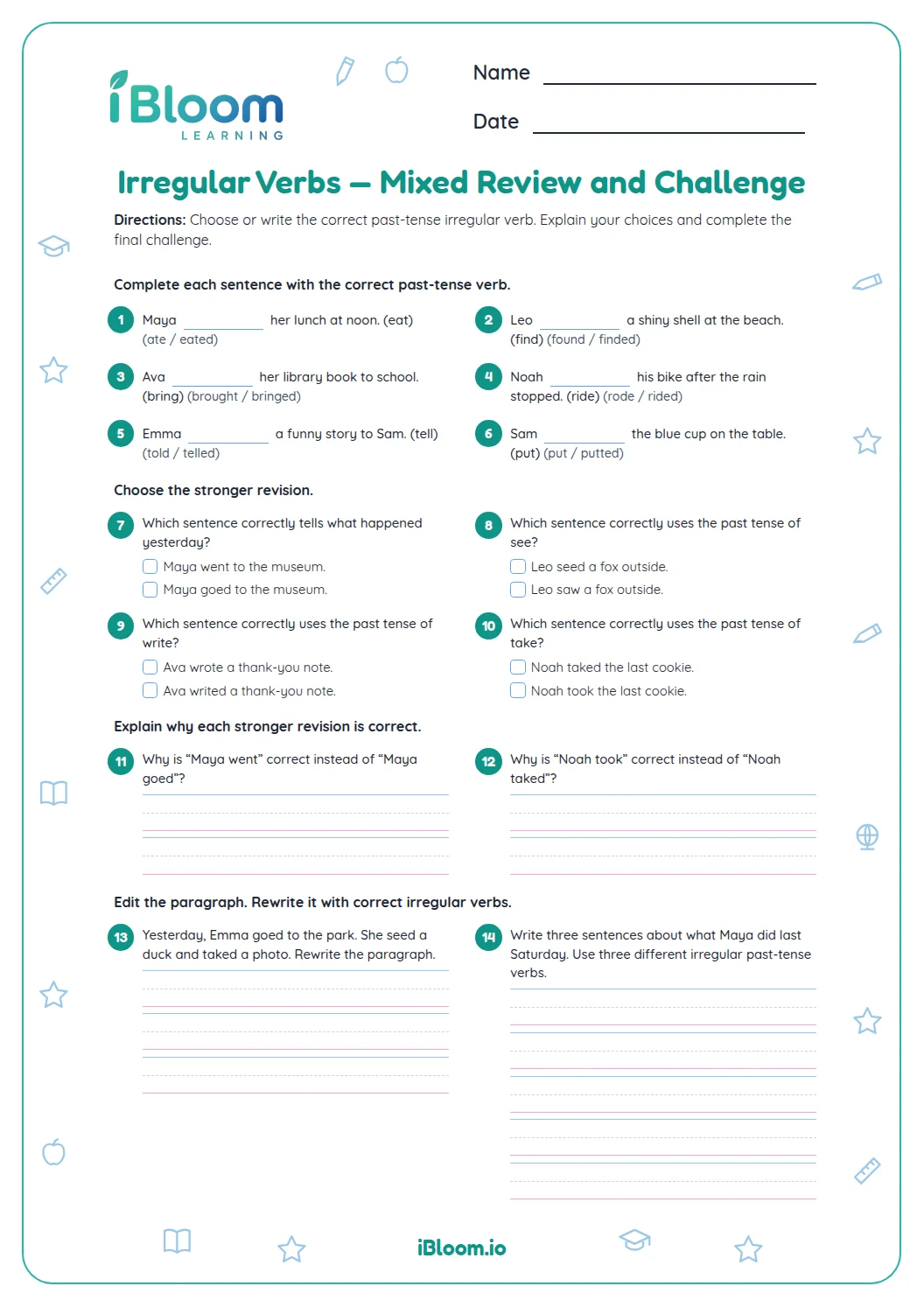
This Grade 3 grammar worksheet helps children recognize and form irregular past-tense verbs. Part A asks students to choose the correct form in eight sentences. Part B gives five base verbs and asks for their past forms. Part C asks students to classify five past-tense verbs as regular or irregular. The separate answer key lists each response. It supports CCSS L.3.1 through work with standard English grammar in sentences.
Aligned to L.3.1
How do students choose an irregular past-tense verb?
Read the time clue, then choose the verb form that fits. “Yesterday” signals that the action happened in the past.
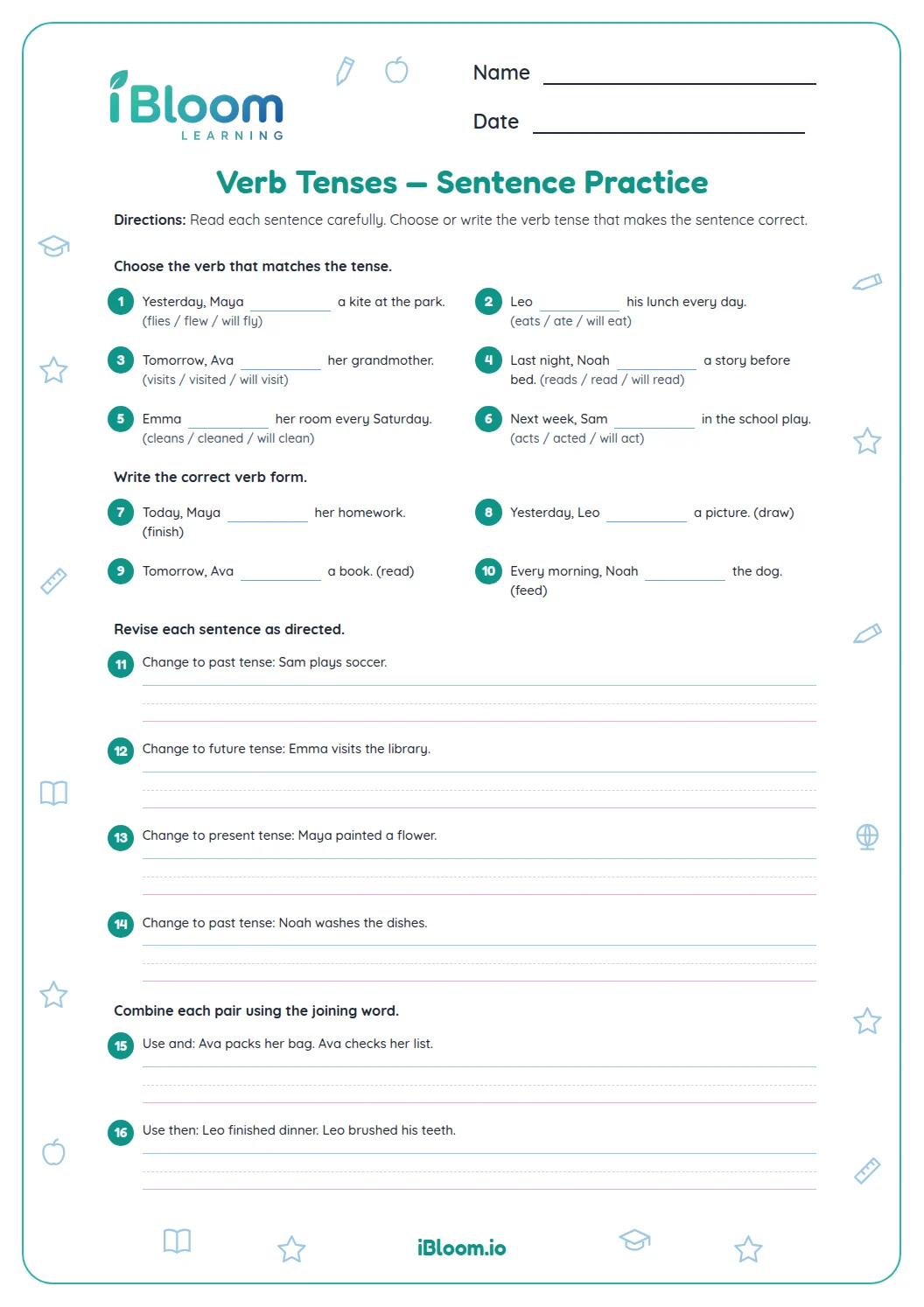
- 1Yesterday, Maya ___ a bright bird. → saw
- 2Saw is the past form of see; “see” is present tense and “seed” is not the verb form.
How can students form irregular past-tense verbs?
Part B gives five base verbs. Students write the past form, such as go → went and find → found.
How can students distinguish regular and irregular forms?
Regular forms usually add -ed, as in jumped and painted. Irregular forms change differently, as in broke, chose, and caught. Part C asks students to classify the verb used in each sentence.
How to use this worksheet
- 1Look for a time clue that signals past action.
- 2Find the action word.
- 3Recall its past-tense form.
- 4Check whether it follows the usual -ed pattern.
Common mistakes and quick fixes
The mistake
Adding -ed to every verb.
The fix
Learn the changed forms, such as bring/brought and catch/caught.
The mistake
Choosing a present form after “yesterday.”
The fix
Reread the time clue and choose a past form.
The mistake
Calling every past-tense verb irregular.
The fix
Check whether the verb simply adds -ed.
This sheet practices the following standard.
Students recognize and use simple past-tense verb forms in sentences.
On this sheet:
Show the official wordingHide the official wording
Demonstrate command of the conventions of standard English grammar and usage when writing or speaking.
What to practice next
Make more practice
Further reading
Questions parents and teachers ask
What is an irregular verb?
An irregular verb forms its past tense in a way that does not follow the usual pattern of adding -ed. For example, see becomes saw and bring becomes brought. The first part gives several forms in a sentence to complete.
Are “jumped” and “painted” irregular verbs?
No. Jumped and painted are regular past-tense forms because each adds -ed to the base verb. Questions 15 and 17 classify these beside irregular forms such as chose, broke, and caught. Students can compare the endings to see why the forms belong in different groups.
Does the worksheet ask students to write long answers?
No. Part A uses choices, Part B asks for one past-tense form per item, and Part C asks for a short classification. The 18 items are split across three parts, and the separate answer key lists concise responses.
What should my child do when a verb changes completely?
Connect the changed form to the base verb and practice it in a sentence: go/went, see/saw, or take/took. Reading the whole sentence helps show when the action happened and which form is needed. Repeating the pair aloud can also make the change easier to remember.
How does this relate to verb tenses?
Irregular past forms are one part of using simple verb tenses. This sheet focuses on recognizing past-tense forms; the Past Present Tense and Verb Tenses worksheets in the same collection give practice with a broader range of tense choices.