


About this worksheet
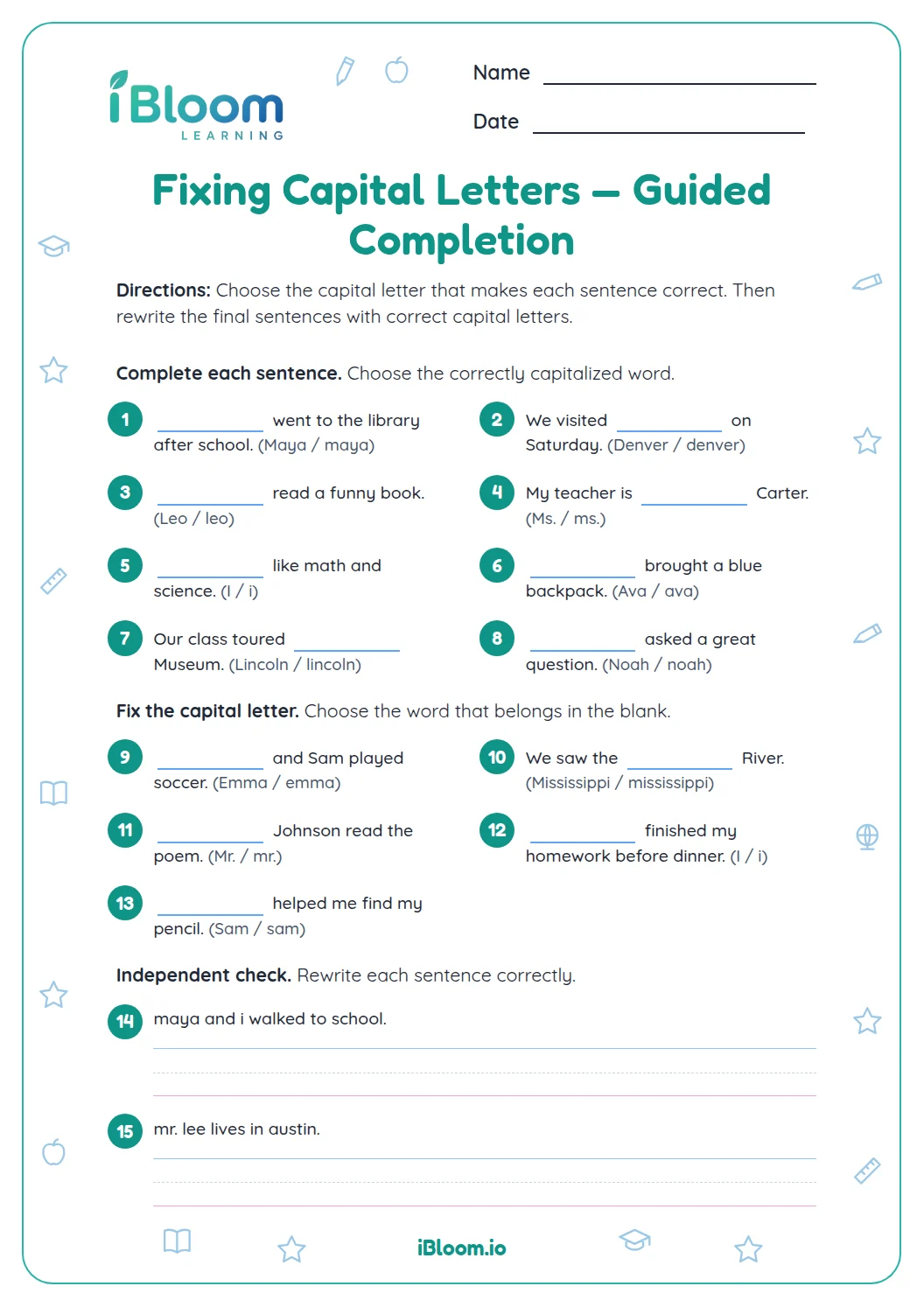
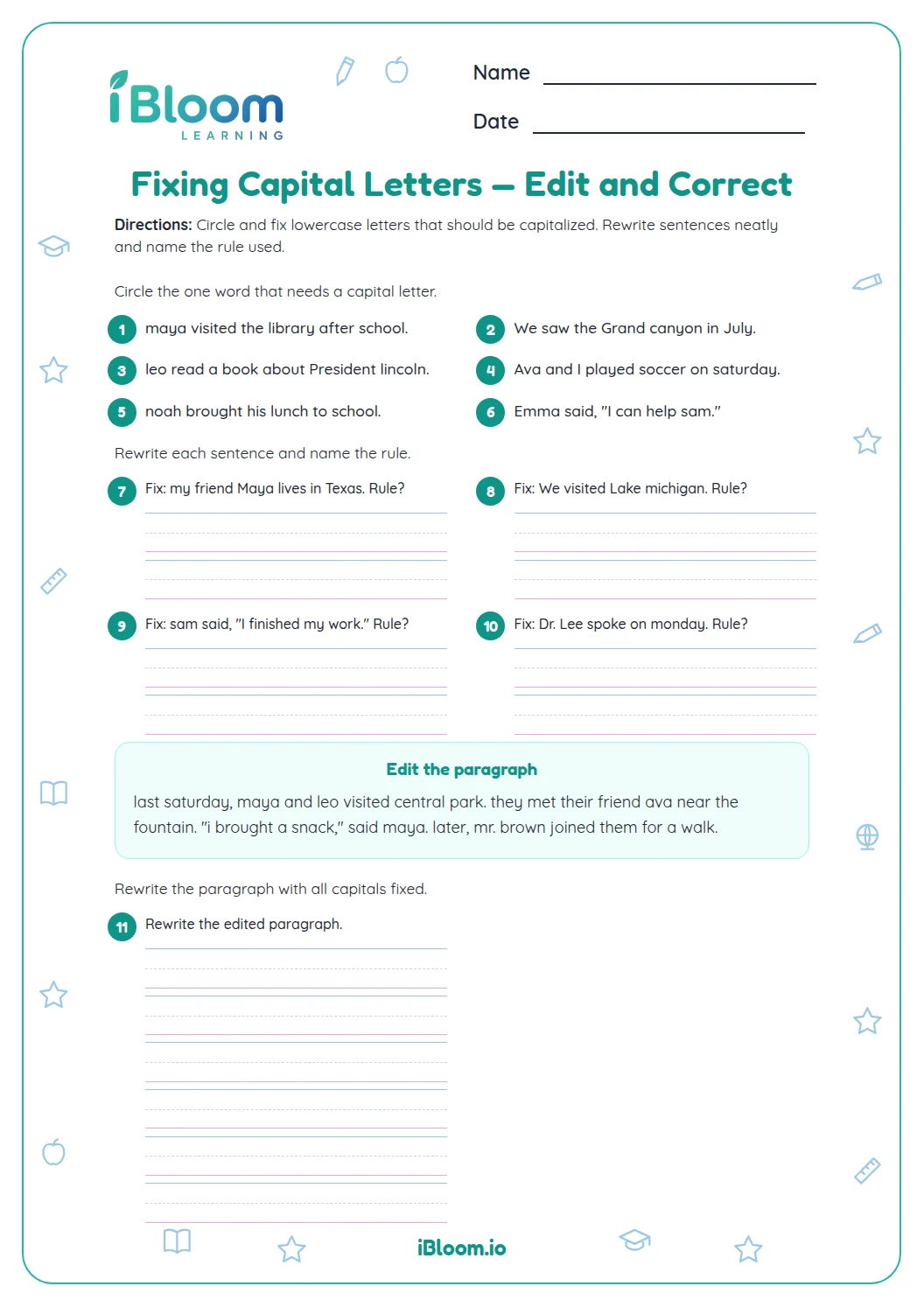
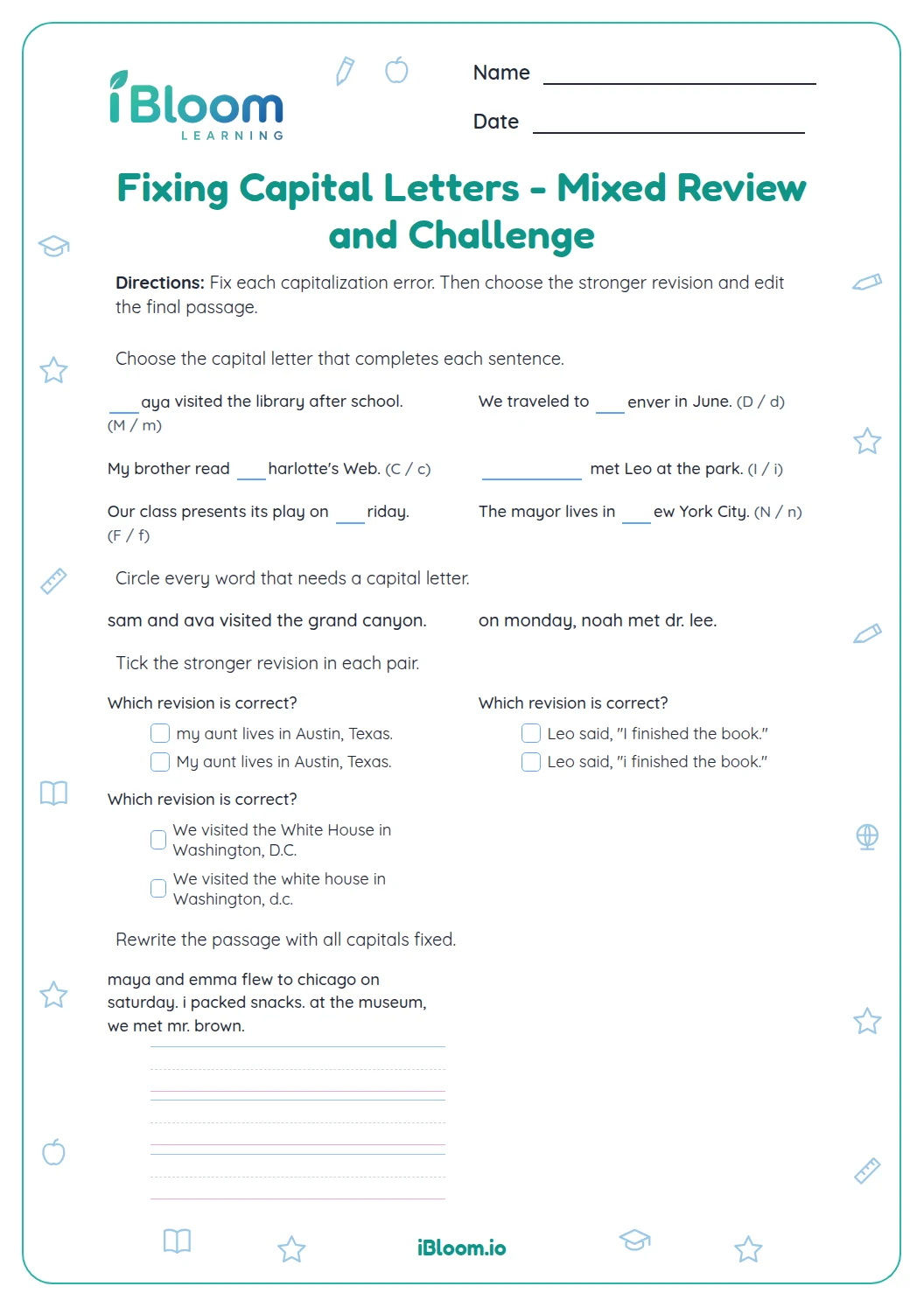
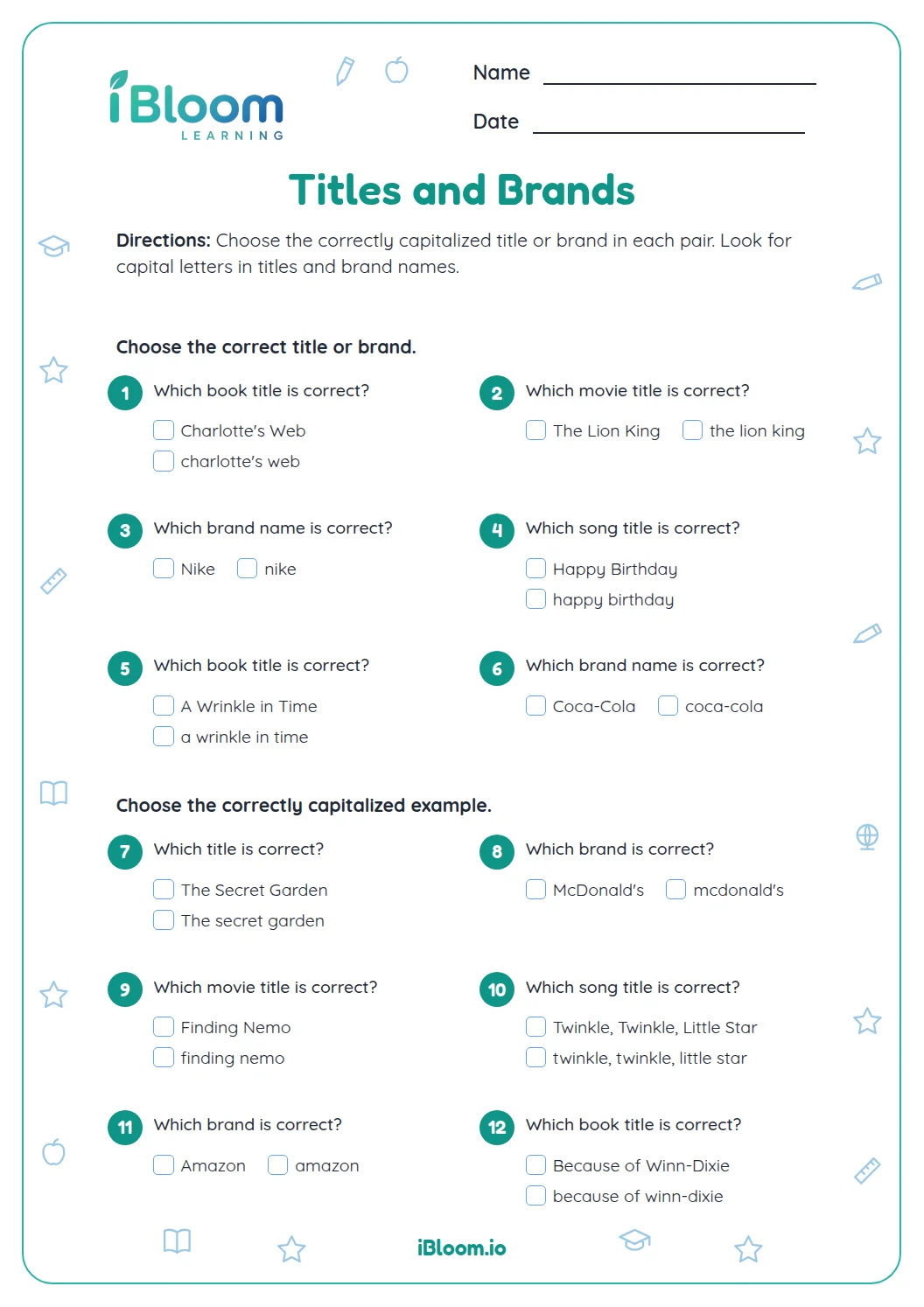
This free Grade 4 capitalization worksheet contains 16 questions in three parts. Students identify correctly capitalized sentences, complete four proper names, then edit sentences with names, places, days, months, and titles. The separate answer key gives the completed names and corrected sentences. The page aligns with Common Core L.4.2.a, which asks students to use correct capitalization.
Aligned to L.4.2.a
Which capitalization rules appear here?
Students first select correctly capitalized sentences, then rewrite sentences that need capitals. The examples include sentence beginnings, the pronoun I, people, states, days, months, book titles, and a movie title.
The 16 questions move from four recognition choices to four compact proper-name completions, then eight sentence edits. The key shows the correct option, completed name, or corrected sentence for each item.
- Part A: recognize correct capitalization
- Part B: complete names with capitals
- Part C: edit full sentences
How can students spot a proper noun?
A proper noun names a particular person or place and begins with a capital letter. In question 6, Matilda is the title of a book, so it needs a capital. Question 10 asks students to correct a sentence with a family title, a person’s name, and a state name.
- 1We read ___.
- 2Matilda
- 3The book title names a particular work.
How should titles be capitalized?
Capitalize the first and last words of a title and the important words in between. Question 6 asks students to complete a book title; question 14 asks them to correct “finding nemo.” The title’s important words begin with capitals.
- 1we watched finding nemo.
- 2We watched Finding Nemo.
What should students check when they edit?
Scan from the start of the sentence for a capital. Then look for names of people and places, days, months, and titles. Do not capitalize every ordinary noun. Question 10 also helps students distinguish a family title from the person’s name that follows it.
How to use this worksheet
- 1Read each choice aloud and notice which words name a particular person, place, or date.
- 2In Part B, copy the whole sentence and change only the letters that need capitals.
- 3Check sentence beginnings and the pronoun I.
- 4Review proper nouns, including people, states, named places, days, and months.
- 5Compare with the key and explain one capitalization choice.
Common mistakes and quick fixes
The mistake
Capitalizing a family word in every sentence.
The fix
Capitalize a family word when it is used as a name; otherwise keep it lowercase.
The mistake
Writing every word in a title with a capital.
The fix
Capitalize the first and last words and the important words between them.
The mistake
Forgetting to capitalize the pronoun I.
The fix
Scan once just for I, even when it appears in the middle of a sentence.
Common Core alignment
This page practices the Grade 4 capitalization convention.
Capitalize sentence beginnings, names, places, days, months, and titles correctly.
On this sheet: Questions ask students to recognize and correct capitalization in sentences and titles.
Show the official wordingHide the official wording
Use correct capitalization.
What to practice next
Make more practice
Further reading
Questions parents and teachers ask
Should every important-looking word be capitalized?
No. Capitals mark sentence beginnings and particular names, not every noun. Question 10 includes a family title followed by a person’s name and a state. In the corrected sentence, the first word and proper names take capitals; the family word in the middle remains lowercase.
Do days and months begin with capital letters?
Yes. Names of days and months are capitalized in English. Question 2 uses Friday, question 9 uses Monday, and question 15 uses June. Seasons are generally lowercase unless they begin a sentence or are part of a proper name. Keep that distinction in mind.
Which words in a book title need capitals?
Capitalize the first and last words and the important words between them. Question 6 asks students to complete the book title Matilda, and question 14 edits “finding nemo.” The key shows the title with its important words capitalized, ready for students to compare.
Why is the word I always capitalized?
The pronoun I is always uppercase in standard English, even when it appears in the middle of a sentence. Question 9 includes “i met ava,” so both I and Ava need capitals in the corrected sentence. Check the pronoun separately after reading the sentence once.
How can students use the answer key?
The sheet has 16 questions in three parts: four choices, four name completions, and eight sentence edits. Students can check each recognition answer or completed sentence against the key, then explain which rule helped them spot the capitals in each example.