


About this worksheet
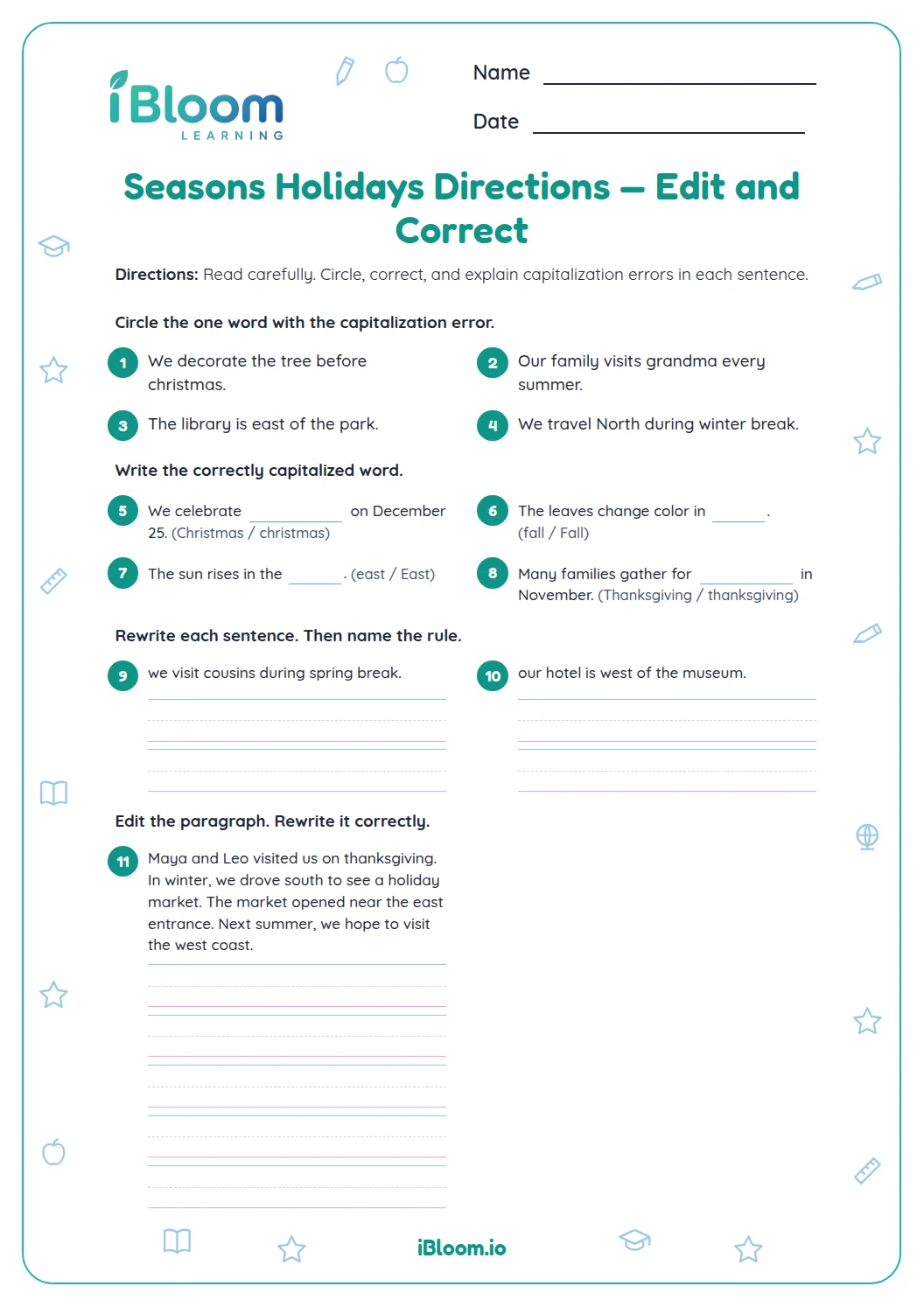
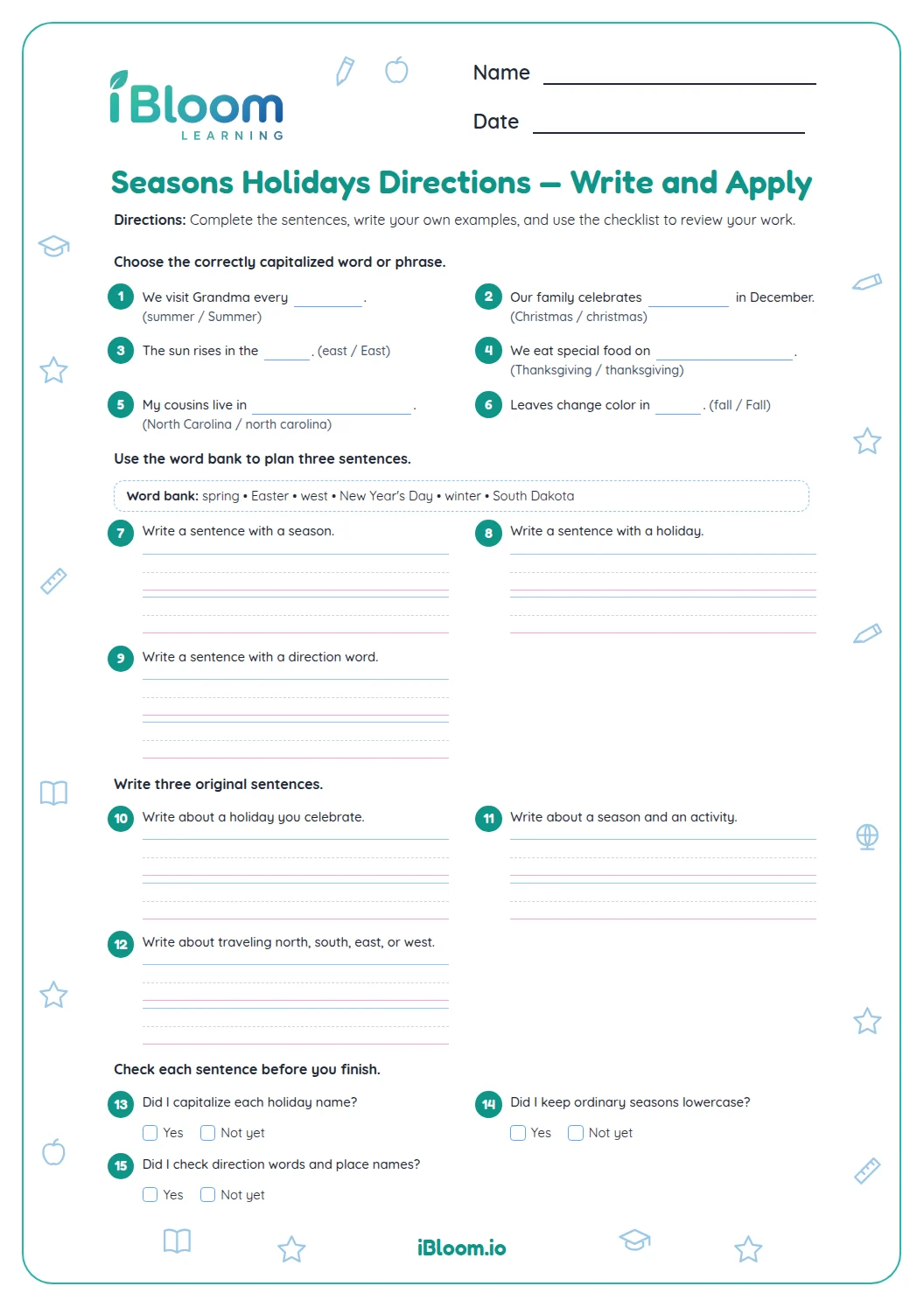
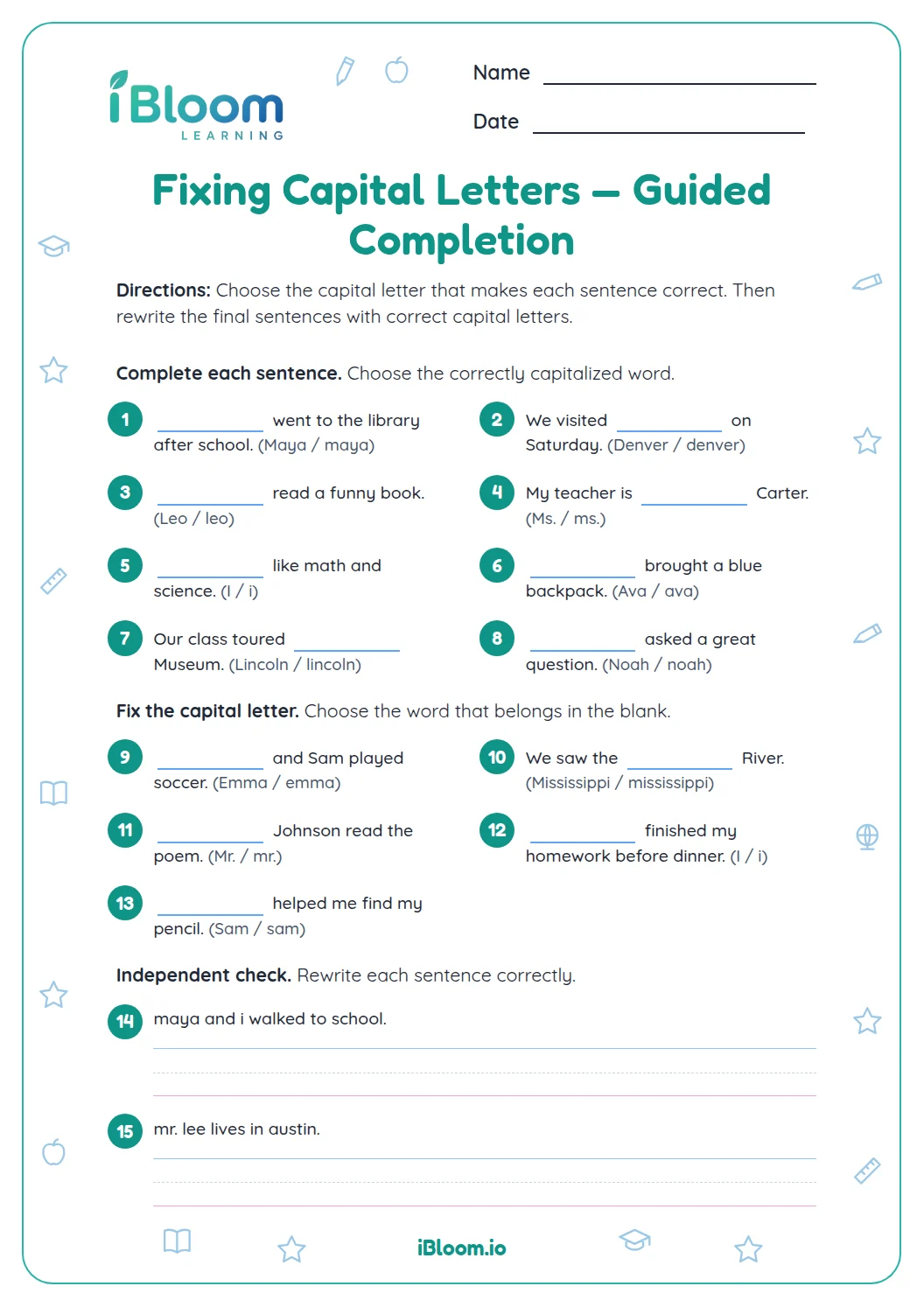
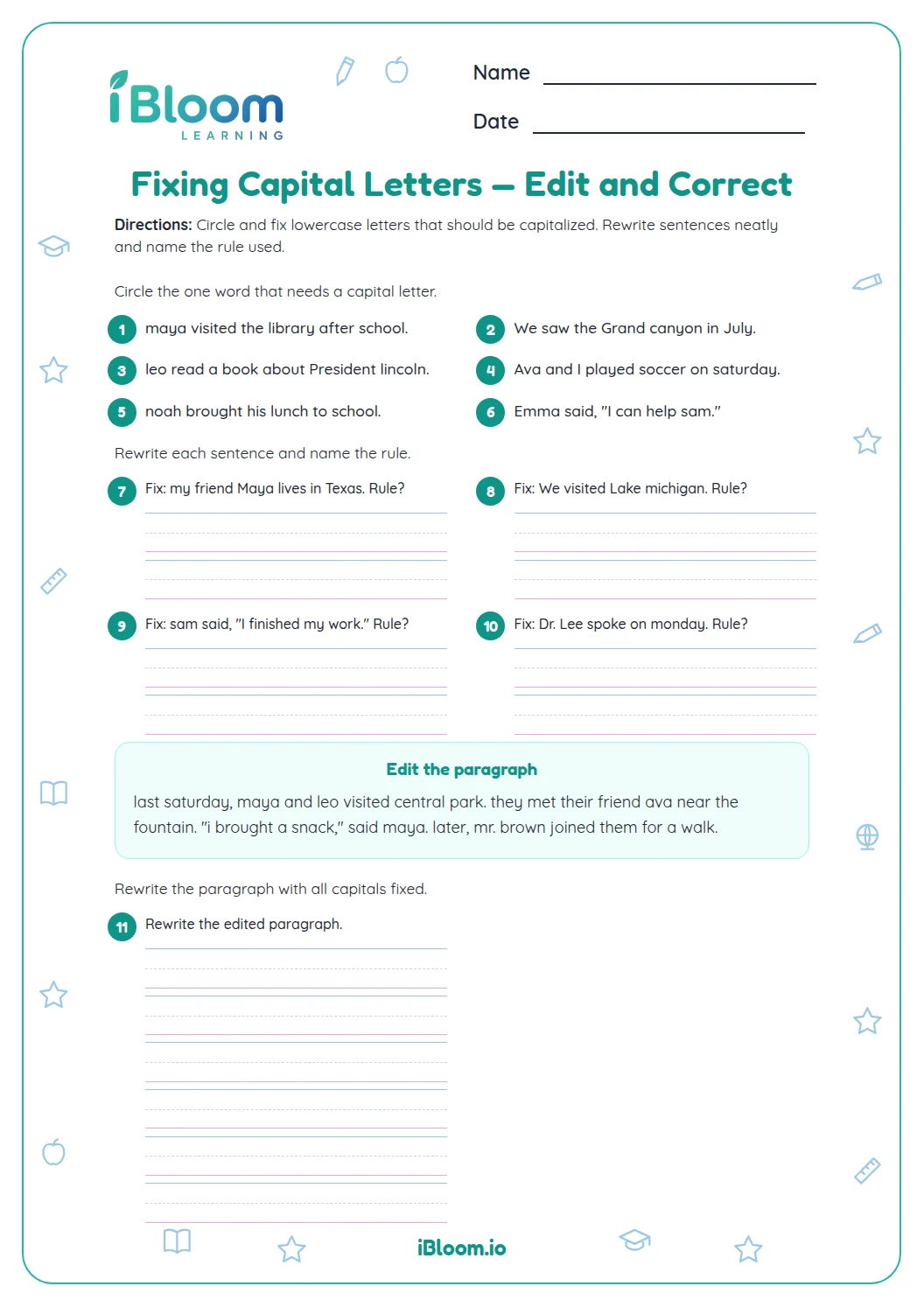
This Grade 4 recognition worksheet helps students identify capitalization rules for proper places, holidays, months, days, seasons, and directions. In each of 14 items, students read a sentence and choose the kind of word that needs a capital or stays lowercase. Three parts group related rules, and the answer key names the rule category for every question. The sheet practices CCSS L.4.2.a.
Aligned to L.4.2.a
Which calendar words need capitals?
Capitalize the names of weekdays, months, and holidays. Keep ordinary season names lowercase unless they begin a sentence or form part of a proper name. Question 3 asks students to identify the category for October; question 5 asks what stays lowercase in “spring.”
- 1spring: Which word type stays lowercase?
- 2Answer: a season
- 3Ordinary season names stay lowercase in a sentence.
When is a direction a proper name?
Compass directions such as north and east are lowercase when they describe where someone travels or turns. A direction used as a name for a region takes a capital, as in “the West.” Proper names of streets, lakes, and other places are capitalized.
How can you check a capitalization choice?
Ask whether the word names a particular day, month, holiday, or place. Then check whether a season or direction is being used as an ordinary word or as part of a proper name. The multiple-choice options focus on the target word in each sentence.
How to use this capitalization worksheet
- 1Read the whole sentence before choosing an answer.
- 2Decide whether the word names a particular date, holiday, or place.
- 3Keep ordinary season names and compass directions lowercase.
- 4Capitalize a direction when it names a region.
- 5Check the target against the answer key.
Common mistakes and quick fixes
The mistake
Capitalizing every season name.
The fix
Keep a season lowercase unless it starts the sentence or is part of a proper name.
The mistake
Capitalizing every compass direction.
The fix
Use lowercase for ordinary travel directions; capitalize regional names such as the West.
The mistake
Capitalizing only the first word of a holiday or place.
The fix
Check the complete proper name, including both words in Memorial Day or Lake Michigan.
Common Core alignment
This worksheet gives students practice with L.4.2.a through the questions on the sheet.
Apply capitalization conventions to calendar names, holidays, and proper names.
On this sheet: Apply capitalization conventions to calendar names, holidays, and proper names.
Show the official wordingHide the official wording
Use correct capitalization.
What to practice next
Make more practice
Further reading
Questions parents and teachers ask
Are season names capitalized?
Ordinary season names such as spring, summer, autumn, and winter are lowercase in the middle of a sentence. A season is capitalized at the start of a sentence or when it appears in a proper name. Question 12 contrasts lowercase “autumn” with the month “October.”
Which calendar names use capitals?
Capitalize weekdays, months, and holidays, including Monday, October, and Thanksgiving. A common season name is usually lowercase. The worksheet asks students to identify the target word in each sentence and the key lists the correct form. A holiday name is a proper name even in the middle of a sentence.
When should a direction be capitalized?
Use lowercase for compass directions that simply tell where to go, such as “Turn east.” Capitalize a direction when it names a region, as in “the West,” or appears within an official place name. The sentence meaning determines the choice.
What does the answer key show?
The key gives a rule category for each of the 14 items, such as a place name, holiday, month, or season. This lets students connect the word in the sentence to the capitalization rule. For example, a month name needs a capital, while an ordinary season name stays lowercase.
How many questions are included?
There are 14 multiple-choice rule questions in three parts. They cover holidays, weekdays, months, season names, compass directions, regional names, and proper places. Students identify the kind of word that needs capitals or stays lowercase, then compare the category with the answer key.