


About this worksheet
This Grade 4 mixed review practices capitalization in sentences about places, holidays, months, seasons, and directions. Students choose the rule that applies in each of 14 compact items, grouped into three parts. The separate answer key names the rule for every item. It practices CCSS L.4.2.a.
Aligned to L.4.2
Which words need capital letters?
Capitalize names of people, places, holidays, and months. In q1, Boston is a city and October is a month, so both are capitalized: “We visit Boston in October.”
- 1we visit boston in october.
- 2We visit Boston in October.
Are seasons and directions capitalized?
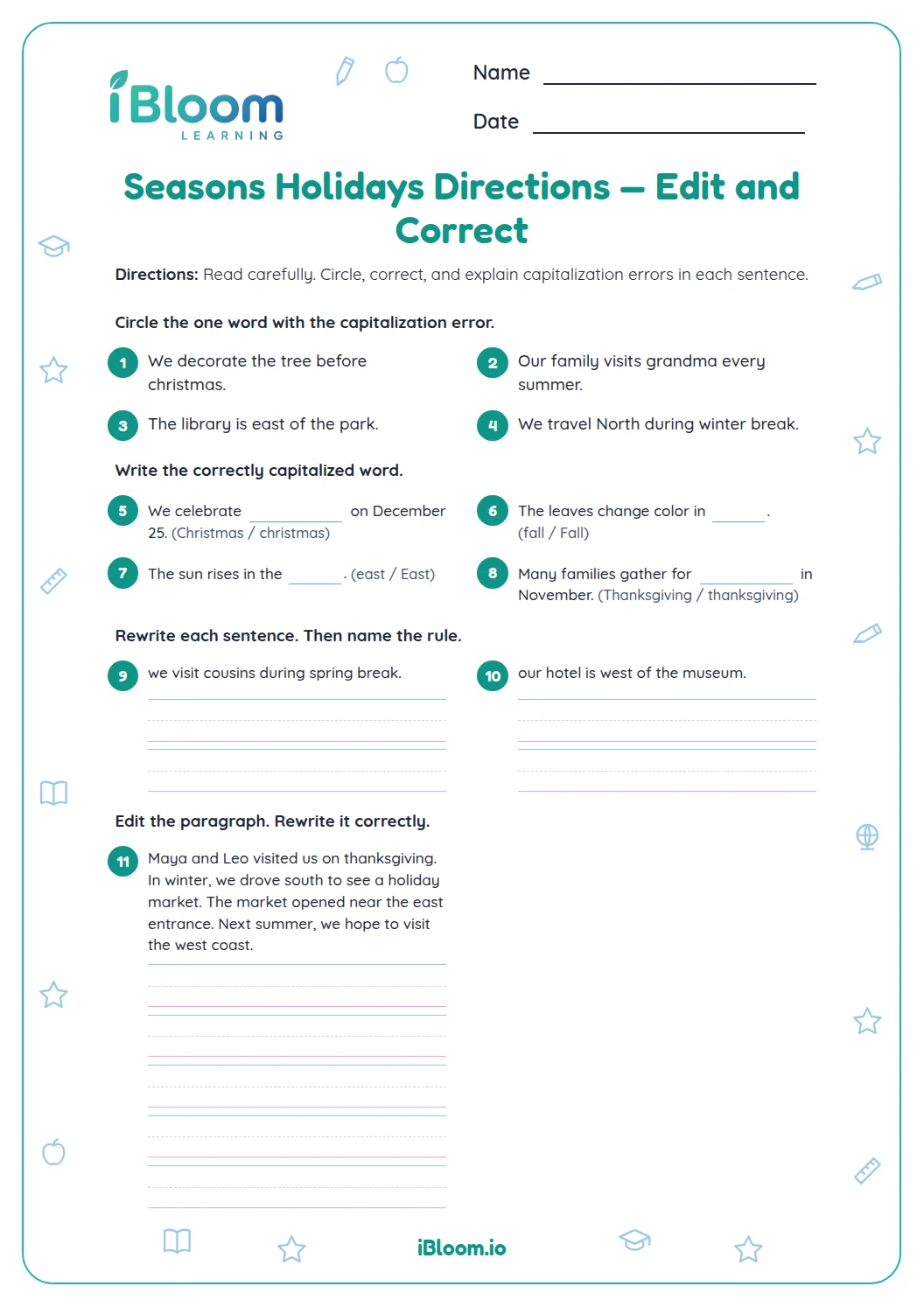
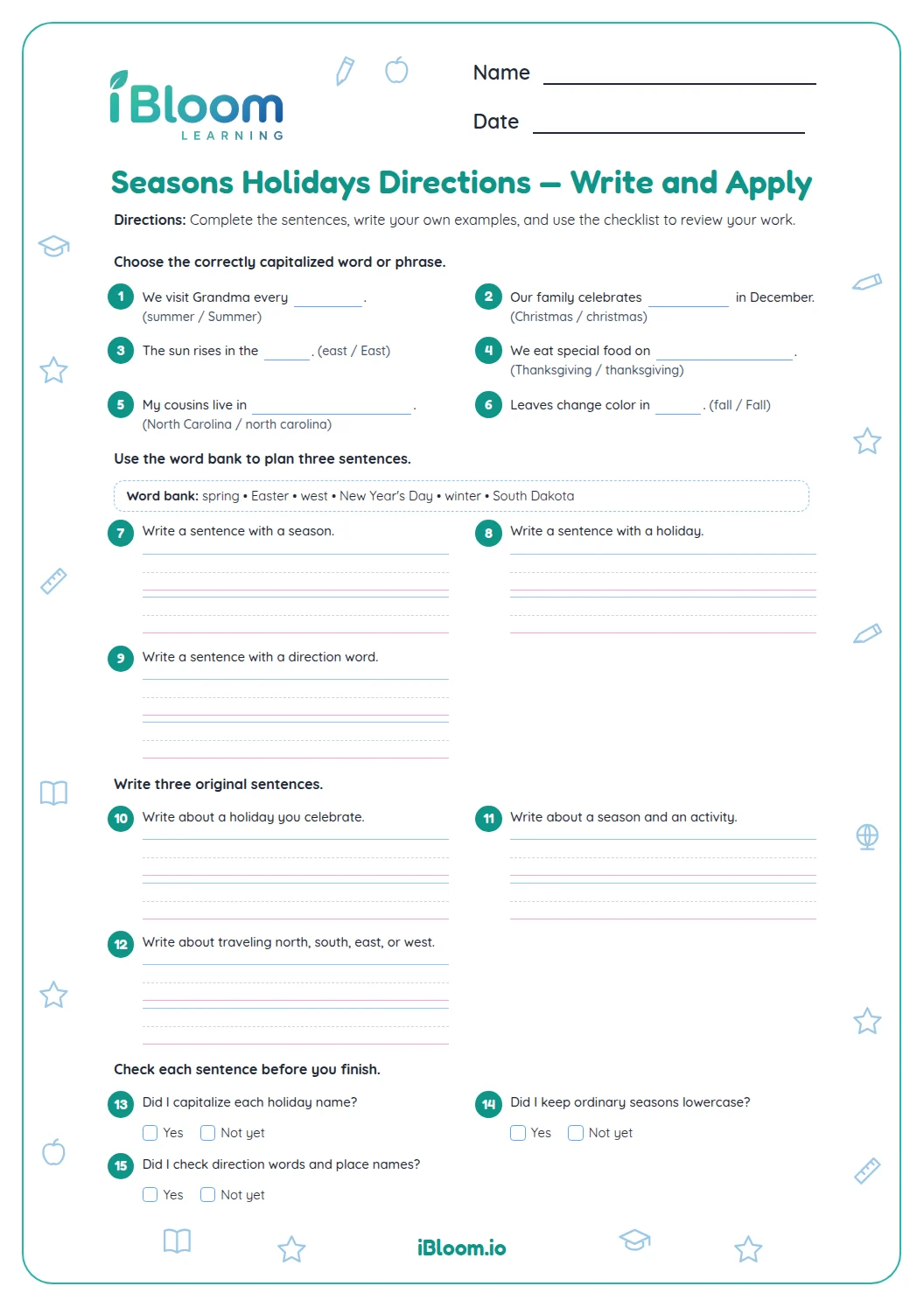
Usually, no. Write spring and winter in lowercase, and write north, south, east, or west in lowercase when they simply give a direction. Capitalize a direction word when it is part of a recognized region name, such as the West.
How can you check a holiday sentence?
Treat a holiday’s full name as a proper name: Thanksgiving, Independence Day, and Labor Day use capitals. Read the whole sentence too, since a person’s name or a month may need a capital as well.
How to check each sentence
- 1Read the sentence for people, places, months, and holiday names.
- 2Capitalize each proper name.
- 3Keep season names lowercase.
- 4Keep compass directions lowercase when they only show where to go.
- 5Read the edited sentence once more for the first word and punctuation.
Capitalization slips to watch for
The mistake
Capitalizing a season just because it names a time of year.
The fix
Write spring, summer, fall, and winter lowercase unless the word begins a sentence or appears in a proper name.
The mistake
Capitalizing every compass direction.
The fix
Use lowercase for a route such as “drive east”; capitalize a region name such as “the West.”
The mistake
Leaving a holiday or month lowercase.
The fix
Check the calendar words and capitalize full holiday names and month names.
Common Core alignment
Apply correct capitalization while editing sentences about places, holidays, and seasons.
On this sheet: Students edit and evaluate capitalization in complete sentences.
Show the official wordingHide the official wording
Demonstrate command of the conventions of standard English capitalization, punctuation, and spelling when writing.
What to practice next
Make more practice
Further reading
Questions parents and teachers ask
Should season names be capitalized?
Usually, season names stay lowercase: spring, summer, fall, and winter. Capitalize one only at the start of a sentence or when it is part of a proper name. This worksheet includes examples where students choose the lowercase season form. Invite the student to reread the example and explain how its clue supports the answer.
Are north, south, east, and west capitalized?
Use lowercase when the word gives an ordinary direction, as in “drive east.” Capitalize it when it names a region, as in “the West.” Students compare context to decide which form is correct on these questions. Invite the student to reread the example and explain how its clue supports the answer.
Which holiday names appear on this worksheet?
The questions include Thanksgiving, Labor Day, Kwanzaa, and Easter. Students also practice capitalizing months and geographic names, including Boston, Pine Street, Lake Erie, Texas, and the West. Invite the student to reread the example and explain how its clue supports the answer.
How many questions are included?
There are 14 multiple-choice questions in three parts. Students identify the capitalization rule that fits each short context, including holiday, place, season, month, and direction words. The answer key gives the rule category for every item. Invite the student to explain which word in the context signals the rule.
Does the worksheet include an answer key?
Yes. The separate answer key lists the correct word or phrase for every item. Students can explain why a holiday or place name takes capitals while a season or ordinary direction stays lowercase. Invite the student to reread the example and explain how its clue supports the answer.