





About this worksheet
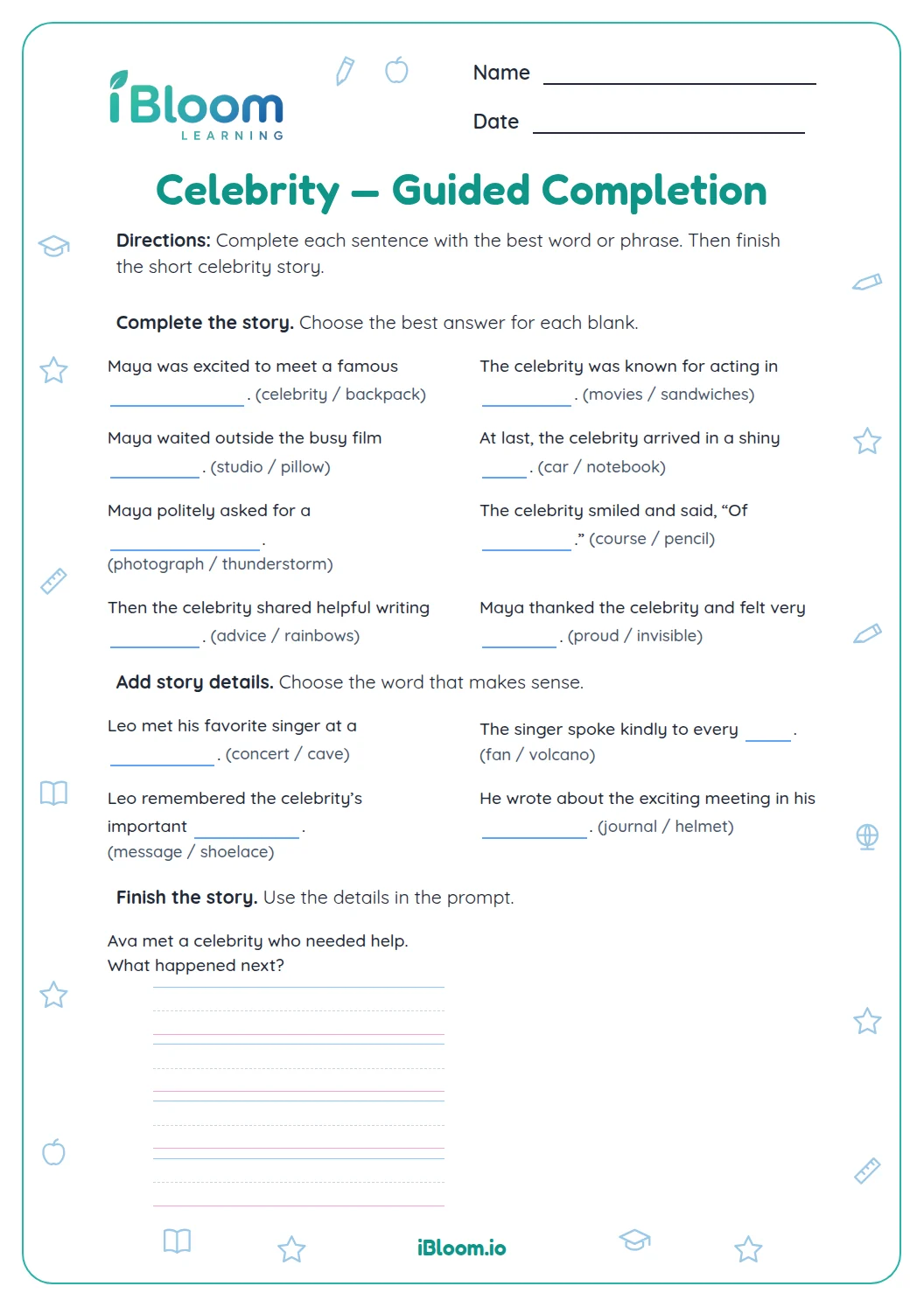
This Grade 4 printable uses an imagined meeting with a famous musician to practice narrative elements and event order. Students choose an opening, setting detail, dialogue, and first event, then complete short sentences about story terms and the search for a missing guitar. The answer key gives the correct choices and missing words. The character, action, and solution keep the practice focused on a clear narrative sequence.
Aligned to W.4.3
How does a story opening introduce a problem?
A singer drops a special notebook before the guitar goes missing.
Question 1 asks students to choose a starting detail that fits the story topic. Questions 2–4 check setting, dialogue, and the first event.
- 1A famous singer drops a special notebook.
- 2The detail introduces a character and an event.
Which narrative words help explain a story?
Questions 5–10 ask for terms such as setting, events, problem, solution, and conclusion. Each word names a part of how a story works. A vivid detail adds a sound, sight, or feeling.
- 1A sound, sight, or feeling can be a vivid ___.
- 2Complete it with “detail.”
How do the final details move the story forward?
The last four items complete short sentences about Nia noticing the missing guitar, asking the crew to search, calling out, and finding it behind an amplifier. The events connect a character’s problem with a possible solution.
How to use this worksheet
- 1Read each story choice and consider how it fits the character and situation.
- 2Check the setting, dialogue, and first event.
- 3Use narrative terms to name story parts and challenges.
- 4Complete each final blank with a detail that fits the story.
- 5Reread the completed sequence to check that the actions make sense.
Common mistakes and quick fixes
The mistake
Choosing a detail that does not fit the story prompt.
The fix
Check that the character, setting, and event belong in the same scene.
The mistake
Mixing up a problem and a solution.
The fix
The problem is the challenge; the solution is the action that fixes it.
The mistake
Using a vague event that does not move the story.
The fix
Choose an action that brings the character closer to solving the problem.
Curriculum alignment
The practice connects to this grade-level standard.
Write an imagined event with descriptive details and a clear event sequence.
On this sheet: The choices practice narrative details and event order; question 11 asks students to write a sentence showing a character response and result.
Show the official wordingHide the official wording
Write narratives to develop real or imagined experiences or events using effective technique, descriptive details, and clear event sequences.
What to practice next
Make more practice
Further reading
Questions parents and teachers ask
What story does this worksheet use?
It follows an imagined meeting with a famous musician whose guitar goes missing at a music festival. Students choose story details and fill in short sentences about the search. The answer key lists the choices and missing words.
What narrative terms are in the fill-in questions?
Students complete terms for setting, events, problem, solution, and conclusion. They also identify a vivid detail and fill in short events that continue the story. The answer key supplies the expected words; rereading the sentence helps confirm each answer fits.
How many questions and pages are included?
The worksheet contains 14 questions in two parts across two pages. Four questions use choices to plan story details, and ten short fill-ins practice narrative terms and events. The separate answer key also runs two pages and shows the expected answers.
What makes a detail fit the story?
A fitting detail advances the search for the missing guitar or helps the reader picture the music festival. It should connect to the stated situation and make the event sequence easier to follow. The questions give students practice checking that connection.
How can students check their completed answers?
Read the full sentence with the chosen word in its blank. Check that the word names the story part being described and that the event fits the scene. The answer key provides the expected choices and fill-ins for a quick comparison.