



About this worksheet
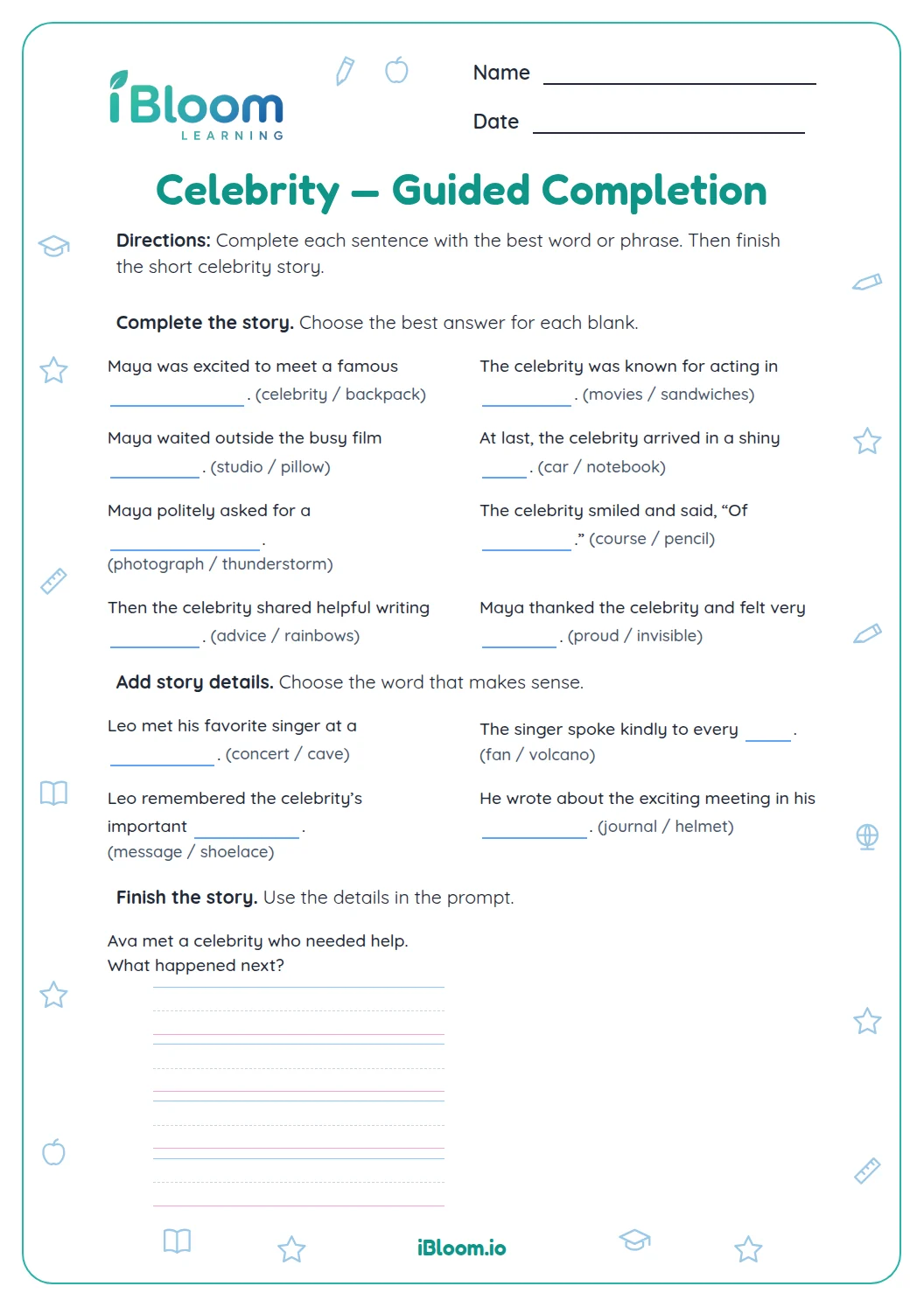
This Grade 4 worksheet practices recognizing celebrity clues in short descriptions. Students complete clues about public figures, circle related words, and sort examples as Celebrity or Not a celebrity. The 14 questions follow the original sheet’s clue, word-circling, and classification approach. A separate answer key is included.
What details can identify a celebrity?
A celebrity is known by many people, often for public work such as performing or competing. Part A uses short clues about singers, actors, athletes, fans, and performances.
- 1Fans may ask a star for an autograph.
- 2The clue points to a word associated with public recognition.
Which words connect to celebrities?
Part C asks students to circle famous, singer, and fans in one sentence. Waved and cheered describe actions, so they are left uncircled.
How do I sort the examples?
Part D distinguishes celebrities from everyday people. A famous singer performing on stage fits Celebrity; a child reading quietly at home fits Not a celebrity. The description supplies the clue for each choice.
How to use this worksheet
- 1Read each clue and identify the person or public activity.
- 2Write the word that completes each of the first eight sentences.
- 3In Part C, circle only words connected to celebrity clues.
- 4For Part D, decide whether each example describes a celebrity.
- 5Check the answer key and explain one clue that helped you sort.
Common mistakes and quick fixes
The mistake
Calling every person in a story a celebrity.
The fix
Look for public recognition or work known by many people.
The mistake
Circling a word just because it appears in the row.
The fix
Circle only words connected with celebrities.
The mistake
Classifying an everyday activity as a celebrity clue.
The fix
Ask whether the example shows public recognition or an ordinary moment.
What to practice next
Make more practice
Questions parents and teachers ask
What makes someone a celebrity?
A celebrity is known by many people, often because of public work such as performing, competing, or appearing in the news. Questions 1–8 use clues about singers, actors, athletes, fans, performances, and interviews. The early items use clues from the sheet’s stage and interview examples.
How many questions are included?
There are 14 questions in four parts: eight celebrity-clue fill-ins, one sentence with words to circle, and five examples to classify. The separate answer key lists each word and classification. Fourteen numbered prompts appear across the two printed worksheet pages.
What words should students circle?
Circle famous, singer, and fans in the sentence on the sheet. Those words point to a public figure and the people who recognize one. Leave waved and cheered uncircled because they describe actions in the sentence. The circle task appears in Part C of the sheet.
How should students sort an example?
Choose Celebrity when the description shows a well-known person in a public role, such as a famous singer performing on stage. Choose Not a celebrity for everyday people or activities without public recognition. In the final group, compare each description with those public clues.
Is a person automatically a celebrity because they appear in a story?
No. A story can include celebrities and everyday people. The worksheet asks students to use clues such as fame, fans, performances, or interviews rather than simply noticing that a person is named. The examples show both kinds. Both kinds of people can appear in a fictional narrative.
Is the answer key included?
Yes. The separate key gives the correct word for each fill-in, the three words to circle, and the classification for all five examples. Ask the student to point to a supporting clue, such as a performance or autograph.