



About this worksheet
This free Grade 4 printable helps students complete an imagined robot story one step at a time. The prompts move from introducing Mira and a robot with a missing map chip to adding a character action, sensory detail, dialogue and events in order. Students complete 16 sentences, then reread the story from discovery to ending. The work practices Common Core W.4.3 by developing an imagined experience with descriptive details and a clear sequence. A separate answer key gives the intended word or phrase for each blank.
Aligned to W.4.3
What does this worksheet ask a writer to complete?
The page follows Mira as she finds a small robot whose map chip is missing. Students add details and actions that make the situation understandable, help move the search forward, and bring the story to a natural finish.
Part A establishes Mira’s discovery and the robot’s problem. Part B moves through the search, the returned chip and a fitting ending. Each blank completes a sentence in the same unfolding adventure.
- Part A: introduce Mira, the robot and the missing chip
- Part B: complete the search, the solution and the ending
- Sixteen sentence blanks build one connected narrative
- The answer key lists the intended word or phrase for each blank
How can a small detail make a story clearer?
A concrete detail helps a reader picture or hear what happens. In question 2, “Its metal hands ___” becomes “Its metal hands trembled,” showing the robot’s nervousness through an action. A sensory detail, such as a voice like a tiny bell, also helps make a moment vivid.
- 1Question 2: “Its metal hands ___.”
- 2Answer: “trembled.”
- 3The action shows the robot’s nervousness instead of naming the feeling.
How do transitions help a story’s events fit together?
Transitions such as “First,” “Next” and “At last” help readers follow a search. In question 6, “return” completes “beneath the return desk,” making the next place Mira searches clear. Each completed sentence should follow naturally from the event before it.
Read the finished sentences in order. The search should lead from the book cart to the desk, then to the blinking chip.
What makes a story ending feel complete?
A conclusion follows from the problem and the character’s actions. Once the chip is found, the robot can follow its path to a charging station, thank Mira and roll home. The last sentences show the characters’ reactions and leave the adventure feeling complete.
Questions 9 through 16 finish the solution and its aftermath. Check that each word fits the sentence and that the final thought follows from the robot’s safe return.
How to use this worksheet
- 1Read the directions for Part A, then follow Mira’s discovery in order.
- 2Fill each blank with the word that makes the sentence clear and complete.
- 3Use the sequence clues “First,” “Next” and “At last” to follow the search.
- 4Reread each completed sentence beside the one before it to check the story’s flow.
- 5Finish Part B by completing the solution and the characters’ responses.
- 6Use the key to check each word or phrase, then read the whole adventure aloud.
Common narrative writing mix-ups
The mistake
Naming a feeling without showing what the character does.
The fix
Add an observable action, such as trembling hands or a robot peeking from behind a cart.
The mistake
Using a transition that signals the wrong relationship between events.
The fix
Choose a word that tells whether time passes, an action happens next, or a search finally succeeds.
The mistake
Ending with an unrelated surprise after the problem is solved.
The fix
Let the last event grow from the solution, then show how the character responds.
Common Core alignment
This guided story page practices Grade 4 narrative writing through an imagined experience, descriptive details and a clear sequence of events.
Develop an imagined story with descriptive details and events in a clear sequence.
On this sheet: The prompts guide students to build and complete an imagined experience with details, dialogue, transitions and a fitting conclusion.
Show the official wordingHide the official wording
Write narratives to develop real or imagined experiences or events using effective technique, descriptive details, and clear event sequences.
What to practice next
Make more practice
Further reading
Questions parents and teachers ask
What story do students complete?
Students help Mira and a small robot solve the problem of a missing map chip. The prompts provide the story situation, then ask students to add details, connect events, write dialogue and bring the robot’s search to a satisfying close. Several answers can be correct when they fit the events.
How many questions are on the worksheet?
There are 16 sentence-completion prompts across two parts. Part A introduces Mira and the robot’s missing chip; Part B follows the search through the solution and ending. A separate answer key lists a word or phrase for every blank, so the completed adventure is easy to check.
Do students need to use the exact sample answers?
The key lists the intended word or phrase for each blank. Some prompts may allow another word that also makes a clear, grammatical sentence and fits the story events. Read any alternate response in the full sentence, then check that it preserves the sequence and meaning of Mira’s search.
What should a student include in a written response?
Look at the action word in the prompt. A response may need to show a character’s action, add dialogue, describe a reaction or write a conclusion. A specific detail such as a blinking light or a relaxed posture makes the event easier to imagine.
How can a student keep the events in order?
Have the student retell what happens from the library discovery through the search and the robot’s departure. Words such as “next,” “at last” and “a moment later” help show how one event follows another. The events should build toward solving the missing-chip problem.
What can we do after completing the page?
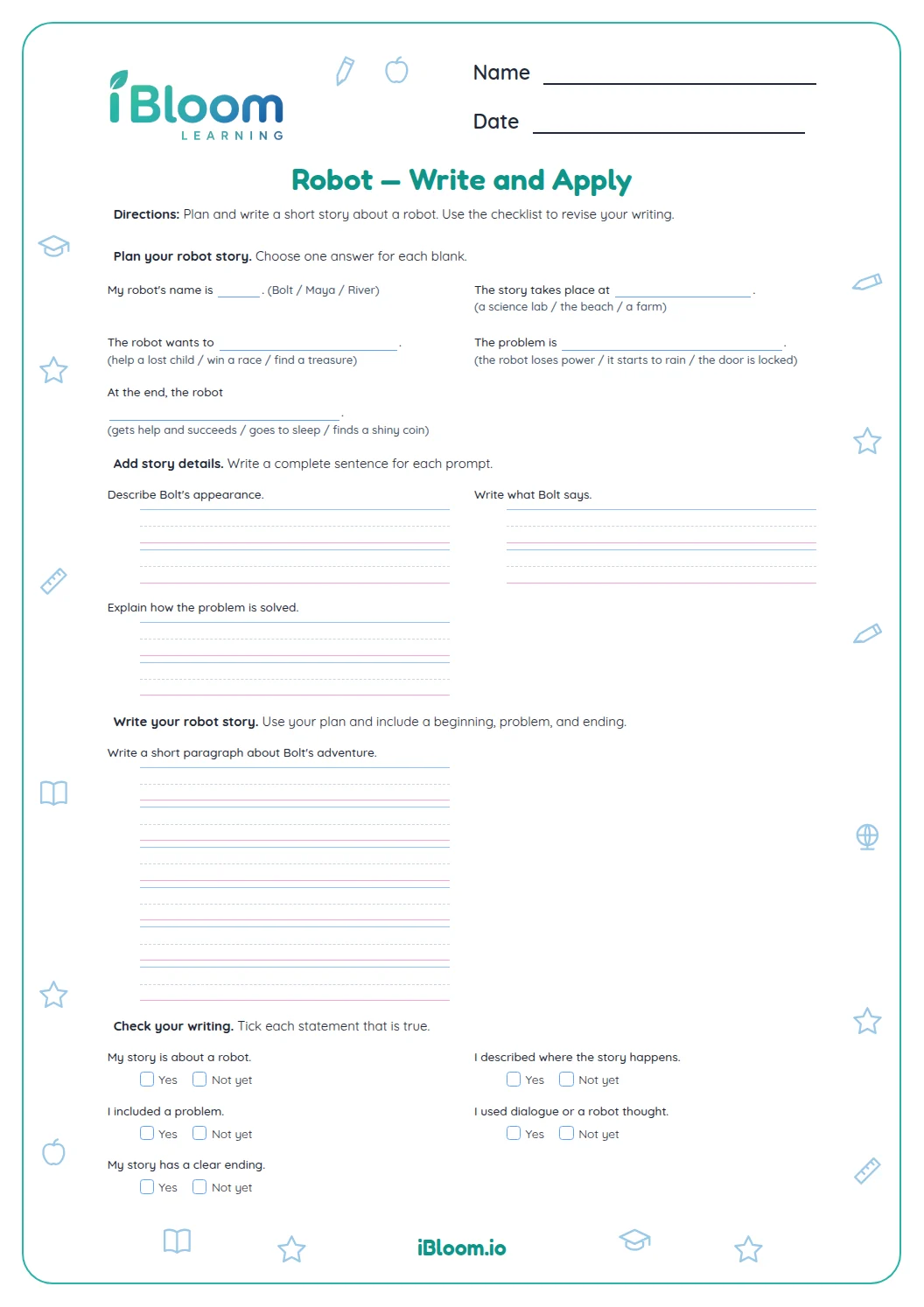
Ask the student to combine the completed responses into a single story, adding any connecting sentences needed. Then try the sibling Robot Write and Apply activity to practice composing a fuller narrative from a prompt, followed by Edit and Correct for revision.