





About this worksheet
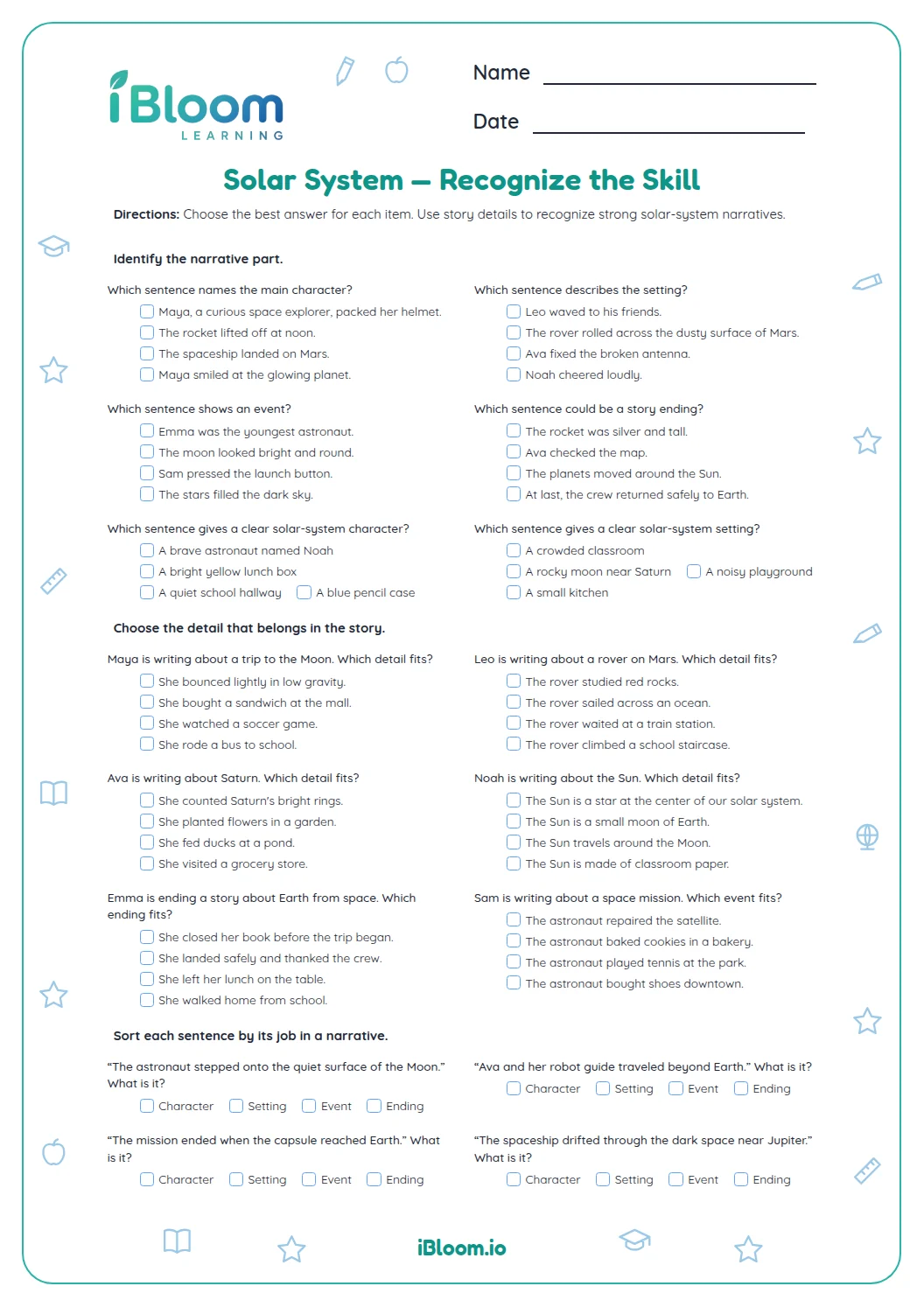
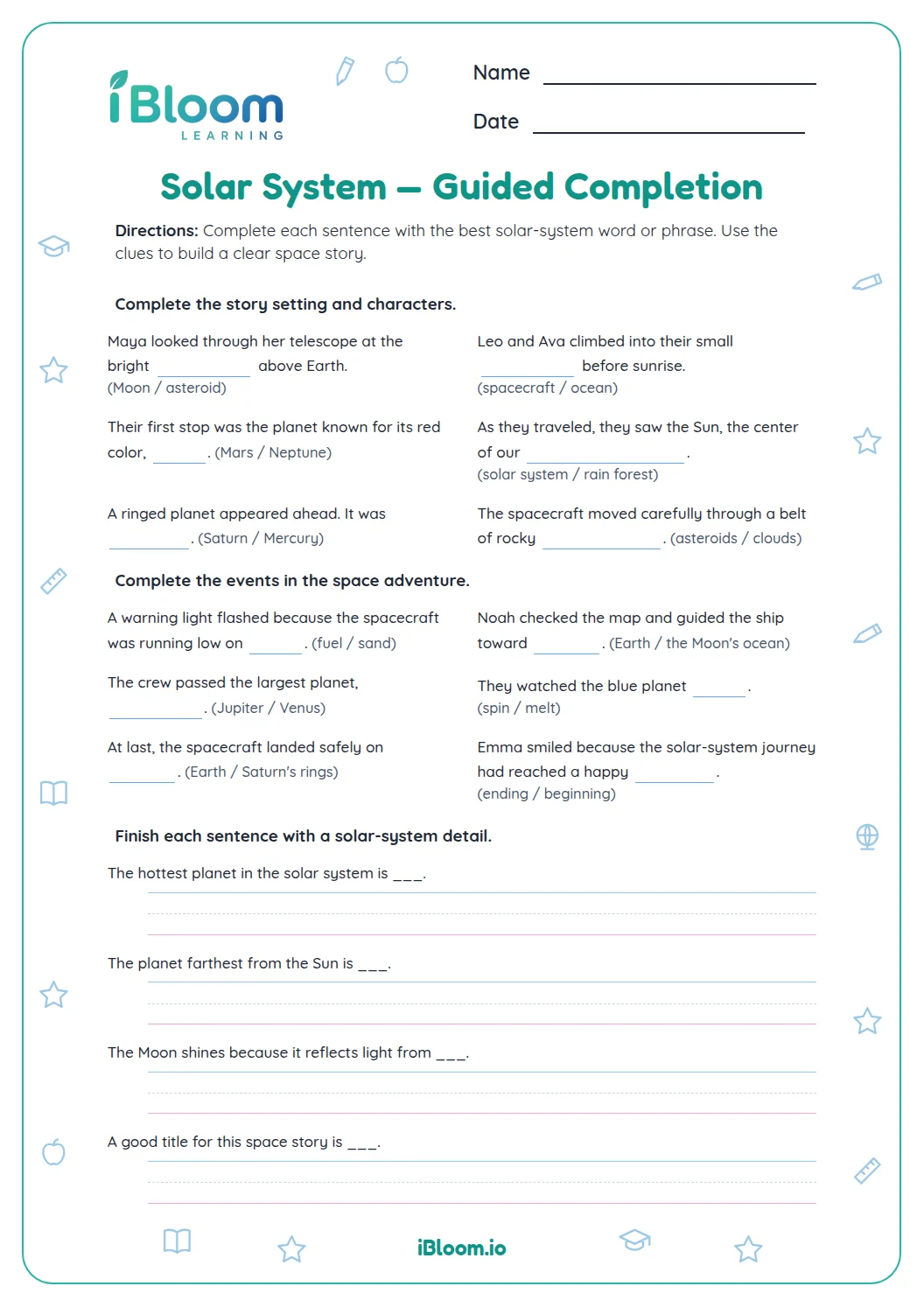
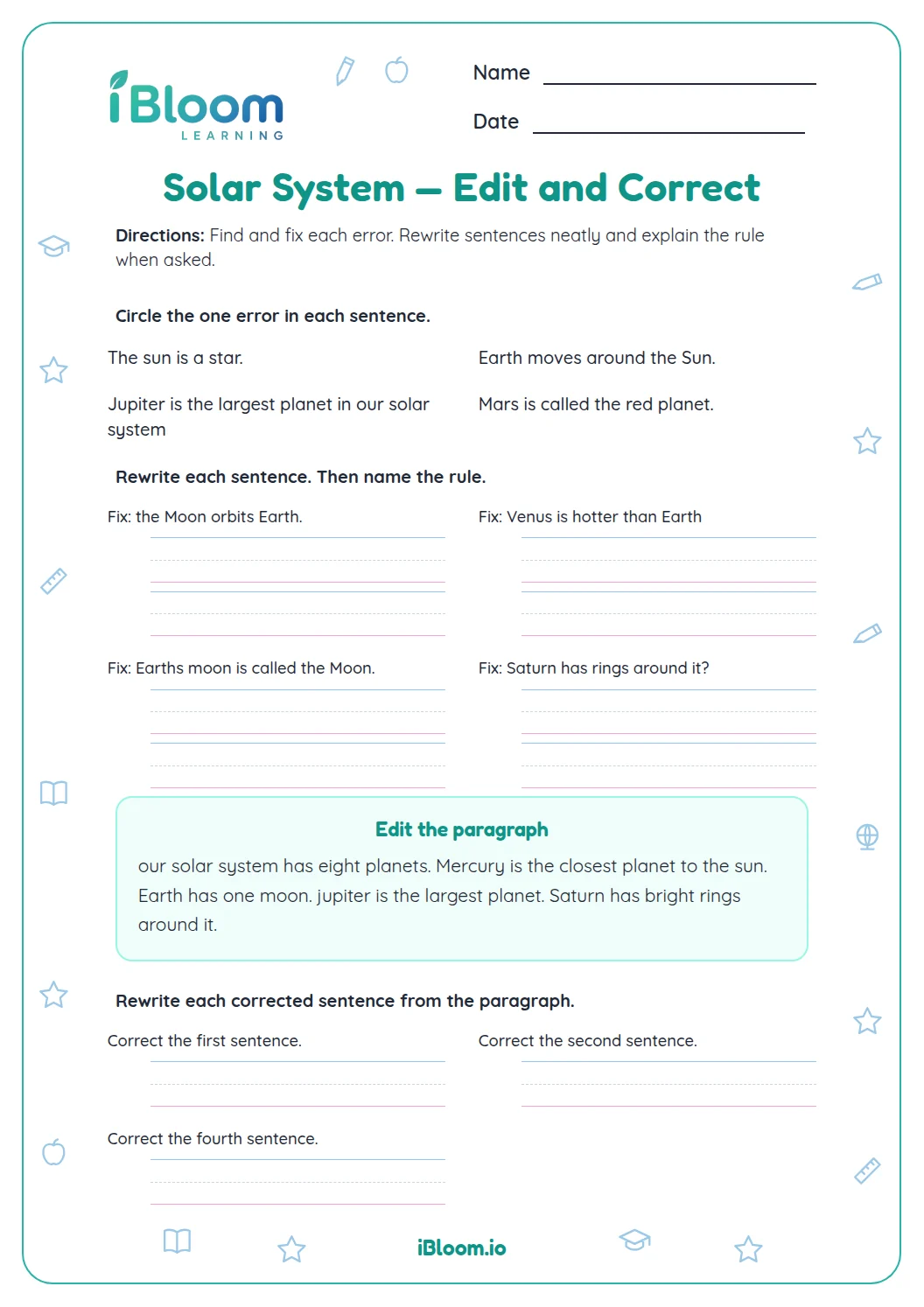
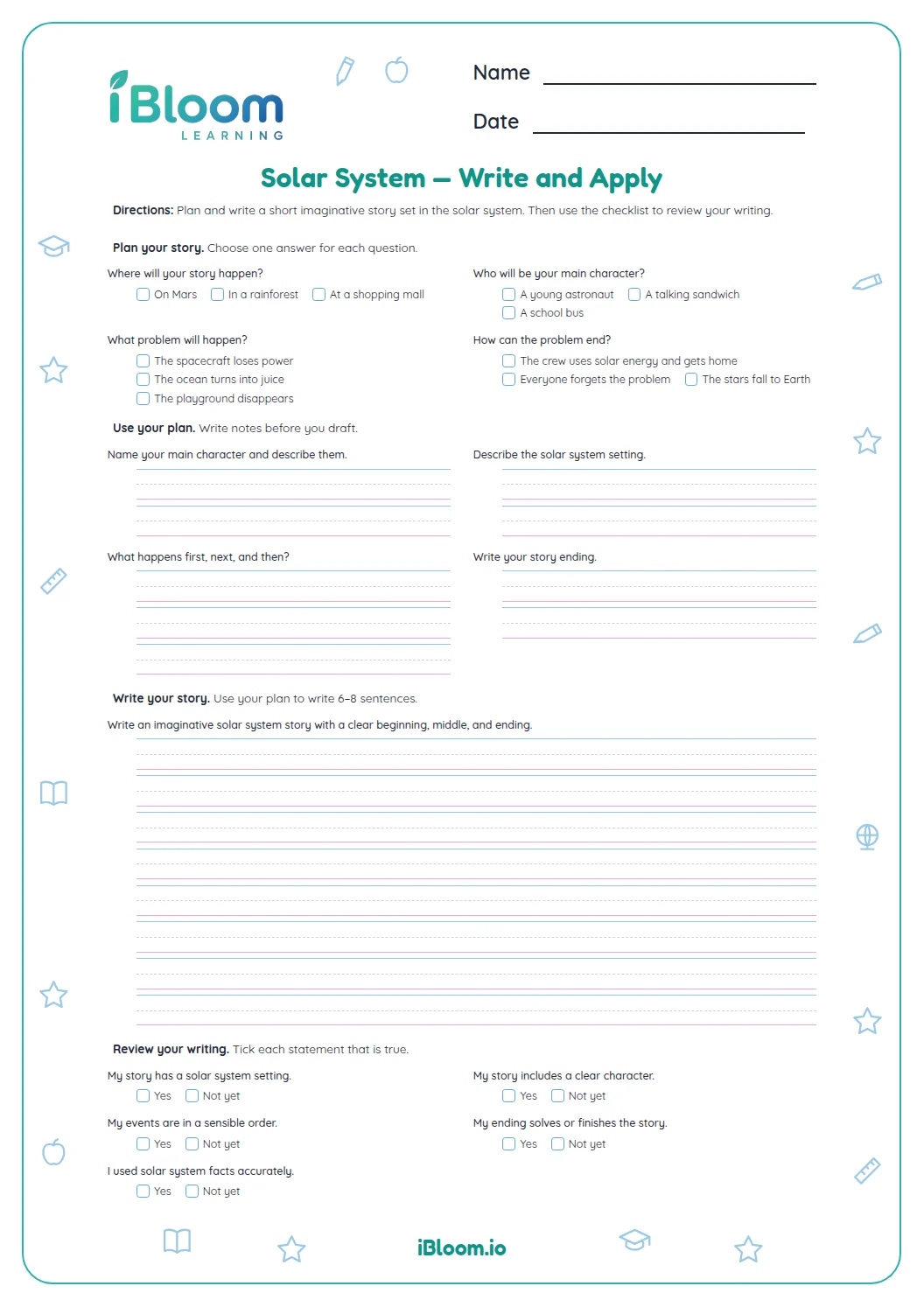
This Grade 4 mixed review uses a solar-system setting to revisit narrative craft. Students identify sensory details, dialogue, character responses, event order, and effective endings, then write four brief story continuations. The answer key gives selected choices and sample responses. The practice supports W.4.3: developing imagined events with technique, details, and clear sequence.
Aligned to W.4.3
What makes a narrative scene clear?
A reader needs to know where the event happens, what changes, and how a character responds. Sensory details and dialogue help bring a scene to life.
How does a detail move a story forward?
A precise detail lets readers picture the moment. In a space story, a jagged rock or a buzzing alarm can make a setting specific, while a character’s action shows what happens next.
- 1“Cold air brushed Maya’s cheeks.”
- 2The sentence uses touch to make the scene vivid.
How should students approach the writing prompts?
Each prompt gives a situation and asks for two connected sentences. Include the next event and a character response, then add a transition or specific detail where it fits. The key responses are samples; students may write other effective continuations.
How to use this worksheet
- 1Read the situation and identify the story moment.
- 2For a choice item, check what the detail or transition contributes.
- 3For a writing prompt, decide what happens next.
- 4Add a character response or a sensory detail.
- 5Reread to make sure the events connect and the ending fits.
Common mistakes and quick fixes
The mistake
Listing events without showing how they connect.
The fix
Use a time transition to make the sequence clear.
The mistake
Adding a detail that does not help readers picture the moment.
The fix
Choose a precise sight, sound, touch, smell, or taste detail.
The mistake
Ending before the problem has a response.
The fix
Show what the character does and how the event concludes.
Common Core alignment
This worksheet practices W.4.3 through its questions and examples.
Plan a story with a clear event sequence and concrete details.
On this sheet: Plan a story with a clear event sequence and concrete details.
Show the official wordingHide the official wording
Write narratives to develop real or imagined experiences or events using effective technique, descriptive details, and clear event sequences.
What to practice next
Make more practice
Further reading
Questions parents and teachers ask
How many items are on the worksheet?
There are 16 items: 12 multiple-choice questions about narrative craft and 4 short writing prompts. The prompts ask for two connected sentences, and the answer key provides sample responses. Children may use different wording if their events are clear and fit the situation.
What does a sensory detail do?
A sensory detail helps a reader imagine what a character sees, hears, feels, smells, or tastes. “A low alarm buzzed” adds sound to a scene. This worksheet asks students to recognize such details and use them in short story continuations.
Do the writing answers have to match the key exactly?
No. The key gives one sample for each prompt. A child’s response can differ while still advancing the event, including a fitting character response, and using connected sentences. Check that the writing answers the prompt and makes sense as a story.
Why does the worksheet use a solar-system setting?
The space setting gives the prompts a shared imaginative backdrop, with places such as Mars and a planetarium. Students focus on sequence, sensory details, dialogue, and character response while inventing story moments. The familiar setting lets them concentrate on narrative choices.
How can a transition improve a story?
A transition clarifies when one event happens in relation to another. “First,” “next,” “meanwhile,” and “at last” help a reader follow sequence or overlap. The transition should match the events rather than being added only to decorate a sentence in the story.
What can follow this mixed review?
Sentence Practice helps students use narrative details in complete sentences. Edit and Correct supports revising sentences, while Write and Apply gives more room to develop a narrative from a prompt. These sibling activities extend the craft choices and short continuations on this worksheet.