







About this worksheet
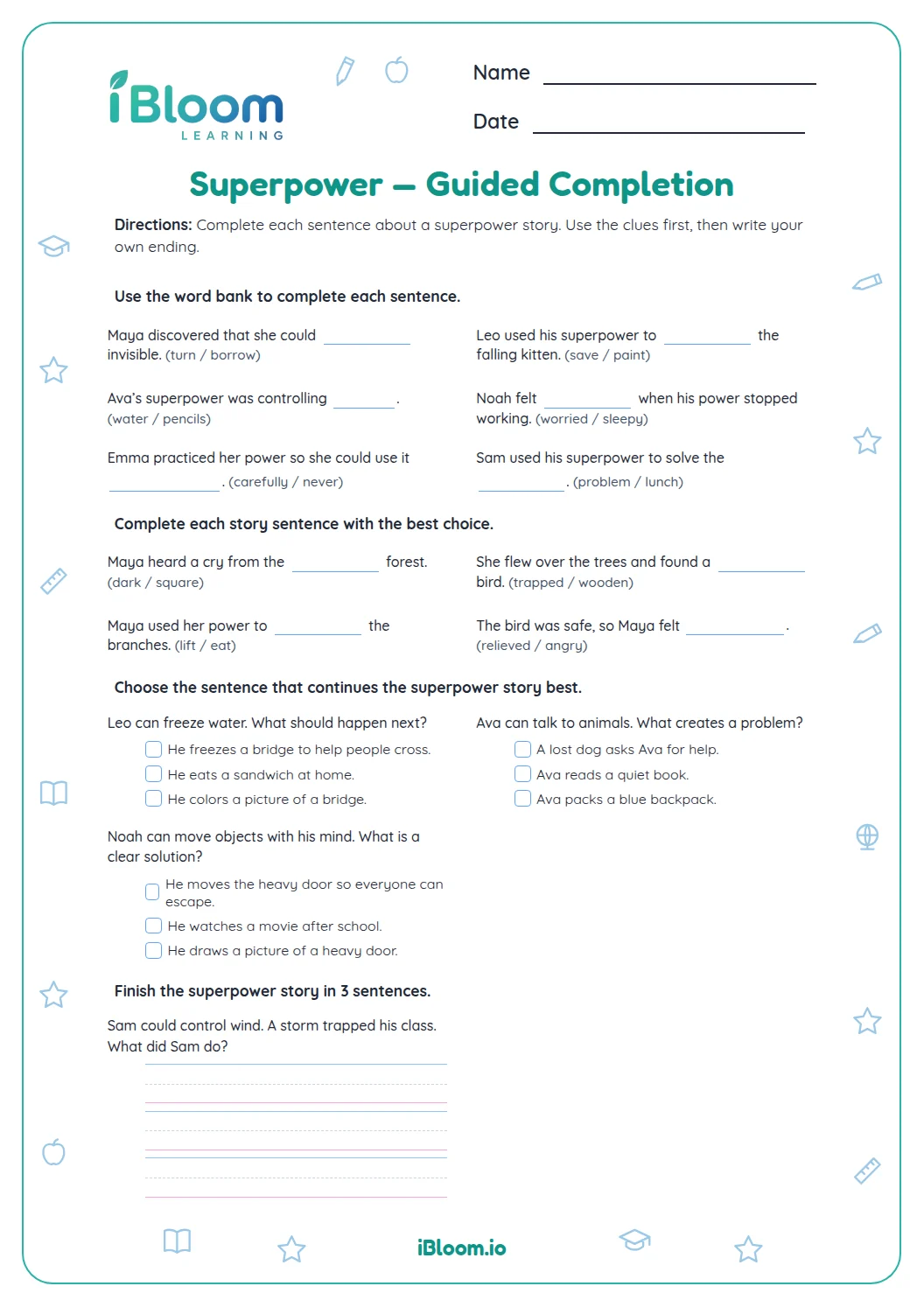
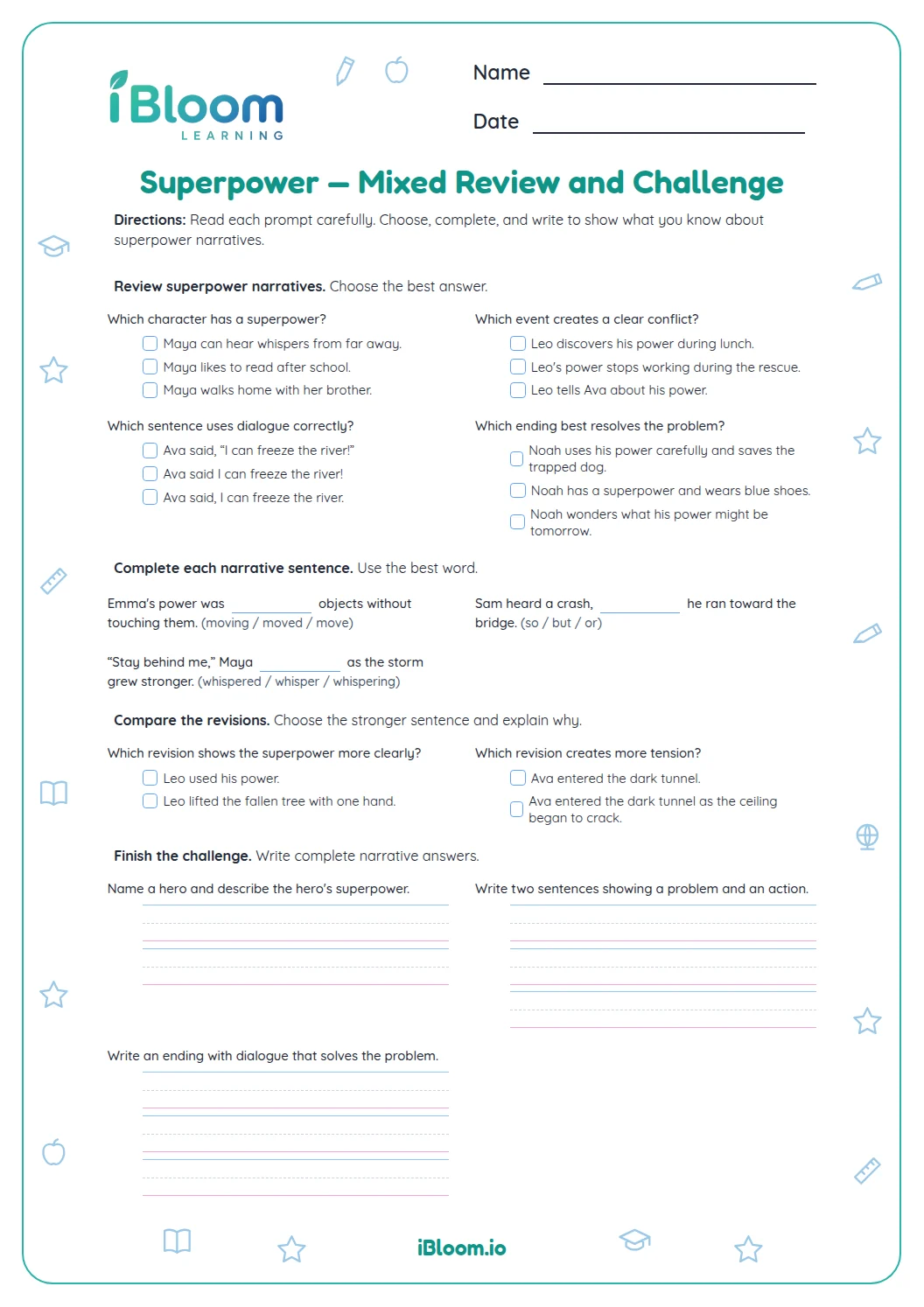
The 14 prompts keep the saved Superpower story theme while moving from recognizing story elements to composing linked sentences. Children practice a character, problem, action, dialogue, reaction, and ending. The sheet supports CCSS W.4.3 through descriptive details and a clear event sequence.
Aligned to W.4.3
What will learners practice?
Narrative sentences and events: openings, character, problem, action, dialogue, reaction, and ending.
The parts progress from direct recognition or conversion to applying the skill in a story, comparison, or written response.
How can a learner solve one question?
Read exactly what the prompt asks, identify the useful detail or relationship, and show the matching reasoning before checking the answer.
- 1Students practice 14 ways to build a story, from introducing a character to showing a problem and writing an ending. In question 9, “raced” gives a precise action that fits the falling cup.
How can families use the answer key?
Check the result and the reasoning together. For open responses, treat the key as a model: another answer is acceptable when it meets the prompt and is supported by the worksheet.
How to build a clear story moment
- 1Identify the character and the situation.
- 2Add a problem that needs attention.
- 3Choose a specific action that responds to the problem.
- 4Use dialogue or a reaction to show what happens next.
- 5End with a result that follows from the action.
Common narrative slips and fixes
The mistake
Starting with “he” or “they” before naming a character.
The fix
Introduce the character or make the person clear in the opening.
The mistake
Using a general verb such as “went” during an important action.
The fix
Choose a precise verb that helps the reader picture the event.
The mistake
Adding an ending unrelated to the problem.
The fix
Make the last sentence show what changed because of the character’s action.
This worksheet gives students direct practice with the listed Common Core skill.
Narrative sentence practice with a superpower theme.
On this sheet:
Show the official wordingHide the official wording
Write narratives to develop real or imagined experiences or events using effective technique, descriptive details, and clear event sequences.
What to practice next
Make more practice
Further reading
Questions parents and teachers ask
What narrative skills do the prompts practice?
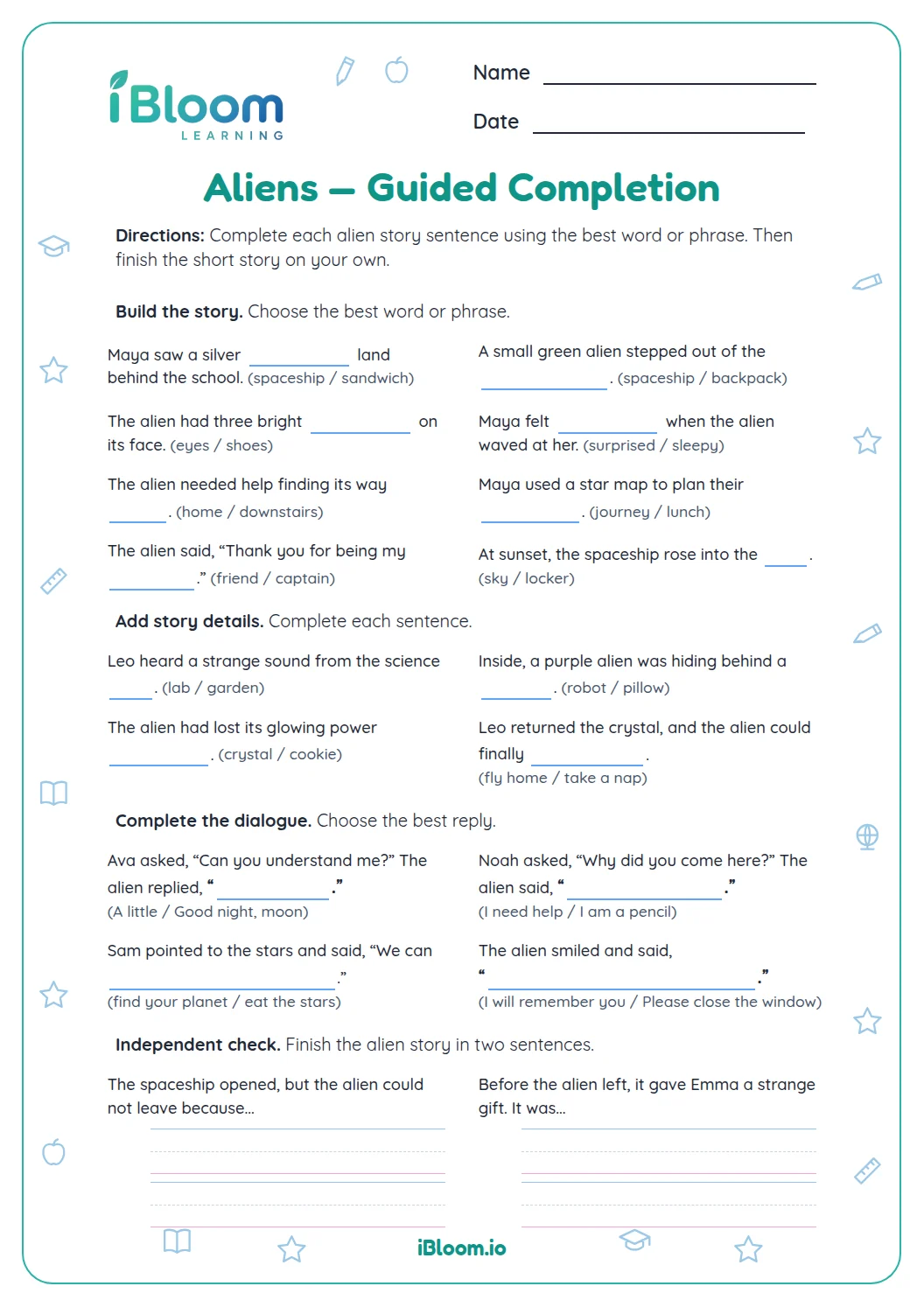
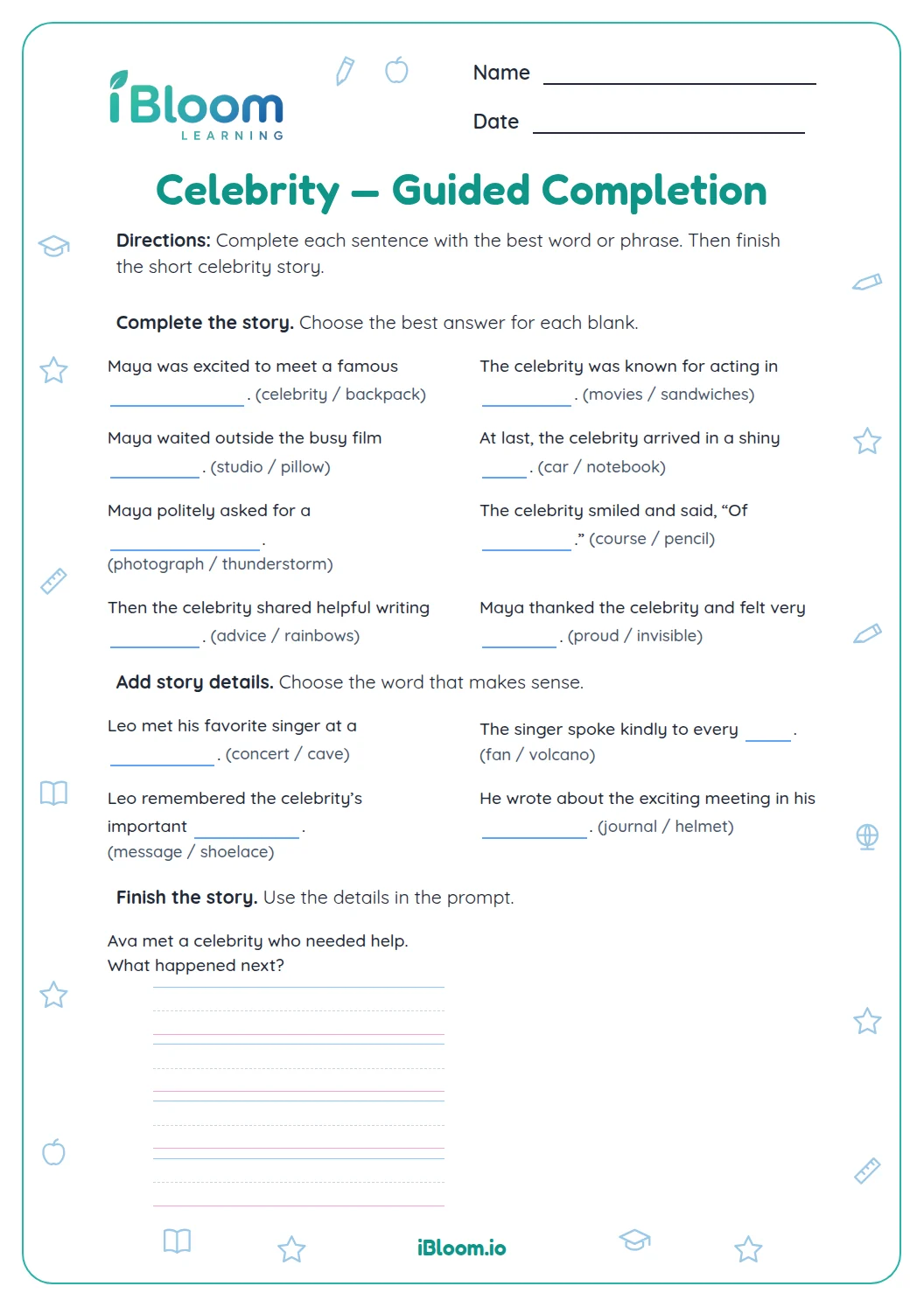
There are 14 questions in four parts across three worksheet pages, followed by a three-page answer key. Children first recognize story elements, then complete sentences and write two connected story endings. The parts build from selecting an example to making story details.
How can a writer make an action sentence stronger?
Choose a verb that lets the reader picture what happens. In question 9, the hero must catch a falling cup, so “raced across the room” is a vivid and fitting model. A different precise verb can work if it makes sense in the sentence.
What counts as a good dialogue line?
The line should sound like something a character says and help move the problem toward a solution. For instance, “Hold the ladder steady!” gives another character a useful action. The key offers a sample, but children may write other sensible lines.
How should a child use the answer key?
Use the key to compare the six selected responses and to discuss the open-ended writing. Several answers can work for questions that ask for a sentence, reaction, or ending. Check that each response follows the prompt and connects clearly to the story event.
How many questions and pages are included?
The worksheet has 14 questions arranged in four parts across three pages, followed by a three-page key. It moves from recognizing story elements to completing sentences and composing story endings. Most prompts use the same superpower story setting. The answer key includes a model for each response.