
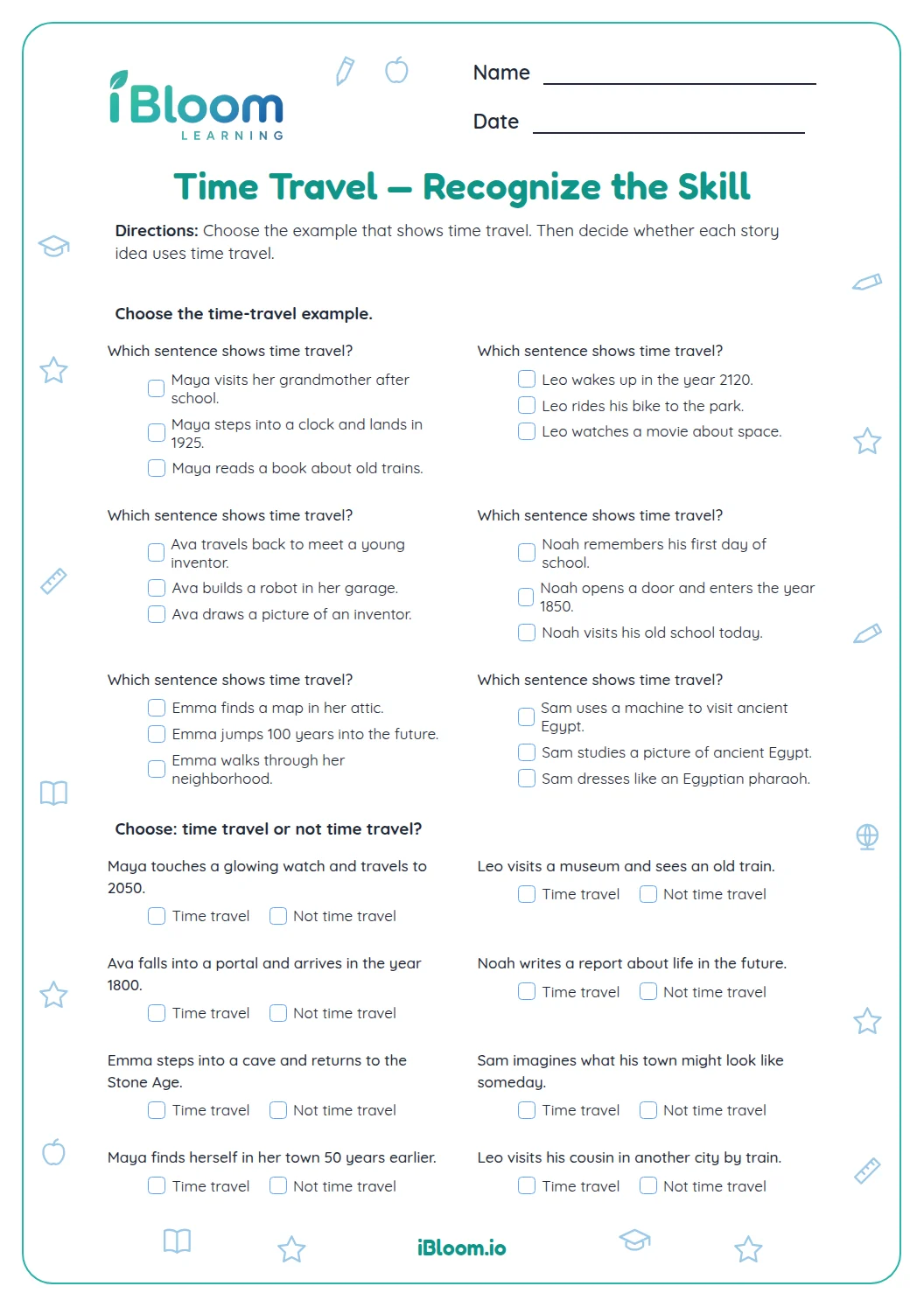
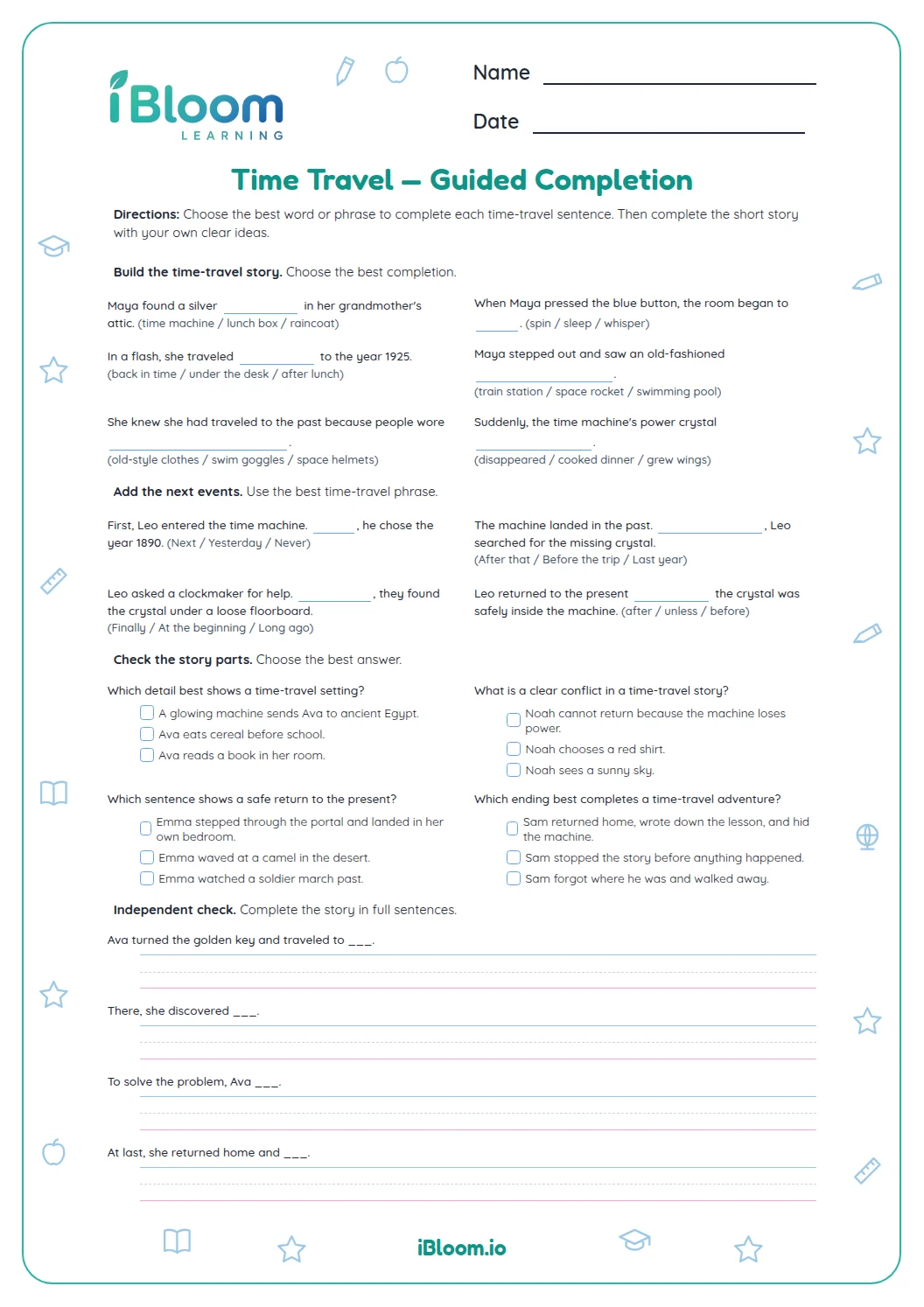
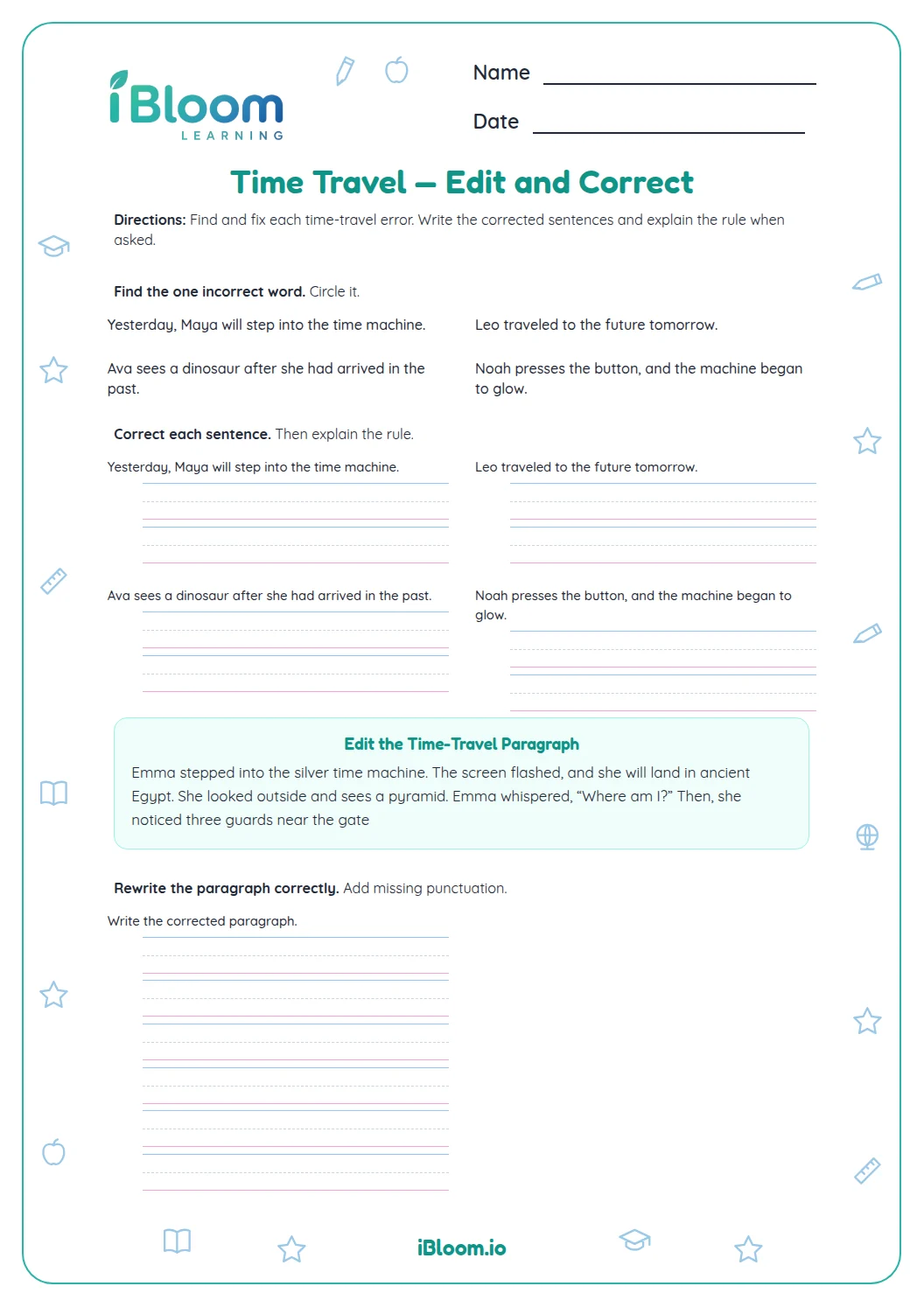


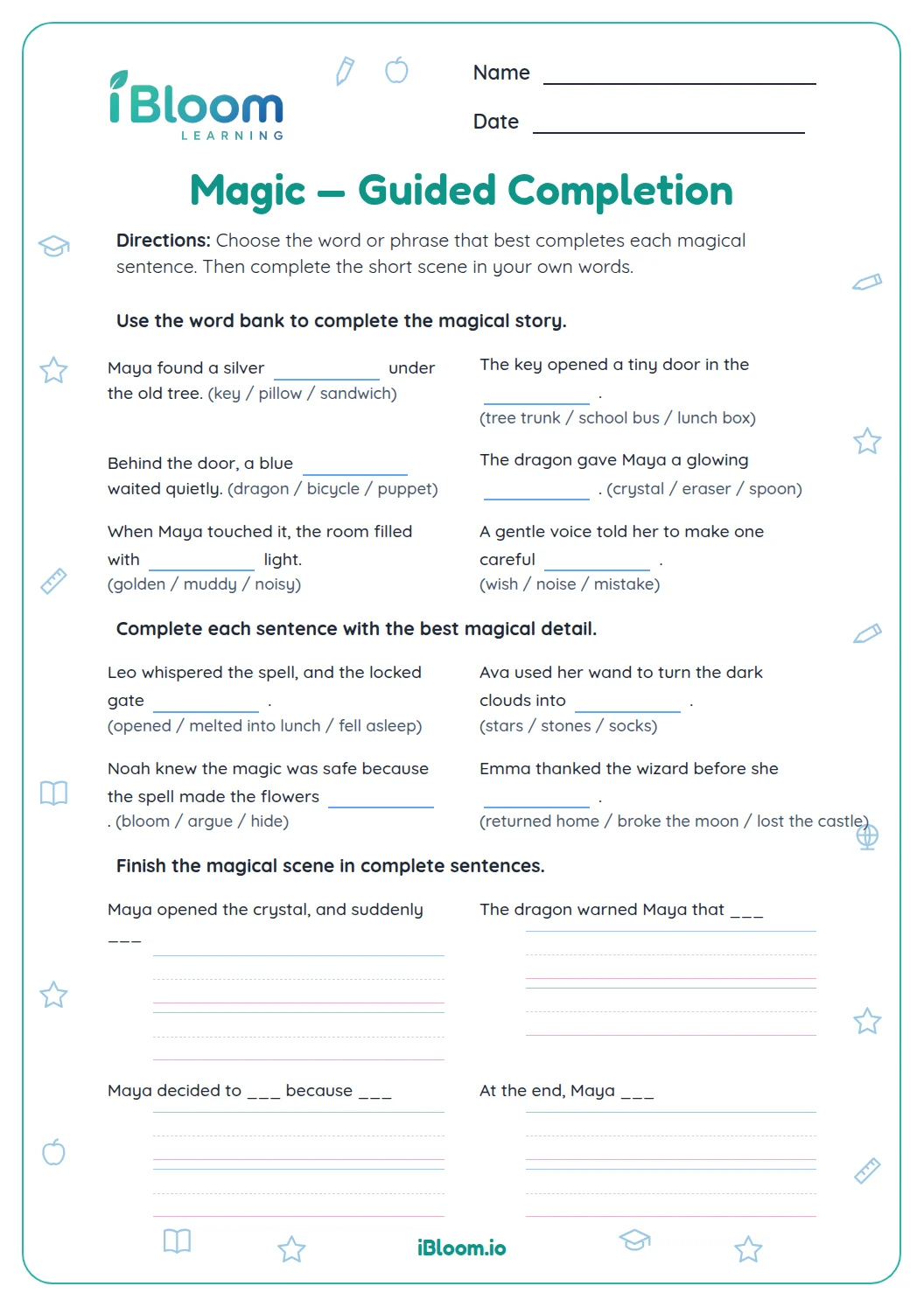

About this worksheet
This Grade 4 narrative worksheet follows Maya’s trip to 1895, where her return key breaks. Students choose details, transitions, dialogue, and actions that strengthen the time-travel plot. Fourteen compact tasks practice story setting, sequence, sensory language, and revision; the separate answer key marks each choice.
Aligned to W.4.3b and W.4.3d
How does a detail establish the time-travel setting?
A useful setting detail gives a reader a time, place, or sensory clue. Question 1 places Maya in the past with a dinosaur near the river; question 6 uses “Back in 1895” to name the time.
How do transitions move Maya’s story forward?
Transitions help readers follow events. In question 2, Maya steps through the time door after it opens. The later questions ask students to select actions and clues that make the broken return key problem understandable.
- 1The time door opened.
- 2Maya stepped through.
- 3The second action follows the first.
What makes a narrative detail stronger?
Specific actions, sensory details, and dialogue help a reader picture an event. “Maya scrambled inside” is more exact than “Maya went in”; “Blue desks gleamed; a bell chimed” adds sight and sound.
How to use this worksheet
- 1Track Maya’s setting and the problem with her return key.
- 2Choose actions that follow the event before them.
- 3Look for time and place clues.
- 4Select exact verbs, sensory details, and dialogue.
- 5Check that each ending follows from the story problem.
Mistakes to watch for
The mistake
Choosing a detail that does not fit the 1895 trip.
The fix
Check the time and place in Maya’s story.
The mistake
Using a vague action such as “went.”
The fix
Choose a verb that shows how the character moves.
The mistake
Selecting an ending that leaves Maya stranded.
The fix
Check that the key is repaired and she returns home.
Common Core alignment
Use speech, actions and description to develop a time traveler’s experience.
On this sheet: Students choose dialogue and actions that develop events and show a character’s response.
Show the official wordingHide the official wording
Use dialogue and description to develop experiences and events or show the responses of characters to situations.
Replace vague descriptions with exact actions and sensory details.
On this sheet: Students select concrete actions and sensory details that describe events precisely.
Show the official wordingHide the official wording
Use concrete words and phrases and sensory details to convey experiences and events precisely.
What to practice next
Make more practice
Further reading
Questions parents and teachers ask
What happens in Maya’s time-travel story?
Maya travels to 1895, but her return key breaks. The worksheet asks students to follow the trip, select story details and revisions, and identify an item Maya must repair before returning home. The answer key identifies each best selection. The plot stays consistent from start to finish.
How many questions are included?
The worksheet has 14 multiple-choice questions in two parts. Students practice setting, event order, transitions, sensory details, dialogue, character actions, and a fitting ending. The separate answer key marks the best choice for each question. Each task uses Maya’s trip as its context.
What does a time transition do?
A time transition tells readers when one event happens in relation to another. A phrase such as “back in 1895” identifies the past, while a word such as “yesterday” helps place an event before the present moment. Students choose the phrase that best fits the sequence.
How can a student make a narrative action more precise?
Choose a verb that shows how the character acts. “Maya scrambled inside” gives a clearer picture than “Maya went in.” The worksheet also asks students to recognize sensory details and dialogue that help a reader imagine a scene. Clear verbs make events easier to follow.
What should a time-travel ending include?
A satisfying ending resolves the story problem and shows where the traveler goes next. For Maya, the return key needs repair before she can get home. Students choose the ending that follows this problem rather than leaving her in 1895.