






About this worksheet
This Grade 4 printable helps students recognize how a story detail signals magic. Across 14 short questions, learners choose impossible events, identify a magical detail or object, and sort story examples from everyday events. The worksheet uses compact choices so students can focus on whether an event could happen in ordinary life. A separate answer key lists each answer.
What is on this magic recognition worksheet?
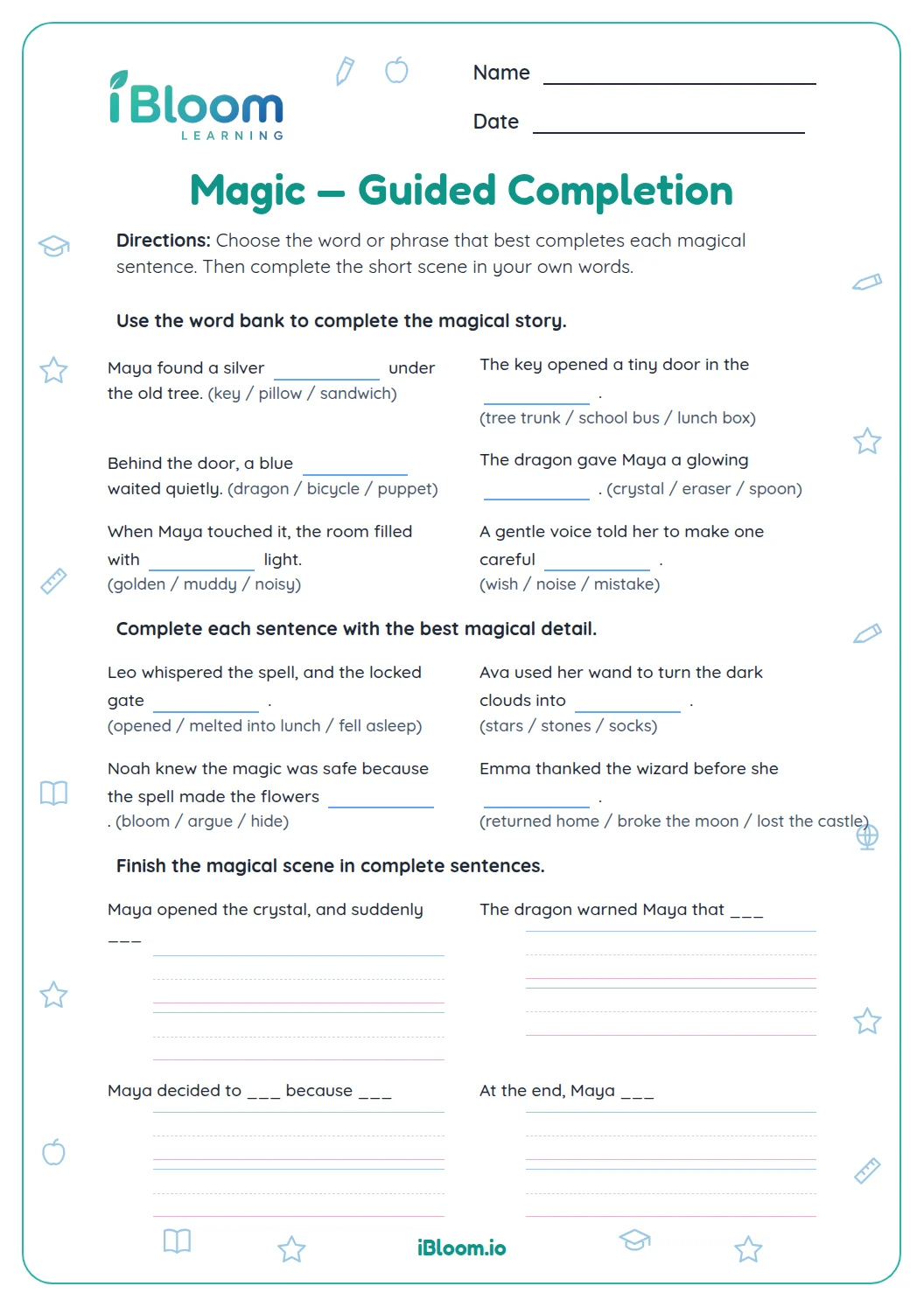
The worksheet has 14 short story events in two parts. Students write “Magical” or “Everyday” beside each event, from a singing lunchbox to an ordinary backpack trip.
Part A contains seven examples, and Part B contains seven more. The separate answer key gives one label for every item.
- Part A: questions 1–7
- Part B: questions 8–14
- One label for each event
- Answer key included
How can a student tell magical from everyday?
Ask whether the event could happen in ordinary life as described. An owl with gray feathers is everyday; an owl speaking to the moon is magical because it breaks an ordinary rule.
For question 1, a lunchbox singing on its own is labeled Magical. The clue is the impossible action, not the fact that the lunchbox is unusual.
- 1Maya’s lunchbox sings on its own. → Magical
- 2The lunchbox does something an ordinary object cannot do.
What clue should a reader look for?
Look at the action in the whole sentence. A familiar object or animal may take part in a magical event when it talks, predicts the future, changes form, or acts without a person.
An unusual color or setting by itself does not make an event magical. The worksheet contrasts impossible actions with ordinary activities so students practice reading the clue carefully.
How can an adult use the answer key?
After each label, ask the student to name the action that supports it. For a Magical answer, the action should break an everyday rule; for an Everyday answer, it should be possible as described.
If a student is unsure, reread the whole sentence and compare it with a familiar real-life example. The key helps check the label while the explanation comes from the event itself.
How to use this worksheet
- 1Read the two labels, Magical and Everyday, before starting.
- 2Complete questions 1–7 and point to the action that supports each label.
- 3Continue with questions 8–14, checking whether each event could happen in ordinary life.
- 4Use the answer key to check every label.
- 5Ask the student to explain one Magical and one Everyday choice in their own words.
Common mistakes and quick fixes
The mistake
Calling every unusual object magical.
The fix
Check what it does. A silver key can be ordinary; a key that opens every door has an impossible power.
The mistake
Labeling an event by its setting instead of its action.
The fix
Read the verb and ask whether that action could happen in everyday life, such as riding a bicycle or making a shadow dance alone.
The mistake
Choosing a label before reading the full sentence.
The fix
Read the whole example first. The action often contains the clue that separates a magical event from an ordinary one.
What to practice next
Make more practice
Questions parents and teachers ask
How many questions are on this worksheet?
There are 14 short questions split into two parts. Students label each event Magical or Everyday, and the separate answer key lists all 14 labels. The examples include impossible actions, such as a singing lunchbox, along with ordinary actions, such as riding a bicycle to the library.
What makes an event magical in this worksheet?
An event is labeled Magical when it breaks the rules of ordinary life as described. A lunchbox singing on its own is magical, while carrying a backpack is everyday. Students look at the action in the sentence instead of deciding from a character or object alone.
Is an unusual object always magical?
No. An object is magical when it has an impossible power or does something outside ordinary life. A silver key by itself is just a key; a key that opens any door has a magical power. Ask the student to explain what the object does.
How should students use the answer key?
Students can finish a part before checking its labels in the answer key. If an answer differs, reread the whole sentence and point to the action that supports the label. The goal is to connect the choice to a clear clue, such as an object singing or a bicycle ride.
Can a talking animal or object be magical?
Yes, when it speaks in a way that could not happen in ordinary life. The worksheet includes an owl speaking to the moon and a lunchbox singing. A student can use the same question for each example: could this action happen in everyday life as written?
What can students practice after this page?
Invite the student to invent one Magical event and one Everyday event, then explain the difference. The other narrative prompt worksheets offer new story settings and characters where students can use the same habit of noticing details that shape a story.