



About this worksheet
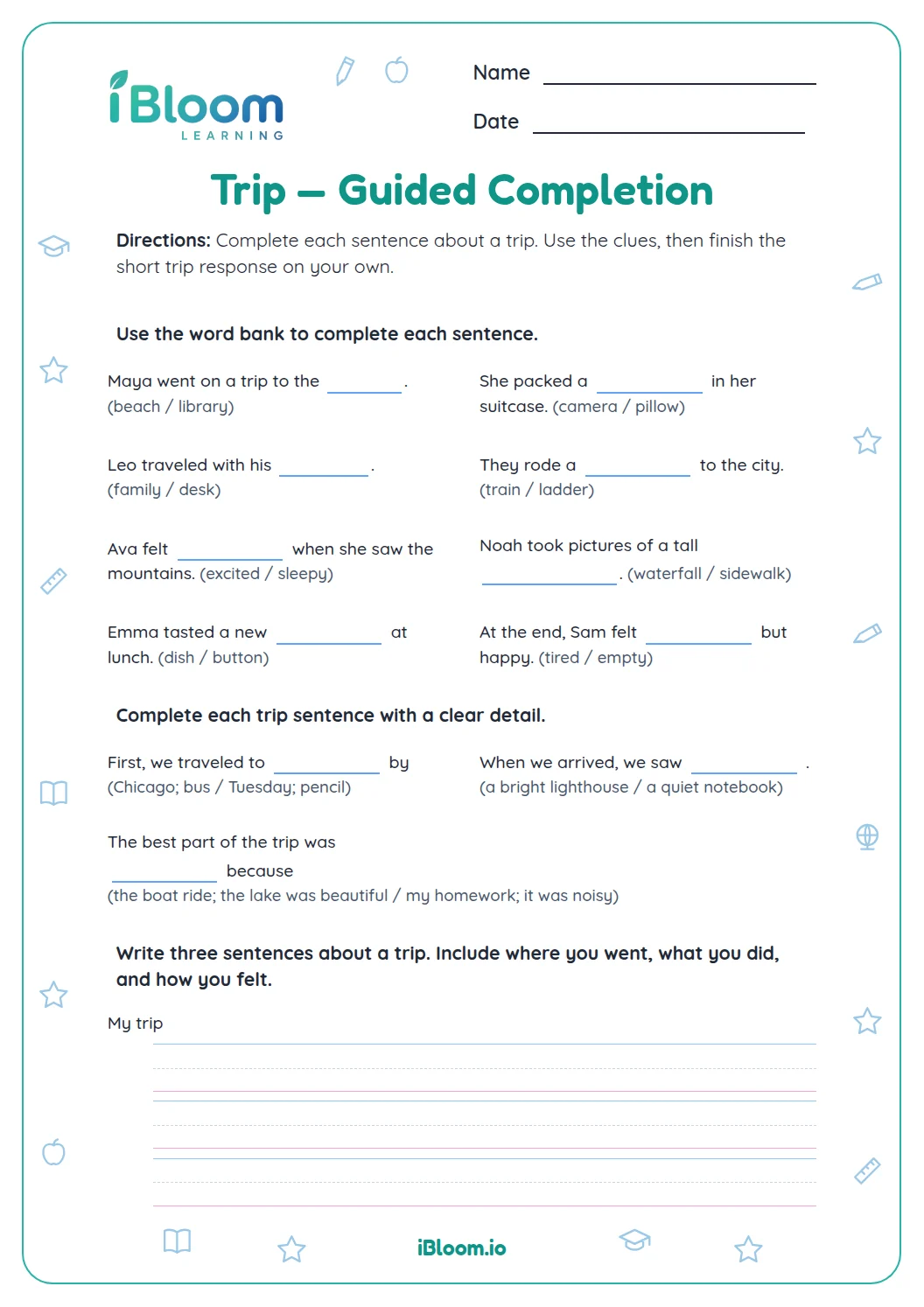
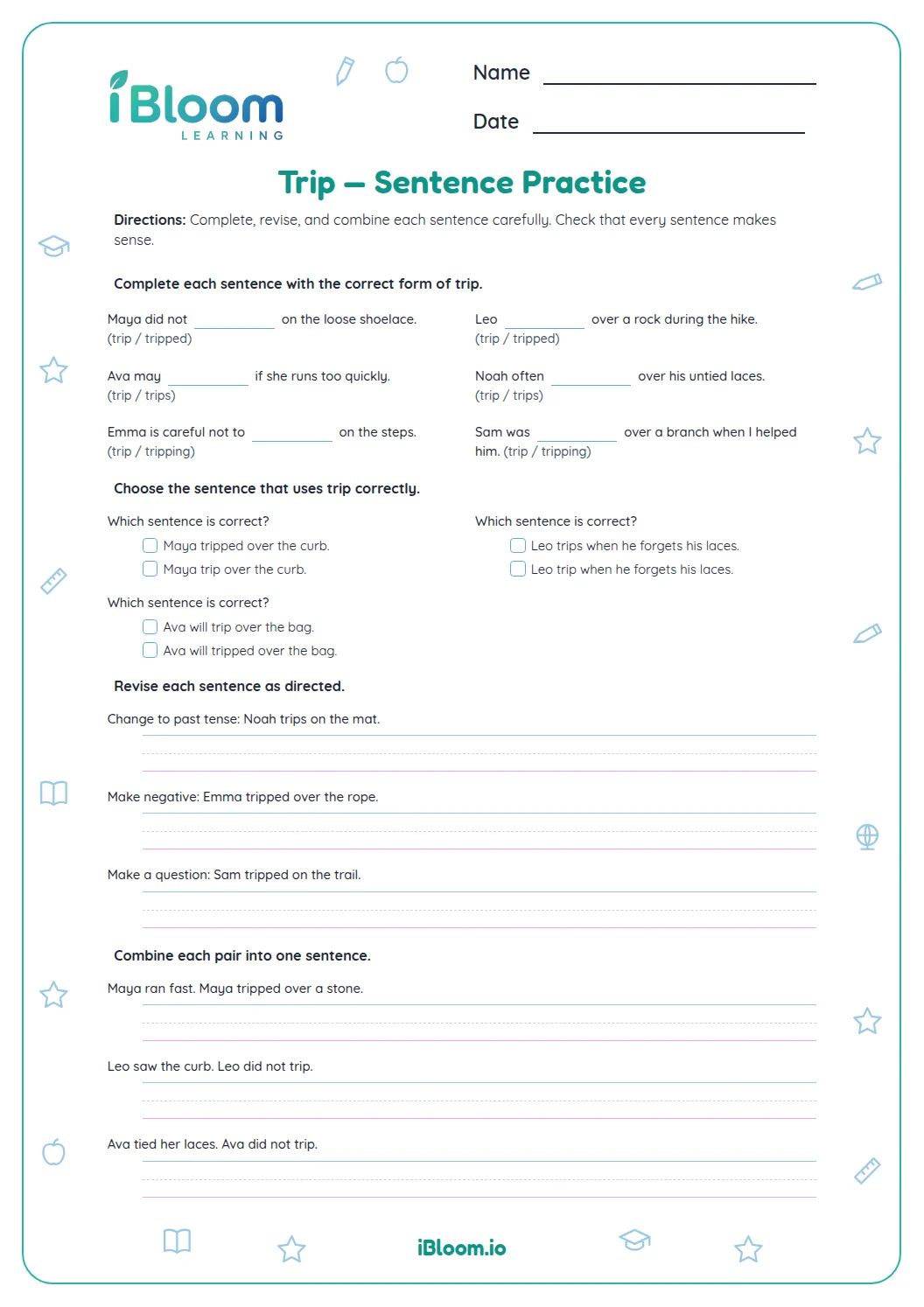
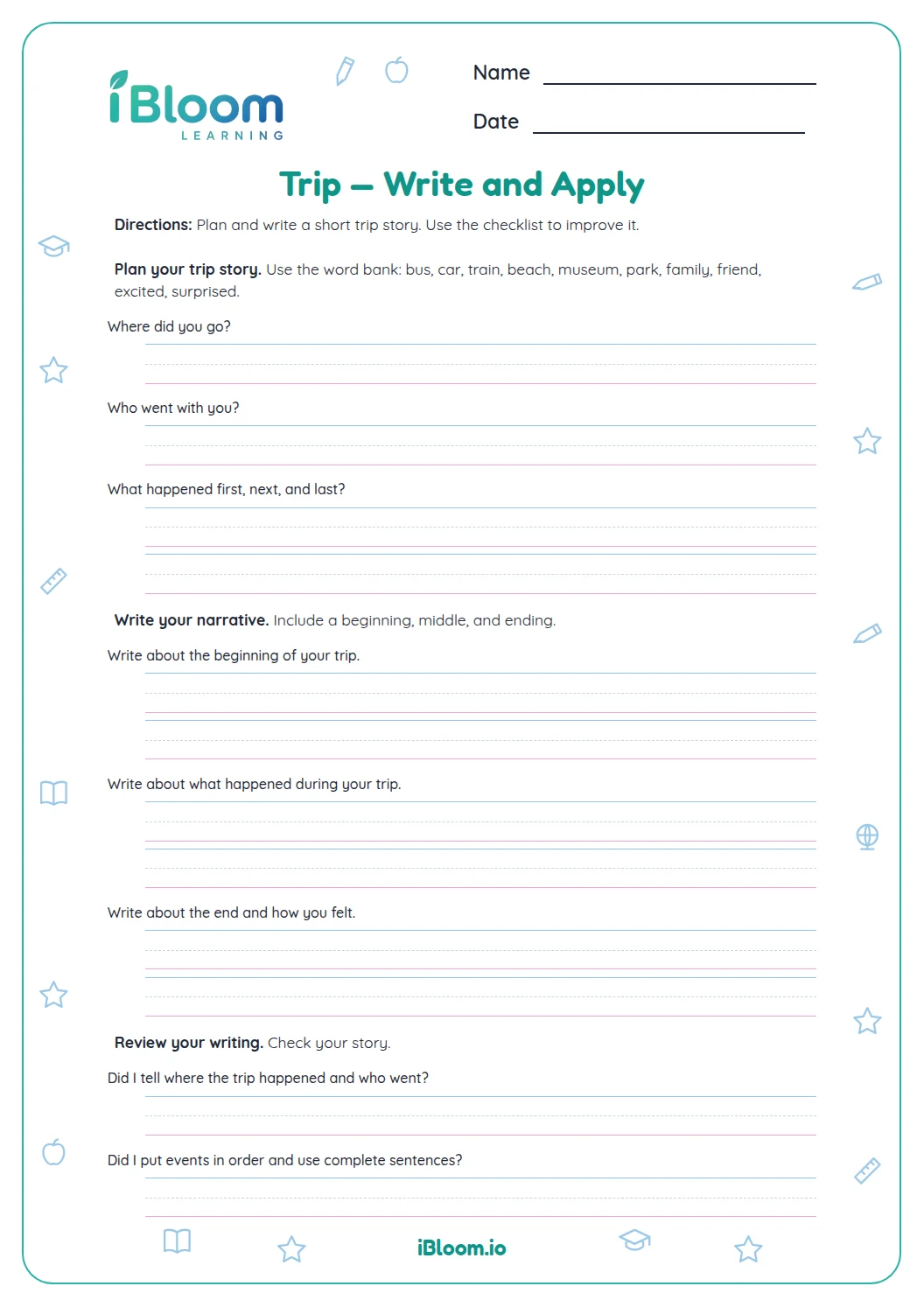
This Grade 4 printable helps writers shape a trip story with a clear beginning, ordered events, and details that help a reader picture the experience. Students choose strong details, complete sentences with transition words, compare revisions, and write two short responses. It practices CCSS W.4.3 and W.4.5. A separate answer key includes sample responses for the open-ended writing items.
Aligned to W.4.3 and W.4.5
Which details help a reader imagine the trip?
A specific action or sensory detail gives the reader more than a general statement. Questions 1–4 ask students to choose details that show excitement, establish a beginning, or make a place easier to picture.
- 1General: We visited a museum.
- 2Specific: The dinosaur skeleton reached the tall ceiling.
- 3The second sentence gives a clear image of the place.
How do transition words keep events in order?
Words such as first, next, then, and finally signal when an event happens. Choose a transition that fits the order of the trip, then reread the sentence to check that the sequence makes sense.
How can revision make a trip story stronger?
Replace general words such as “things” with a precise action or object. Questions 13 and 14 ask writers to add a specific trip detail and make an ending that orders events while sharing a feeling.
How to work through the trip story review
- 1Read each sentence for the event or feeling it needs to show.
- 2Choose details that a reader can picture, not a repeated general statement.
- 3Use first, next, then, and finally to keep events in a logical order.
- 4For revision questions, replace vague words with a specific action or image.
- 5Write complete responses for the last two prompts; keep each event in order.
- 6Use the answer key to compare choices and read the sample responses.
Common mistakes and quick fixes
The mistake
Choosing a sentence that repeats the topic but adds no new detail.
The fix
Look for a concrete action, object, or feeling that helps a reader picture the moment.
The mistake
Using finally for an event that happens near the beginning.
The fix
Number the events first, then select the transition that matches their order.
The mistake
Adding a detail that does not fit the trip scene.
The fix
Keep the detail connected to the place, event, or feeling in the sentence.
Common Core alignment
The sheet focuses on narrative event sequence and revision with descriptive details.
Develop a trip story with descriptive details and a clear event sequence.
On this sheet: Children identify and create narrative details, transitions, and ordered events.
Show the official wordingHide the official wording
Write narratives to develop real or imagined experiences or events using effective technique, descriptive details, and clear event sequences.
Strengthen a trip story by revising vague sentences and adding details.
On this sheet: Revision questions replace vague wording with precise details and develop an ending.
Show the official wordingHide the official wording
With guidance and support from peers and adults, develop and strengthen writing as needed by planning, revising, and editing. (Editing for conventions should demonstrate command of Language standards 1-3 up to and including grade 4 here.)
What to practice next
Make more practice
Further reading
Questions parents and teachers ask
What makes a narrative detail strong?
A strong detail gives the reader something specific to imagine, such as a bright blue heron lifting from a quiet pond. The worksheet contrasts that kind of image with general sentences such as “We saw a bird,” so students can notice how precise language strengthens a trip story.
Which transition words are practiced?
The sentence completions use first, next, then, and finally. Each word signals a place in the event sequence. Students should check the events around the blank and choose the transition that keeps the trip actions in a sensible order. Each task keeps the practice connected to the named skill.
How many writing responses are included?
There are two short written responses at the end, along with 12 selection items. The writing prompts ask students to revise a vague sentence and create a short trip ending with several events and a feeling. Sample responses appear in the answer key.
Does the worksheet ask children to write a full story?
No, the printable gives focused mixed review rather than a full-page story assignment. Students practice choosing details and transitions, then write two concise responses. These pieces can help prepare a longer narrative writing session. Each task keeps the practice connected to the named skill.
How does revision appear on the sheet?
Students compare stronger and weaker versions, then revise a vague sentence such as “We went there and saw things.” The key offers one possible revision, while other clear, relevant sentences can also demonstrate the skill. A quick reread of the passage or prompt helps connect the answer to its evidence.
Which standards does the worksheet practice?
It practices CCSS W.4.3 through event order and descriptive narrative details, and W.4.5 through revision. The curriculum section includes the official standard wording and link. A quick reread of the passage or prompt helps connect the answer to its evidence.