
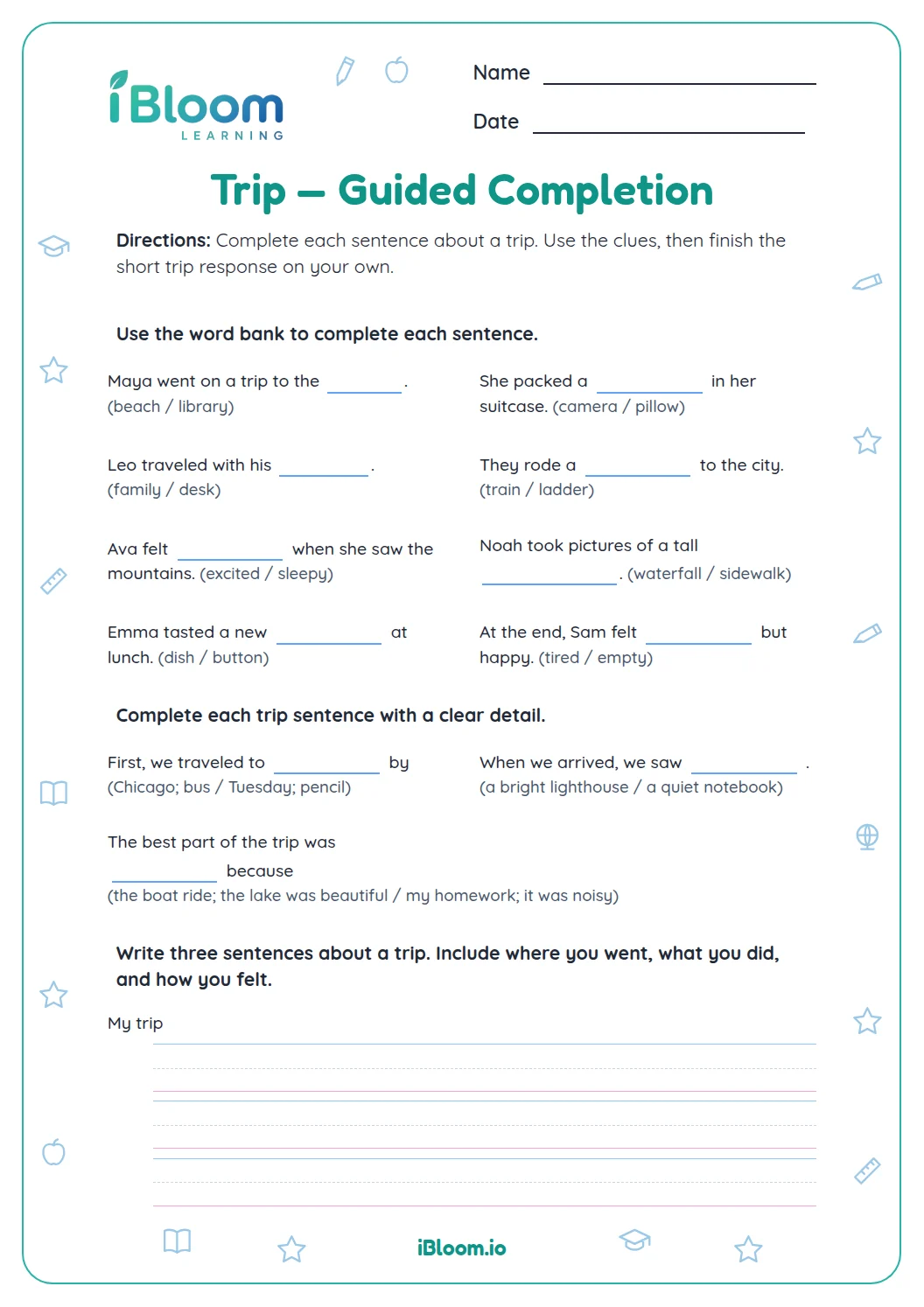
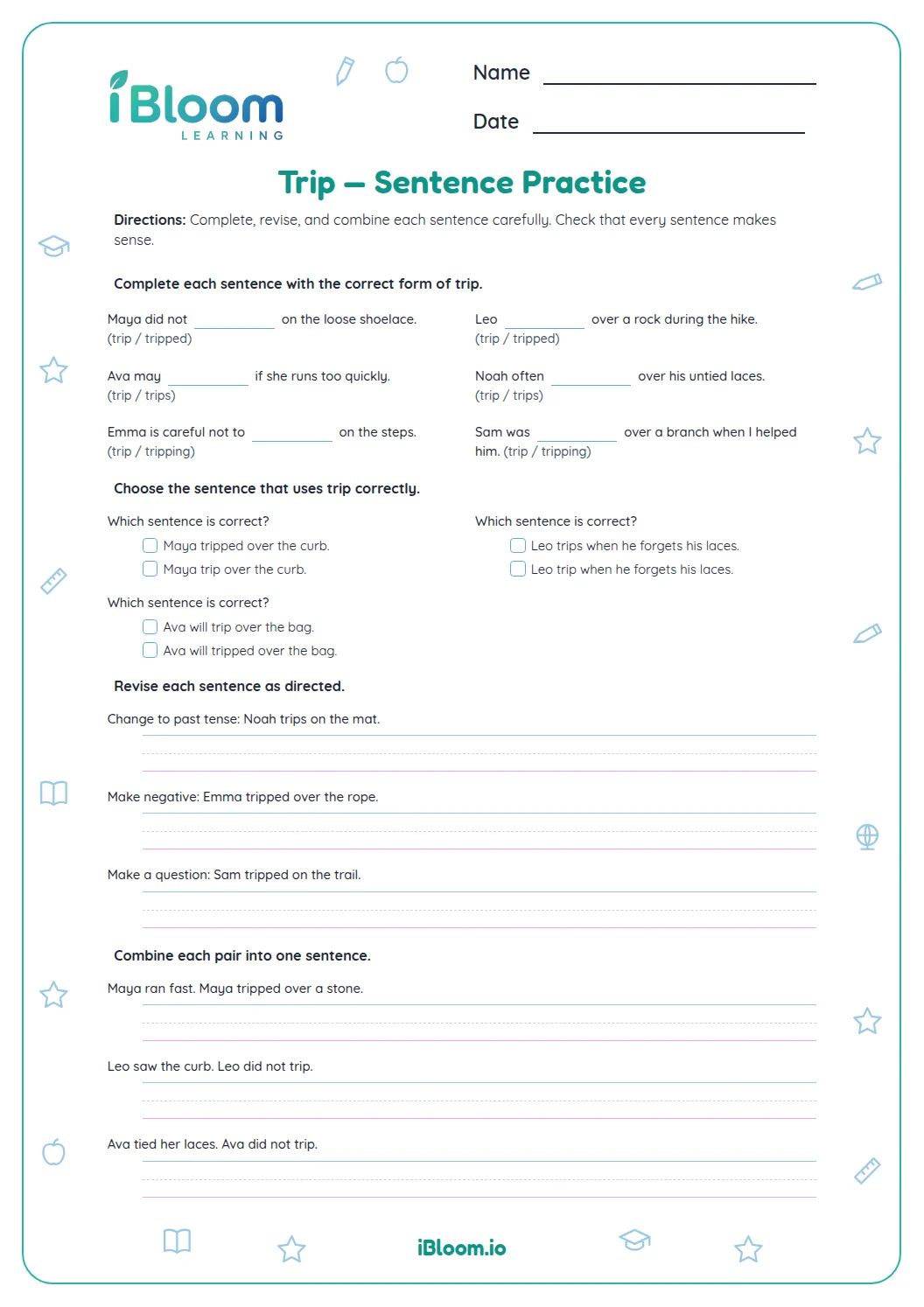

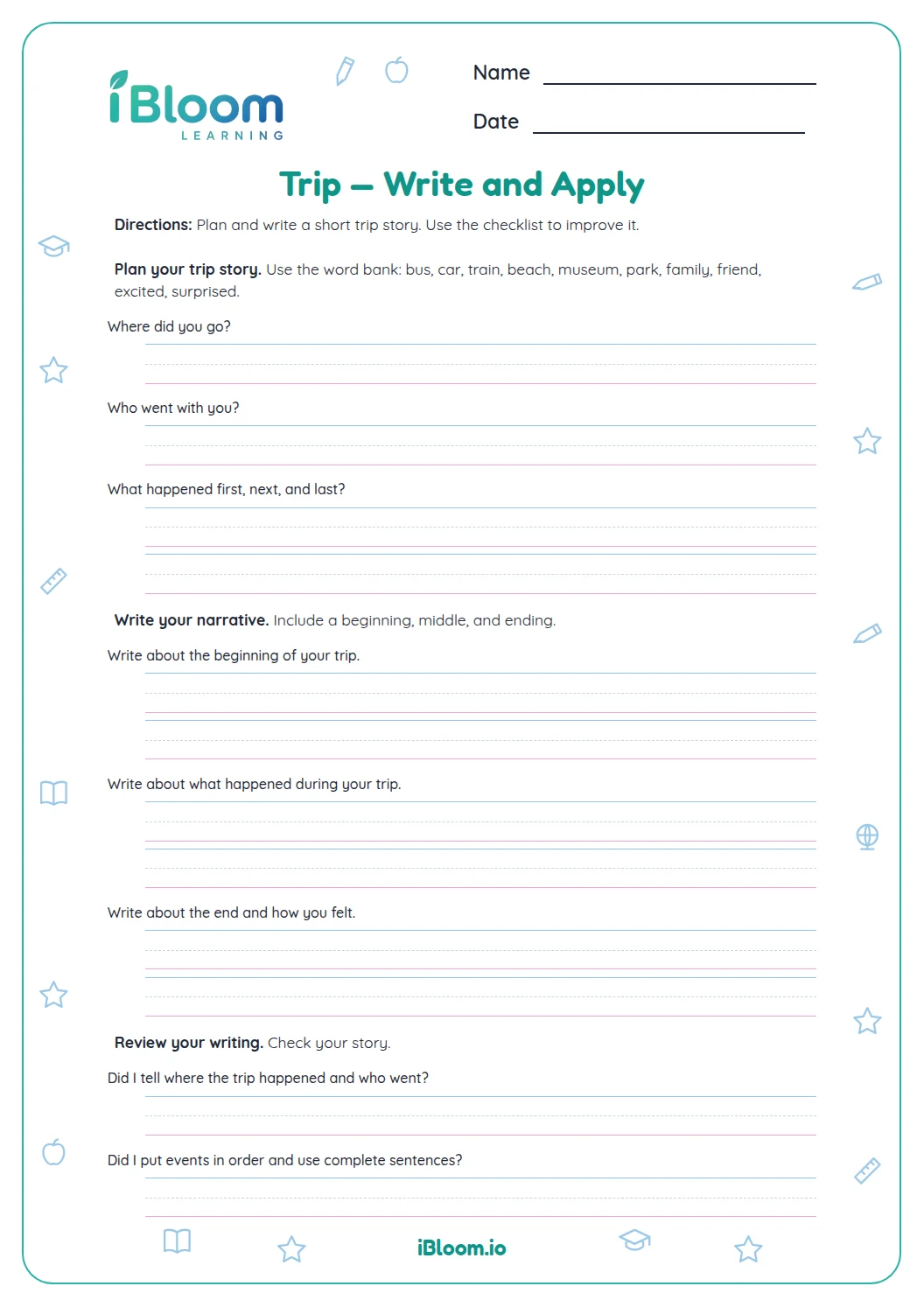


About this worksheet
This Grade 4 writing worksheet uses a trip story setting to help students recognize narrative craft. They identify a situation and characters, dialogue, sensory details, character responses, transitions, event sequence, and a fitting ending. The practice connects to Common Core W.4.3, which describes developing real or imagined experiences with effective techniques, details, and clear sequences. Fourteen recognition questions fill the printable pages, followed by an answer key.
Aligned to W.4.3
Which details help a trip story feel like a narrative?
The choices focus on a trip by Nia and her uncle. Students identify a situation, dialogue, sensory description, character response, transitions, and closure.
Question 1 introduces the situation: “On Saturday, Nia and her uncle set out for the lake.” Question 3 uses dialogue to reveal the missing-sign problem.
- 1Question 1 introduces the trip and its characters.
- 2Question 3 gives Nia dialogue about the missing trail sign.
How do transitions help readers follow events?
Words such as “Then” and “After a short rest” show how one event follows another. Questions 4, 8, and 9 ask readers to choose transitions and lines that make the order clear.
What makes a narrative ending feel complete?
A closing detail follows from the events and gives the reader a sense that the experience has ended. The muddy boots in question 6 connect Nia’s reflection to the trip she took.
Read each question for the narrative job it names.
- 1Look for clues in the sentence: dialogue marks speech, while sensory words describe a scene.
- 2Check transition words to follow event order.
- 3Choose details that fit the moment in Nia’s trip.
- 4Choose a detail or ending that fits the moment in Nia’s trip.
Common mistakes and quick fixes
The mistake
Confusing a fact about a setting with an event.
The fix
Ask whether the sentence moves the story forward or only names a detail.
The mistake
Choosing any transition without checking order.
The fix
Read the events before and after the blank to see what comes next.
The mistake
Ending with a new problem that has no resolution.
The fix
Choose a closing detail that reflects the trip and signals completion.
Common Core alignment
This practice connects to W.4.3 through the skill named on the worksheet.
Recognize situation, sequence, dialogue, description, transitions, and closure in a trip narrative.
On this sheet: The questions identify narrative techniques, descriptive details, transitions, event order, and an ending.
Show the official wordingHide the official wording
Write narratives to develop real or imagined experiences or events using effective technique, descriptive details, and clear event sequences.
What to practice next
Make more practice
Further reading
Questions parents and teachers ask
What narrative skills does the trip worksheet practice?
Students recognize a situation and characters, sensory description, dialogue, character responses, transitions, event order, and closure. The examples follow Nia and her uncle on a trip, so children can consider how each sentence helps readers follow that experience. Each prompt asks students to recognize one craft choice.
How can I tell whether a sentence uses dialogue?
Dialogue shows a character’s spoken words, usually inside quotation marks. On this worksheet, “The trail sign is missing,” Nia said, reveals a concern through what she says. Other questions focus on action, description, transitions, and narrative endings. The worksheet includes both direct dialogue and speech paired with an action, giving children two concrete examples to compare.
Why do narrative transitions matter?
Transitions help readers understand when events happen and how one moment connects to the next. Words such as “Then” and phrases such as “After a short rest” make the order clearer. Students choose transitions and event sequences that fit the trip.
What makes a narrative ending feel complete?
A fitting ending follows from the events and signals that the experience has reached a stopping point. Nia smiling at her muddy boots recalls the trip and its resolution. Question 6 asks students to choose that closure over details that merely add setting information.
Does this worksheet ask students to write a story?
No. The 14 items are multiple-choice recognition questions. Students identify narrative details, dialogue, transitions, sequence, character response, and closure in examples from Nia and her uncle’s trip. Related writing practice can build on these choices by asking a child to draft an original trip story.